ScienceFreePrintable
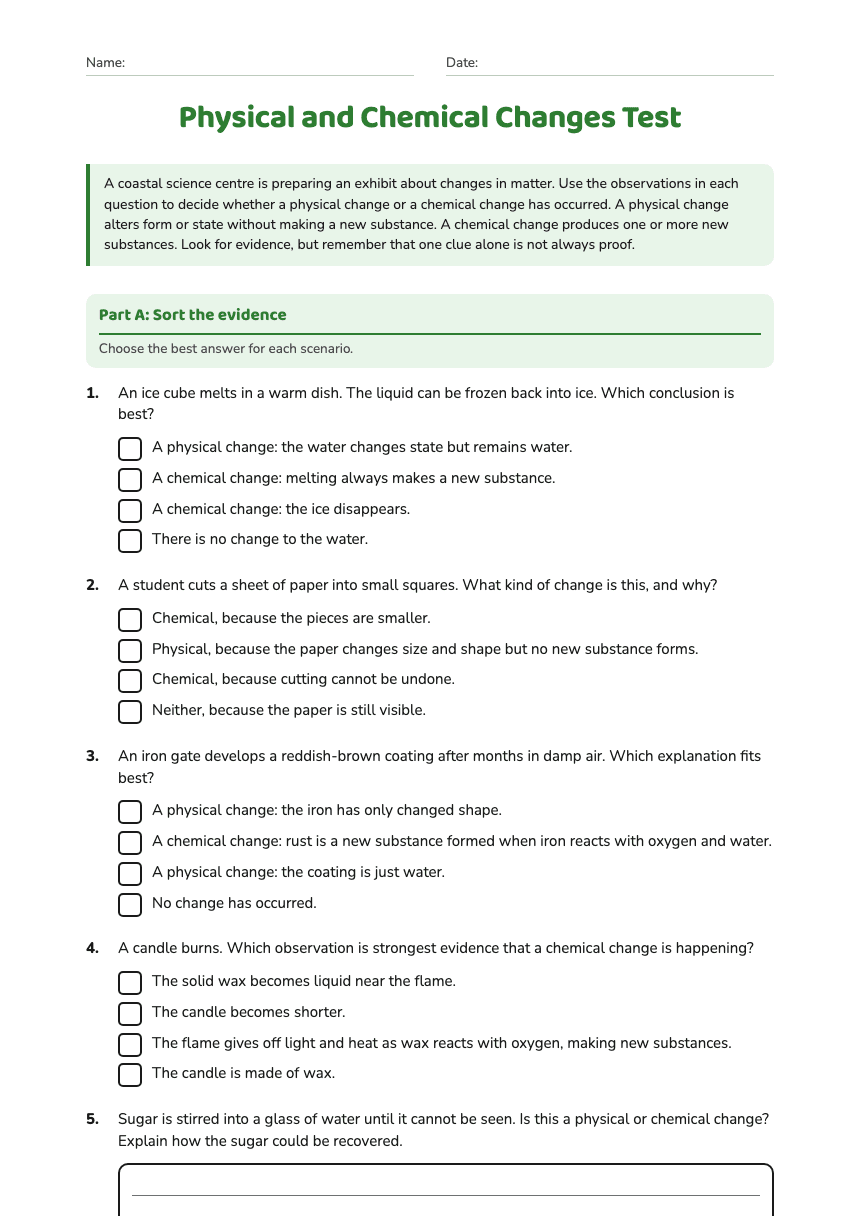
Physical and Chemical Changes Test
A free science worksheet ready for your classroom. Open in Kuraplan to grab the print-ready PDF, customize it for your students, or generate a fresh version in seconds.
Name:Date:
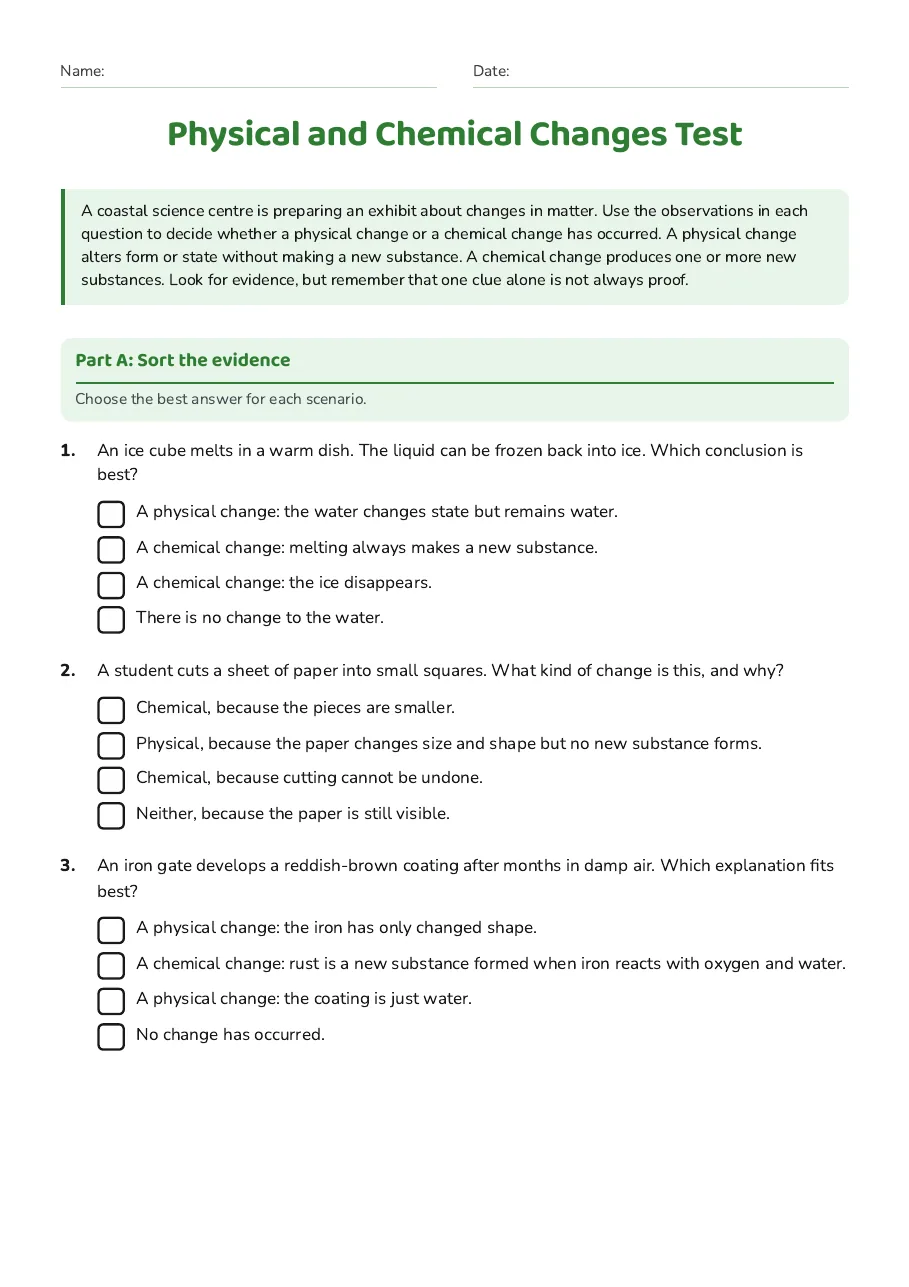
Physical and Chemical Changes Test
A coastal science centre is preparing an exhibit about changes in matter. Use the observations in each question to decide whether a physical change or a chemical change has occurred. A physical change alters form or state without making a new substance. A chemical change produces one or more new substances. Look for evidence, but remember that one clue alone is not always proof.
Part A: Sort the evidence
Choose the best answer for each scenario.
1.An ice cube melts in a warm dish. The liquid can be frozen back into ice. Which conclusion is best?
- A physical change: the water changes state but remains water.
- A chemical change: melting always makes a new substance.
- A chemical change: the ice disappears.
- There is no change to the water.
2.A student cuts a sheet of paper into small squares. What kind of change is this, and why?
- Chemical, because the pieces are smaller.
- Physical, because the paper changes size and shape but no new substance forms.
- Chemical, because cutting cannot be undone.
- Neither, because the paper is still visible.
3.An iron gate develops a reddish-brown coating after months in damp air. Which explanation fits best?
- A physical change: the iron has only changed shape.
- A chemical change: rust is a new substance formed when iron reacts with oxygen and water.
- A physical change: the coating is just water.
- No change has occurred.
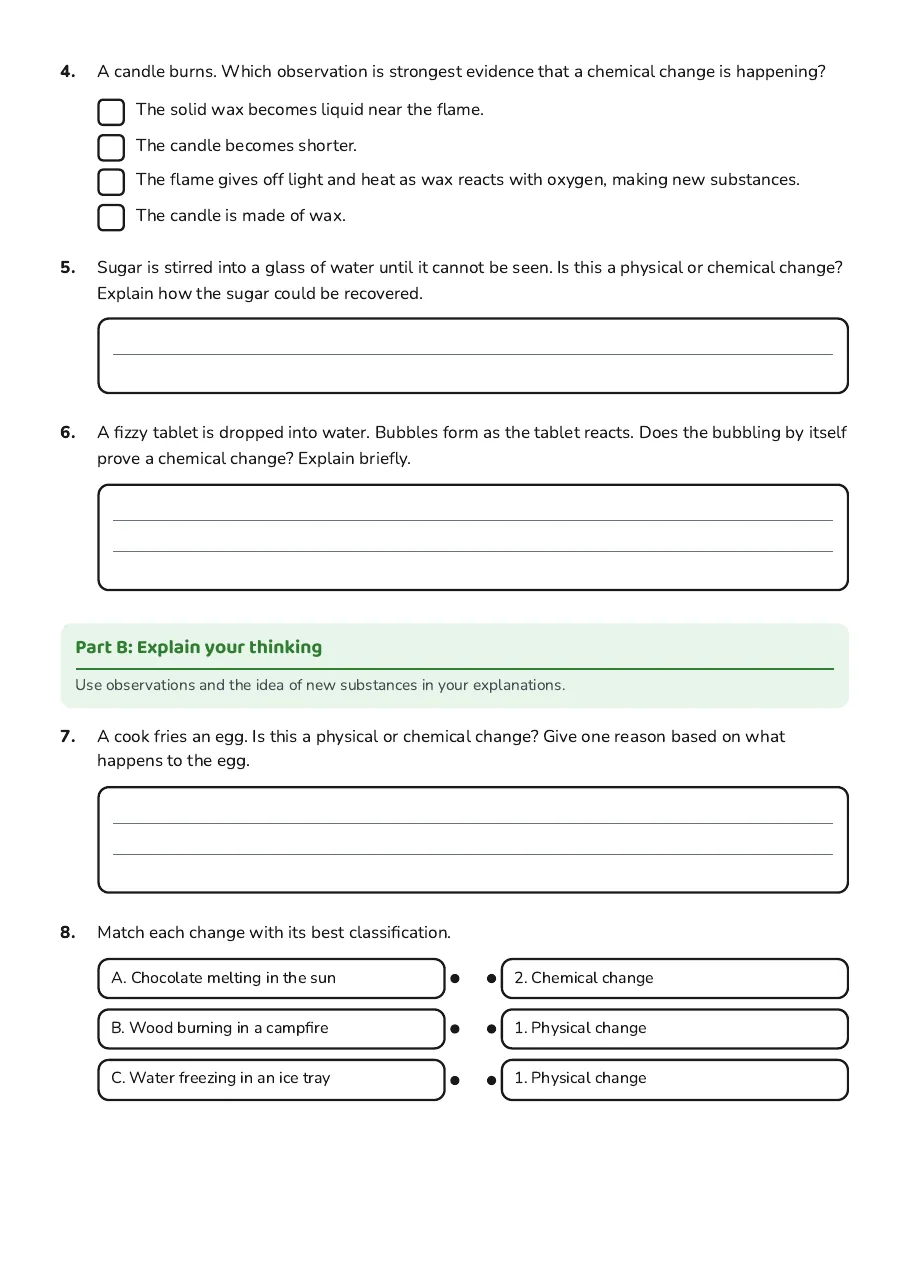
4.A candle burns. Which observation is strongest evidence that a chemical change is happening?
- The solid wax becomes liquid near the flame.
- The candle becomes shorter.
- The flame gives off light and heat as wax reacts with oxygen, making new substances.
- The candle is made of wax.
5.Sugar is stirred into a glass of water until it cannot be seen. Is this a physical or chemical change? Explain how the sugar could be recovered.
6.A fizzy tablet is dropped into water. Bubbles form as the tablet reacts. Does the bubbling by itself prove a chemical change? Explain briefly.
Part B: Explain your thinking
Use observations and the idea of new substances in your explanations.
7.A cook fries an egg. Is this a physical or chemical change? Give one reason based on what happens to the egg.
8.Match each change with its best classification.
- A. Chocolate melting in the sun
- B. Wood burning in a campfire
- C. Water freezing in an ice tray
- 2. Chemical change
- 1. Physical change
- 1. Physical change
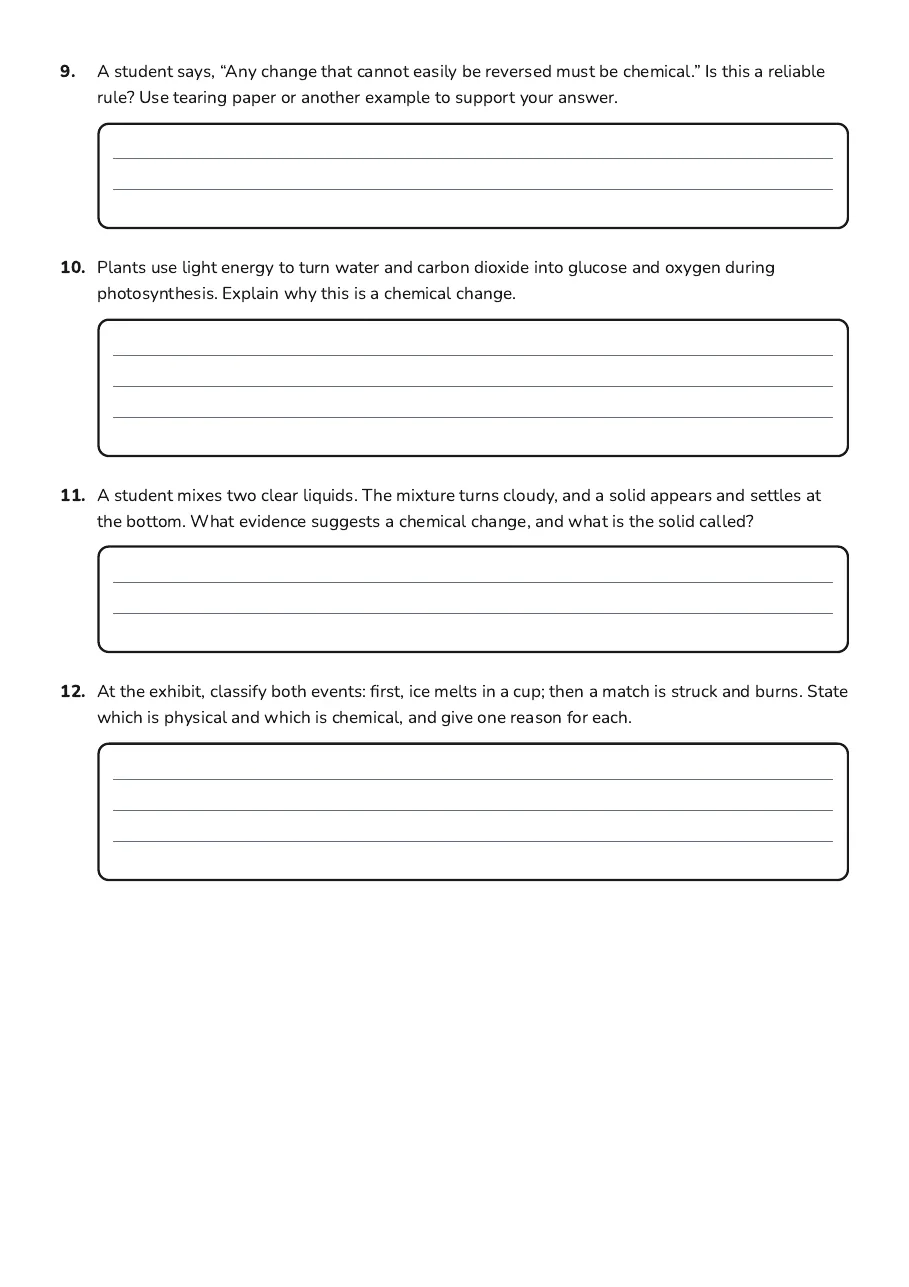
9.A student says, “Any change that cannot easily be reversed must be chemical.” Is this a reliable rule? Use tearing paper or another example to support your answer.
10.Plants use light energy to turn water and carbon dioxide into glucose and oxygen during photosynthesis. Explain why this is a chemical change.
11.A student mixes two clear liquids. The mixture turns cloudy, and a solid appears and settles at the bottom. What evidence suggests a chemical change, and what is the solid called?
12.At the exhibit, classify both events: first, ice melts in a cup; then a match is struck and burns. State which is physical and which is chemical, and give one reason for each.
3 printable pages
Page 1
Page 2
Page 3
About This Worksheet
Free in Kuraplan
Sign up free, grab the PDF, and customize it for your class.
Print-Ready
Formatted for standard paper. Clean layout, easy to read.
AI-Generated
Created with Kuraplan's AI, designed for real classroom use.
For Teachers & Parents
Use in classrooms, for homework, tutoring, or homeschool.
Need a custom version of this worksheet?
Kuraplan's AI generates custom worksheets in seconds — differentiated for every learner, aligned to your curriculum.
Generate Custom Worksheets — Free No credit card Curriculum-aligned Under 60 seconds
More Science Worksheets
Year 8
Elements & Compounds Worksheet
Free
Year 8
Elements and Compounds Worksheet
Free
Isotopes and Radiation Quiz
Free
Year 8
Chemical Symbols and Formulas
Free
Year 7
Exploring Solutions Worksheet
Free
Year 9
Reproducible Chemical Testing Worksheet
Free
Year 10
Conservation of Mass
Free
Year 11