MathsFreePrintable
Real-World Measurement Problems
A free maths worksheet ready for your classroom. Open in Kuraplan to grab the print-ready PDF, customize it for your students, or generate a fresh version in seconds.
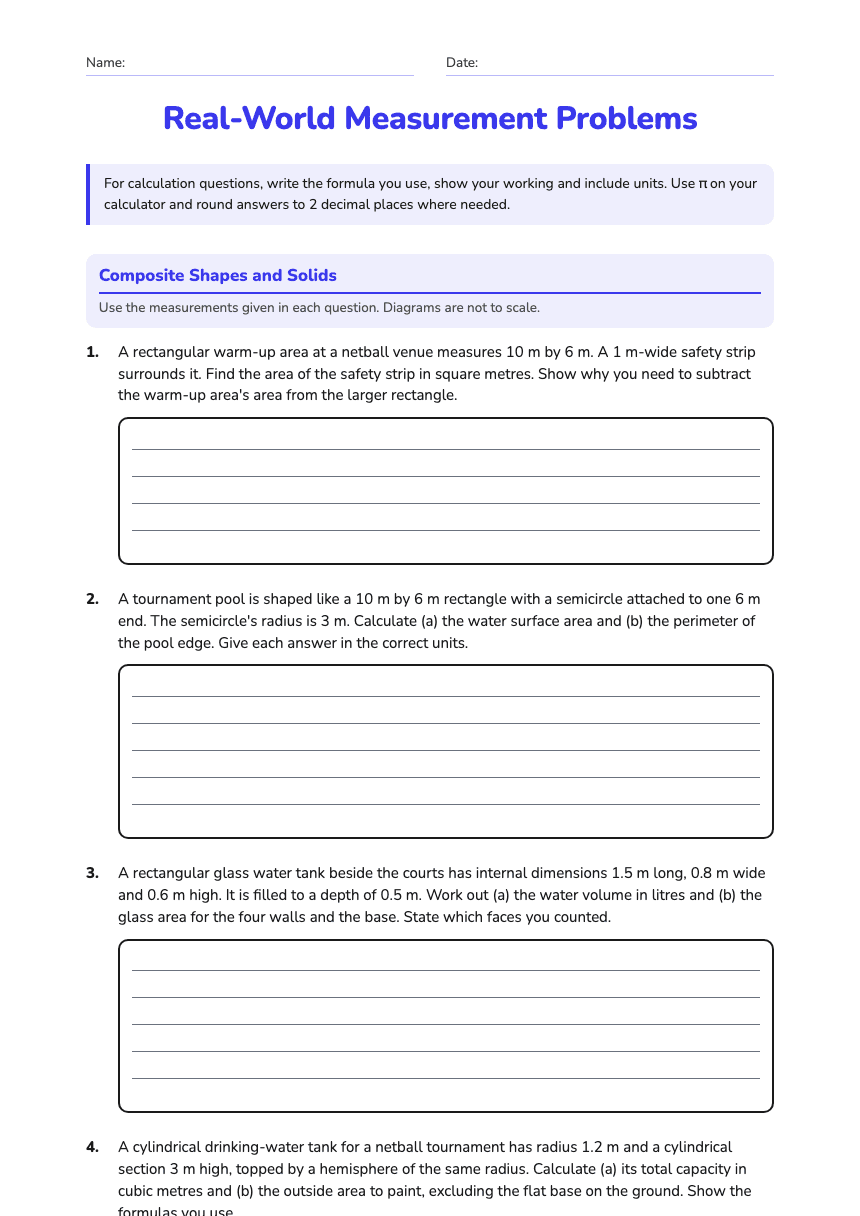
Name:Date:
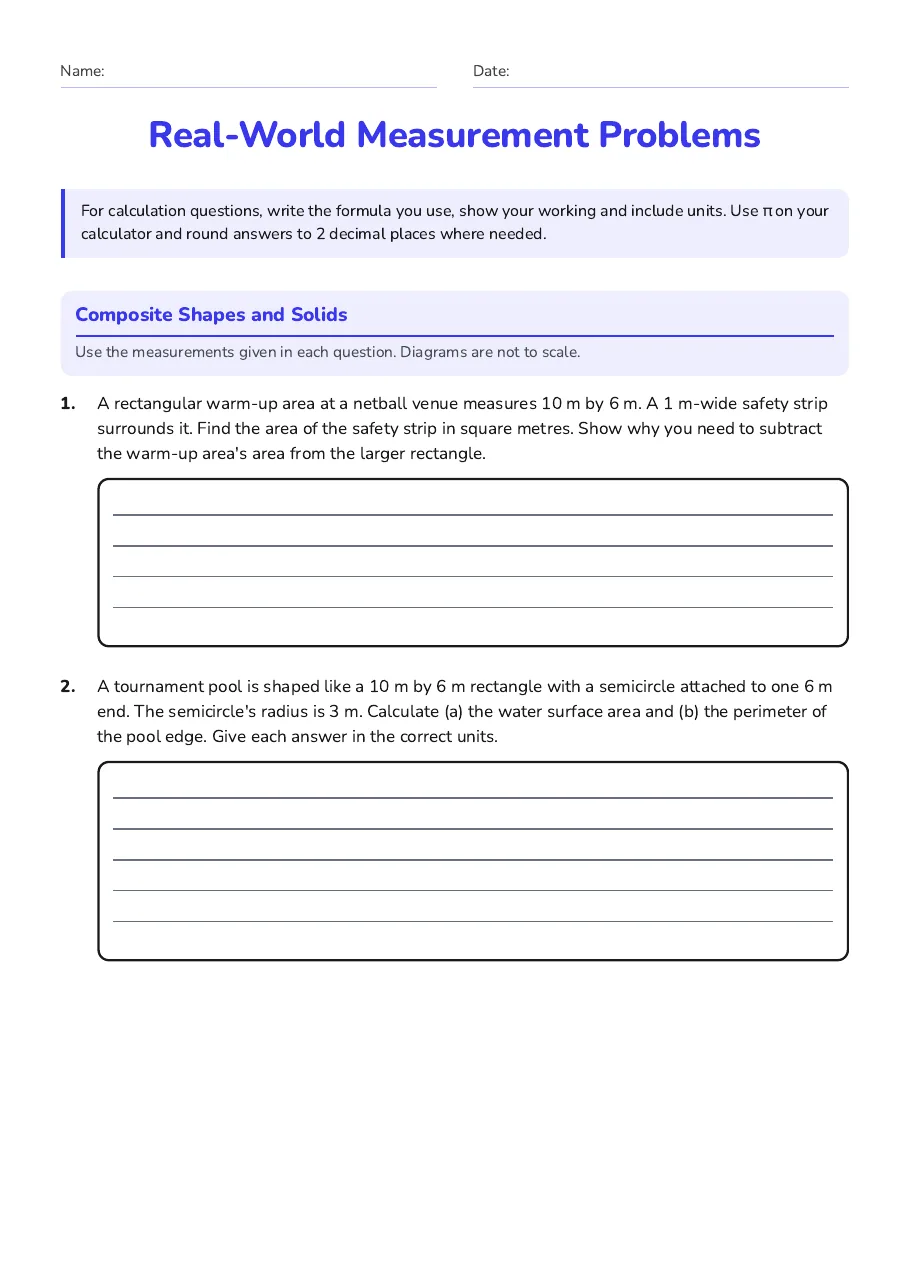
Real-World Measurement Problems
For calculation questions, write the formula you use, show your working and include units. Use π on your calculator and round answers to 2 decimal places where needed.
Composite Shapes and Solids
Use the measurements given in each question. Diagrams are not to scale.
1.A rectangular warm-up area at a netball venue measures 10 m by 6 m. A 1 m-wide safety strip surrounds it. Find the area of the safety strip in square metres. Show why you need to subtract the warm-up area's area from the larger rectangle.
2.A tournament pool is shaped like a 10 m by 6 m rectangle with a semicircle attached to one 6 m end. The semicircle's radius is 3 m. Calculate (a) the water surface area and (b) the perimeter of the pool edge. Give each answer in the correct units.
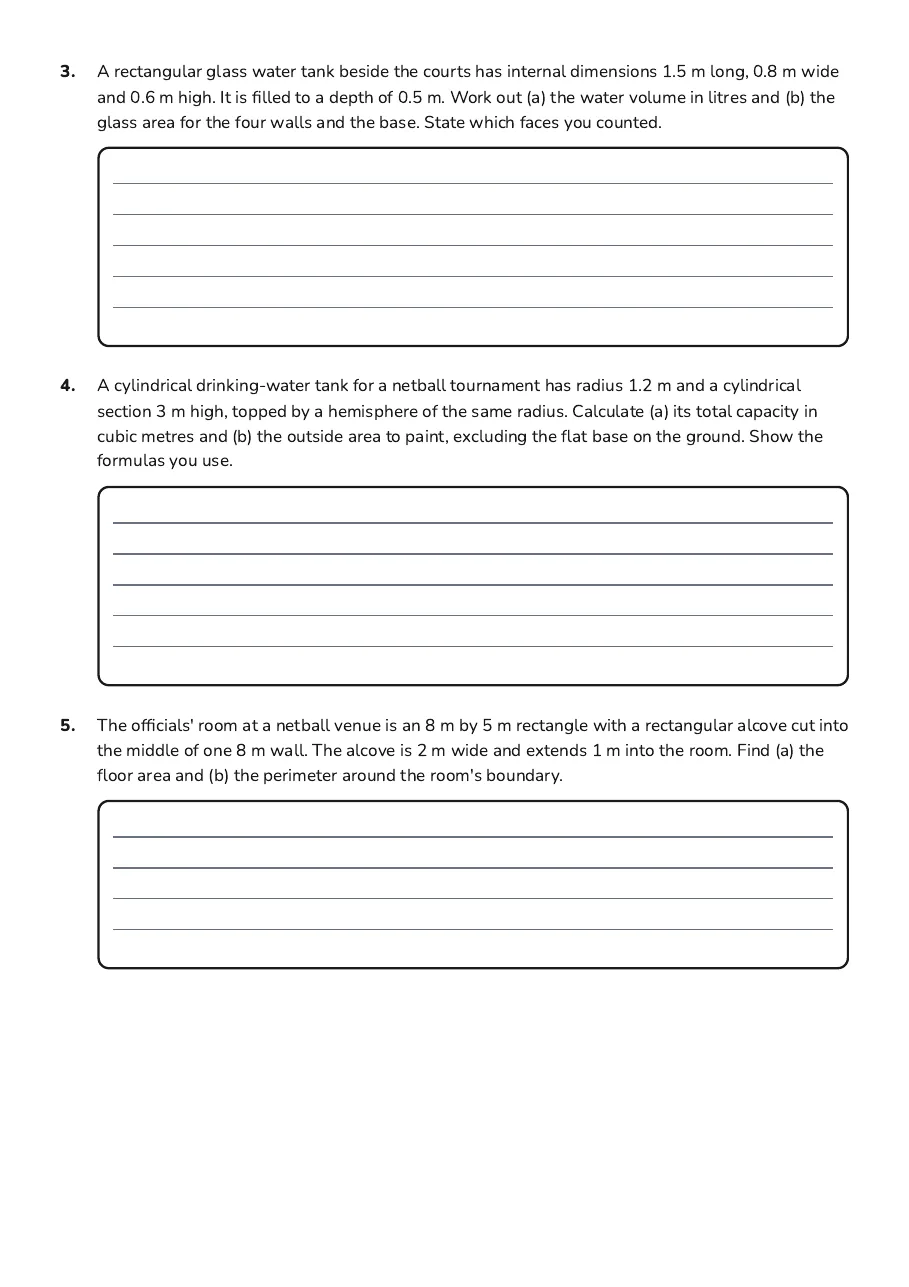
3.A rectangular glass water tank beside the courts has internal dimensions 1.5 m long, 0.8 m wide and 0.6 m high. It is filled to a depth of 0.5 m. Work out (a) the water volume in litres and (b) the glass area for the four walls and the base. State which faces you counted.
4.A cylindrical drinking-water tank for a netball tournament has radius 1.2 m and a cylindrical section 3 m high, topped by a hemisphere of the same radius. Calculate (a) its total capacity in cubic metres and (b) the outside area to paint, excluding the flat base on the ground. Show the formulas you use.
5.The officials' room at a netball venue is an 8 m by 5 m rectangle with a rectangular alcove cut into the middle of one 8 m wall. The alcove is 2 m wide and extends 1 m into the room. Find (a) the floor area and (b) the perimeter around the room's boundary.
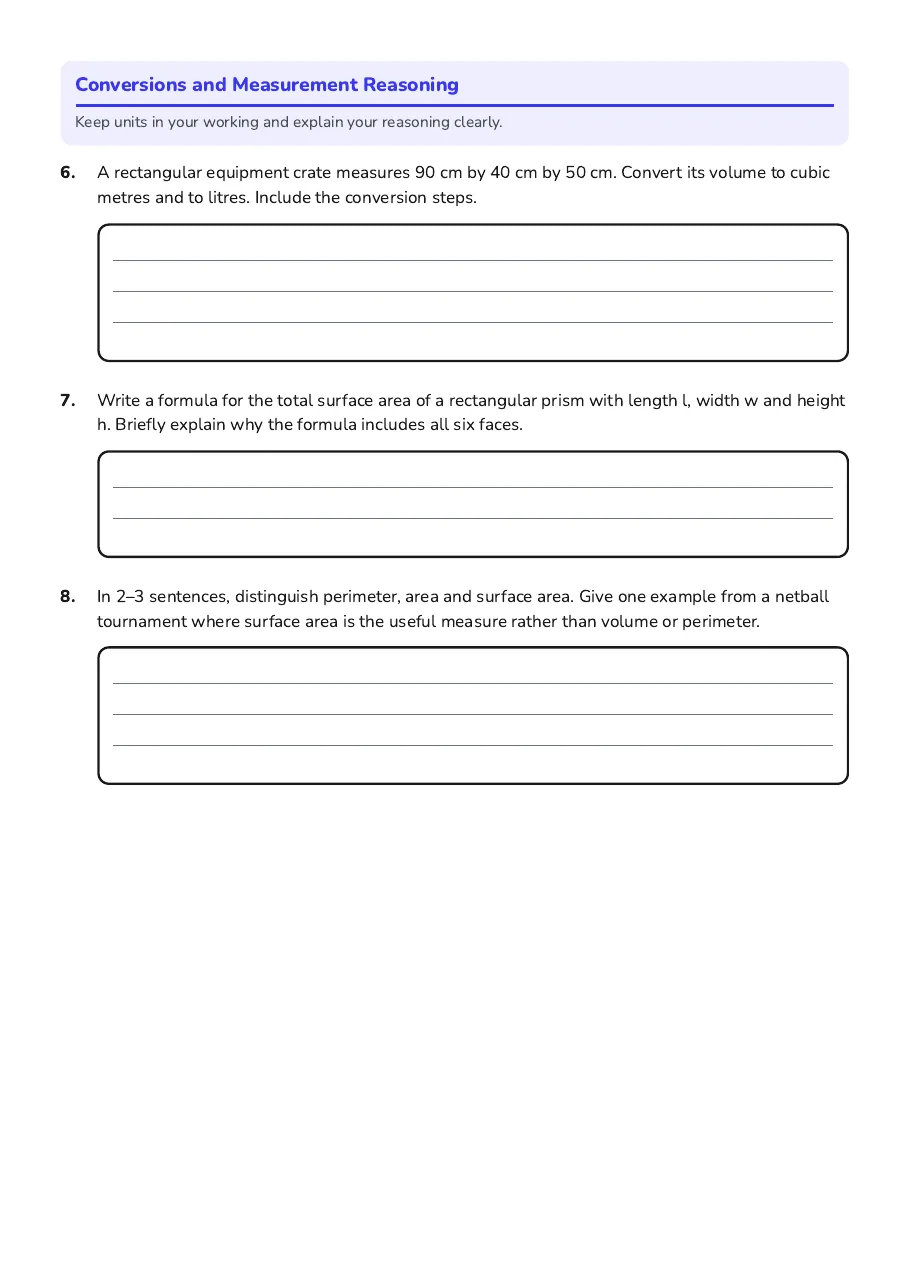
Conversions and Measurement Reasoning
Keep units in your working and explain your reasoning clearly.
6.A rectangular equipment crate measures 90 cm by 40 cm by 50 cm. Convert its volume to cubic metres and to litres. Include the conversion steps.
7.Write a formula for the total surface area of a rectangular prism with length l, width w and height h. Briefly explain why the formula includes all six faces.
8.In 2–3 sentences, distinguish perimeter, area and surface area. Give one example from a netball tournament where surface area is the useful measure rather than volume or perimeter.
3 printable pages
Page 1
Page 2
Page 3
About This Worksheet
Free in Kuraplan
Sign up free, grab the PDF, and customize it for your class.
Print-Ready
Formatted for standard paper. Clean layout, easy to read.
AI-Generated
Created with Kuraplan's AI, designed for real classroom use.
For Teachers & Parents
Use in classrooms, for homework, tutoring, or homeschool.
Need a custom version of this worksheet?
Kuraplan's AI generates custom worksheets in seconds — differentiated for every learner, aligned to your curriculum.
Generate Custom Worksheets — Free No credit card Curriculum-aligned Under 60 seconds