Romeo and Juliet Literary Analysis
A free english worksheet ready for your classroom. Open in Kuraplan to grab the print-ready PDF, customize it for your students, or generate a fresh version in seconds.
Romeo and Juliet Literary Analysis
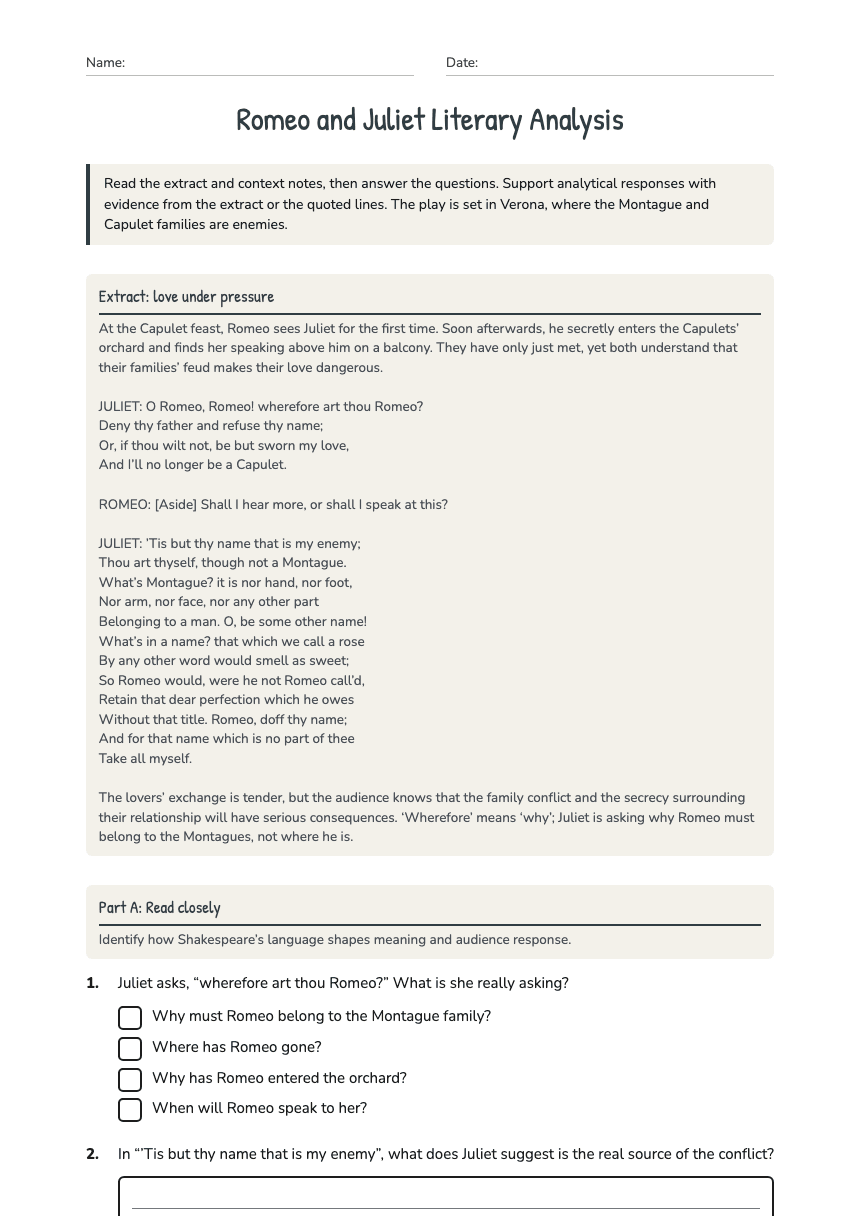
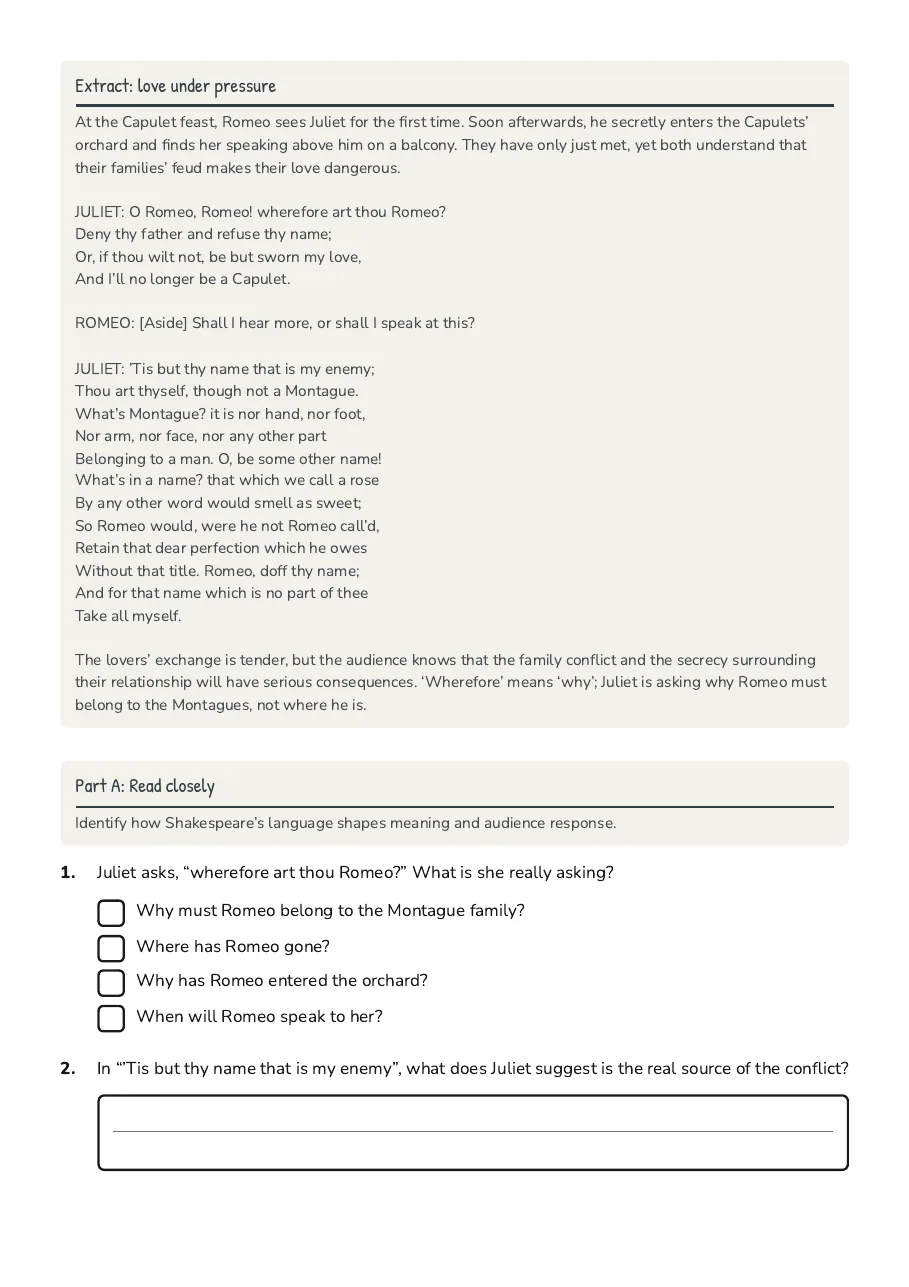
Extract: love under pressure
At the Capulet feast, Romeo sees Juliet for the first time. Soon afterwards, he secretly enters the Capulets’ orchard and finds her speaking above him on a balcony. They have only just met, yet both understand that their families’ feud makes their love dangerous. JULIET: O Romeo, Romeo! wherefore art thou Romeo? Deny thy father and refuse thy name; Or, if thou wilt not, be but sworn my love, And I’ll no longer be a Capulet. ROMEO: [Aside] Shall I hear more, or shall I speak at this? JULIET: ’Tis but thy name that is my enemy; Thou art thyself, though not a Montague. What’s Montague? it is nor hand, nor foot, Nor arm, nor face, nor any other part Belonging to a man. O, be some other name! What’s in a name? that which we call a rose By any other word would smell as sweet; So Romeo would, were he not Romeo call’d, Retain that dear perfection which he owes Without that title. Romeo, doff thy name; And for that name which is no part of thee Take all myself. The lovers’ exchange is tender, but the audience knows that the family conflict and the secrecy surrounding their relationship will have serious consequences. ‘Wherefore’ means ‘why’; Juliet is asking why Romeo must belong to the Montagues, not where he is.
Part A: Read closely
Identify how Shakespeare’s language shapes meaning and audience response.
- Why must Romeo belong to the Montague family?
- Where has Romeo gone?
- Why has Romeo entered the orchard?
- When will Romeo speak to her?
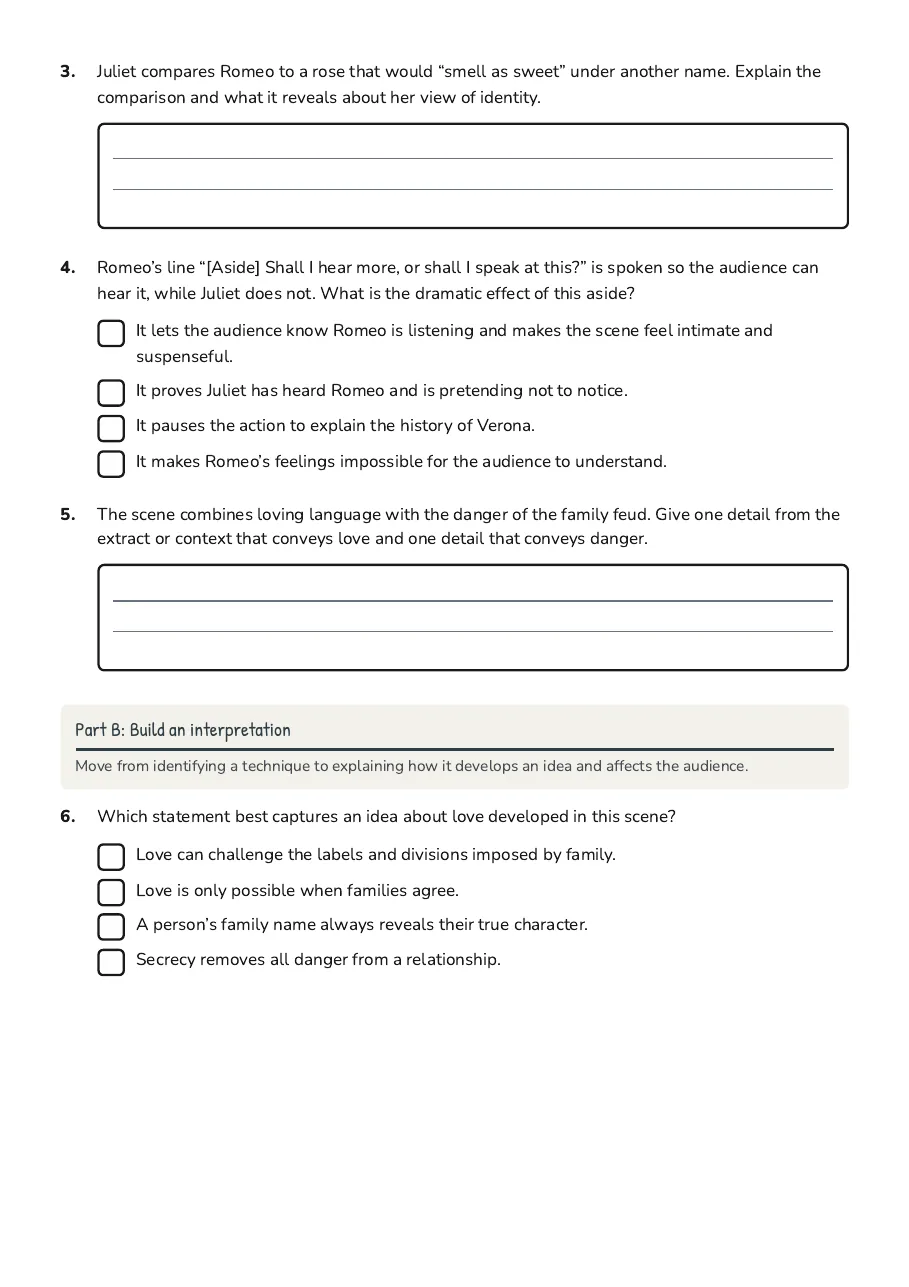
- It lets the audience know Romeo is listening and makes the scene feel intimate and suspenseful.
- It proves Juliet has heard Romeo and is pretending not to notice.
- It pauses the action to explain the history of Verona.
- It makes Romeo’s feelings impossible for the audience to understand.
Part B: Build an interpretation
Move from identifying a technique to explaining how it develops an idea and affects the audience.
- Love can challenge the labels and divisions imposed by family.
- Love is only possible when families agree.
- A person’s family name always reveals their true character.
- Secrecy removes all danger from a relationship.
4 printable pages

Page 1
Page 2
Page 3
Page 4
About This Worksheet
Free in Kuraplan
Sign up free, grab the PDF, and customize it for your class.
Print-Ready
Formatted for standard paper. Clean layout, easy to read.
AI-Generated
Created with Kuraplan's AI, designed for real classroom use.
For Teachers & Parents
Use in classrooms, for homework, tutoring, or homeschool.
Need a custom version of this worksheet?
Kuraplan's AI generates custom worksheets in seconds — differentiated for every learner, aligned to your curriculum.
Generate Custom Worksheets — Free