EnglishFreePrintable

Satire and Social Critique

A free english worksheet ready for your classroom. Open in Kuraplan to grab the print-ready PDF, customize it for your students, or generate a fresh version in seconds.
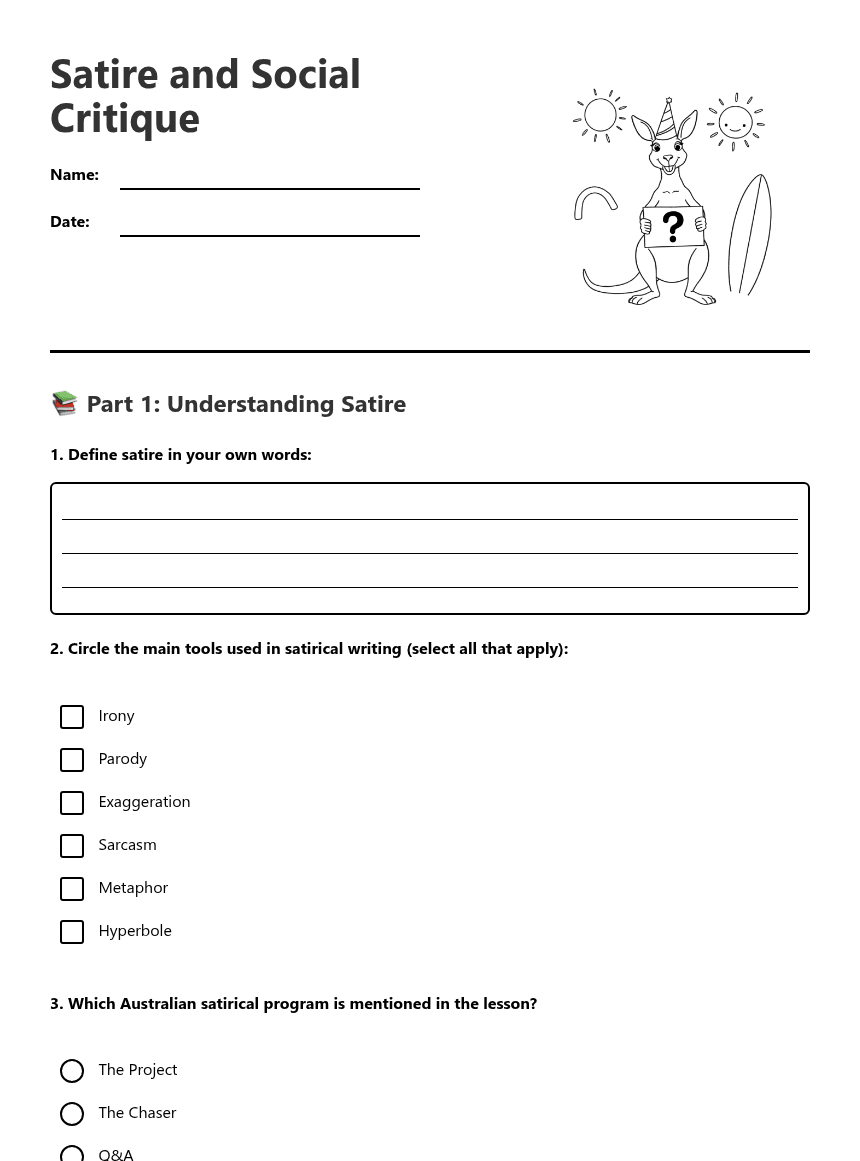
Satire and Social Critique worksheet preview
Satire and Social Critique

Satire and Social Critique

Satirical cartoon illustration

📚 Part 1: Understanding Satire

1. Define satire in your own words:
2. Circle the main tools used in satirical writing (select all that apply):

Irony

Parody

Exaggeration

Sarcasm

Metaphor

Hyperbole

3. Which Australian satirical program is mentioned in the lesson?

The Project

The Chaser

Q&A

Media Watch

🔍 Part 2: Analysing Satirical Techniques

4. Read the following satirical statement and identify the techniques used:

"Local politician announces groundbreaking plan to solve traffic congestion by adding more cars to the roads, claiming 'If we can't beat them, join them - and bring your friends!'"

a) What satirical technique is primarily used here?
b) What social issue is being critiqued?
c) How does this satire make the issue more memorable or impactful?
5. Match the satirical technique with its definition:
1. Irony
2. Parody
3. Exaggeration
4. Sarcasm
A. Imitating a style to create humour
B. Saying the opposite of what you mean
C. Making something seem bigger than it is
D. Using bitter or cutting remarks

⚖️ Part 3: Ethics and Impact of Satire

6. Fill in the blanks about satirical responsibility:

Satirists have a responsibility to consider the _____________ impact of their work. While satire can effectively _____________ social issues and challenge _____________ perspectives, it can also potentially _____________ or mislead audiences if not used thoughtfully.

7. List three positive effects satire can have on society:
8. When might satirical content cross ethical boundaries? (Select the most appropriate answer)

When it makes people laugh

When it reinforces harmful stereotypes

When it criticises government policies

When it uses exaggeration

9. Explain how satire can influence public opinion:

💭 Part 4: Critical Reflection

10. Think of a satirical example you've encountered (TV show, meme, cartoon, etc.). Describe it briefly:
11. What social norm or cultural issue was this satirical example critiquing?
12. How did this satirical example change or reinforce your views about the issue? (Write approximately 100 words)
13. Create your own satirical headline about a current social issue:
14. Explain what technique(s) you used and what message you're trying to convey:

About This Worksheet

Free in Kuraplan

Sign up free, grab the PDF, and customize it for your class.

Print-Ready

Formatted for standard paper. Clean layout, easy to read.

AI-Generated

Created with Kuraplan's AI, designed for real classroom use.

For Teachers & Parents

Use in classrooms, for homework, tutoring, or homeschool.

Need a custom version of this worksheet?

Kuraplan's AI generates custom worksheets in seconds — differentiated for every learner, aligned to your curriculum.

Generate Custom Worksheets — Free
No credit card Curriculum-aligned Under 60 seconds