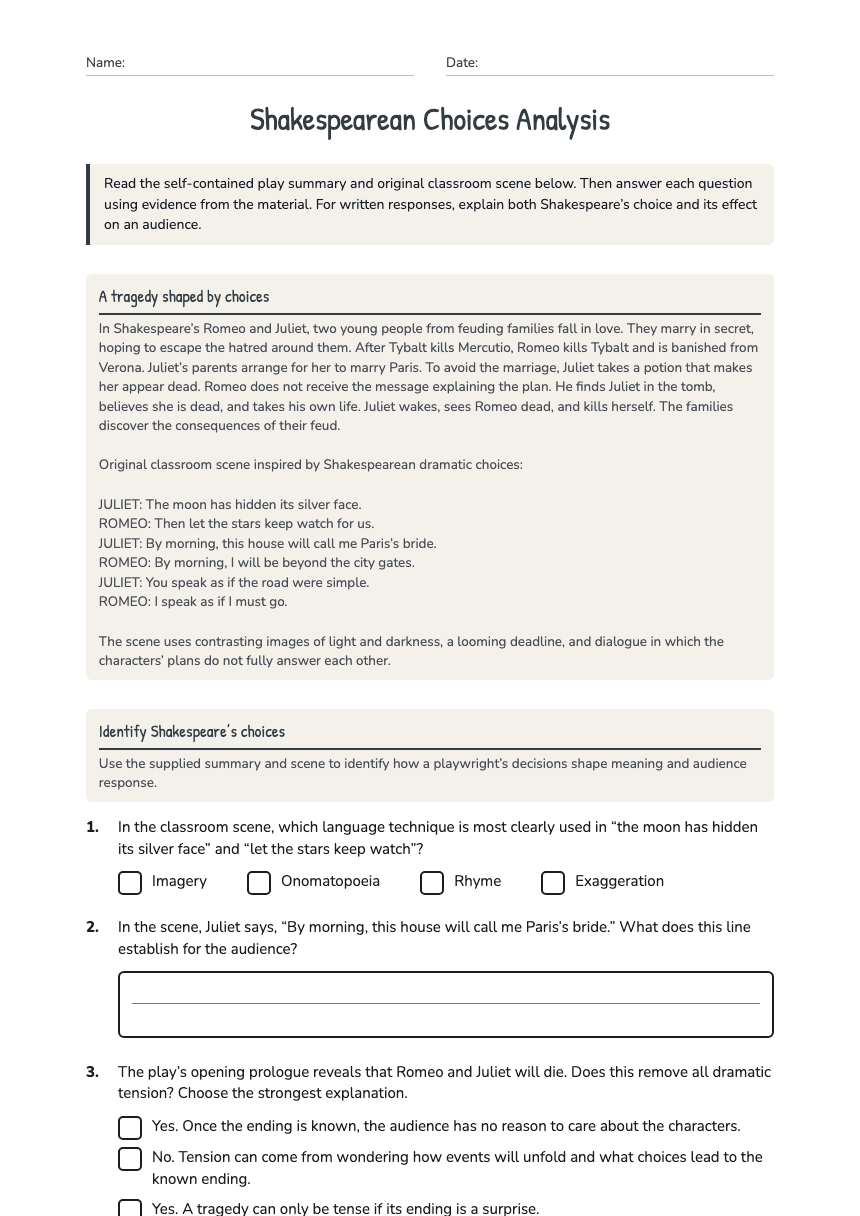
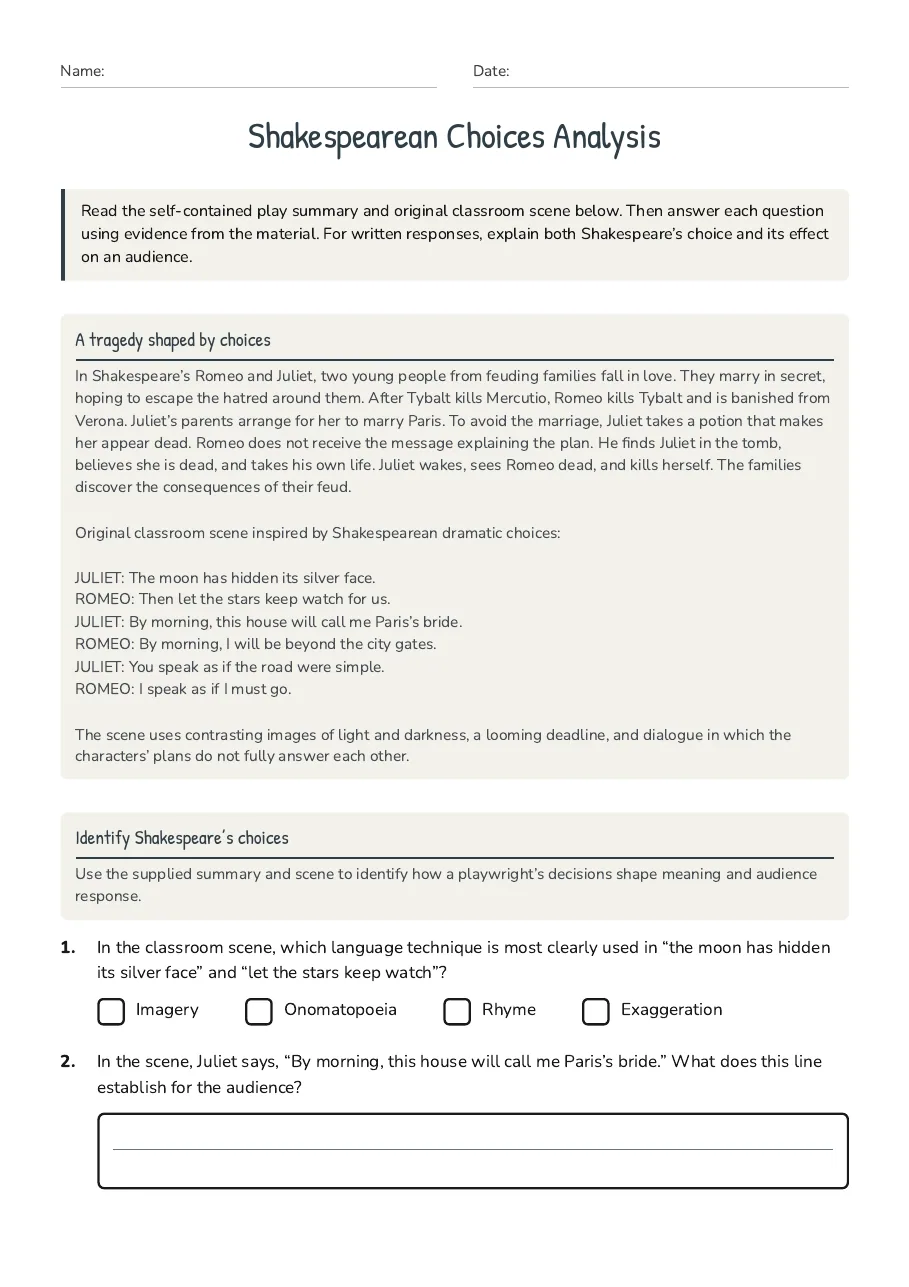
Shakespearean Choices Analysis
A free english worksheet ready for your classroom. Open in Kuraplan to grab the print-ready PDF, customize it for your students, or generate a fresh version in seconds.
Shakespearean Choices Analysis
A tragedy shaped by choices
In Shakespeare’s Romeo and Juliet, two young people from feuding families fall in love. They marry in secret, hoping to escape the hatred around them. After Tybalt kills Mercutio, Romeo kills Tybalt and is banished from Verona. Juliet’s parents arrange for her to marry Paris. To avoid the marriage, Juliet takes a potion that makes her appear dead. Romeo does not receive the message explaining the plan. He finds Juliet in the tomb, believes she is dead, and takes his own life. Juliet wakes, sees Romeo dead, and kills herself. The families discover the consequences of their feud. Original classroom scene inspired by Shakespearean dramatic choices: JULIET: The moon has hidden its silver face. ROMEO: Then let the stars keep watch for us. JULIET: By morning, this house will call me Paris’s bride. ROMEO: By morning, I will be beyond the city gates. JULIET: You speak as if the road were simple. ROMEO: I speak as if I must go. The scene uses contrasting images of light and darkness, a looming deadline, and dialogue in which the characters’ plans do not fully answer each other.
Identify Shakespeare’s choices
Use the supplied summary and scene to identify how a playwright’s decisions shape meaning and audience response.
- Imagery
- Onomatopoeia
- Rhyme
- Exaggeration
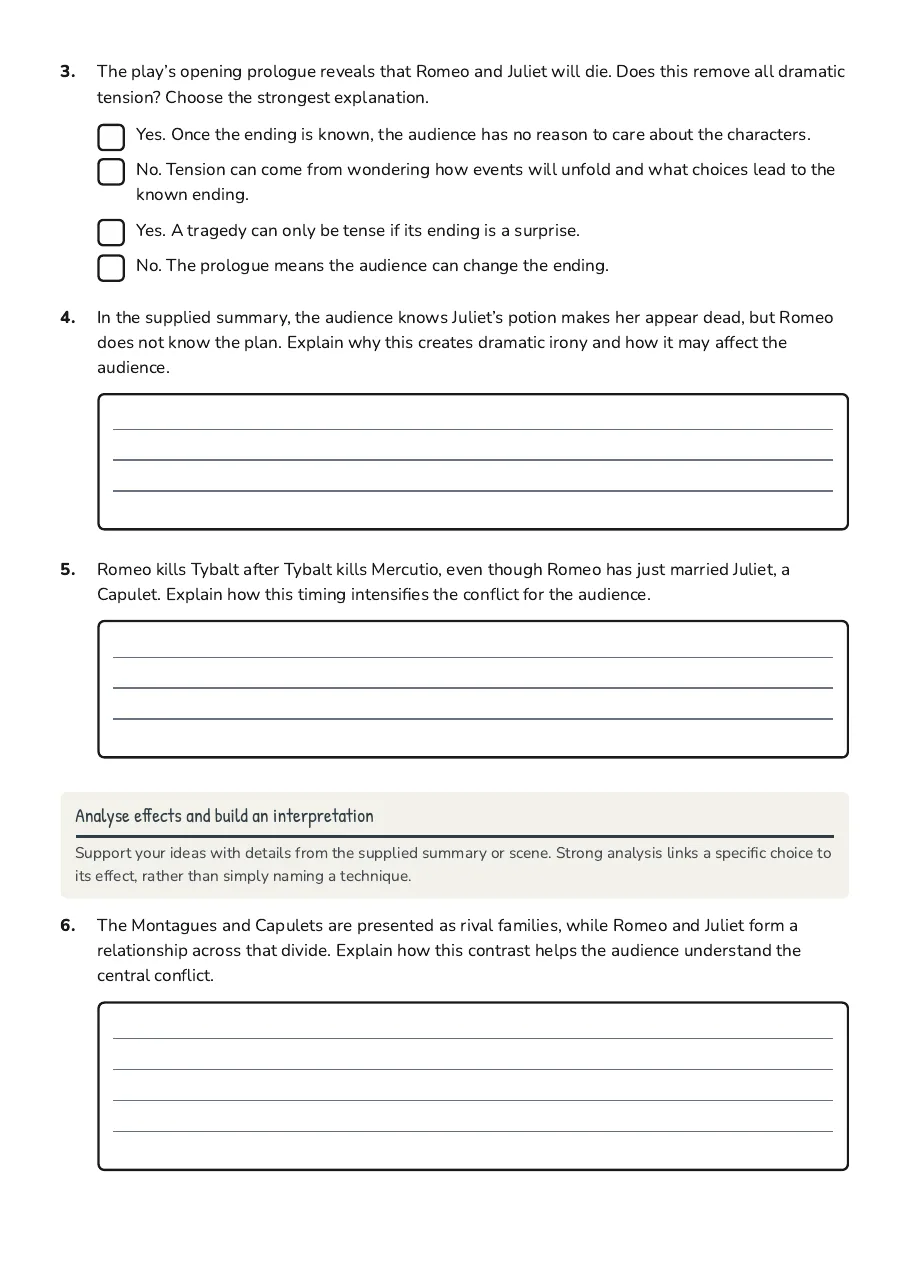
- Yes. Once the ending is known, the audience has no reason to care about the characters.
- No. Tension can come from wondering how events will unfold and what choices lead to the known ending.
- Yes. A tragedy can only be tense if its ending is a surprise.
- No. The prologue means the audience can change the ending.
Analyse effects and build an interpretation
Support your ideas with details from the supplied summary or scene. Strong analysis links a specific choice to its effect, rather than simply naming a technique.
3 printable pages
Page 1
Page 2
Page 3
About This Worksheet
Free in Kuraplan
Sign up free, grab the PDF, and customize it for your class.
Print-Ready
Formatted for standard paper. Clean layout, easy to read.
AI-Generated
Created with Kuraplan's AI, designed for real classroom use.
For Teachers & Parents
Use in classrooms, for homework, tutoring, or homeschool.
Need a custom version of this worksheet?
Kuraplan's AI generates custom worksheets in seconds — differentiated for every learner, aligned to your curriculum.
Generate Custom Worksheets — Free