Shirley Jackson Gothic Analysis
A free english worksheet ready for your classroom. Open in Kuraplan to grab the print-ready PDF, customize it for your students, or generate a fresh version in seconds.
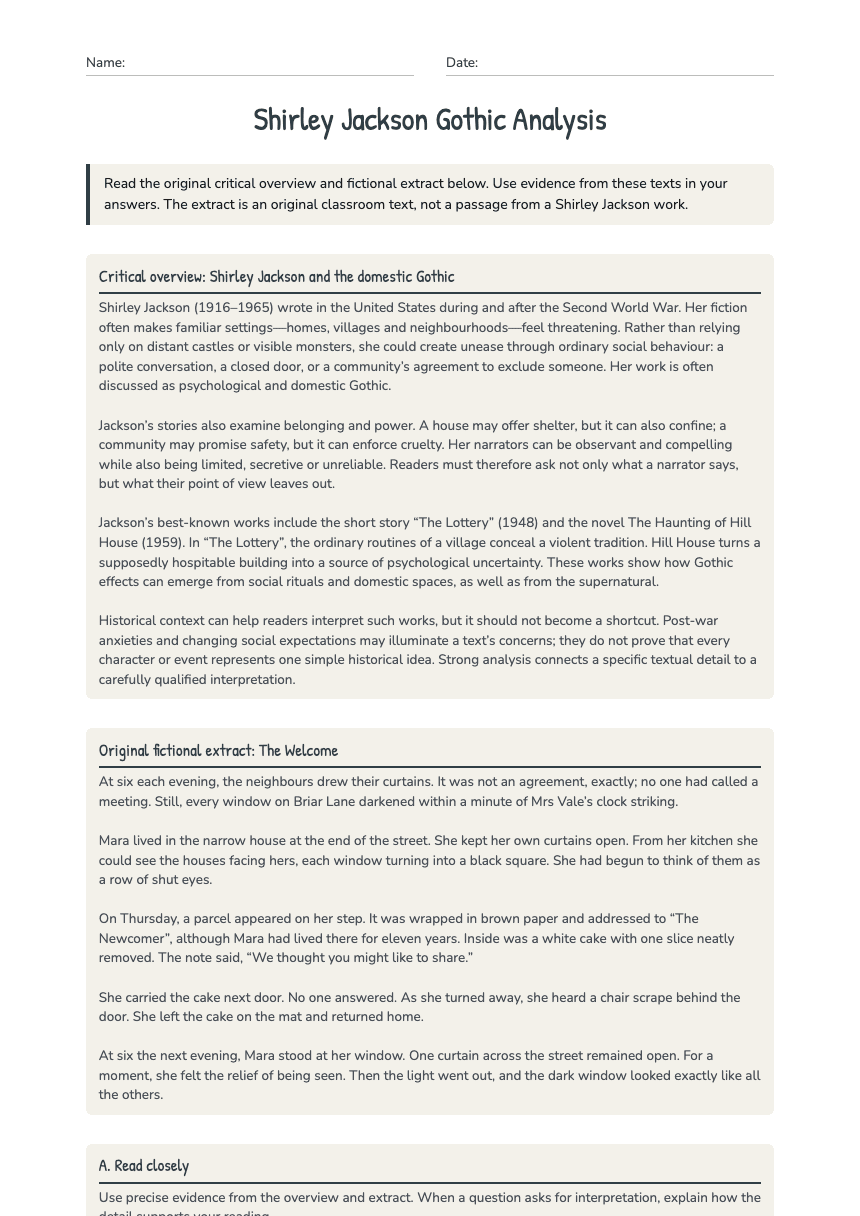
Shirley Jackson Gothic Analysis
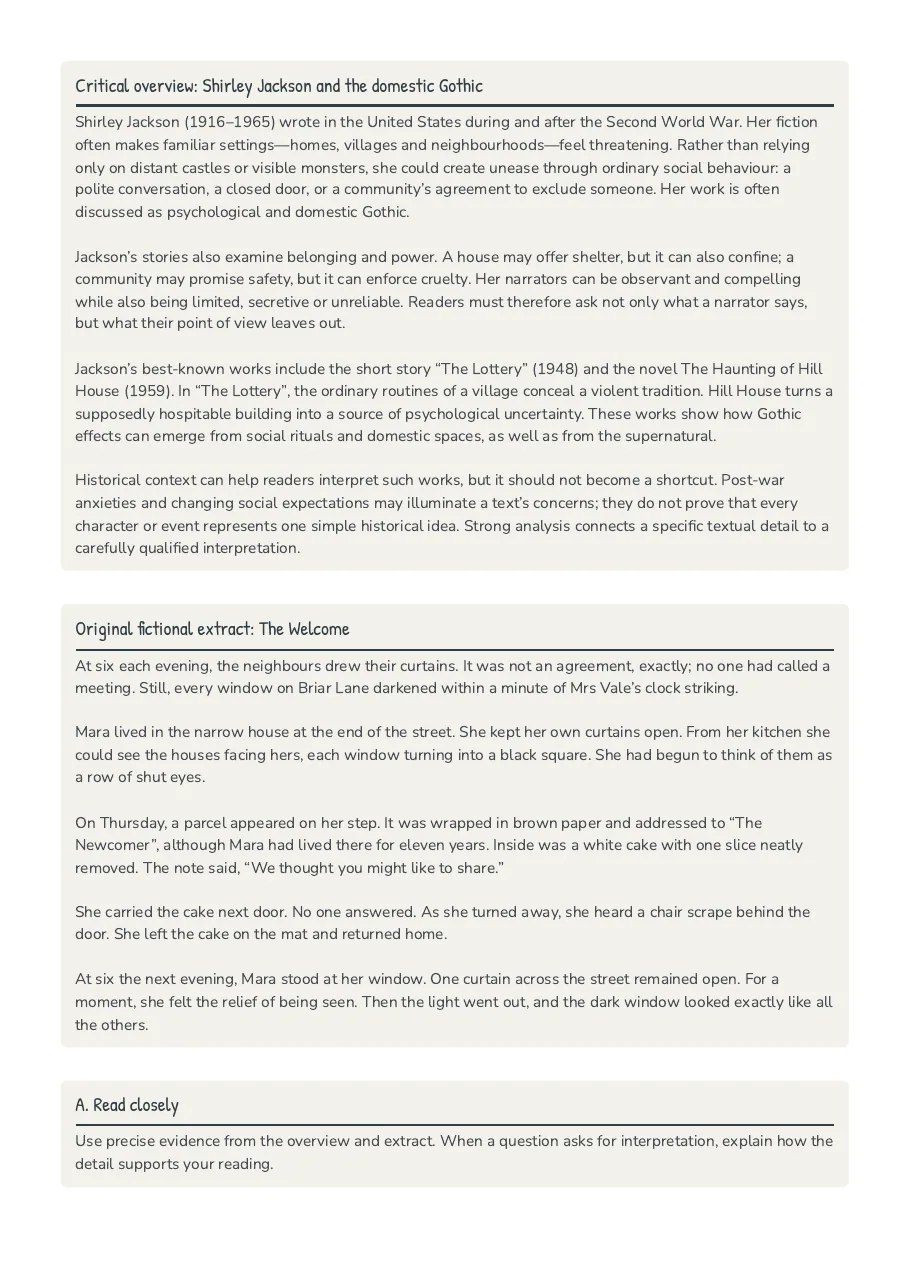
Critical overview: Shirley Jackson and the domestic Gothic
Shirley Jackson (1916–1965) wrote in the United States during and after the Second World War. Her fiction often makes familiar settings—homes, villages and neighbourhoods—feel threatening. Rather than relying only on distant castles or visible monsters, she could create unease through ordinary social behaviour: a polite conversation, a closed door, or a community’s agreement to exclude someone. Her work is often discussed as psychological and domestic Gothic. Jackson’s stories also examine belonging and power. A house may offer shelter, but it can also confine; a community may promise safety, but it can enforce cruelty. Her narrators can be observant and compelling while also being limited, secretive or unreliable. Readers must therefore ask not only what a narrator says, but what their point of view leaves out. Jackson’s best-known works include the short story “The Lottery” (1948) and the novel The Haunting of Hill House (1959). In “The Lottery”, the ordinary routines of a village conceal a violent tradition. Hill House turns a supposedly hospitable building into a source of psychological uncertainty. These works show how Gothic effects can emerge from social rituals and domestic spaces, as well as from the supernatural. Historical context can help readers interpret such works, but it should not become a shortcut. Post-war anxieties and changing social expectations may illuminate a text’s concerns; they do not prove that every character or event represents one simple historical idea. Strong analysis connects a specific textual detail to a carefully qualified interpretation.
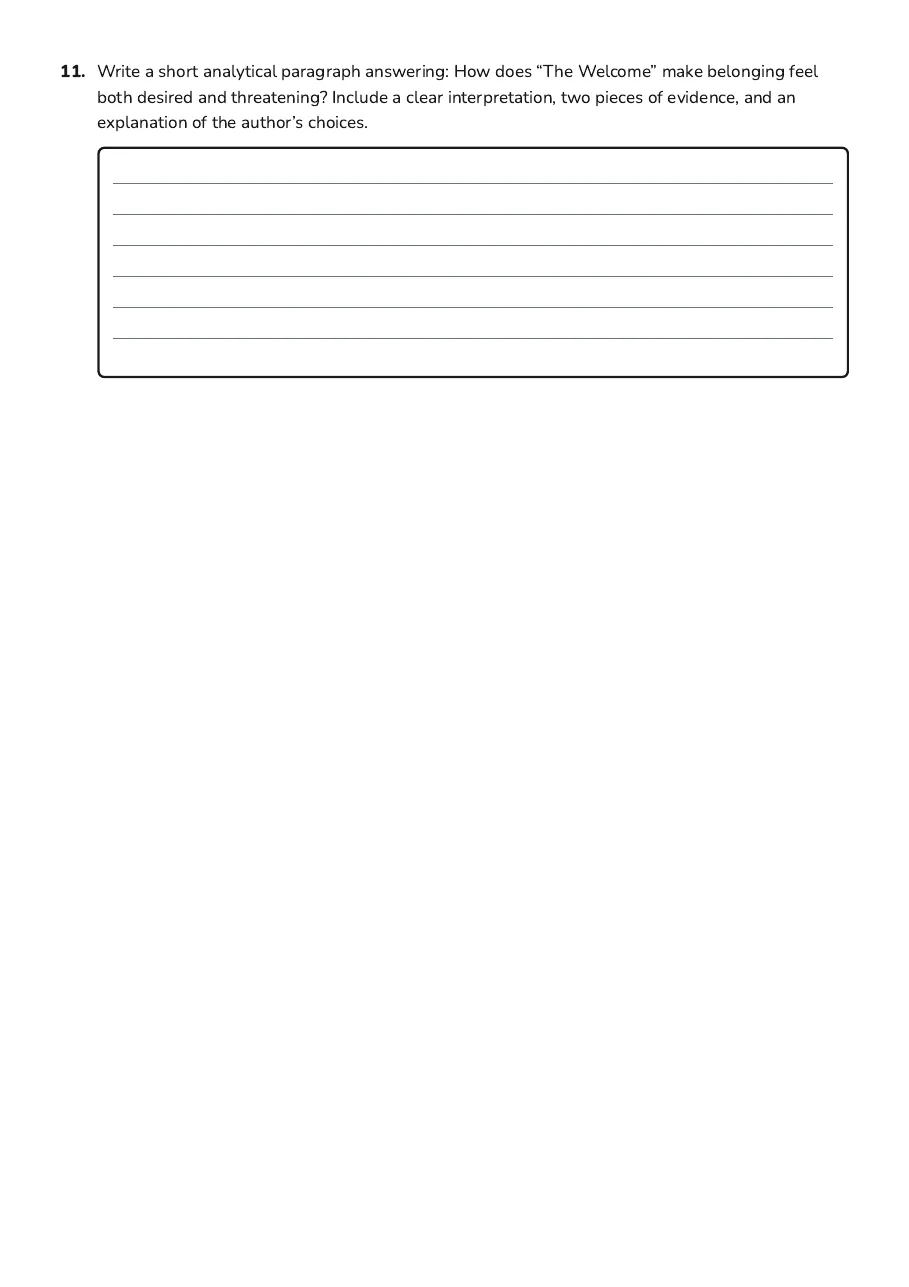
Original fictional extract: The Welcome
At six each evening, the neighbours drew their curtains. It was not an agreement, exactly; no one had called a meeting. Still, every window on Briar Lane darkened within a minute of Mrs Vale’s clock striking. Mara lived in the narrow house at the end of the street. She kept her own curtains open. From her kitchen she could see the houses facing hers, each window turning into a black square. She had begun to think of them as a row of shut eyes. On Thursday, a parcel appeared on her step. It was wrapped in brown paper and addressed to “The Newcomer”, although Mara had lived there for eleven years. Inside was a white cake with one slice neatly removed. The note said, “We thought you might like to share.” She carried the cake next door. No one answered. As she turned away, she heard a chair scrape behind the door. She left the cake on the mat and returned home. At six the next evening, Mara stood at her window. One curtain across the street remained open. For a moment, she felt the relief of being seen. Then the light went out, and the dark window looked exactly like all the others.
A. Read closely
Use precise evidence from the overview and extract. When a question asks for interpretation, explain how the detail supports your reading.
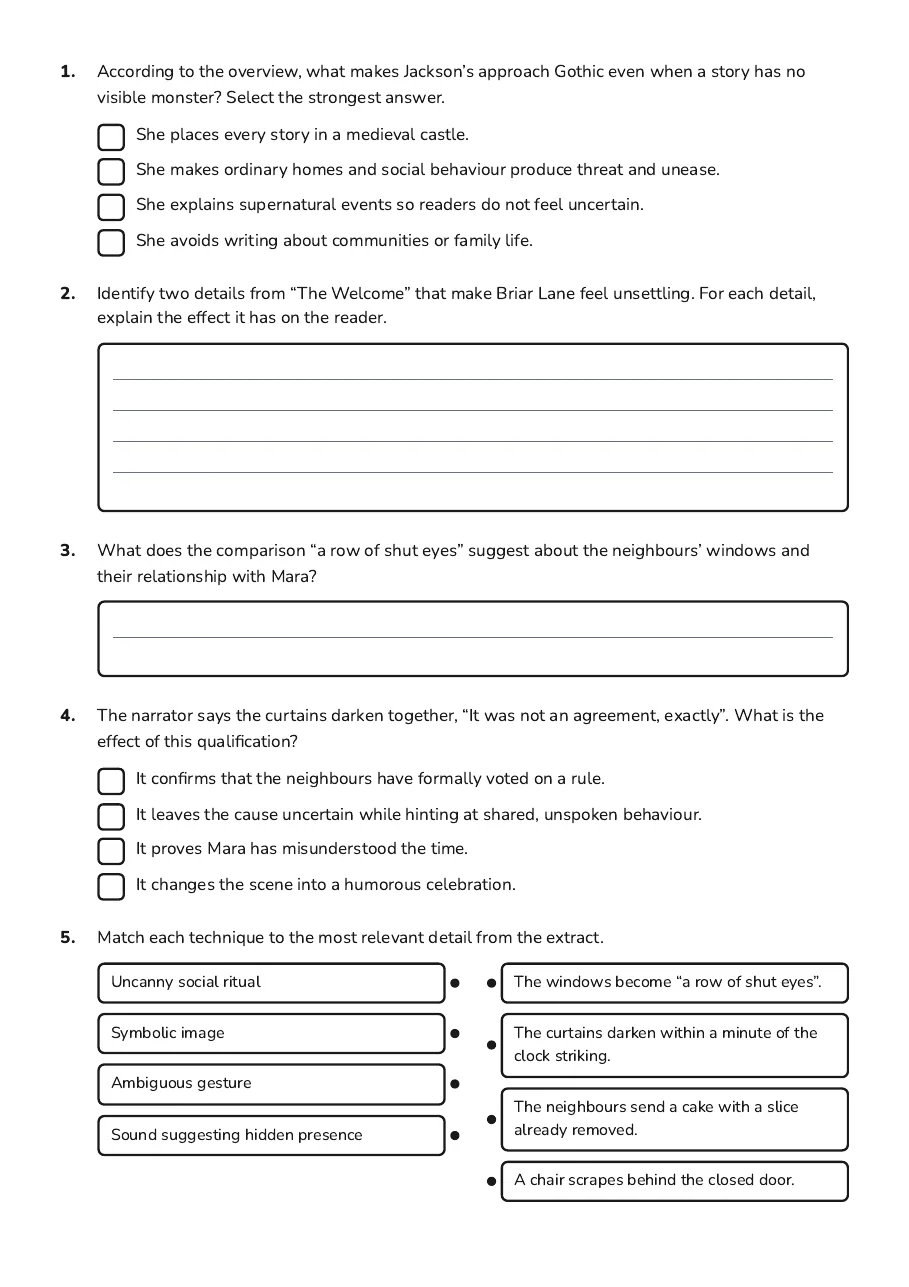
- She places every story in a medieval castle.
- She makes ordinary homes and social behaviour produce threat and unease.
- She explains supernatural events so readers do not feel uncertain.
- She avoids writing about communities or family life.
- It confirms that the neighbours have formally voted on a rule.
- It leaves the cause uncertain while hinting at shared, unspoken behaviour.
- It proves Mara has misunderstood the time.
- It changes the scene into a humorous celebration.
- Uncanny social ritual
- Symbolic image
- Ambiguous gesture
- Sound suggesting hidden presence
- The windows become “a row of shut eyes”.
- The curtains darken within a minute of the clock striking.
- The neighbours send a cake with a slice already removed.
- A chair scrapes behind the closed door.
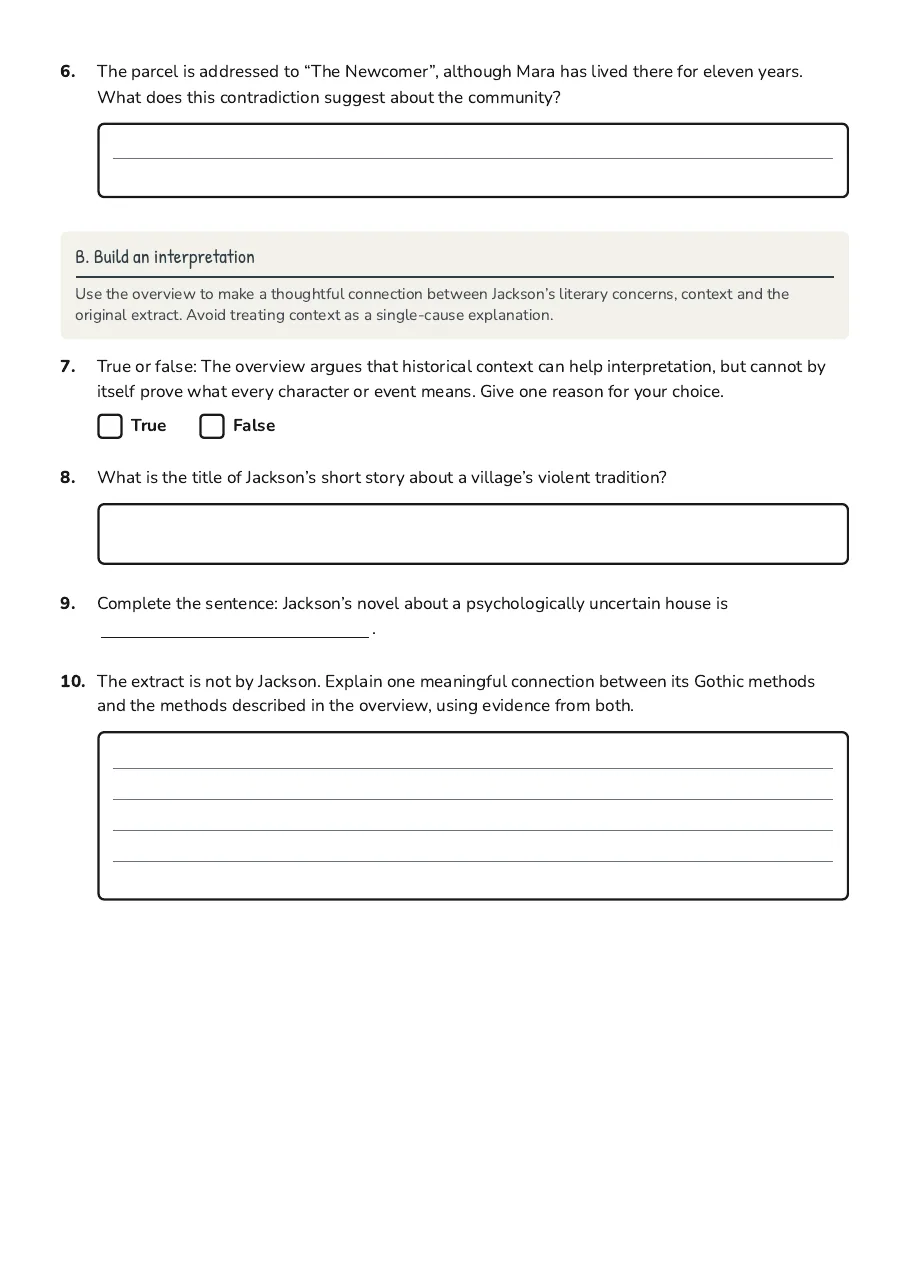
B. Build an interpretation
Use the overview to make a thoughtful connection between Jackson’s literary concerns, context and the original extract. Avoid treating context as a single-cause explanation.
5 printable pages

Page 1
Page 2
Page 3
Page 4
Page 5
About This Worksheet
Free in Kuraplan
Sign up free, grab the PDF, and customize it for your class.
Print-Ready
Formatted for standard paper. Clean layout, easy to read.
AI-Generated
Created with Kuraplan's AI, designed for real classroom use.
For Teachers & Parents
Use in classrooms, for homework, tutoring, or homeschool.
Need a custom version of this worksheet?
Kuraplan's AI generates custom worksheets in seconds — differentiated for every learner, aligned to your curriculum.
Generate Custom Worksheets — Free