Shirley Jackson Gothic Analysis
A free english worksheet ready for your classroom. Open in Kuraplan to grab the print-ready PDF, customize it for your students, or generate a fresh version in seconds.

Shirley Jackson Gothic Analysis
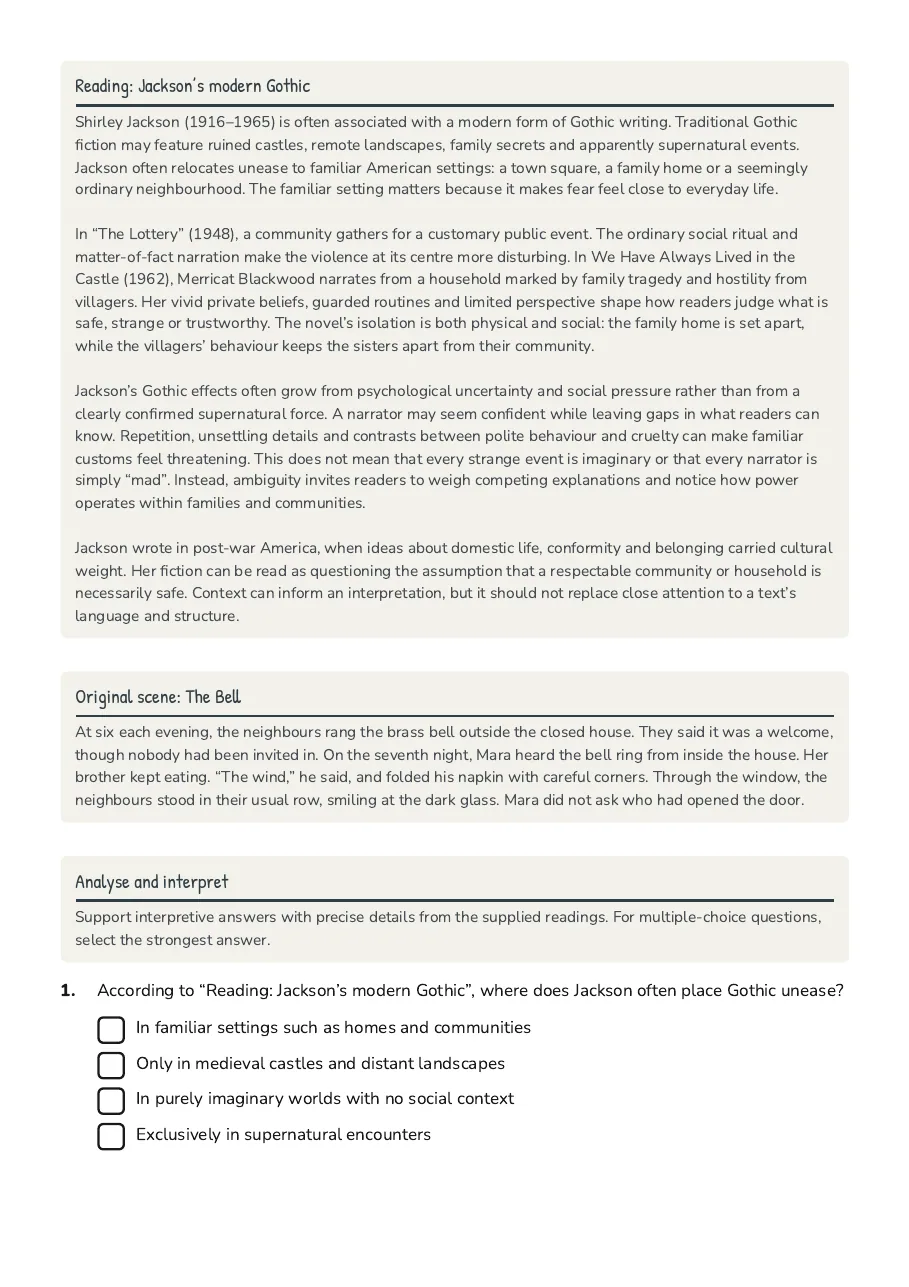
Reading: Jackson’s modern Gothic
Shirley Jackson (1916–1965) is often associated with a modern form of Gothic writing. Traditional Gothic fiction may feature ruined castles, remote landscapes, family secrets and apparently supernatural events. Jackson often relocates unease to familiar American settings: a town square, a family home or a seemingly ordinary neighbourhood. The familiar setting matters because it makes fear feel close to everyday life. In “The Lottery” (1948), a community gathers for a customary public event. The ordinary social ritual and matter-of-fact narration make the violence at its centre more disturbing. In We Have Always Lived in the Castle (1962), Merricat Blackwood narrates from a household marked by family tragedy and hostility from villagers. Her vivid private beliefs, guarded routines and limited perspective shape how readers judge what is safe, strange or trustworthy. The novel’s isolation is both physical and social: the family home is set apart, while the villagers’ behaviour keeps the sisters apart from their community. Jackson’s Gothic effects often grow from psychological uncertainty and social pressure rather than from a clearly confirmed supernatural force. A narrator may seem confident while leaving gaps in what readers can know. Repetition, unsettling details and contrasts between polite behaviour and cruelty can make familiar customs feel threatening. This does not mean that every strange event is imaginary or that every narrator is simply “mad”. Instead, ambiguity invites readers to weigh competing explanations and notice how power operates within families and communities. Jackson wrote in post-war America, when ideas about domestic life, conformity and belonging carried cultural weight. Her fiction can be read as questioning the assumption that a respectable community or household is necessarily safe. Context can inform an interpretation, but it should not replace close attention to a text’s language and structure.
Original scene: The Bell
At six each evening, the neighbours rang the brass bell outside the closed house. They said it was a welcome, though nobody had been invited in. On the seventh night, Mara heard the bell ring from inside the house. Her brother kept eating. “The wind,” he said, and folded his napkin with careful corners. Through the window, the neighbours stood in their usual row, smiling at the dark glass. Mara did not ask who had opened the door.
Analyse and interpret
Support interpretive answers with precise details from the supplied readings. For multiple-choice questions, select the strongest answer.
- In familiar settings such as homes and communities
- Only in medieval castles and distant landscapes
- In purely imaginary worlds with no social context
- Exclusively in supernatural encounters
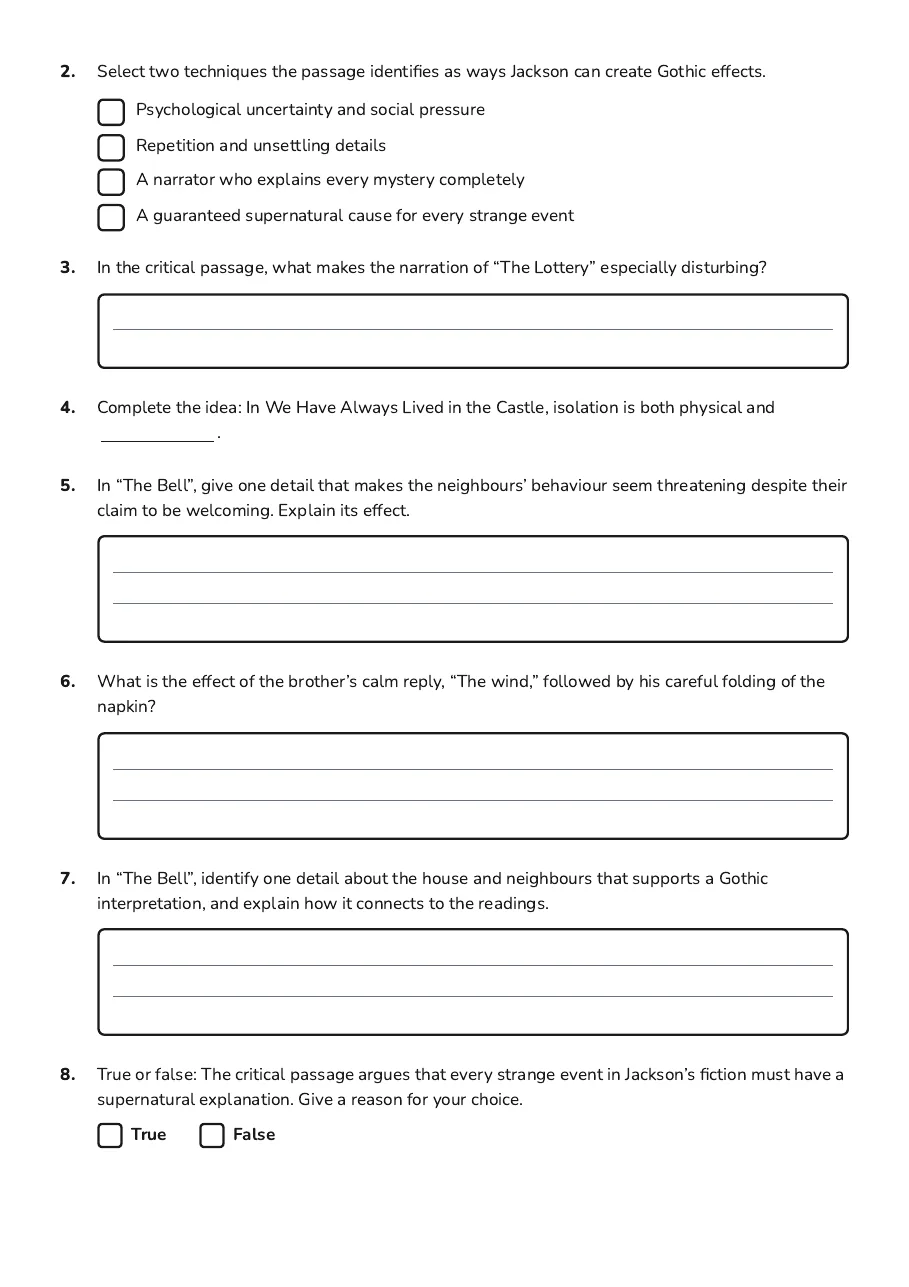
- Psychological uncertainty and social pressure
- Repetition and unsettling details
- A narrator who explains every mystery completely
- A guaranteed supernatural cause for every strange event
4 printable pages

Page 1
Page 2
Page 3
Page 4
About This Worksheet
Free in Kuraplan
Sign up free, grab the PDF, and customize it for your class.
Print-Ready
Formatted for standard paper. Clean layout, easy to read.
AI-Generated
Created with Kuraplan's AI, designed for real classroom use.
For Teachers & Parents
Use in classrooms, for homework, tutoring, or homeschool.
Need a custom version of this worksheet?
Kuraplan's AI generates custom worksheets in seconds — differentiated for every learner, aligned to your curriculum.
Generate Custom Worksheets — Free