Space Technology Exploration Worksheet
A free science worksheet ready for your classroom. Open in Kuraplan to grab the print-ready PDF, customize it for your students, or generate a fresh version in seconds.
Space Technology Exploration Worksheet
🔭 Part 1: Space Technology — Match & Label
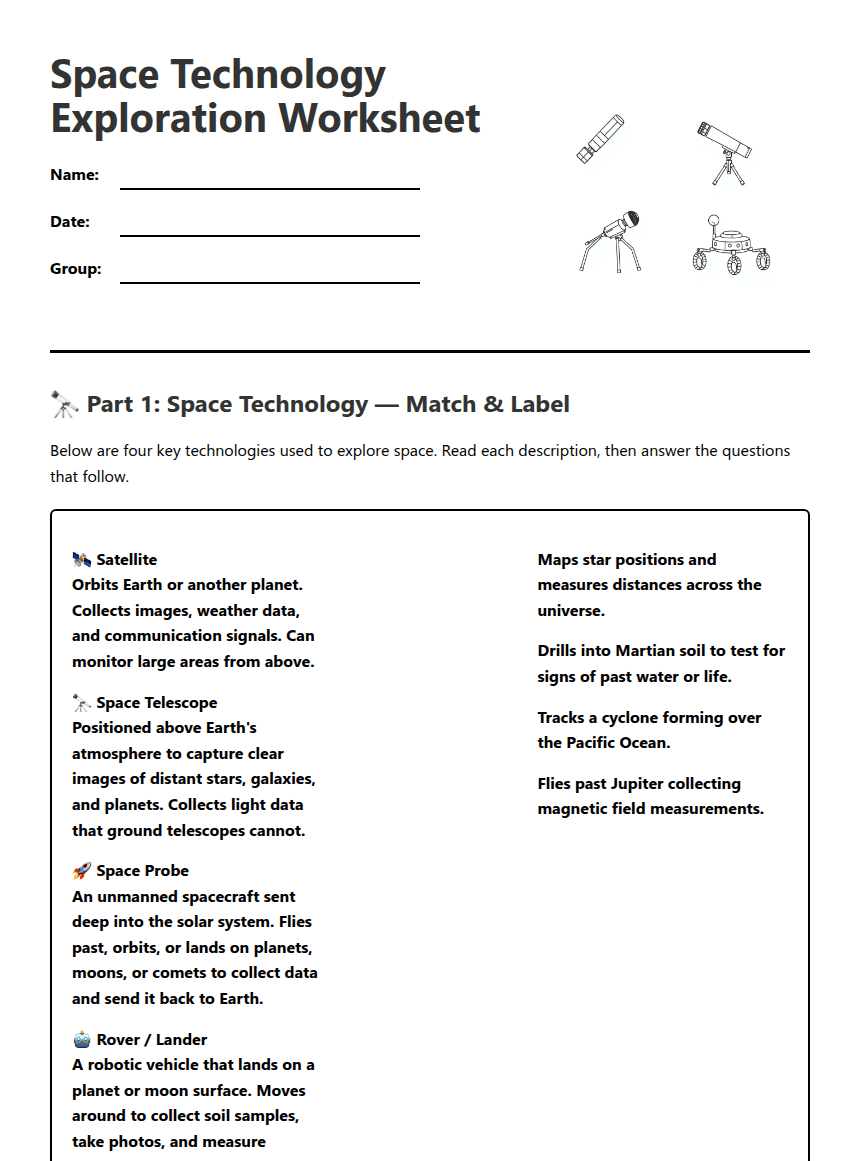
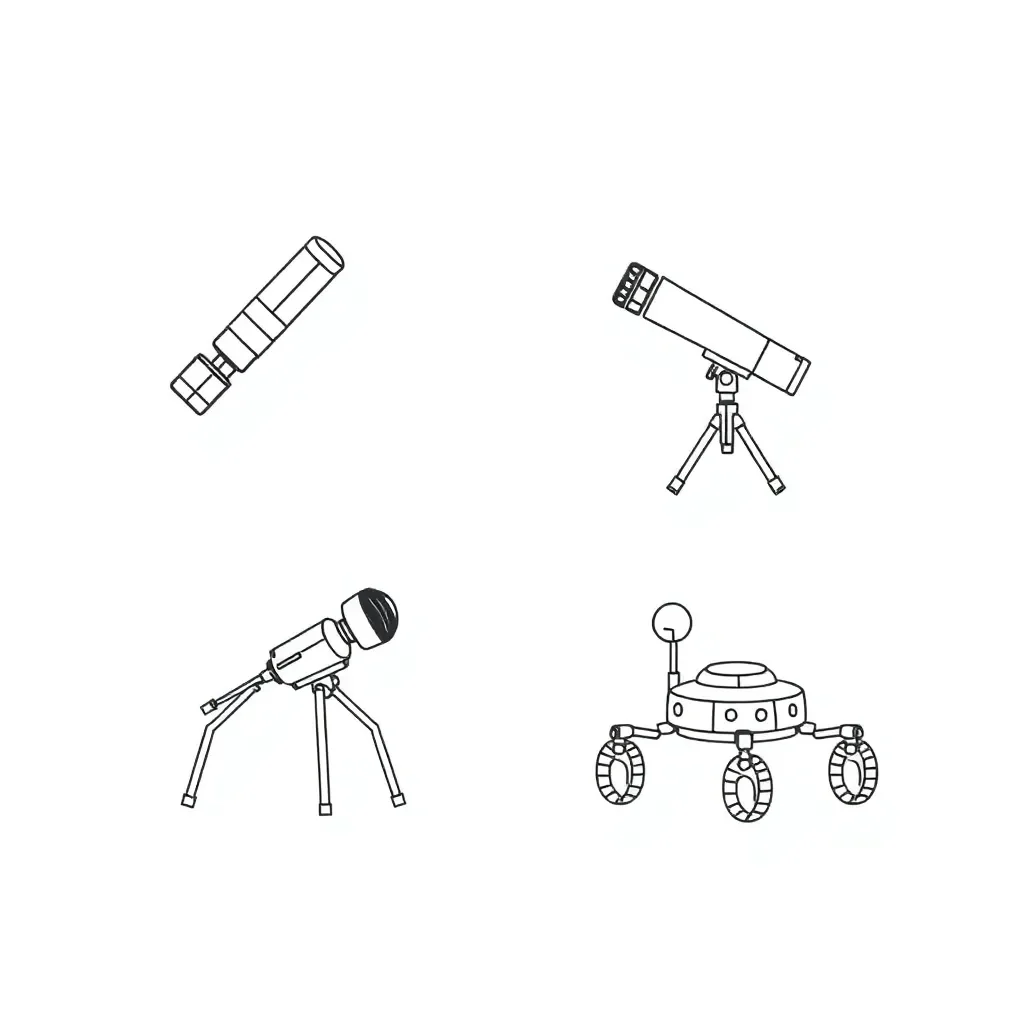
Below are four key technologies used to explore space. Read each description, then answer the questions that follow.
Orbits Earth or another planet. Collects images, weather data, and communication signals. Can monitor large areas from above.
Positioned above Earth's atmosphere to capture clear images of distant stars, galaxies, and planets. Collects light data that ground telescopes cannot.
An unmanned spacecraft sent deep into the solar system. Flies past, orbits, or lands on planets, moons, or comets to collect data and send it back to Earth.
A robotic vehicle that lands on a planet or moon surface. Moves around to collect soil samples, take photos, and measure temperature and atmosphere.
Draw a line to match each space technology (left) to the job it is best suited for (right).
✏️ Part 2: Short Answer — Evidence & Observations
Technology chosen: _______________________________
Scientists use a _______________________________ to explore _______________________________ because it can collect data such as _______________________________, which helps them understand _______________________________.
Our technology choice: _______________________________
Our prediction:
Our reason (linked to evidence):
🚀 Part 3: Exit Ticket — Quick Check
Answer these questions on your own before handing in your worksheet.
Technology: _______________________________
Data / observation it collects:
💡 Word Bank: satellite | telescope | probe | rover | observe | data | evidence | conclude | because | technology
About This Worksheet
Free in Kuraplan
Sign up free, grab the PDF, and customize it for your class.
Print-Ready
Formatted for standard paper. Clean layout, easy to read.
AI-Generated
Created with Kuraplan's AI, designed for real classroom use.
For Teachers & Parents
Use in classrooms, for homework, tutoring, or homeschool.
Need a custom version of this worksheet?
Kuraplan's AI generates custom worksheets in seconds — differentiated for every learner, aligned to your curriculum.
Generate Custom Worksheets — FreeMore Science Worksheets
Personal Geography Spaces
Free
Understanding Personal Spaces
Free
Earth & Space Science Quiz
Free
Year 9 Earth & Space Practice
Free
Earth and Space Concepts
Free
Space Counting Mission
Free
Sustainable Technology Research Guide
Free