Stratigraphy and Archaeology Passages
A free social sciences worksheet ready for your classroom. Open in Kuraplan to grab the print-ready PDF, customize it for your students, or generate a fresh version in seconds.
Stratigraphy and Archaeology Passages
📚 Level A: Foundation Reading
Focus: This passage explains how archaeologists use layers in the ground to learn about the past.
How Earth Layers Tell Stories
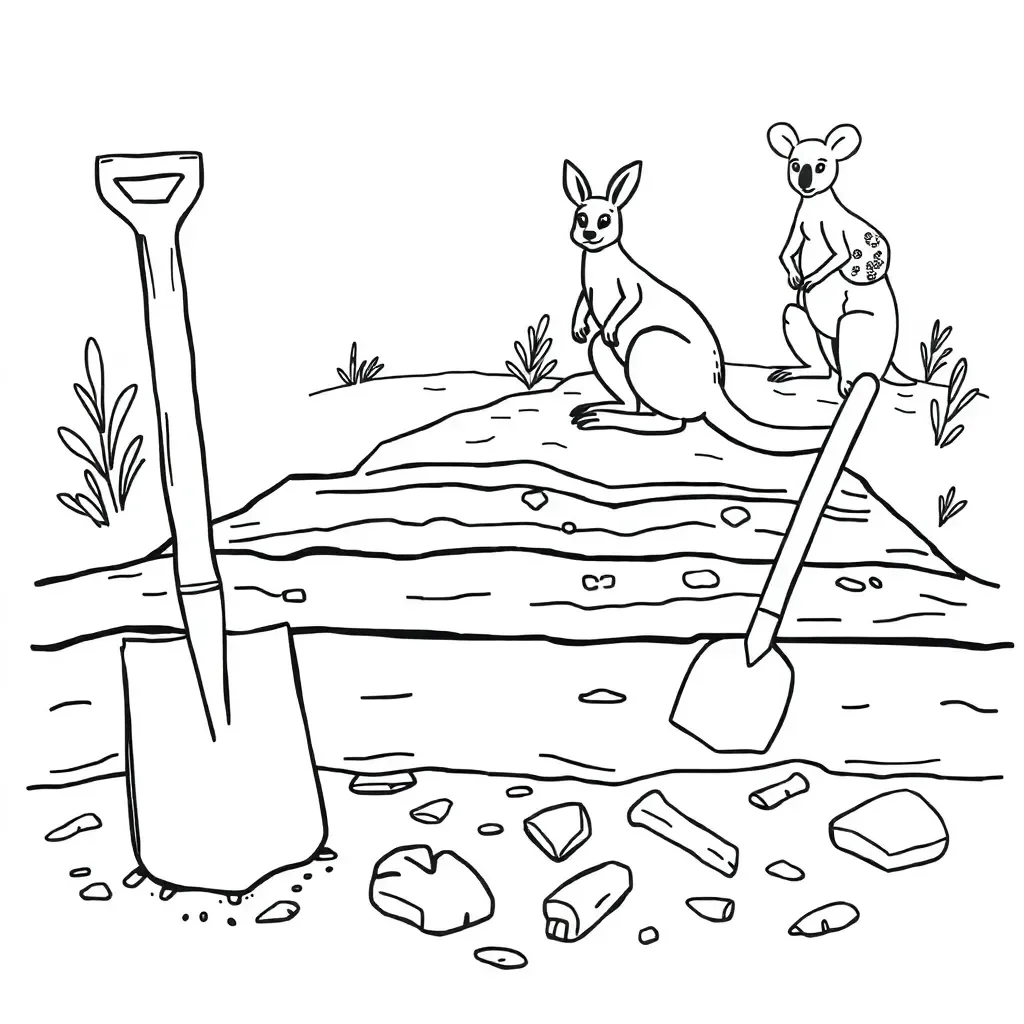
Archaeologists are like detectives. They dig into the ground to find clues about people from long ago. The earth has layers, like a sandwich. The bottom layers are the oldest. The top layers are the newest.
When archaeologists dig, they find different things in each layer. Old tools, broken pots, and bones help tell the story. The deeper they dig, the older the things they find. This is called stratigraphy.
Archaeologists use many sources to study the past:
• Pottery pieces
• Stone tools
• Animal bones
• Seeds and plants
• Old coins
Each layer shows a different time in history. This helps archaeologists understand how people lived long ago.
📖 Level B: Developing Reading
Focus: This passage explores how archaeologists use stratigraphic methods to understand ancient societies and their development over time.
Stratigraphy: Reading the Earth's History
Archaeologists use a scientific method called stratigraphy to investigate past civilisations. Stratigraphy is the study of rock and soil layers, which form over thousands of years. These layers act like pages in a history book, with each level representing a different period in time.
The principle is simple: older layers lie beneath newer ones. As archaeologists carefully excavate a site, they record which layer each artefact comes from. This helps them determine the age of different societies and how they changed over time.
Archaeological sources found in stratigraphic layers include:
• Ceramic pottery and decorative items
• Stone, bone, and metal tools
• Food remains and cooking areas
• Building foundations and structures
• Burial sites and human remains
• Environmental evidence like pollen and seeds
By analysing these sources within their stratigraphic context, archaeologists can reconstruct how ancient societies lived, what they ate, their technology, and how their culture developed over centuries.
📝 Level C: Extension Reading
Focus: This passage examines the sophisticated stratigraphic techniques archaeologists employ to reconstruct complex chronological sequences and interpret material culture.
Stratigraphic Analysis in Archaeological Investigation
Stratigraphy represents one of archaeology's most fundamental methodological approaches for establishing chronological sequences and understanding cultural change. This technique relies on the law of superposition, which states that in undisturbed deposits, older strata lie beneath more recent ones, creating a relative chronology of human occupation.
Archaeological stratigraphy involves meticulous documentation of contextual relationships between artefacts, features, and deposits. Each stratigraphic unit represents a discrete temporal episode, allowing researchers to trace technological innovations, cultural transformations, and environmental adaptations across millennia.
Material evidence recovered through stratigraphic excavation encompasses diverse categories:
• Lithic assemblages revealing technological traditions
• Ceramic typologies indicating cultural affiliations
• Faunal and botanical remains documenting subsistence strategies
• Architectural features demonstrating settlement patterns
• Mortuary practices reflecting social organisation
• Geochemical signatures indicating environmental conditions
Contemporary archaeological practice integrates stratigraphic data with absolute dating techniques, spatial analysis, and interdisciplinary collaboration to construct comprehensive interpretations of past societies' complexity, resilience, and transformation.
About This Worksheet
Free in Kuraplan
Sign up free, grab the PDF, and customize it for your class.
Print-Ready
Formatted for standard paper. Clean layout, easy to read.
AI-Generated
Created with Kuraplan's AI, designed for real classroom use.
For Teachers & Parents
Use in classrooms, for homework, tutoring, or homeschool.
Need a custom version of this worksheet?
Kuraplan's AI generates custom worksheets in seconds — differentiated for every learner, aligned to your curriculum.
Generate Custom Worksheets — FreeMore Social Sciences Worksheets
Gender Stereotypes Through Time
Free
Year 7 History Worksheet
Free
Chinese Miners and Colonisation
Free
Chinese Miners and Colonisation
Free
Bennelong and Early Colonisation
Free
Australian Federation Fun Facts
Free
Bushido Karate Adventure
Free