The Crucible Themes
A free english worksheet ready for your classroom. Open in Kuraplan to grab the print-ready PDF, customize it for your students, or generate a fresh version in seconds.
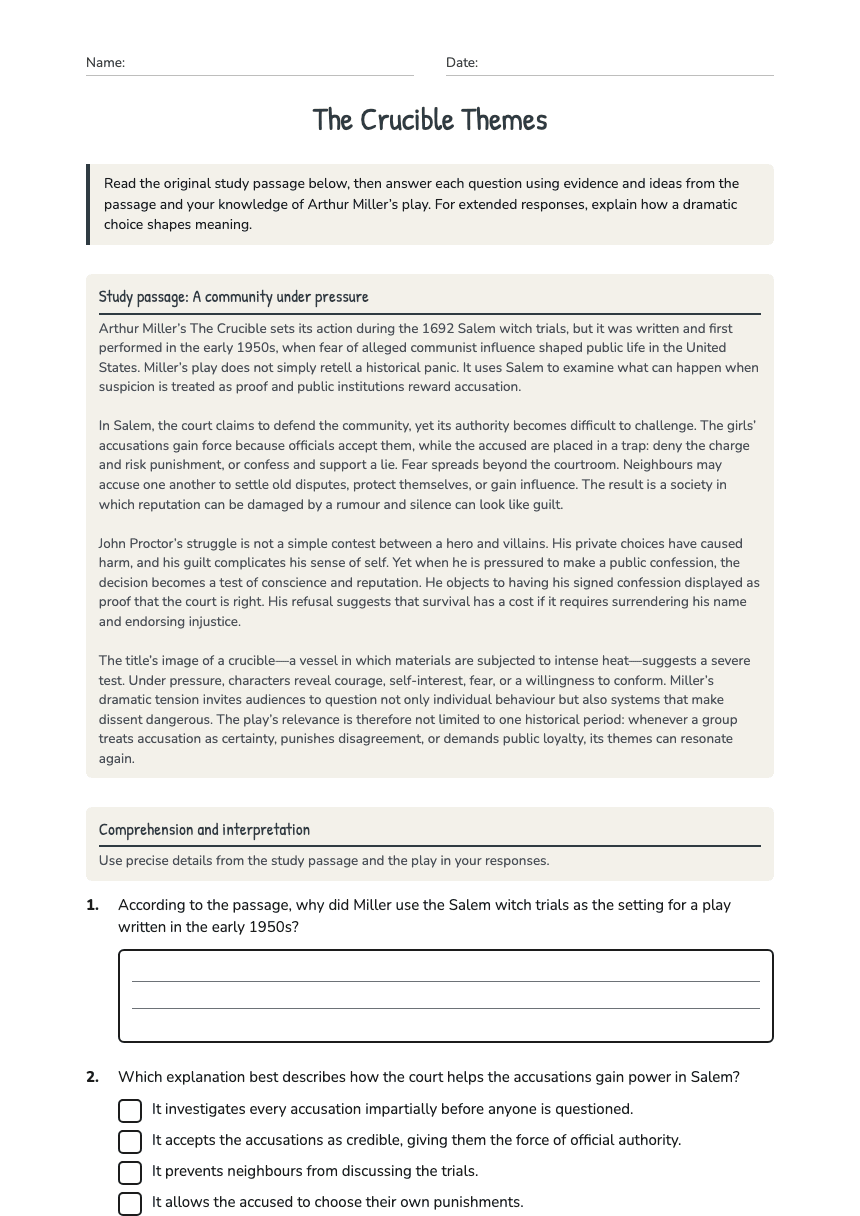
The Crucible Themes
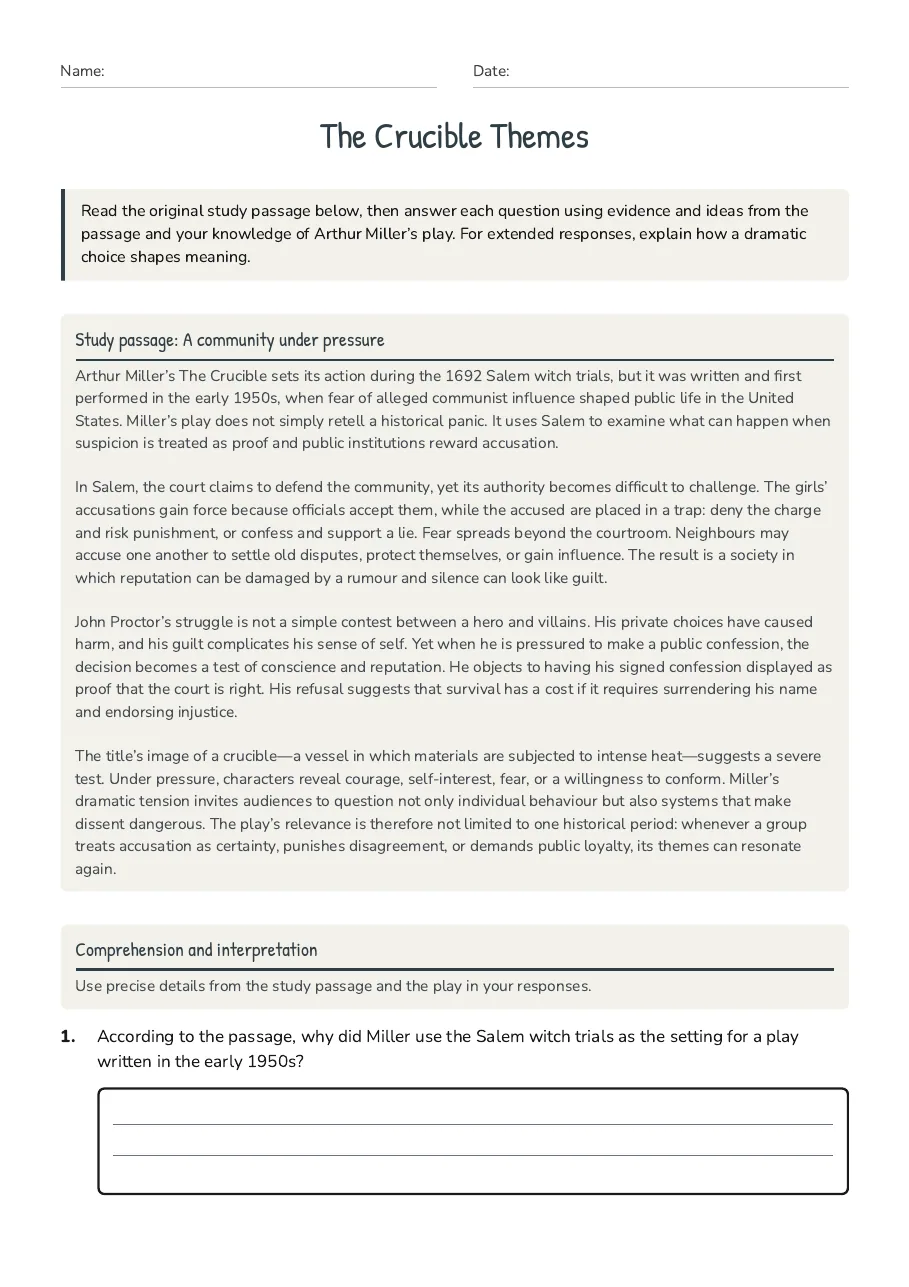
Study passage: A community under pressure
Arthur Miller’s The Crucible sets its action during the 1692 Salem witch trials, but it was written and first performed in the early 1950s, when fear of alleged communist influence shaped public life in the United States. Miller’s play does not simply retell a historical panic. It uses Salem to examine what can happen when suspicion is treated as proof and public institutions reward accusation. In Salem, the court claims to defend the community, yet its authority becomes difficult to challenge. The girls’ accusations gain force because officials accept them, while the accused are placed in a trap: deny the charge and risk punishment, or confess and support a lie. Fear spreads beyond the courtroom. Neighbours may accuse one another to settle old disputes, protect themselves, or gain influence. The result is a society in which reputation can be damaged by a rumour and silence can look like guilt. John Proctor’s struggle is not a simple contest between a hero and villains. His private choices have caused harm, and his guilt complicates his sense of self. Yet when he is pressured to make a public confession, the decision becomes a test of conscience and reputation. He objects to having his signed confession displayed as proof that the court is right. His refusal suggests that survival has a cost if it requires surrendering his name and endorsing injustice. The title’s image of a crucible—a vessel in which materials are subjected to intense heat—suggests a severe test. Under pressure, characters reveal courage, self-interest, fear, or a willingness to conform. Miller’s dramatic tension invites audiences to question not only individual behaviour but also systems that make dissent dangerous. The play’s relevance is therefore not limited to one historical period: whenever a group treats accusation as certainty, punishes disagreement, or demands public loyalty, its themes can resonate again.
Comprehension and interpretation
Use precise details from the study passage and the play in your responses.
- It investigates every accusation impartially before anyone is questioned.
- It accepts the accusations as credible, giving them the force of official authority.
- It prevents neighbours from discussing the trials.
- It allows the accused to choose their own punishments.
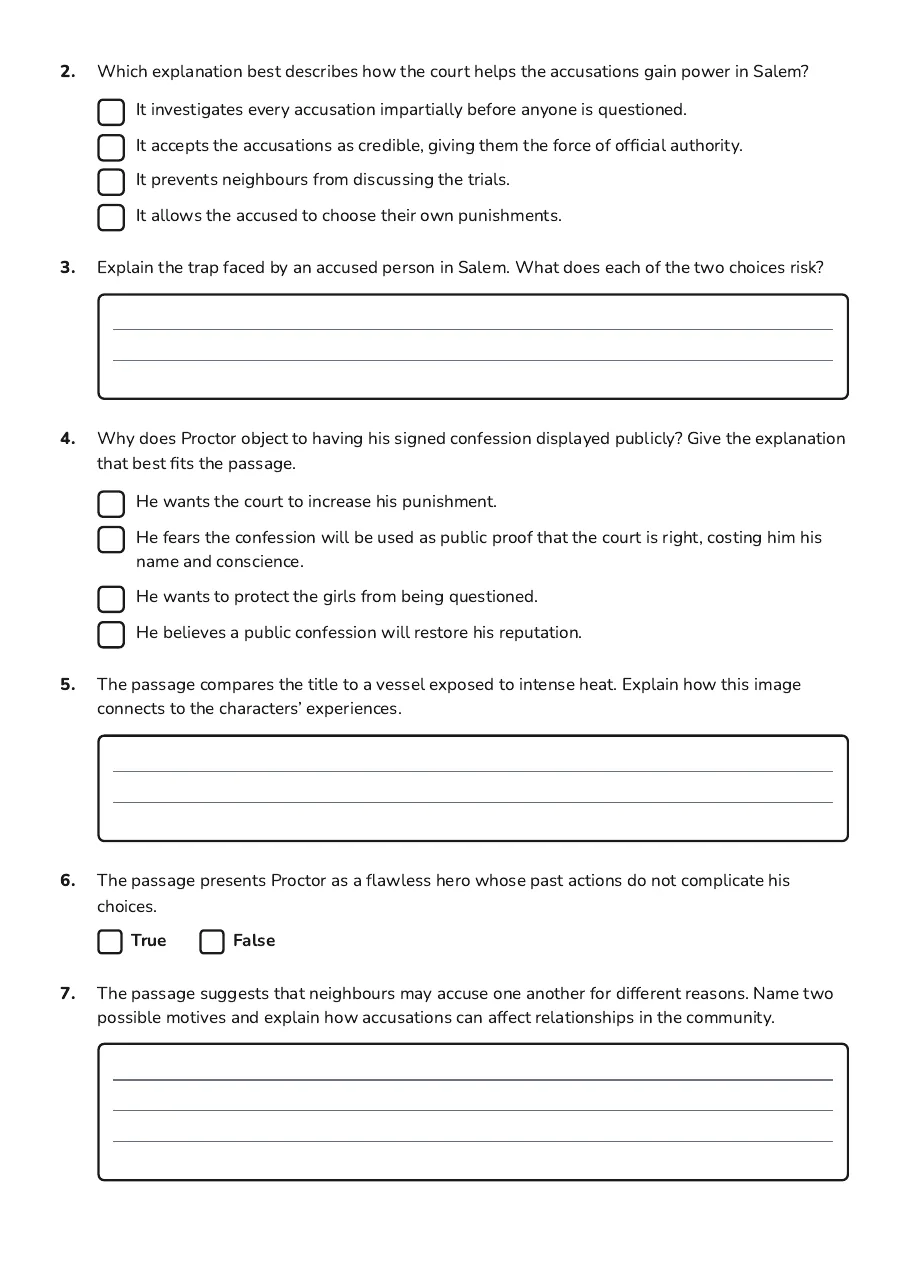
- He wants the court to increase his punishment.
- He fears the confession will be used as public proof that the court is right, costing him his name and conscience.
- He wants to protect the girls from being questioned.
- He believes a public confession will restore his reputation.
3 printable pages
Page 1
Page 2
Page 3
About This Worksheet
Free in Kuraplan
Sign up free, grab the PDF, and customize it for your class.
Print-Ready
Formatted for standard paper. Clean layout, easy to read.
AI-Generated
Created with Kuraplan's AI, designed for real classroom use.
For Teachers & Parents
Use in classrooms, for homework, tutoring, or homeschool.
Need a custom version of this worksheet?
Kuraplan's AI generates custom worksheets in seconds — differentiated for every learner, aligned to your curriculum.
Generate Custom Worksheets — Free