The Wave Character Reactions
A free english worksheet ready for your classroom. Open in Kuraplan to grab the print-ready PDF, customize it for your students, or generate a fresh version in seconds.
The Wave Character Reactions
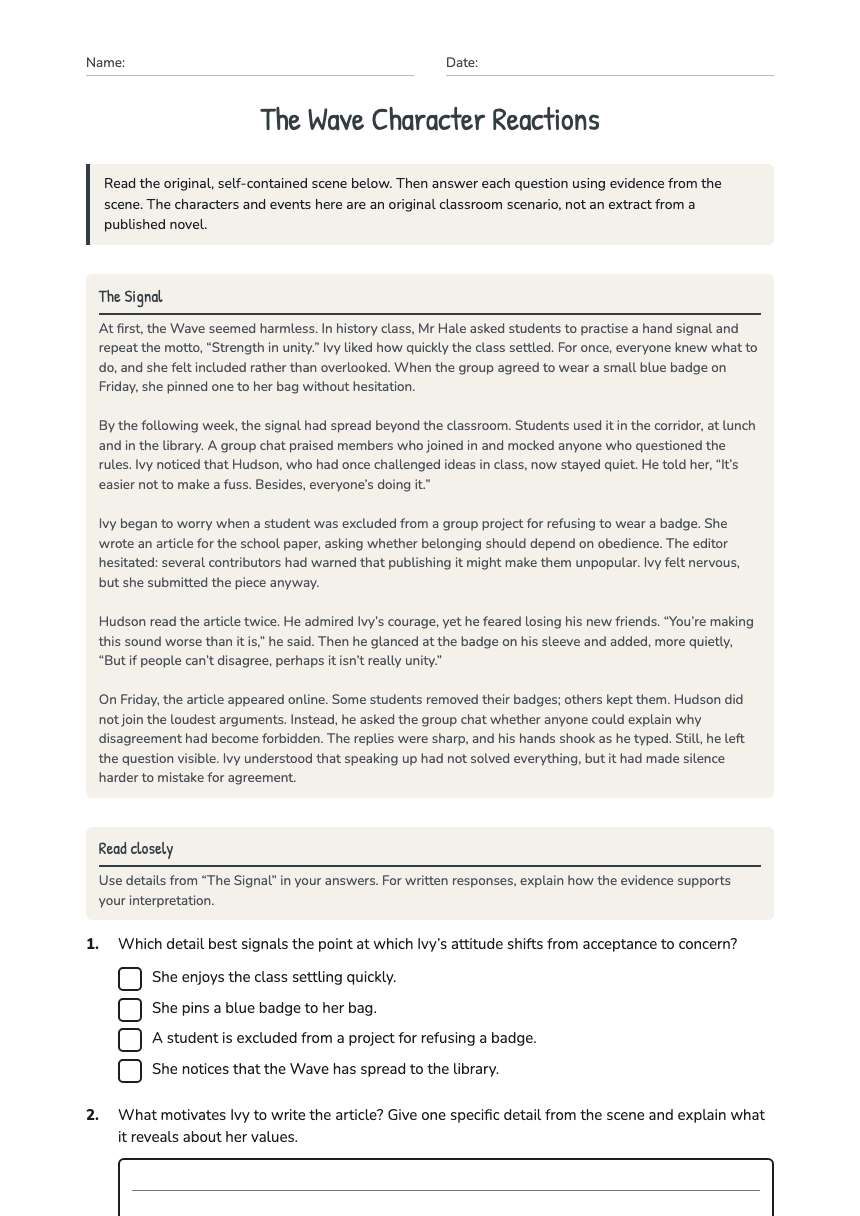
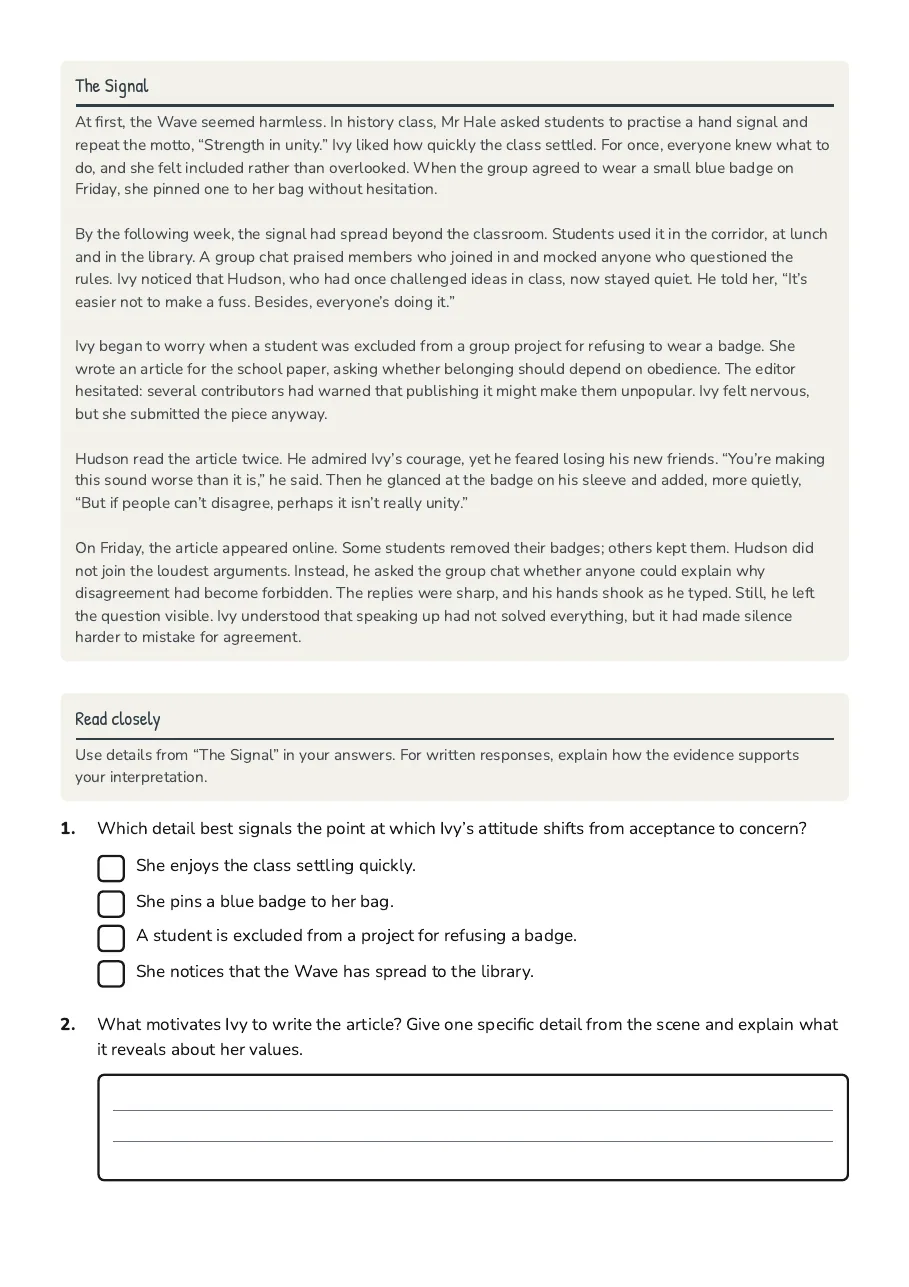
The Signal
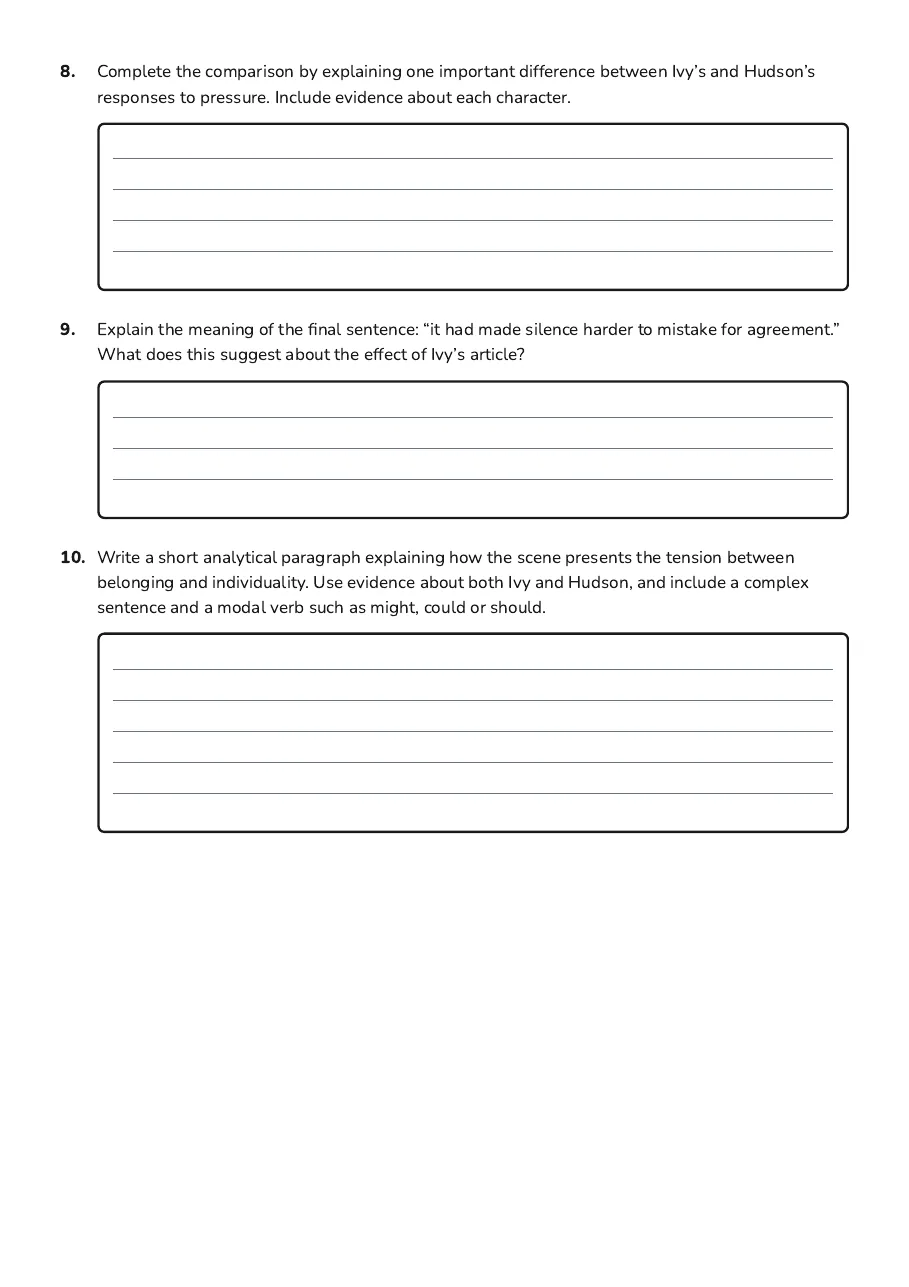
At first, the Wave seemed harmless. In history class, Mr Hale asked students to practise a hand signal and repeat the motto, “Strength in unity.” Ivy liked how quickly the class settled. For once, everyone knew what to do, and she felt included rather than overlooked. When the group agreed to wear a small blue badge on Friday, she pinned one to her bag without hesitation. By the following week, the signal had spread beyond the classroom. Students used it in the corridor, at lunch and in the library. A group chat praised members who joined in and mocked anyone who questioned the rules. Ivy noticed that Hudson, who had once challenged ideas in class, now stayed quiet. He told her, “It’s easier not to make a fuss. Besides, everyone’s doing it.” Ivy began to worry when a student was excluded from a group project for refusing to wear a badge. She wrote an article for the school paper, asking whether belonging should depend on obedience. The editor hesitated: several contributors had warned that publishing it might make them unpopular. Ivy felt nervous, but she submitted the piece anyway. Hudson read the article twice. He admired Ivy’s courage, yet he feared losing his new friends. “You’re making this sound worse than it is,” he said. Then he glanced at the badge on his sleeve and added, more quietly, “But if people can’t disagree, perhaps it isn’t really unity.” On Friday, the article appeared online. Some students removed their badges; others kept them. Hudson did not join the loudest arguments. Instead, he asked the group chat whether anyone could explain why disagreement had become forbidden. The replies were sharp, and his hands shook as he typed. Still, he left the question visible. Ivy understood that speaking up had not solved everything, but it had made silence harder to mistake for agreement.
Read closely
Use details from “The Signal” in your answers. For written responses, explain how the evidence supports your interpretation.
- She enjoys the class settling quickly.
- She pins a blue badge to her bag.
- A student is excluded from a project for refusing a badge.
- She notices that the Wave has spread to the library.
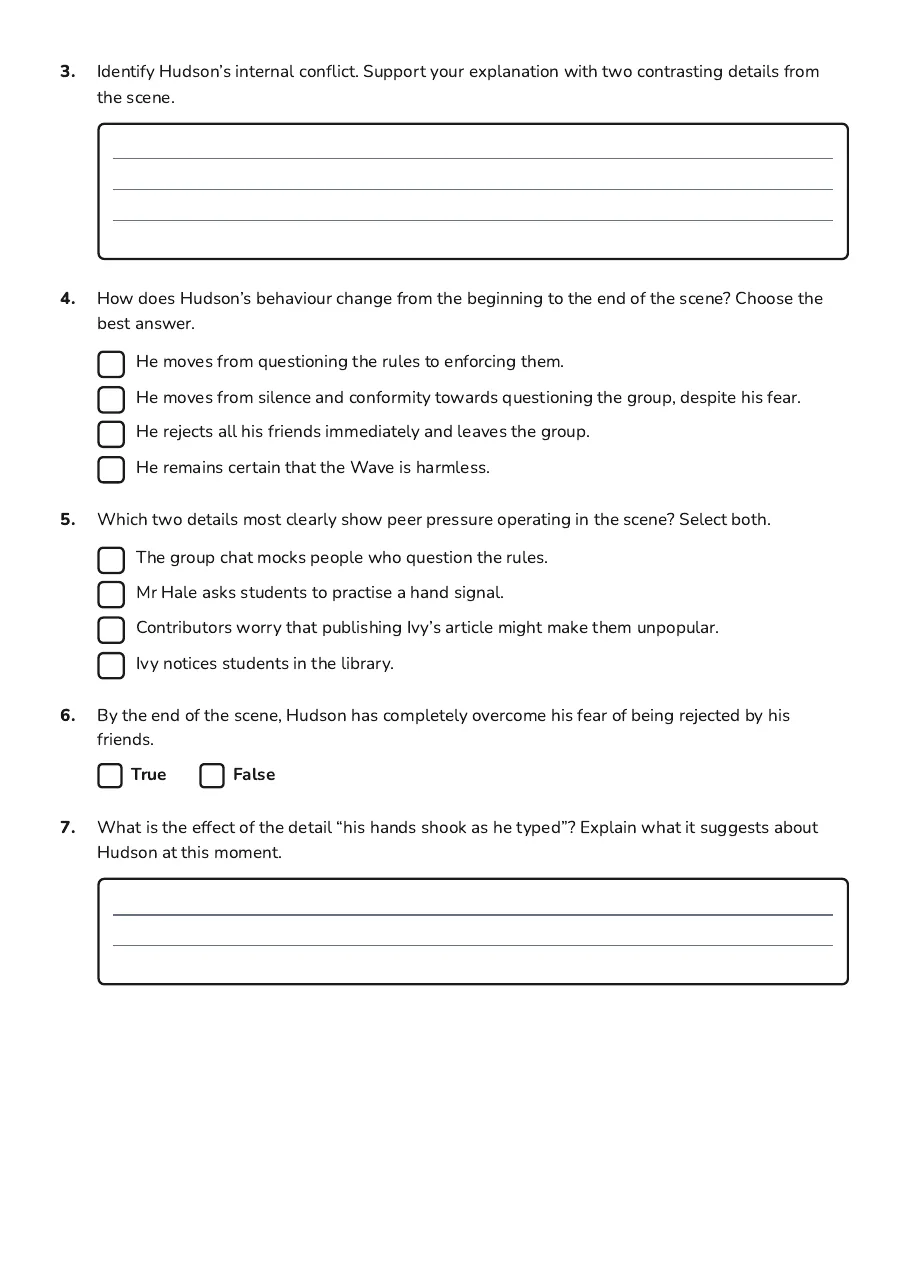
- He moves from questioning the rules to enforcing them.
- He moves from silence and conformity towards questioning the group, despite his fear.
- He rejects all his friends immediately and leaves the group.
- He remains certain that the Wave is harmless.
- The group chat mocks people who question the rules.
- Mr Hale asks students to practise a hand signal.
- Contributors worry that publishing Ivy’s article might make them unpopular.
- Ivy notices students in the library.
4 printable pages
Page 1
Page 2
Page 3
Page 4
About This Worksheet
Free in Kuraplan
Sign up free, grab the PDF, and customize it for your class.
Print-Ready
Formatted for standard paper. Clean layout, easy to read.
AI-Generated
Created with Kuraplan's AI, designed for real classroom use.
For Teachers & Parents
Use in classrooms, for homework, tutoring, or homeschool.
Need a custom version of this worksheet?
Kuraplan's AI generates custom worksheets in seconds — differentiated for every learner, aligned to your curriculum.
Generate Custom Worksheets — Free