The Wave LitChart Analysis
A free english worksheet ready for your classroom. Open in Kuraplan to grab the print-ready PDF, customize it for your students, or generate a fresh version in seconds.
The Wave LitChart Analysis
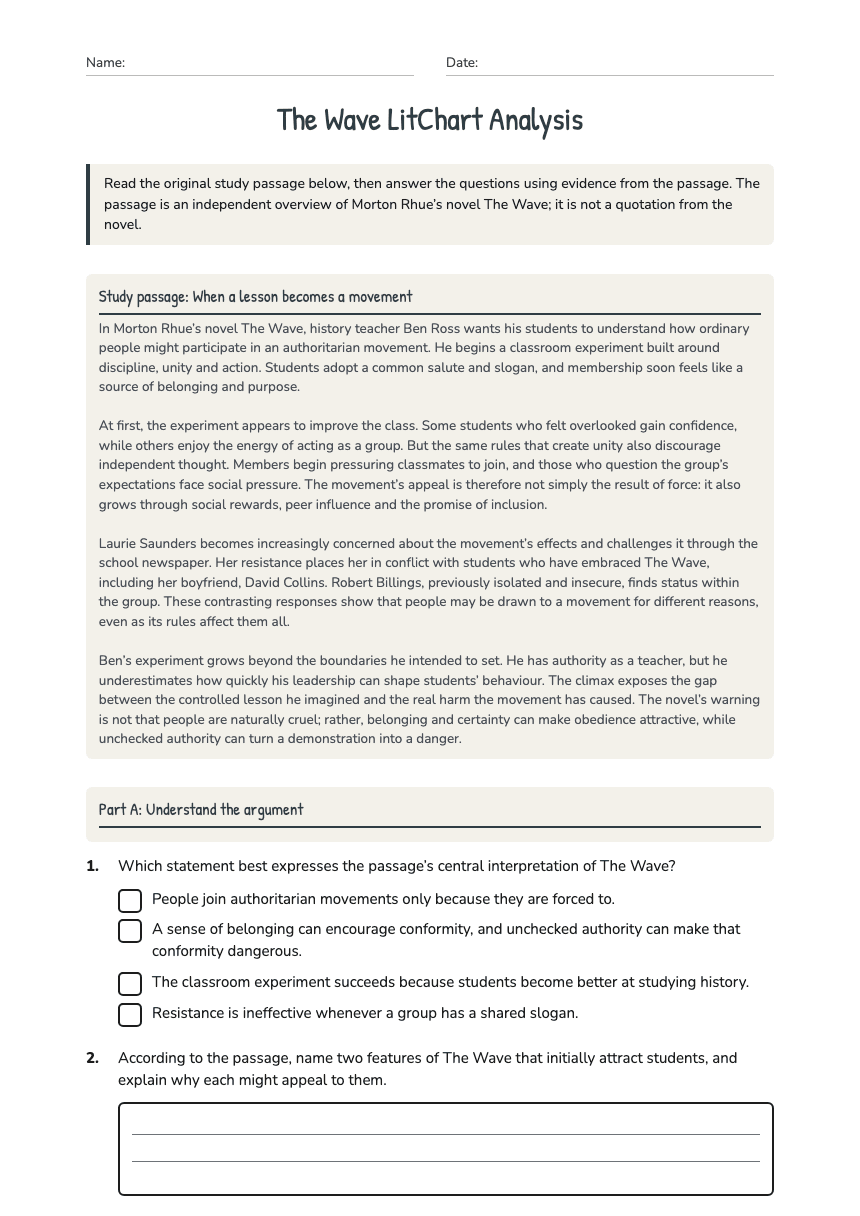
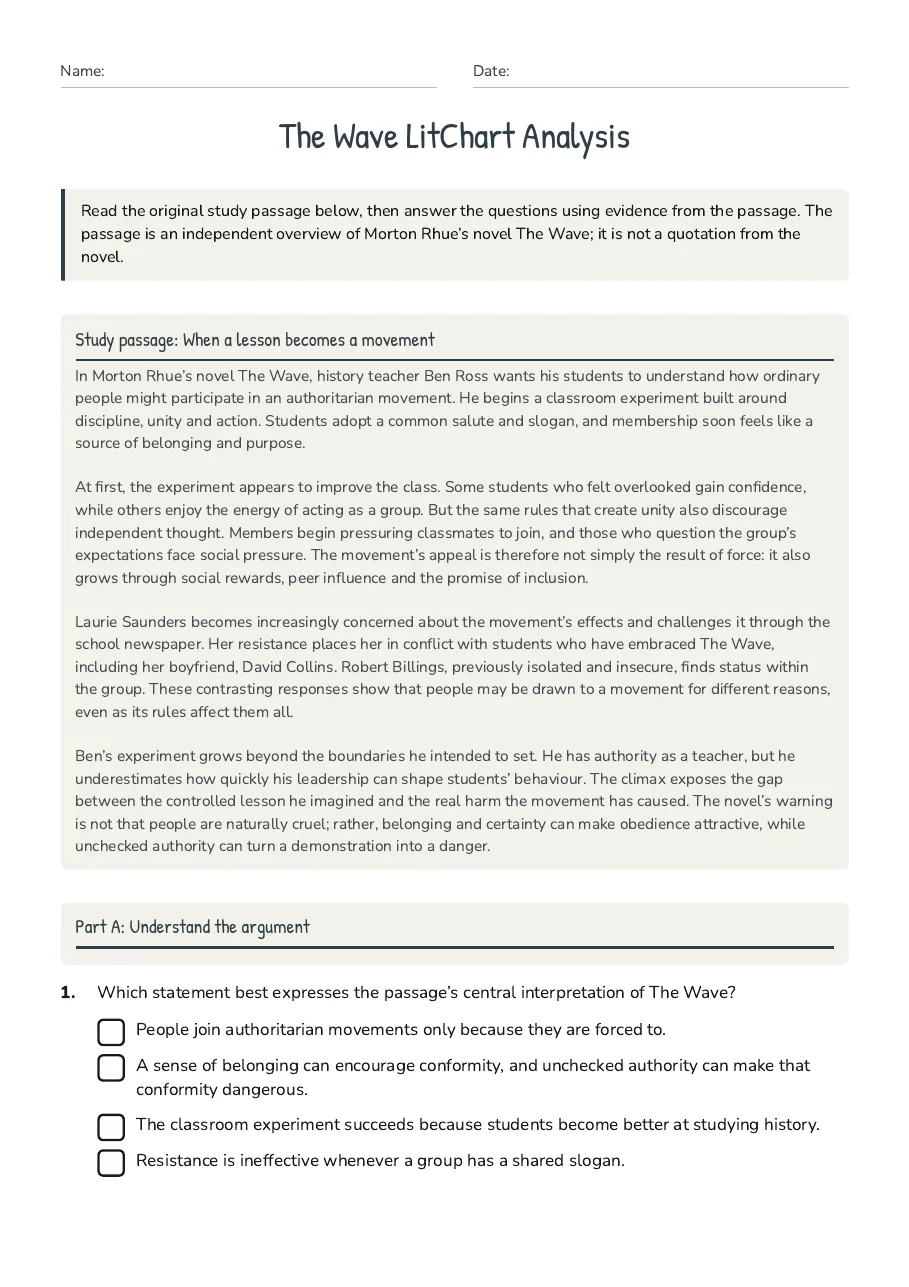
Study passage: When a lesson becomes a movement
In Morton Rhue’s novel The Wave, history teacher Ben Ross wants his students to understand how ordinary people might participate in an authoritarian movement. He begins a classroom experiment built around discipline, unity and action. Students adopt a common salute and slogan, and membership soon feels like a source of belonging and purpose. At first, the experiment appears to improve the class. Some students who felt overlooked gain confidence, while others enjoy the energy of acting as a group. But the same rules that create unity also discourage independent thought. Members begin pressuring classmates to join, and those who question the group’s expectations face social pressure. The movement’s appeal is therefore not simply the result of force: it also grows through social rewards, peer influence and the promise of inclusion. Laurie Saunders becomes increasingly concerned about the movement’s effects and challenges it through the school newspaper. Her resistance places her in conflict with students who have embraced The Wave, including her boyfriend, David Collins. Robert Billings, previously isolated and insecure, finds status within the group. These contrasting responses show that people may be drawn to a movement for different reasons, even as its rules affect them all. Ben’s experiment grows beyond the boundaries he intended to set. He has authority as a teacher, but he underestimates how quickly his leadership can shape students’ behaviour. The climax exposes the gap between the controlled lesson he imagined and the real harm the movement has caused. The novel’s warning is not that people are naturally cruel; rather, belonging and certainty can make obedience attractive, while unchecked authority can turn a demonstration into a danger.
Part A: Understand the argument
- People join authoritarian movements only because they are forced to.
- A sense of belonging can encourage conformity, and unchecked authority can make that conformity dangerous.
- The classroom experiment succeeds because students become better at studying history.
- Resistance is ineffective whenever a group has a shared slogan.
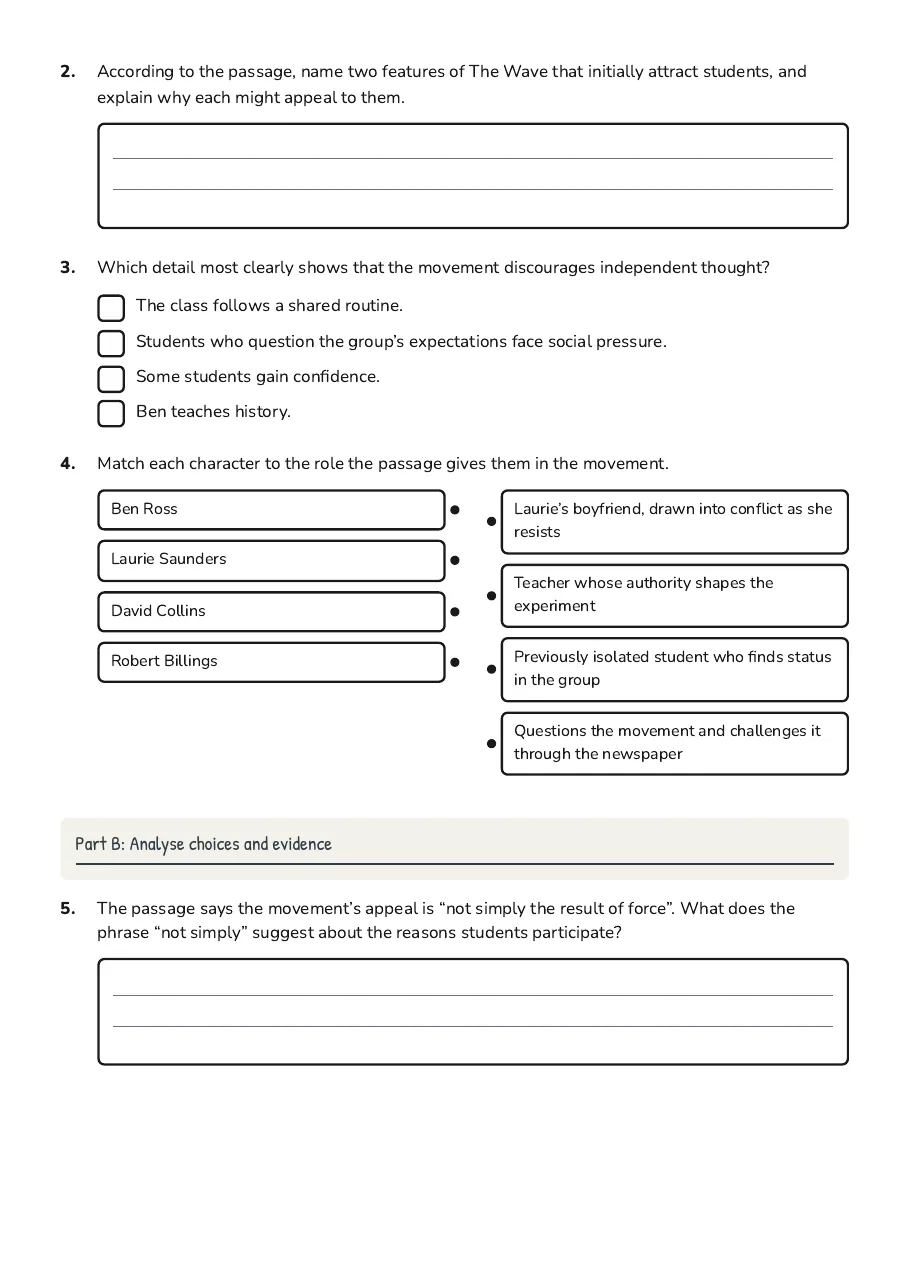
- The class follows a shared routine.
- Students who question the group’s expectations face social pressure.
- Some students gain confidence.
- Ben teaches history.
- Ben Ross
- Laurie Saunders
- David Collins
- Robert Billings
- Laurie’s boyfriend, drawn into conflict as she resists
- Teacher whose authority shapes the experiment
- Previously isolated student who finds status in the group
- Questions the movement and challenges it through the newspaper
Part B: Analyse choices and evidence
3 printable pages
Page 1
Page 2
Page 3
About This Worksheet
Free in Kuraplan
Sign up free, grab the PDF, and customize it for your class.
Print-Ready
Formatted for standard paper. Clean layout, easy to read.
AI-Generated
Created with Kuraplan's AI, designed for real classroom use.
For Teachers & Parents
Use in classrooms, for homework, tutoring, or homeschool.
Need a custom version of this worksheet?
Kuraplan's AI generates custom worksheets in seconds — differentiated for every learner, aligned to your curriculum.
Generate Custom Worksheets — Free