ScienceFreePrintable

Understanding Chemical Equilibrium

A free science worksheet ready for your classroom. Open in Kuraplan to grab the print-ready PDF, customize it for your students, or generate a fresh version in seconds.
Understanding Chemical Equilibrium worksheet preview
Name:Date:

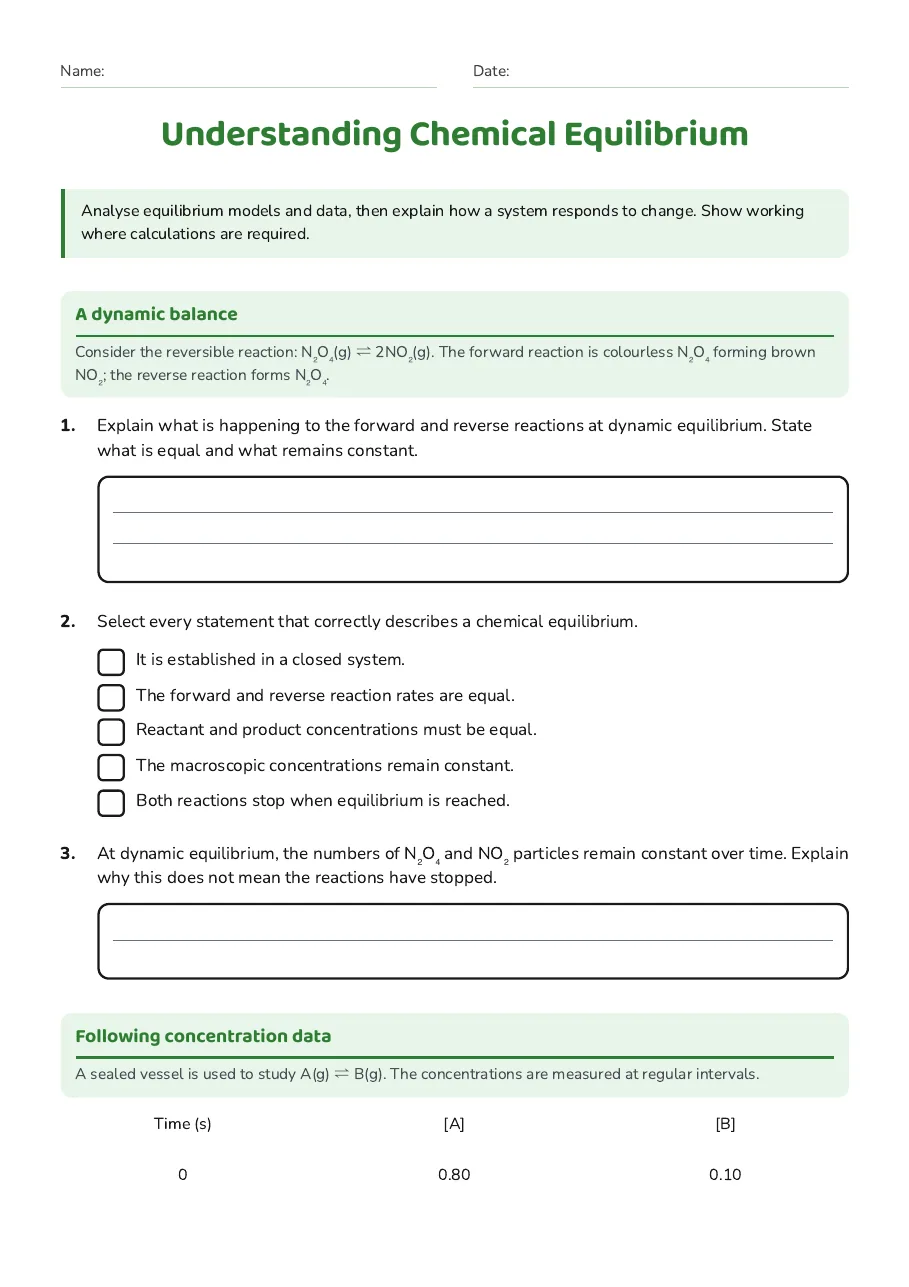
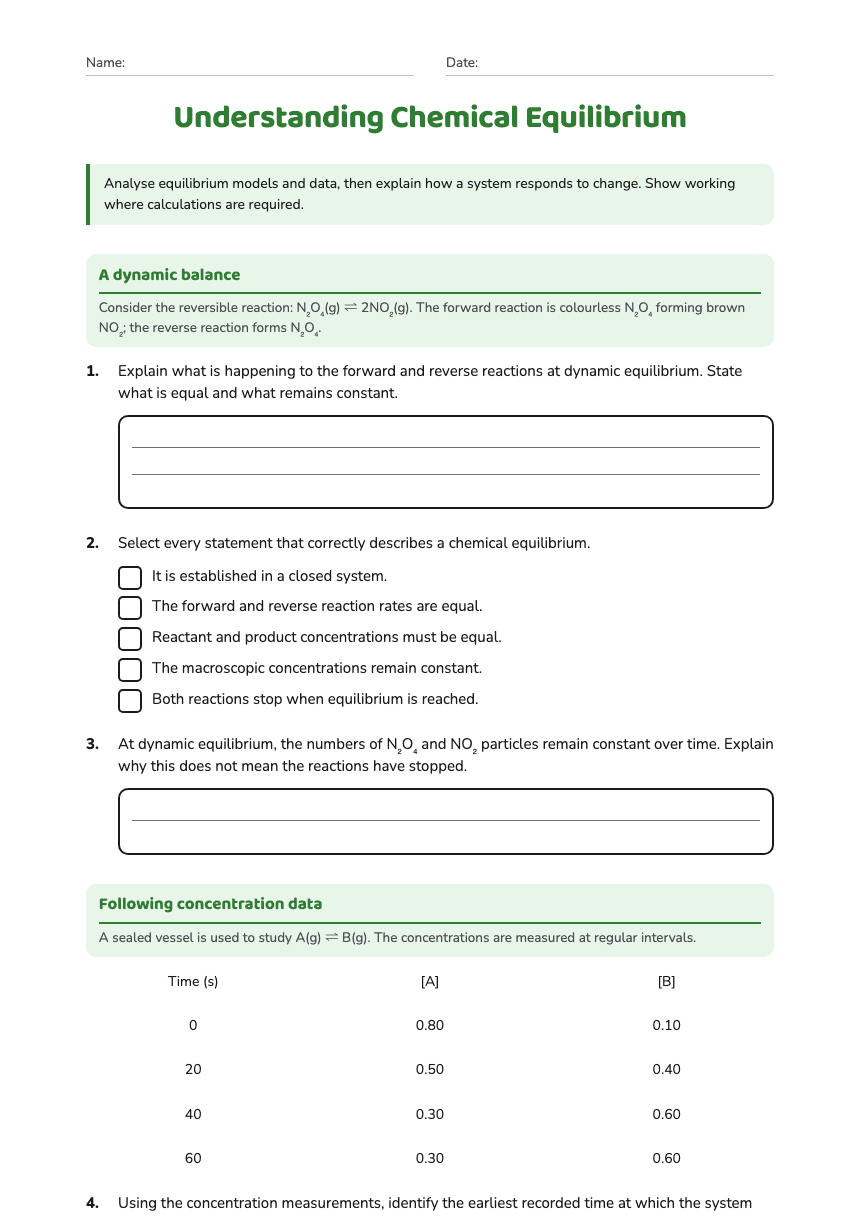
Understanding Chemical Equilibrium

Analyse equilibrium models and data, then explain how a system responds to change. Show working where calculations are required.

A dynamic balance

Consider the reversible reaction: N₂O₄(g) ⇌ 2NO₂(g). The forward reaction is colourless N₂O₄ forming brown NO₂; the reverse reaction forms N₂O₄.

1.Explain what is happening to the forward and reverse reactions at dynamic equilibrium. State what is equal and what remains constant.
2.Select every statement that correctly describes a chemical equilibrium.
  • It is established in a closed system.
  • The forward and reverse reaction rates are equal.
  • Reactant and product concentrations must be equal.
  • The macroscopic concentrations remain constant.
  • Both reactions stop when equilibrium is reached.
3.At dynamic equilibrium, the numbers of N₂O₄ and NO₂ particles remain constant over time. Explain why this does not mean the reactions have stopped.

Following concentration data

A sealed vessel is used to study A(g) ⇌ B(g). The concentrations are measured at regular intervals.

Time (s)

[A]

[B]

0

0.80

0.10

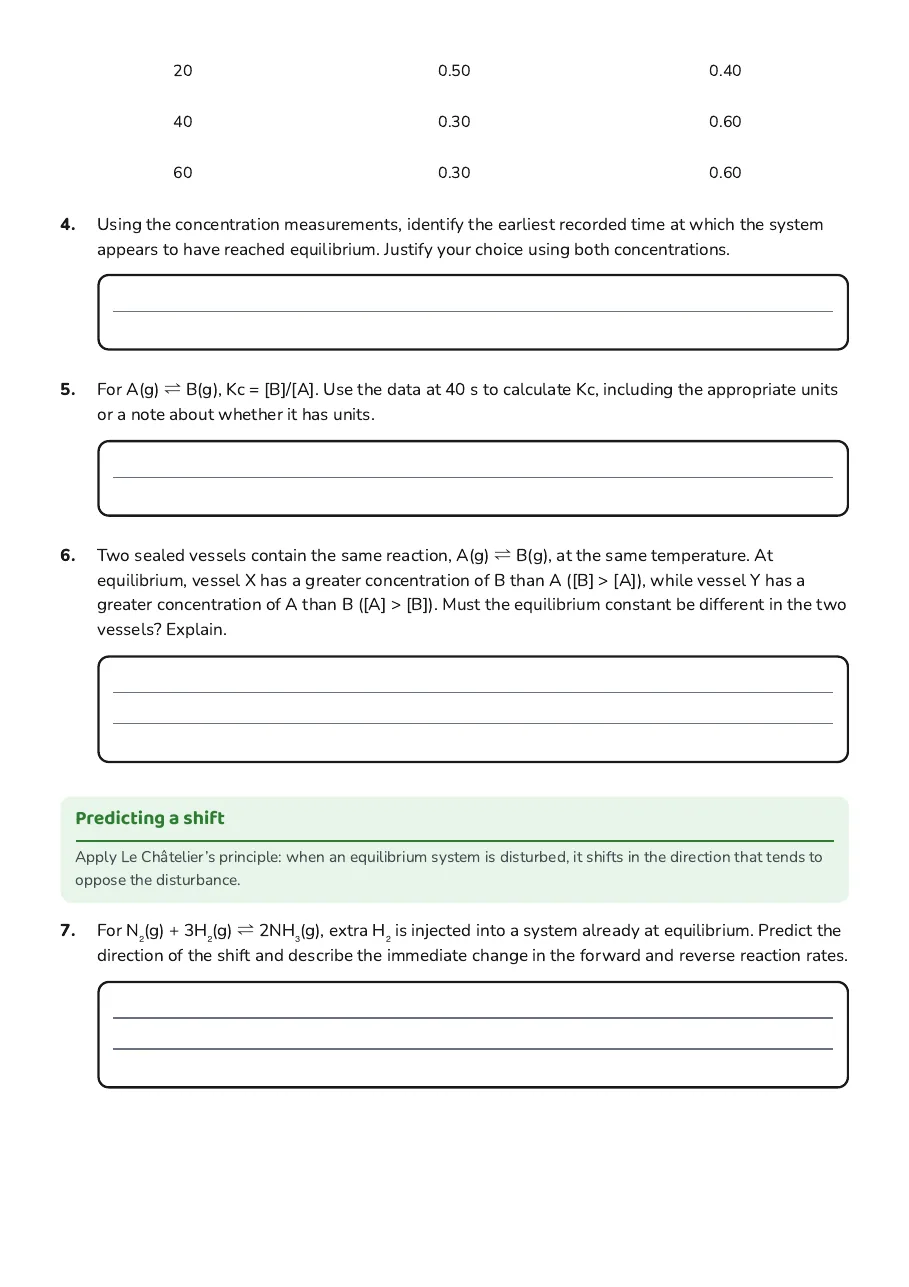
20

0.50

0.40

40

0.30

0.60

60

0.30

0.60

4.Using the concentration measurements, identify the earliest recorded time at which the system appears to have reached equilibrium. Justify your choice using both concentrations.
5.For A(g) ⇌ B(g), Kc = [B]/[A]. Use the data at 40 s to calculate Kc, including the appropriate units or a note about whether it has units.
6.Two sealed vessels contain the same reaction, A(g) ⇌ B(g), at the same temperature. At equilibrium, vessel X has a greater concentration of B than A ([B] > [A]), while vessel Y has a greater concentration of A than B ([A] > [B]). Must the equilibrium constant be different in the two vessels? Explain.

Predicting a shift

Apply Le Châtelier’s principle: when an equilibrium system is disturbed, it shifts in the direction that tends to oppose the disturbance.

7.For N₂(g) + 3H₂(g) ⇌ 2NH₃(g), extra H₂ is injected into a system already at equilibrium. Predict the direction of the shift and describe the immediate change in the forward and reverse reaction rates.
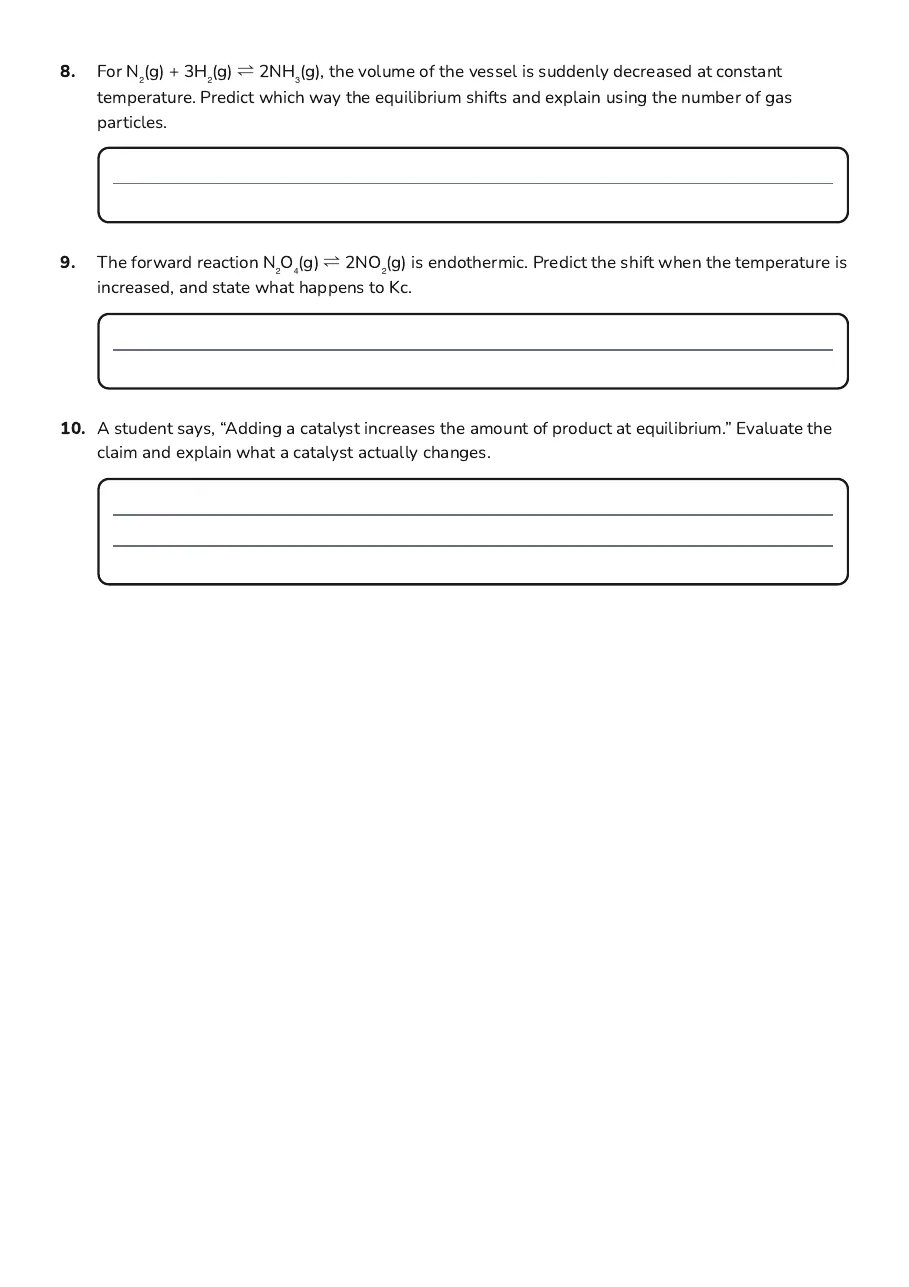
8.For N₂(g) + 3H₂(g) ⇌ 2NH₃(g), the volume of the vessel is suddenly decreased at constant temperature. Predict which way the equilibrium shifts and explain using the number of gas particles.
9.The forward reaction N₂O₄(g) ⇌ 2NO₂(g) is endothermic. Predict the shift when the temperature is increased, and state what happens to Kc.
10.A student says, “Adding a catalyst increases the amount of product at equilibrium.” Evaluate the claim and explain what a catalyst actually changes.

3 printable pages

  • Particle model of dynamic equilibrium and questions on equilibrium characteristics.

    Page 1

  • Concentration data for a reversible reaction with questions on equilibrium and Kc.

    Page 2

  • Le Châtelier’s principle questions about concentration, pressure, temperature and catalysts.

    Page 3

About This Worksheet

Free in Kuraplan

Sign up free, grab the PDF, and customize it for your class.

Print-Ready

Formatted for standard paper. Clean layout, easy to read.

AI-Generated

Created with Kuraplan's AI, designed for real classroom use.

For Teachers & Parents

Use in classrooms, for homework, tutoring, or homeschool.

Need a custom version of this worksheet?

Kuraplan's AI generates custom worksheets in seconds — differentiated for every learner, aligned to your curriculum.

Generate Custom Worksheets — Free
No credit card Curriculum-aligned Under 60 seconds