Wave Persuasive Language Analysis
A free english worksheet ready for your classroom. Open in Kuraplan to grab the print-ready PDF, customize it for your students, or generate a fresh version in seconds.

Wave Persuasive Language Analysis
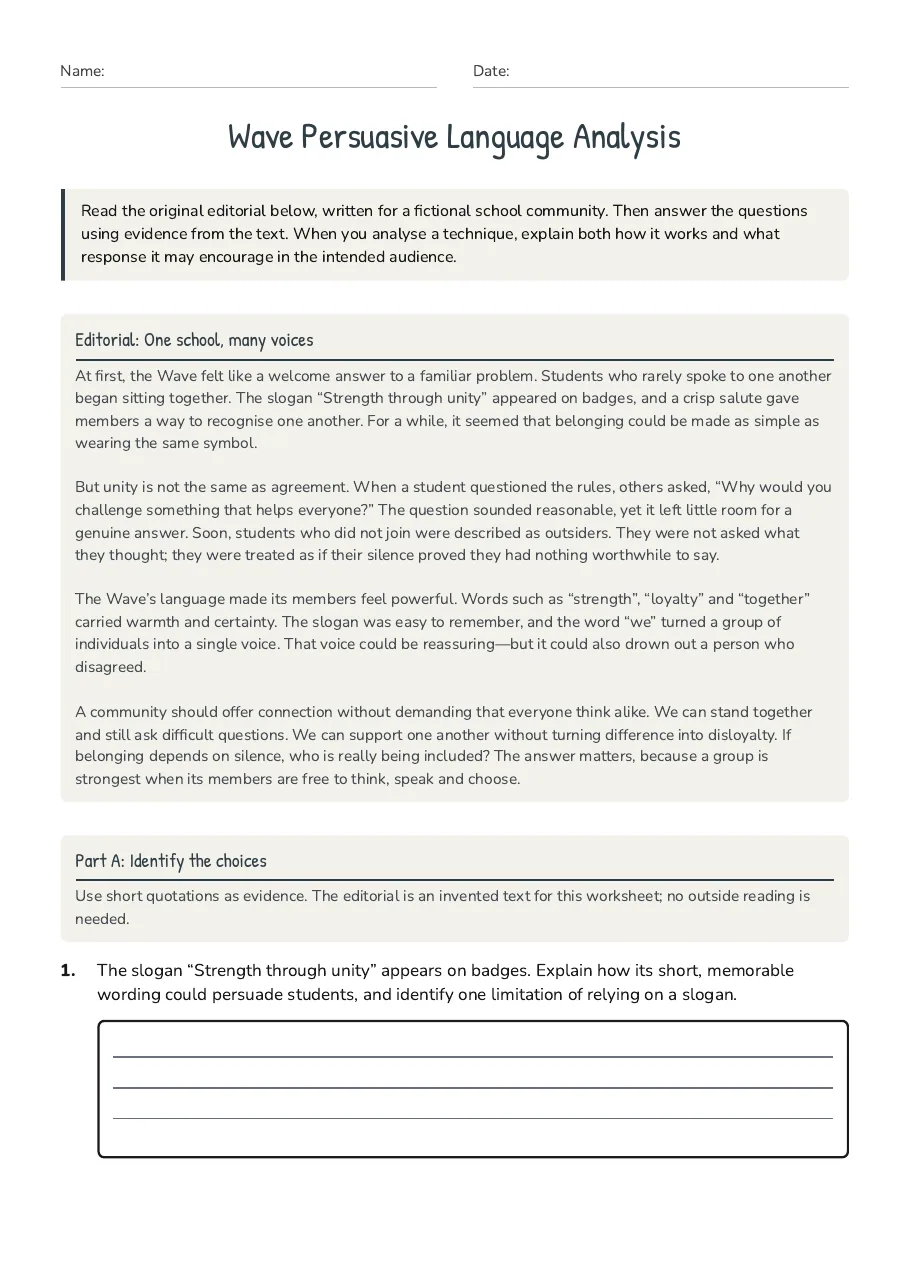
Editorial: One school, many voices
At first, the Wave felt like a welcome answer to a familiar problem. Students who rarely spoke to one another began sitting together. The slogan “Strength through unity” appeared on badges, and a crisp salute gave members a way to recognise one another. For a while, it seemed that belonging could be made as simple as wearing the same symbol. But unity is not the same as agreement. When a student questioned the rules, others asked, “Why would you challenge something that helps everyone?” The question sounded reasonable, yet it left little room for a genuine answer. Soon, students who did not join were described as outsiders. They were not asked what they thought; they were treated as if their silence proved they had nothing worthwhile to say. The Wave’s language made its members feel powerful. Words such as “strength”, “loyalty” and “together” carried warmth and certainty. The slogan was easy to remember, and the word “we” turned a group of individuals into a single voice. That voice could be reassuring—but it could also drown out a person who disagreed. A community should offer connection without demanding that everyone think alike. We can stand together and still ask difficult questions. We can support one another without turning difference into disloyalty. If belonging depends on silence, who is really being included? The answer matters, because a group is strongest when its members are free to think, speak and choose.
Part A: Identify the choices
Use short quotations as evidence. The editorial is an invented text for this worksheet; no outside reading is needed.
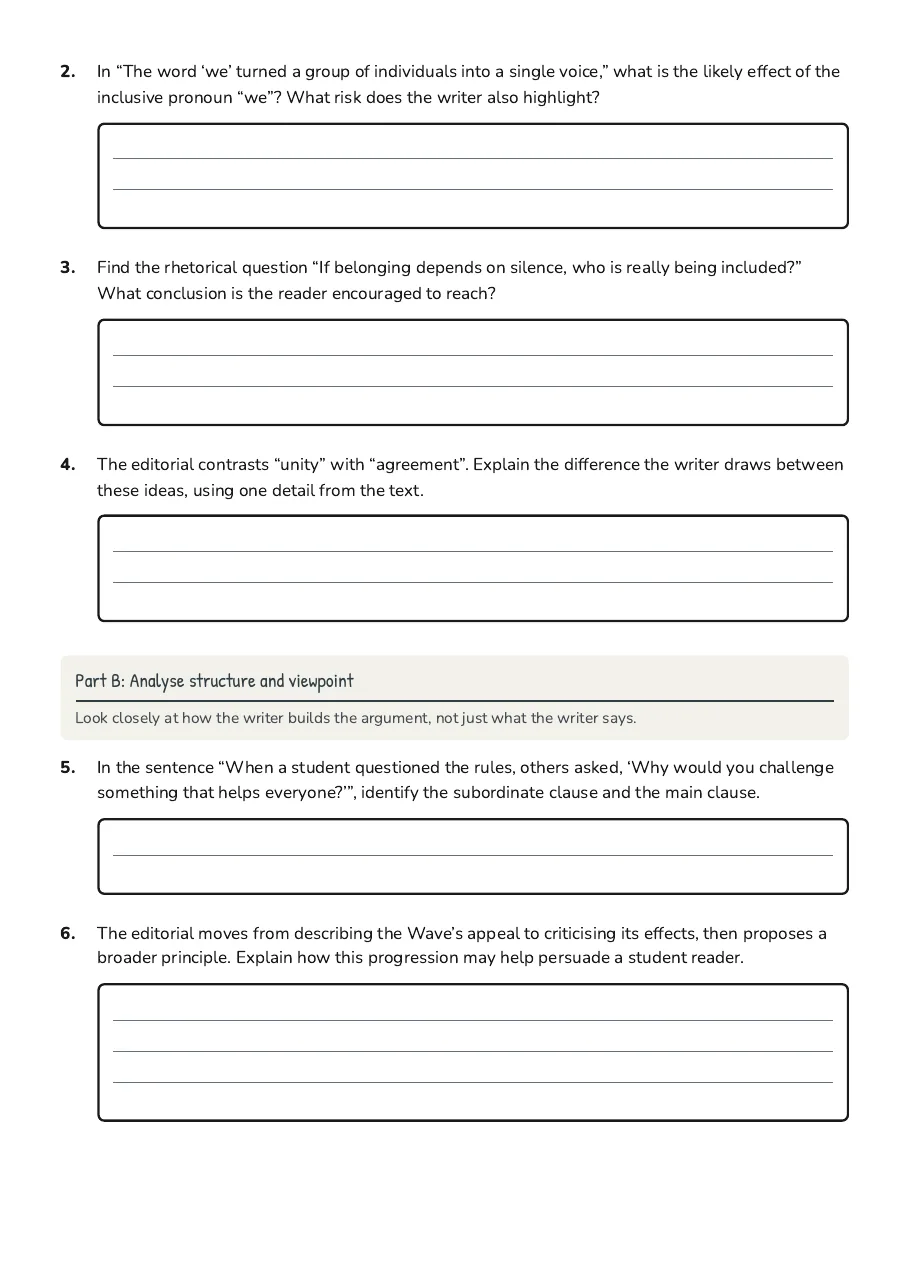
Part B: Analyse structure and viewpoint
Look closely at how the writer builds the argument, not just what the writer says.
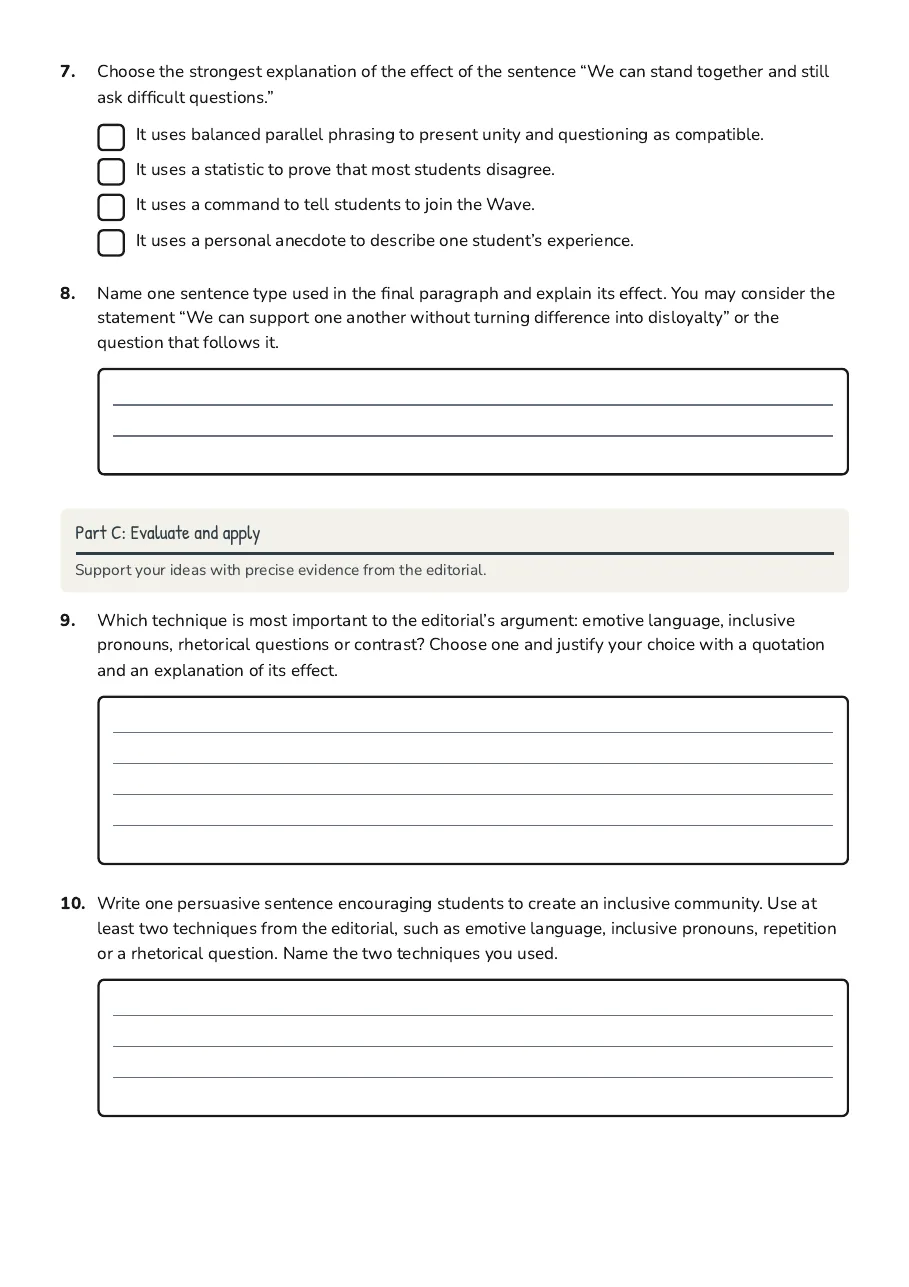
- It uses balanced parallel phrasing to present unity and questioning as compatible.
- It uses a statistic to prove that most students disagree.
- It uses a command to tell students to join the Wave.
- It uses a personal anecdote to describe one student’s experience.
Part C: Evaluate and apply
Support your ideas with precise evidence from the editorial.
4 printable pages
Page 1
Page 2
Page 3
Page 4
About This Worksheet
Free in Kuraplan
Sign up free, grab the PDF, and customize it for your class.
Print-Ready
Formatted for standard paper. Clean layout, easy to read.
AI-Generated
Created with Kuraplan's AI, designed for real classroom use.
For Teachers & Parents
Use in classrooms, for homework, tutoring, or homeschool.
Need a custom version of this worksheet?
Kuraplan's AI generates custom worksheets in seconds — differentiated for every learner, aligned to your curriculum.
Generate Custom Worksheets — Free