EnglishFreePrintable

What is Poetry?

A free english worksheet ready for your classroom. Open in Kuraplan to grab the print-ready PDF, customize it for your students, or generate a fresh version in seconds.
What is Poetry? worksheet preview
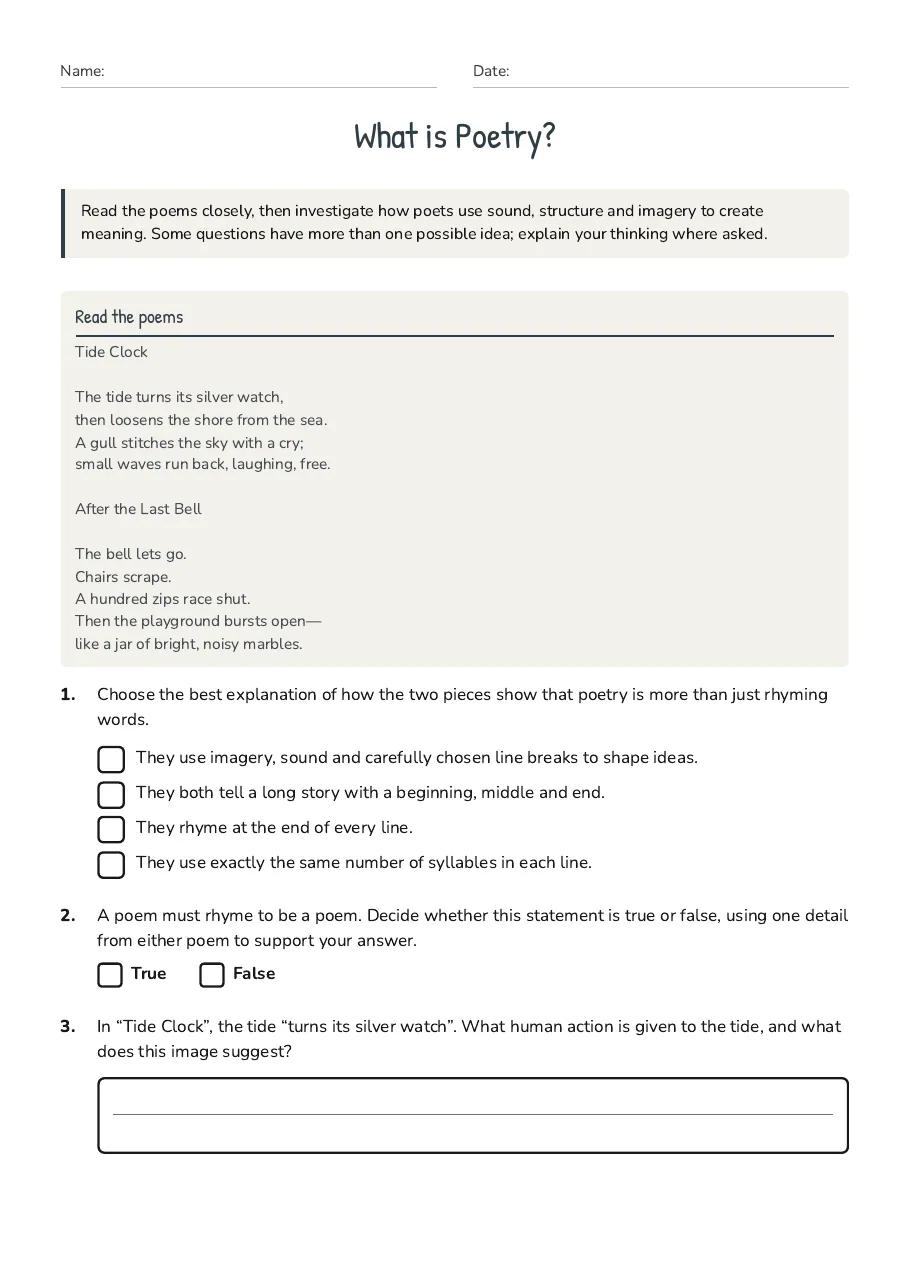
Name:Date:

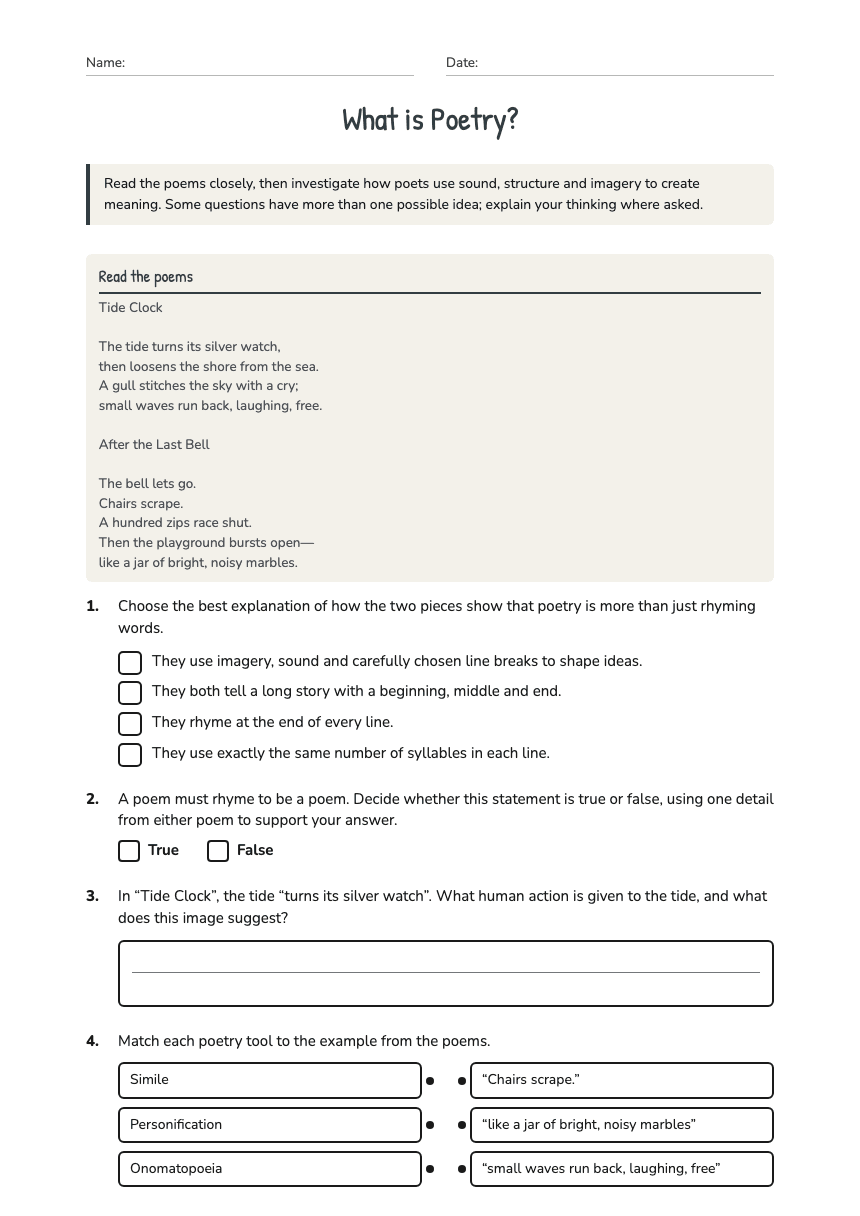
What is Poetry?

Read the poems closely, then investigate how poets use sound, structure and imagery to create meaning. Some questions have more than one possible idea; explain your thinking where asked.

Read the poems

Tide Clock The tide turns its silver watch, then loosens the shore from the sea. A gull stitches the sky with a cry; small waves run back, laughing, free. After the Last Bell The bell lets go. Chairs scrape. A hundred zips race shut. Then the playground bursts open— like a jar of bright, noisy marbles.

1.Choose the best explanation of how the two pieces show that poetry is more than just rhyming words.
  • They use imagery, sound and carefully chosen line breaks to shape ideas.
  • They both tell a long story with a beginning, middle and end.
  • They rhyme at the end of every line.
  • They use exactly the same number of syllables in each line.
2.A poem must rhyme to be a poem. Decide whether this statement is true or false, using one detail from either poem to support your answer.
TrueFalse
3.In “Tide Clock”, the tide “turns its silver watch”. What human action is given to the tide, and what does this image suggest?
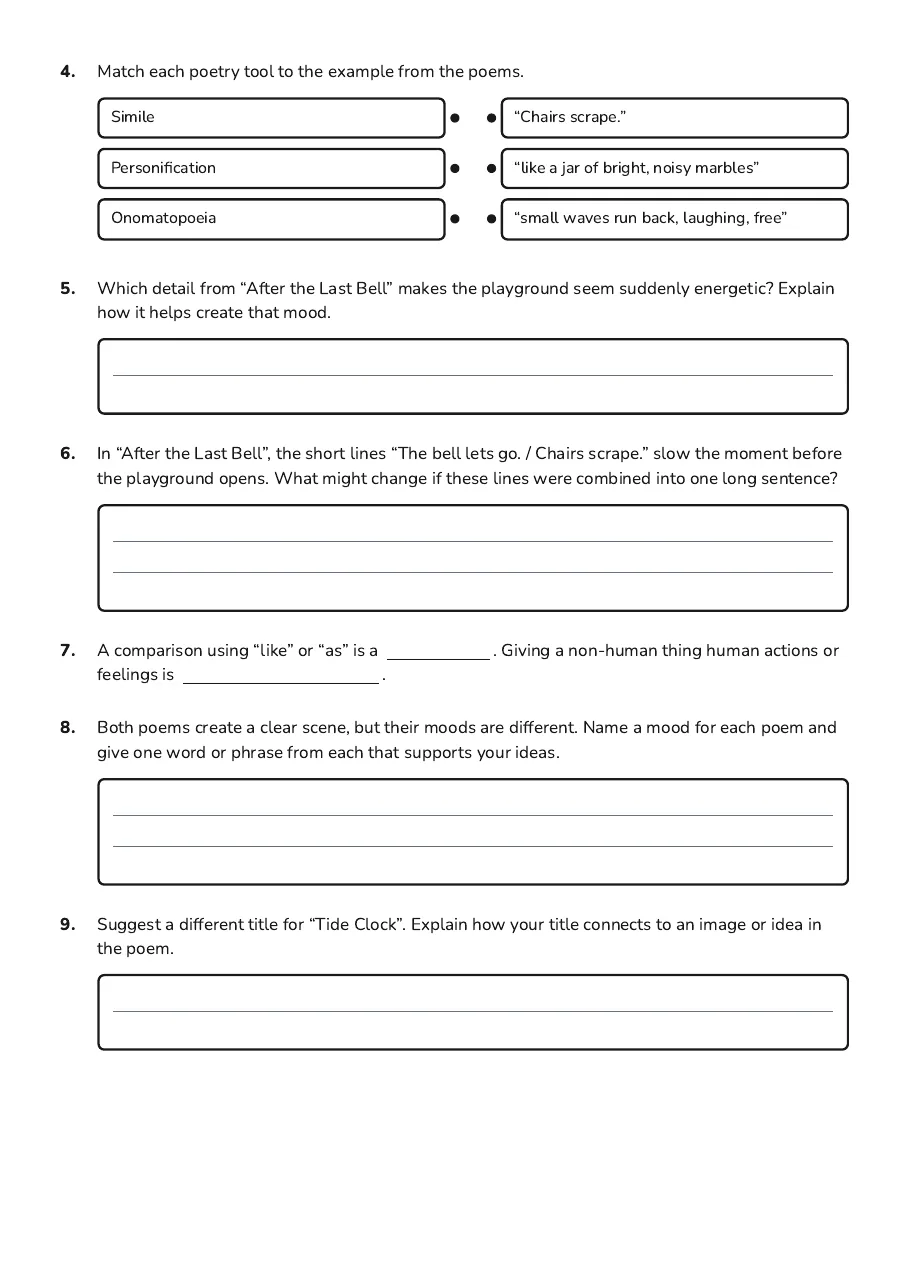
4.Match each poetry tool to the example from the poems.
  • Simile
  • Personification
  • Onomatopoeia
  • “Chairs scrape.”
  • “like a jar of bright, noisy marbles”
  • “small waves run back, laughing, free”
5.Which detail from “After the Last Bell” makes the playground seem suddenly energetic? Explain how it helps create that mood.
6.In “After the Last Bell”, the short lines “The bell lets go. / Chairs scrape.” slow the moment before the playground opens. What might change if these lines were combined into one long sentence?
7.A comparison using “like” or “as” is a . Giving a non-human thing human actions or feelings is .
8.Both poems create a clear scene, but their moods are different. Name a mood for each poem and give one word or phrase from each that supports your ideas.
9.Suggest a different title for “Tide Clock”. Explain how your title connects to an image or idea in the poem.
10.Write a two-line free-verse poem about a familiar sound or place. Include one strong image or comparison. Underline the image or comparison you used.

3 printable pages

  • What is Poetry?, page 1 of 3: Read the poems

    Page 1

  • What is Poetry?, page 2 of 3: 4. Match each poetry tool to the example from the poems.

    Page 2

  • What is Poetry?, page 3 of 3: 10. Write a two-line free-verse poem about a familiar sound or place. Include one strong…

    Page 3

About This Worksheet

Free in Kuraplan

Sign up free, grab the PDF, and customize it for your class.

Print-Ready

Formatted for standard paper. Clean layout, easy to read.

AI-Generated

Created with Kuraplan's AI, designed for real classroom use.

For Teachers & Parents

Use in classrooms, for homework, tutoring, or homeschool.

Need a custom version of this worksheet?

Kuraplan's AI generates custom worksheets in seconds — differentiated for every learner, aligned to your curriculum.

Generate Custom Worksheets — Free
No credit card Curriculum-aligned Under 60 seconds