World Music Introduction Worksheet
A free music worksheet ready for your classroom. Open in Kuraplan to grab the print-ready PDF, customize it for your students, or generate a fresh version in seconds.
World Music Introduction Worksheet
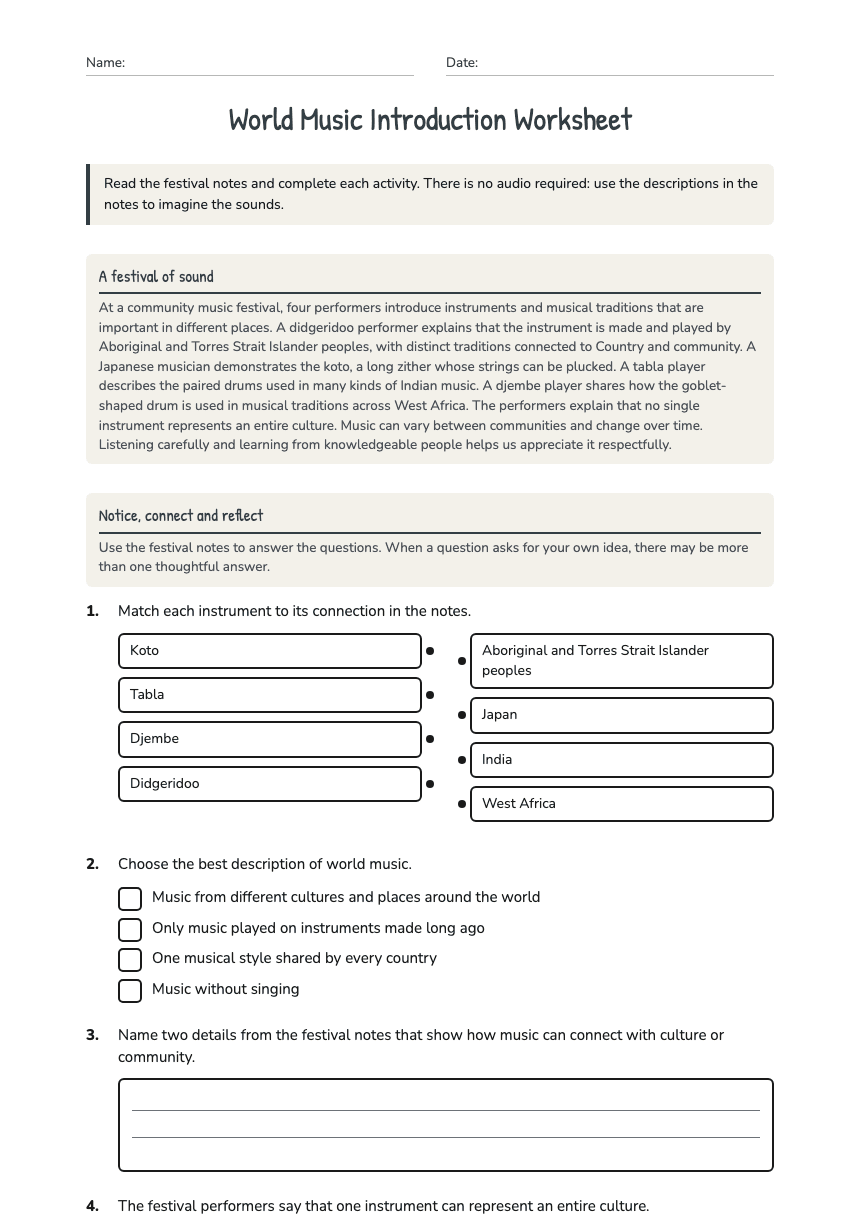
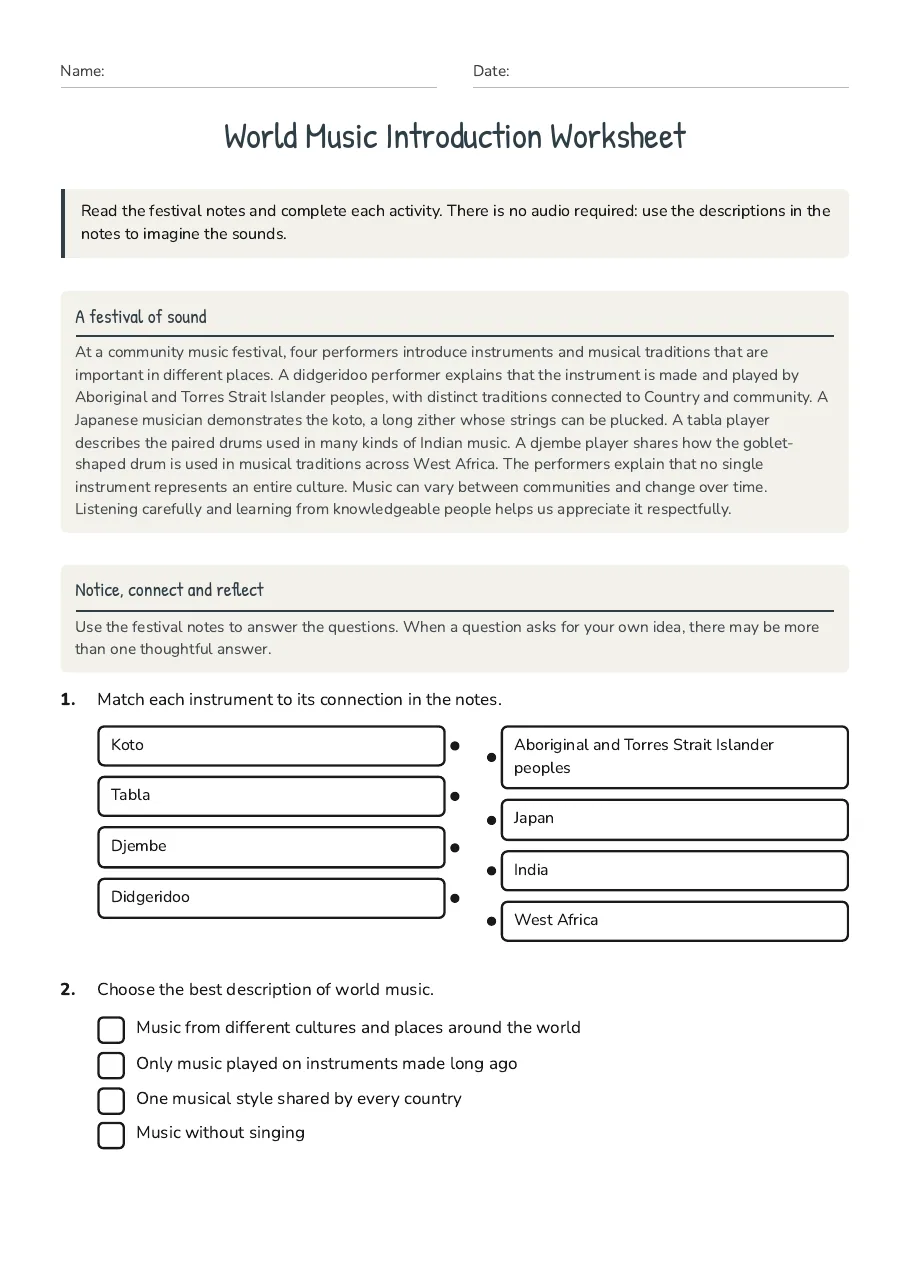
A festival of sound
At a community music festival, four performers introduce instruments and musical traditions that are important in different places. A didgeridoo performer explains that the instrument is made and played by Aboriginal and Torres Strait Islander peoples, with distinct traditions connected to Country and community. A Japanese musician demonstrates the koto, a long zither whose strings can be plucked. A tabla player describes the paired drums used in many kinds of Indian music. A djembe player shares how the goblet-shaped drum is used in musical traditions across West Africa. The performers explain that no single instrument represents an entire culture. Music can vary between communities and change over time. Listening carefully and learning from knowledgeable people helps us appreciate it respectfully.
Notice, connect and reflect
Use the festival notes to answer the questions. When a question asks for your own idea, there may be more than one thoughtful answer.
- Koto
- Tabla
- Djembe
- Didgeridoo
- Aboriginal and Torres Strait Islander peoples
- Japan
- India
- West Africa
- Music from different cultures and places around the world
- Only music played on instruments made long ago
- One musical style shared by every country
- Music without singing
3 printable pages
Page 1
Page 2
Page 3
About This Worksheet
Free in Kuraplan
Sign up free, grab the PDF, and customize it for your class.
Print-Ready
Formatted for standard paper. Clean layout, easy to read.
AI-Generated
Created with Kuraplan's AI, designed for real classroom use.
For Teachers & Parents
Use in classrooms, for homework, tutoring, or homeschool.
Need a custom version of this worksheet?
Kuraplan's AI generates custom worksheets in seconds — differentiated for every learner, aligned to your curriculum.
Generate Custom Worksheets — Free