The first weeks of sixth grade can feel like three different jobs at once. Students are learning new routines, carrying more responsibility for materials and deadlines, and facing assignments that ask them to explain their thinking instead of just provide an answer. A child who was confident with elementary arithmetic may hesitate over ratios, variables, or a multi-step word problem. A strong reader may still need help moving from retelling a chapter to building an argument with text evidence.
That tension is what makes the 6th grade curriculum a bridge between elementary foundations and middle school independence. The answer isn't to rush through every standard or turn every lesson into a test. Teachers need a clear map, purposeful practice, manageable checks for understanding, and flexible materials that can change when a class needs more time.
Welcome to 6th Grade and Why This Year Feels Different
On the first Monday, you might hand students a short reading passage and ask them to annotate it. Several students underline nearly every sentence. In math, a familiar-looking problem includes a ratio, and students reach for the operation they used most recently rather than identify the relationship. In science, they can name an ecosystem term, but they struggle to support a claim with observations.
None of this means the class is unprepared. It means sixth grade asks students to transfer skills into new settings. They're moving from “Can I do this?” toward “Can I explain why this works, choose a method, and defend my conclusion?”
The bridge has two lanes
The academic lane includes more abstract content. A representative Grade 6 curriculum guide expects students to work with whole-number exponents, ratios, fraction quotients, multi-digit decimals, and area problems involving triangles and other polygons, while also reading within the grades 6–8 text-complexity band with appropriate scaffolding (Grade 6 Curriculum Guide).
The independence lane is just as important. Students must learn how to unpack directions, organize evidence, revise work, ask for clarification, and use feedback. A successful lesson often teaches the content and the learning behavior together. For example, a ratio task can include a short routine for highlighting quantities, naming the relationship, selecting a representation, and checking whether the answer makes sense.
Practical rule: Plan for the student who understands the idea but hasn't yet learned how to show it independently.
This guide is for classroom teachers, student teachers, instructional coaches, and anyone building a coherent sixth-grade program. Use it as a planning companion rather than a script. The useful outcome is a curriculum map you can adapt, with enough structure to protect the sequence and enough flexibility to respond to real children.
Start with the year's essential understandings. Then connect those understandings to daily tasks, formative checks, differentiated supports, and assessments that reveal more than recall. When the pieces fit, sixth grade feels less like a sudden jump and more like a carefully built walkway.
Understanding What 6th Grade Curriculum Really Covers
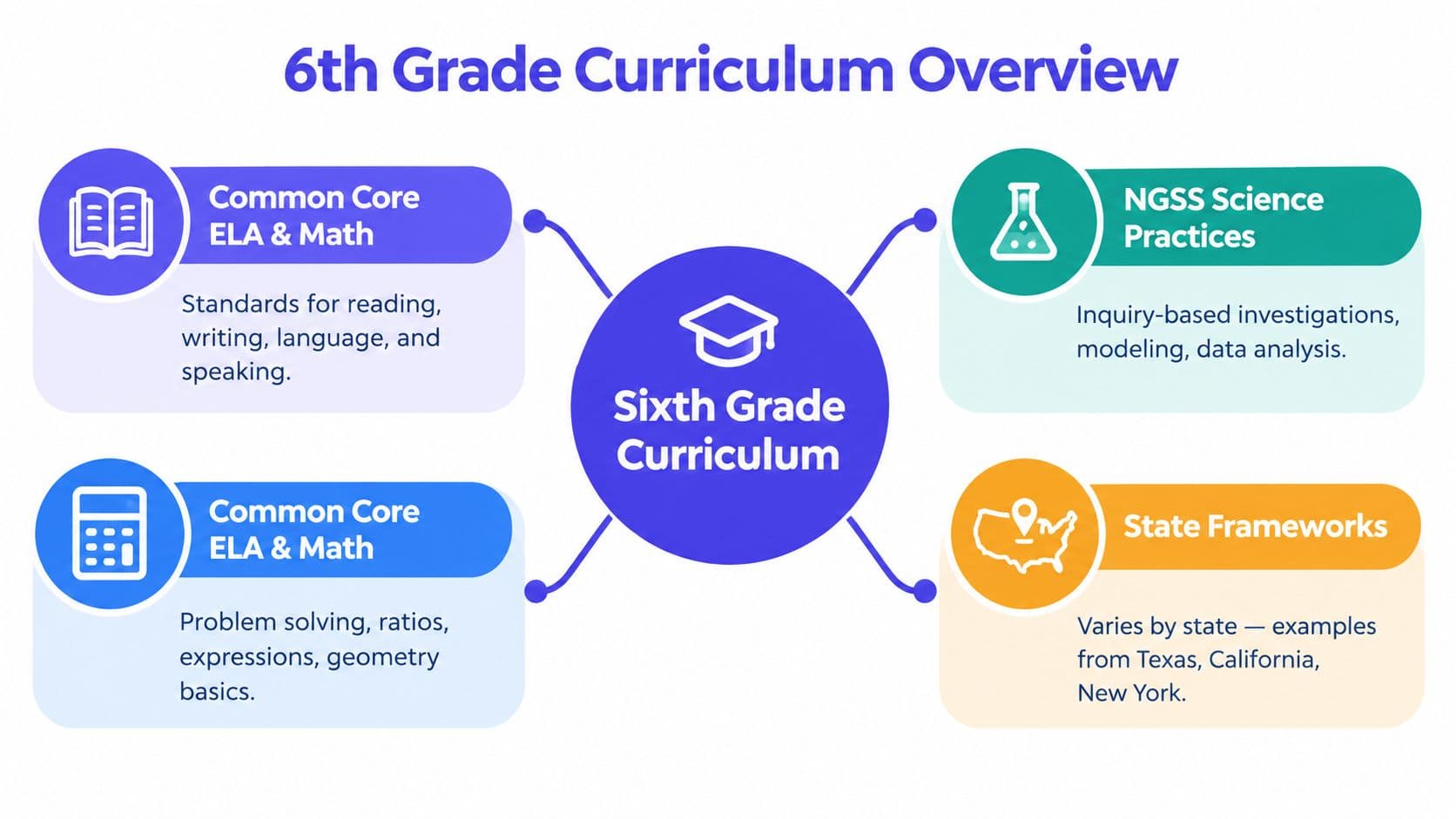
A sixth-grade curriculum works best as a system of content, practices, and increasing independence. Students are crossing from elementary routines into middle school expectations, so the plan must show both what they will learn and how they will demonstrate it. Standards name the destination, progression shows the growing challenge, and classroom materials provide practice along the way.
Read standards as a planning tool
Start with the verb. “Recognize,” “describe,” “compute,” “analyze,” and “justify” call for different tasks and different evidence. Then identify the knowledge students need, the representation they will use, and the work that will show proficiency.
In math, the Common Core Grade 6 Statistics and Probability standards ask students to recognize statistical questions, describe data by center, spread, and shape, and display numerical data with dot plots, histograms, and box plots. Ohio's Grade 6 model curriculum frames statistics as a four-step GAISE process: formulate a question, collect data, analyze it, and interpret the results. That sequence turns a broad standard into a classroom investigation.
Science planning follows the same pattern. Students use models, data analysis, and argument from evidence to explain processes such as photosynthesis, energy flow, ecosystems, gravity, and geologic change. The Kentucky Grade 6 Academic Standards Family Guide illustrates how standards can connect content knowledge with observable student work.
Build a toolkit, not a checklist
Each subject contributes a tool to the same bridge:
- Math supplies quantitative reasoning and representations.
- ELA teaches students to interpret ideas, communicate clearly, and use evidence.
- Science gives them models, investigations, and explanations.
- Social studies places evidence, systems, geography, and civic decisions in context.
State frameworks arrange these tools in different ways. New York's Grade 6 math standards, for example, organize work around ratios and proportional relationships, the number system, expressions and equations, geometry, and statistics and probability. The New York State Grade 6 Math Crosswalk includes work with negative numbers, division of fractions, and surface area and volume.
When a standards document feels dense, create three columns: standard language, student-friendly objective, observable evidence. Before writing the note, the Storyloft guide to textbook breakdown can help you anticipate where students may lose the thread of a textbook chapter. End with something visible or audible in class, such as, “Students compare two data displays and explain which better answers the question.” That final column keeps planning tied to instruction, differentiation, and assessment.
Core Subjects and Standards Alignment in 6th Grade
Strong alignment starts with the task students complete, not the label on the unit folder. Ask what students will produce, what reasoning they'll use, and which standard describes that work.
English language arts
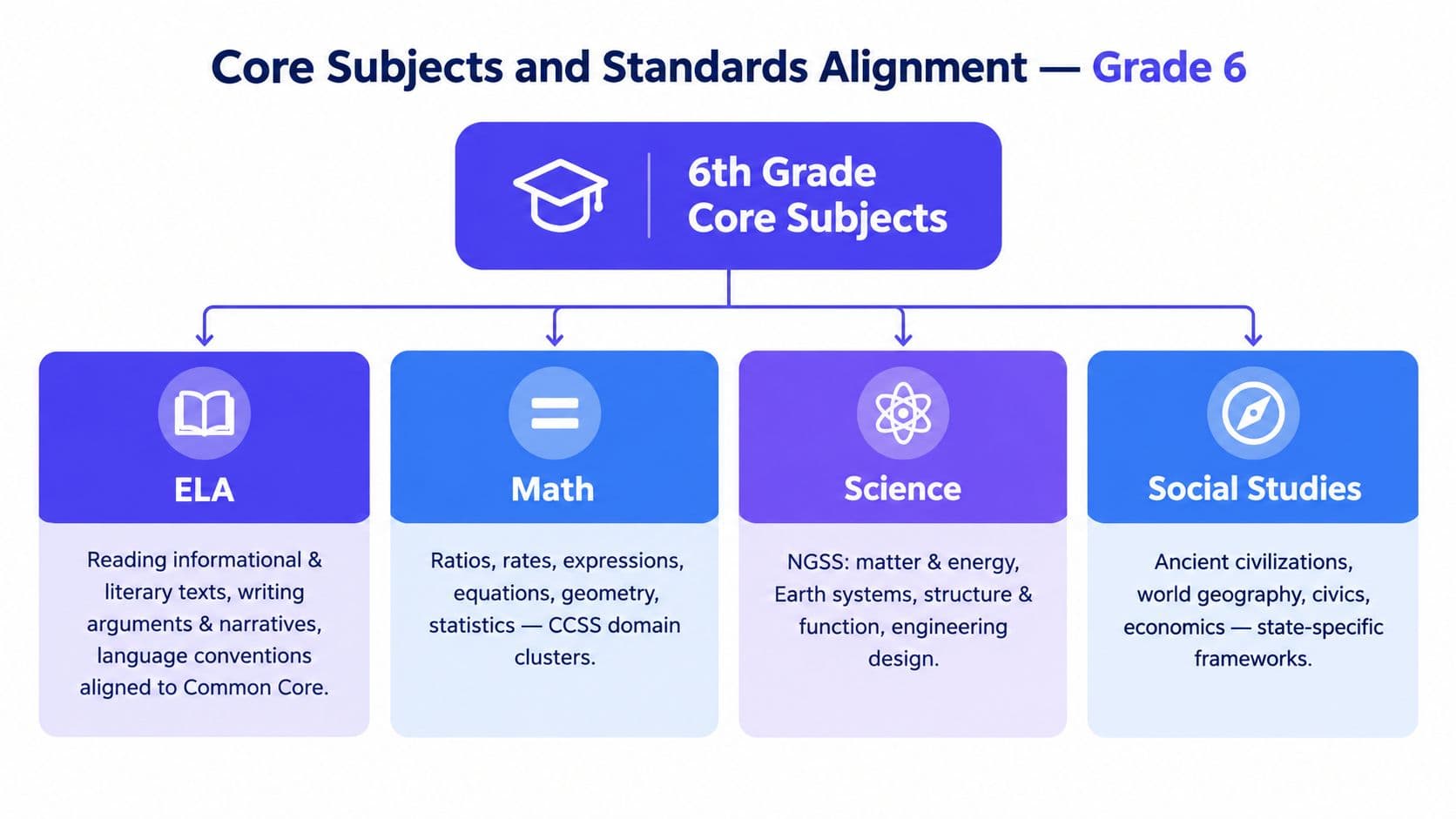
ELA planning usually combines reading literature, reading informational text, writing, language, and speaking and listening. Students need practice identifying central ideas, tracing how characters or ideas develop, selecting relevant evidence, and explaining how that evidence supports an interpretation.
The complexity expectation matters. Sixth graders are generally expected to read and comprehend literature in the grades 6–8 text-complexity band proficiently, with scaffolding when a text reaches the upper end of that range (Grade 6 Curriculum Guide). In practice, that means you might pair a challenging anchor text with vocabulary support, chunked reading, audio access, and a clear evidence organizer. The goal isn't to lower the thinking. It's to remove barriers that prevent students from reaching the thinking.
Writing should move beyond isolated paragraphs. Students can write narratives with deliberate details, explanatory pieces with organized information, and arguments that state a claim, use evidence, and address reasoning. A short discussion before writing helps students rehearse ideas and hear the difference between a personal reaction and a defensible claim.
Mathematics
Math in Grade 6 emphasizes proportional reasoning and the move from arithmetic toward algebraic thinking. Students solve ratio and rate problems, interpret and compute fraction quotients, and write and use expressions and equations with variables. They also reason about dependent and independent variables within major standards frameworks (Ohio Grade 6 Mathematics Standards).
A useful lesson sequence is concrete representation, visual model, symbolic notation, and explanation. For a ratio problem, students might compare two quantities with counters or a double number line before writing an equivalent ratio or equation. Ask them to explain what each number represents. That question often exposes misunderstanding faster than another page of exercises.
Science
Science instruction should make students investigators. A lesson on ecosystems, for example, can ask students to interpret a food-web model, analyze observations, and argue how energy moves through the system. A lesson on gravity can use a model and evidence table before students write an explanation.
The important alignment is between the content and the practice. If the standard expects evidence-based reasoning, a vocabulary quiz alone can't demonstrate the target. Students need to make a claim, use observations or data, and explain the connection.
For printable practice that can support a Grade 6 science sequence, teachers can use the Kuraplan 6th grade science worksheets as one planning resource.
Social studies
Social studies frameworks vary by state, but the transferable work remains familiar. Students read maps and primary or secondary sources, establish context, compare perspectives, identify cause and effect, and communicate conclusions. A source-analysis routine can stay consistent even when the historical content changes: observe, contextualize, question, corroborate, and explain.
The four subjects should not become isolated islands. A data display in science can reinforce statistics. A social studies source set can strengthen informational reading. An ELA argument can use a civic issue. Those connections make the curriculum feel coherent without forcing every subject into one artificial project.
Pacing Guides and Sample Unit Plans That Fit Your Year
A pacing guide should answer three practical questions: What comes first, how long will it take, and what evidence tells us to move on? It is a shared map, not a promise that every class will move at the same speed. For sixth grade, that distinction matters because students are adjusting to middle school routines while still building habits they began in elementary school. The guide protects priority learning and leaves room for reteaching.
Start with the year and work inward
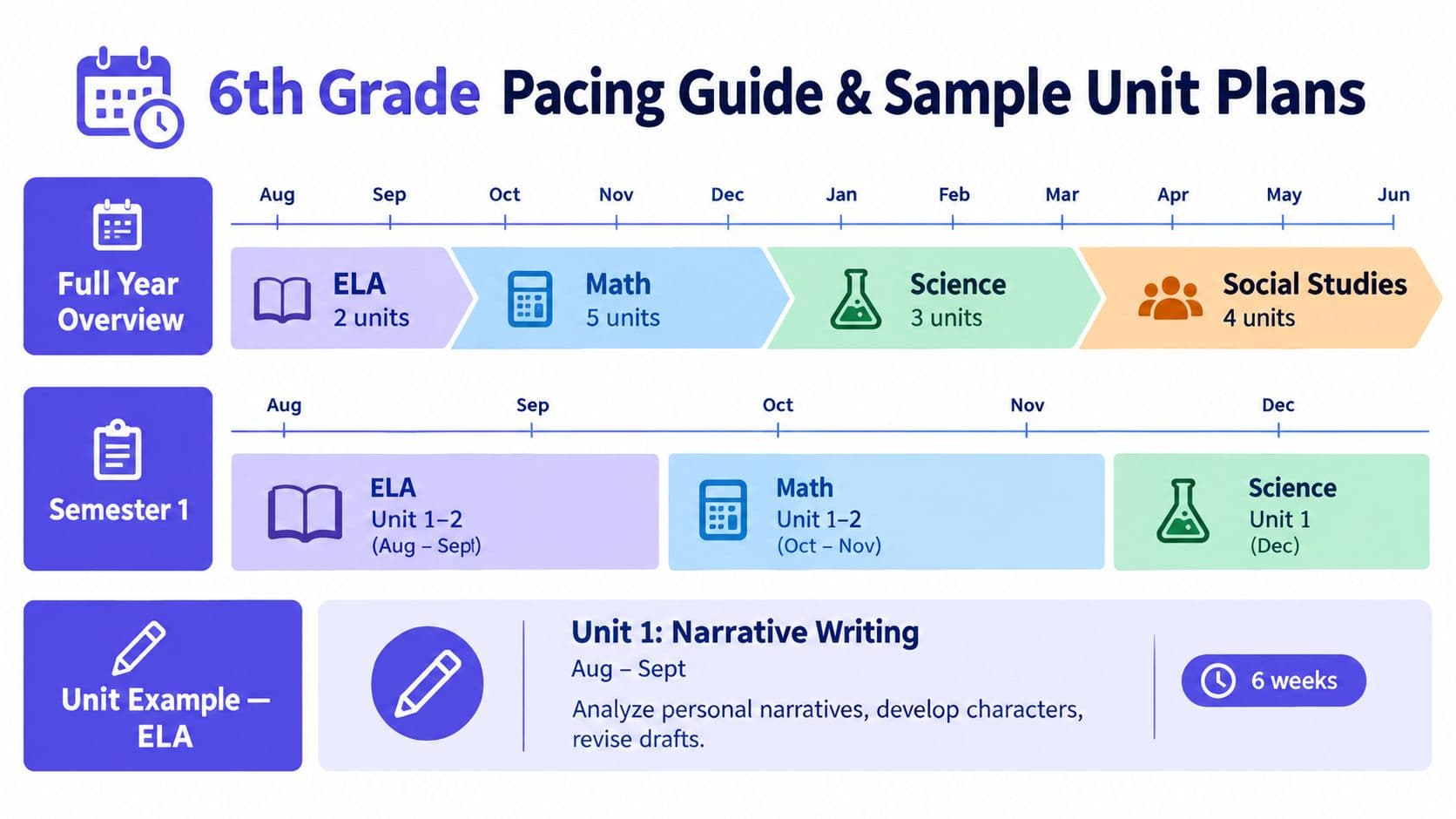
Place major units on a year-at-a-glance calendar. Mark required assessments, school events, likely interruptions, and buffer time before dividing the year into smaller pieces. Then shape each unit into a three- or four-week arc, extending it when students need sustained practice. At the weekly level, name the core learning target, choose one formative check, and identify the lesson that will respond to what students show.
A practical unit arc might look like this:
- Launch: Introduce the context, activate prior knowledge, and establish the essential question.
- Build: Teach core concepts through models, worked examples, reading, discussion, and guided practice.
- Apply: Ask students to use the skill in a less familiar situation.
- Show and reflect: Collect an assessment, review errors, and plan targeted follow-up.
That sequence works like a staircase. Each phase gives students the footing they need for the next one, while the checkpoints show whether the class is ready to climb.
A math unit example
For a proportional reasoning unit, the objective could be for students to solve ratio and rate problems and explain the representation they chose. Early lessons might use tables and double number lines. The middle of the unit can introduce equations and variable relationships. At a formative checkpoint, students diagnose an incorrect solution and revise the reasoning. The culminating task might ask them to compare two rates and defend a recommendation in writing.
An ELA unit example
A narrative writing unit can begin with mentor-text analysis. Students identify how authors reveal character, establish setting, and sequence events. They then draft a personal or fictional narrative, conference with a partner, revise for clarity and detail, and publish a final piece. Keep the rubric visible from the start, with separate criteria for organization, development, evidence of revision, and language conventions.
Leave room for unfinished thinking. Buffer time lets you reteach a foundational skill, confer with writers, or revisit a misconception revealed by a quick check. When you build those weeks into the calendar, an exam planner that fits real life can help students and families spread preparation across the available time instead of cramming.
Kuraplan can generate unit plans with sequential lessons, aligned objectives, and integrated assessments in minutes. Whether you draft manually or use software to speed up the first version, review every lesson for developmental fit, local requirements, and the actual needs of your class. In a bridge year, that review helps keep the plan structured without making it rigid.
Use this short planning check before finalizing a unit:
- Sequence: Does each lesson prepare students for the next one?
- Evidence: Where will students demonstrate the target before the final assessment?
- Flexibility: Where can you pause, regroup, or extend?
- Transfer: Does the final task require students to apply the learning?
Assessment Ideas and Rubrics That Show Real Learning
Assessment works best when each type has a distinct job. A formative check helps you decide what to teach next. A summative assessment records what students can do after instruction. A performance task reveals whether students can combine skills in a meaningful situation.
Choose the assessment for the decision
| Assessment Type | Best For | Example in 6th Grade |
|---|---|---|
| Formative | Adjusting instruction during learning | An exit ticket asks students to represent a ratio in a table and explain the relationship |
| Summative | Evaluating learning after a unit | A math assessment includes ratio problems, expressions, and written reasoning |
| Performance-based | Demonstrating transfer and communication | Students analyze a data set, create a display, and present a conclusion |
| Conference or observation | Identifying process needs | A teacher listens as a student cites evidence and notes whether the student explains its relevance |
A good exit ticket is small enough to review quickly but specific enough to reveal the misconception. “Do you understand ratios?” won't help much. “Which representation best shows this relationship, and why?” gives you something actionable.
For ELA, ask students to answer a focused question with a quoted or paraphrased detail from the text and an explanation of its importance. In science, use an argument prompt such as: “What evidence supports your explanation of energy flow?” The response can be brief, but it should require the practice named by the standard.
Make rubrics usable
A sixth-grade rubric should sound like something students can understand and use. Limit the criteria to the features that matter for the task. For an evidence-based paragraph, criteria might address a clear claim, relevant evidence, reasoning, organization, and conventions. Describe what success looks like rather than relying on broad labels such as “excellent” or “weak.”
Share the rubric before students begin. Let them mark one criterion they feel confident about and one they want to improve. After grading, record one next step instead of covering the page with comments.
Teachers looking for practical classroom checks can use these formative assessment examples when building a routine. The key is consistency. A simple check used often can guide reteaching more effectively than a large assessment that arrives after the opportunity to adjust has passed.
Differentiation Strategies and Ready to Use Planning Templates
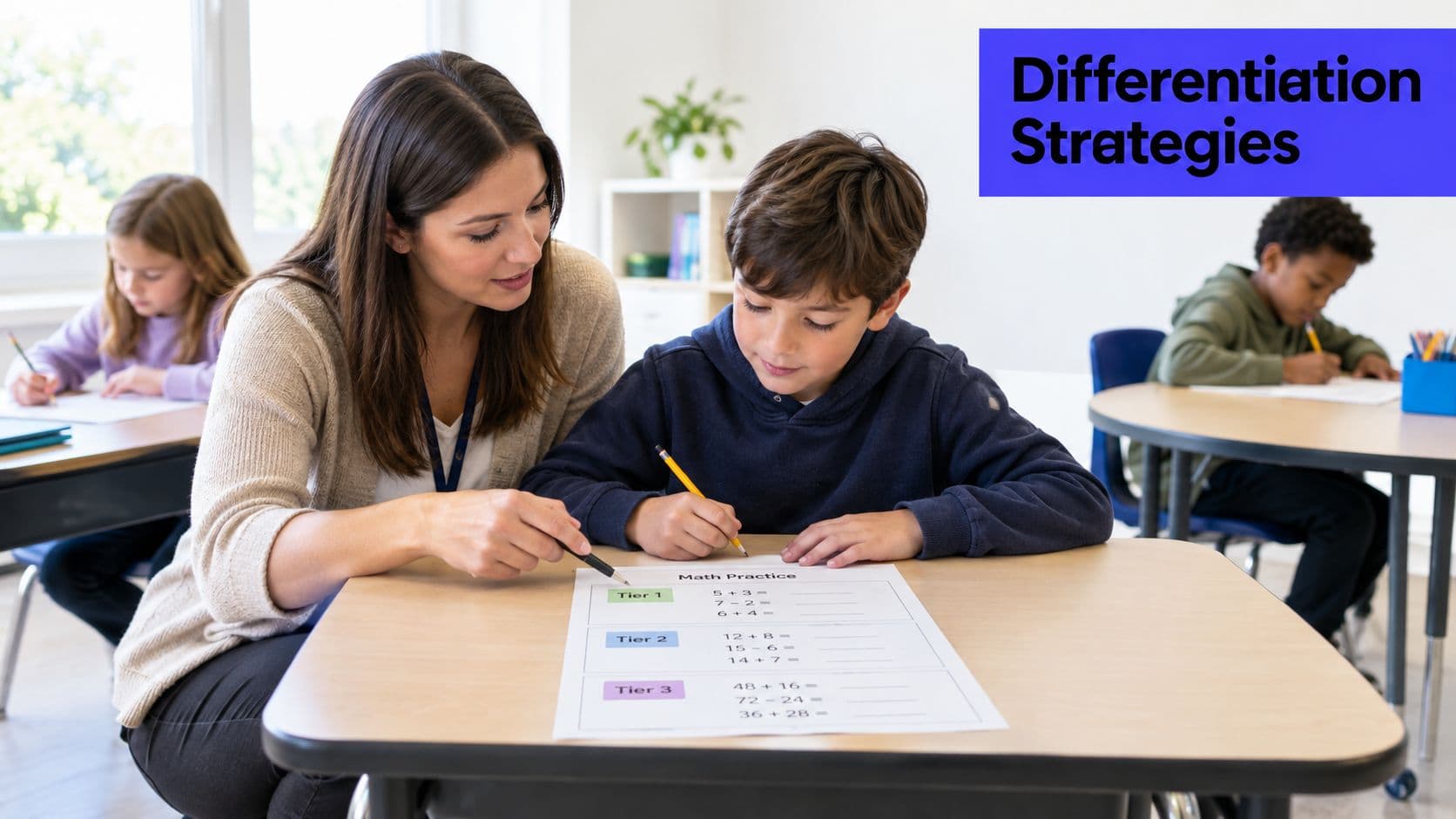
Differentiation doesn't mean writing a separate curriculum for every student. It means keeping the learning target steady while changing the support, route, or level of independence.
Change the access point
For a complex reading, offer a vocabulary preview, audio support, chunked sections, and guiding questions. Students can work with the same central idea while receiving different amounts of scaffolding. Gradually remove the support as students demonstrate control.
For math, use visual models before symbols. A ratio table, number line, or area diagram can make an abstract relationship visible. In science, provide a partially completed model or evidence organizer, then ask students to complete more of the representation independently.
Tiered tasks can preserve the same objective:
- Supported: Students solve a ratio problem with a double number line and sentence frames.
- Core: Students select a representation, solve, and explain their reasoning.
- Extension: Students create a related problem, solve it, and justify why their answer is reasonable.
Use templates that reduce decision fatigue
A reusable lesson template can include the objective, prior knowledge, vocabulary, model, guided practice, independent task, formative check, and differentiation notes. A worksheet template might include a worked example, a visual representation, practice items that increase in complexity, and a short reflection.
For an argument-writing task, provide a claim-evidence-reasoning organizer. For a data investigation, provide spaces for the question, collection method, display, description, and interpretation. For a science explanation, include a model box, evidence table, and reasoning prompt.
Planning habit: Differentiate the first draft of the task before you start making decorative materials. Access and thinking matter more than appearance.
Kuraplan can function as an AI planning assistant that differentiates instruction, creates worksheets, and generates kid-friendly illustrations and diagrams across subjects. Teachers can turn a lesson into printable or shareable materials, then revise the output to match their students and school expectations. Its differentiation teaching strategies resource can also support planning conversations with grade-level teams.
A sensible workflow is simple: write the target, generate or draft the core task, create supported and extended versions, add a visual only where it clarifies the idea, and review the language for age appropriateness. Technology should shorten formatting work, not replace teacher judgment.
Your Next Steps for a Confident and Connected 6th Grade Year
A manageable sixth-grade plan begins with a bridge-year mindset. Students need access to elementary foundations, but they also need regular opportunities to reason abstractly, communicate evidence, and take ownership of their work. Your curriculum map should make that progression visible.
Audit the current plan with a short checklist:
- Standards: Can you name the content and practice in each major unit?
- Sequence: Does the order build knowledge rather than follow a textbook?
- Practice: Do students explain, model, analyze, and revise, not just recall?
- Assessment: Is there an early check before each major graded task?
- Access: Are scaffolds and extensions prepared before students need them?
- Time: Does the calendar include room for reteaching and reflection?
Choose one unit to refine first. Look for the place where students most often lose the thread, then improve the objective, model, formative check, and differentiated materials around that point. Share the revised plan with a colleague so the work becomes a team asset rather than a private document.
A standards-aligned 6th grade curriculum doesn't need to be complicated to be rigorous. It needs a clear destination, purposeful steps, and responsive teaching along the way.
Kuraplan helps teachers create standards-aligned lesson and unit plans, differentiated worksheets, educational visuals, and assessment rubrics for sixth grade in minutes. Visit Kuraplan to build a connected plan for your next unit and reclaim planning time for the students in front of you.