If you're staring at a stack of copied “All About Me” worksheets and thinking, I know my students need more than this, you're right. I've taught this lesson enough times to know what falls flat. A cute self-portrait with “my favorite food” and “my family” can get pencils moving, but it doesn't automatically build belonging, language, or respectful classroom routines.
A useful All About Me lesson plan does more. It gives children safe ways to share, helps you learn who they are, and sets up the talk moves and reflection habits you'll keep using all year. When I plan it as a short unit opener instead of a one-day craft, the lesson gets calmer, more inclusive, and much easier to assess.
What This Lesson Is and What Students Will Walk Out Knowing
A child steps up to share, then freezes. Another student wants to answer, but the only option on the table is speaking out loud. That is usually the moment I know the lesson needs more structure, more choice, and a clearer goal.
I post one target from the start:
Learning target: I can identify and communicate three things about myself, and I can respond respectfully to a classmate.
That target is simple enough for young children and strong enough to teach from. I write it as a child-friendly learning intention with matching success criteria, following the kind of planning language described in this guide to learning intentions and success criteria. For a typical 40 to 50 minute block, I use a scaffolded sequence drawn from classroom research: 5 minutes for framing, 10 minutes for read-aloud or discussion, 15 minutes for the identity artifact, 5 to 10 minutes for a gallery walk, and 3 to 5 minutes for reflection, as outlined in this scaffolded lesson sequence for social-emotional learning activities.
Lesson at a Glance
| Segment | Time | Student Action |
|---|---|---|
| Framing and safety | 5 minutes | Listen, notice choices, learn that passing is allowed |
| Read-aloud or guided discussion | 10 minutes | Name identity words and connect to examples |
| Identity artifact | 15 minutes | Draw, write, dictate, point, or collage to show who they are |
| Gallery walk or partner share | 5 to 10 minutes | Respond with one similarity, one respectful question, or one affirmation |
| Reflection | 3 to 5 minutes | Say, draw, or write what they learned |
The materials stay practical: chart paper, markers, picture cards, sentence frames, blank paper or a template, crayons, glue sticks, optional magazines or pre-cut collage images, and a few “pass” cards. I plan the choices before the lesson starts. I decide which prompts are optional, what counts as participation, and which response modes students can use besides talking in front of the whole class.
That planning matters. A lesson like this works best when children can show identity in more than one way, not just by speaking fast or writing full sentences.
I keep the artifact broad on purpose. Students should leave able to identify at least three aspects of personal identity, communicate them through at least one chosen response mode, and respond respectfully to a peer's contribution. That might look like drawing favorite activities, dictating labels, pointing to symbols, or sharing one selected detail with a partner.
For teachers who create and share classroom resources, the structure matters too. The AmaJova digital product guide is a useful example of how clear templates and organized prompts make a resource easier to use without taking judgment away from the teacher.
What this lesson is not
This is not a quick icebreaker that ends when the crayons go back in the bin. It is the opening lesson in a longer belonging sequence that supports speaking and listening, early writing, self-awareness, and respectful comparison of similarities and differences.
Why All About Me Belongs in Your Standards Map
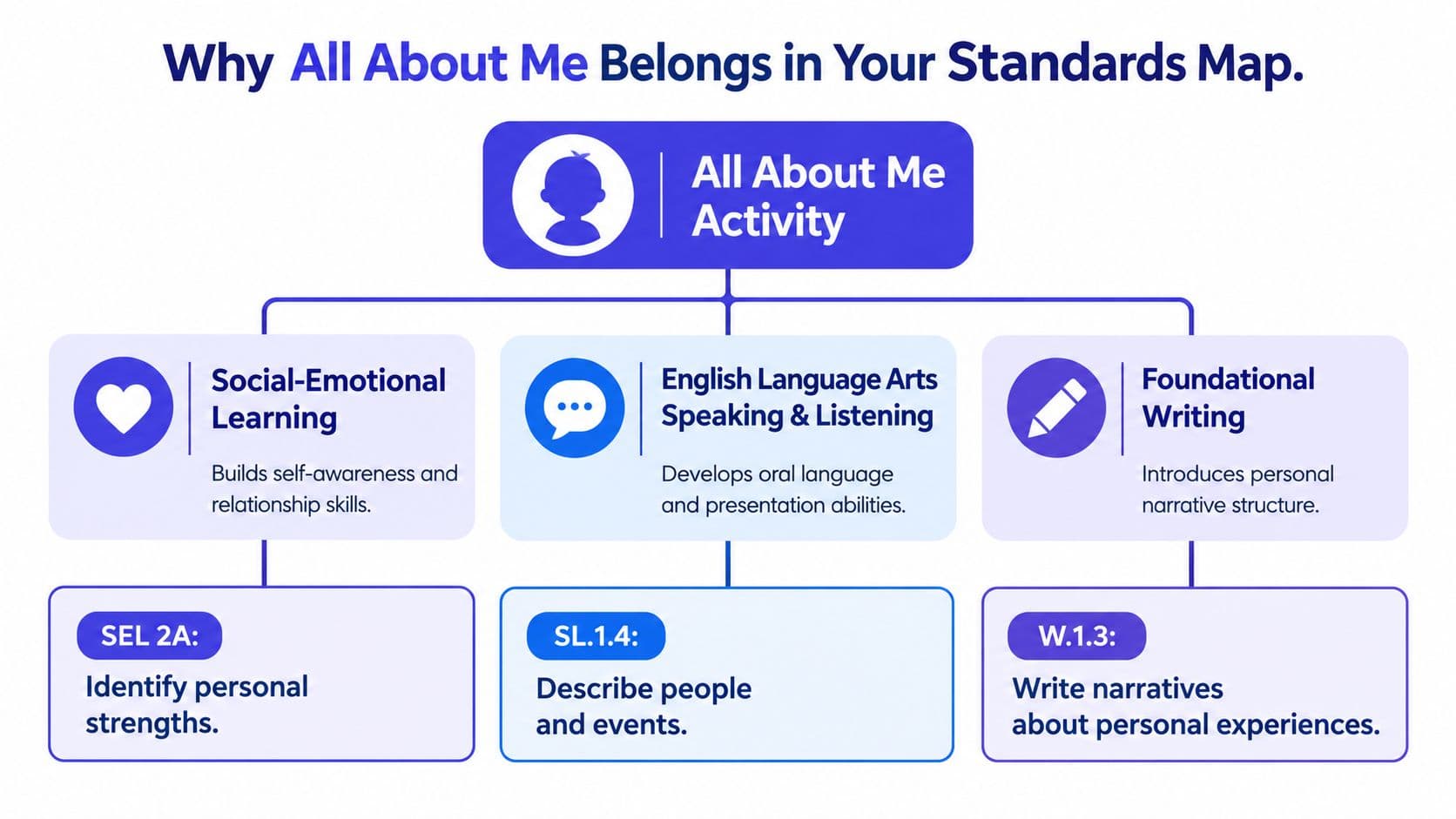
A child arrives with a family drawing, another points to a favorite game, and a third prefers to pass. The learning can still be rigorous. An All About Me lesson plan belongs in formal planning because it gives children structured practice with identity, communication, listening, and respectful relationships, while allowing different levels of personal disclosure.
That connection begins with belonging, not with a craft. Research summarized by the New South Wales Department of Education on school belonging links positive school belonging with stronger engagement, attendance, school completion, and academic outcomes. The same summary reports that a Year 5 student with positive school friendships was at least 2 months ahead in NAPLAN reading by Year 7, that Year 10 students with positive teacher-student relationships had a predicted school-completion rate 3 percentage points higher, and that for Aboriginal students in Year 7, stronger belonging, school pride, and feeling understood by teachers were associated with as many as 5 additional school days per year.
Objectives you can post
For K to 2, I post child-friendly goals:
- I can name things that help tell about me.
- I can share my ideas in a way that works for me.
- I can listen when a classmate shares.
- I can notice one way we are alike or different and say it kindly.
- I can choose what I want to keep private.
These statements leave room for drawing, dictation, pointing, signing, partner talk, or a carefully chosen spoken detail. The target stays steady even when the response mode changes.
For grades 3 to 5, I extend the language:
- I can explain how different parts of my identity connect to my experiences.
- I can ask respectful questions without pressuring someone to share more than they want to.
Standards anchors that make sense
The Learning for Justice Social Justice Standards treat identity as multiple and interacting. That idea helps children describe themselves without squeezing their lives into one trait, one label, or one family template.
UDL gives the lesson a practical access structure. CAST organizes learning around Engagement, Representation, and Action & Expression, as explained in the CAST overview of Universal Design for Learning. In classroom terms, keep the objective fixed while varying examples, directions, materials, and response options. A drawing, audio response, home-language label, or private teacher conference can demonstrate the same learning as a written paragraph.
Practical rule: If the lesson only works for children who can draw, write, and speak publicly, it needs more accessible response choices.
Identity-affirming teaching also requires sustained attention, not a single display of student work. The NYU Metro Center fact sheet on culturally responsive education reports that having at least one Black teacher between Grades 3 and 5 reduced a Black student's probability of dropping out by 29%. It also describes an ethnic studies program linked with a 21 percentage point increase in ninth-grade attendance, a 1.4 grade point rise in average GPA, and 23 additional credits earned. Those findings do not mean one autobiography page causes these outcomes. They show why identity-centered teaching deserves clear objectives, consent-aware participation, and a place in the standards map.
The Four Core Activities Teachers Can Run Tomorrow
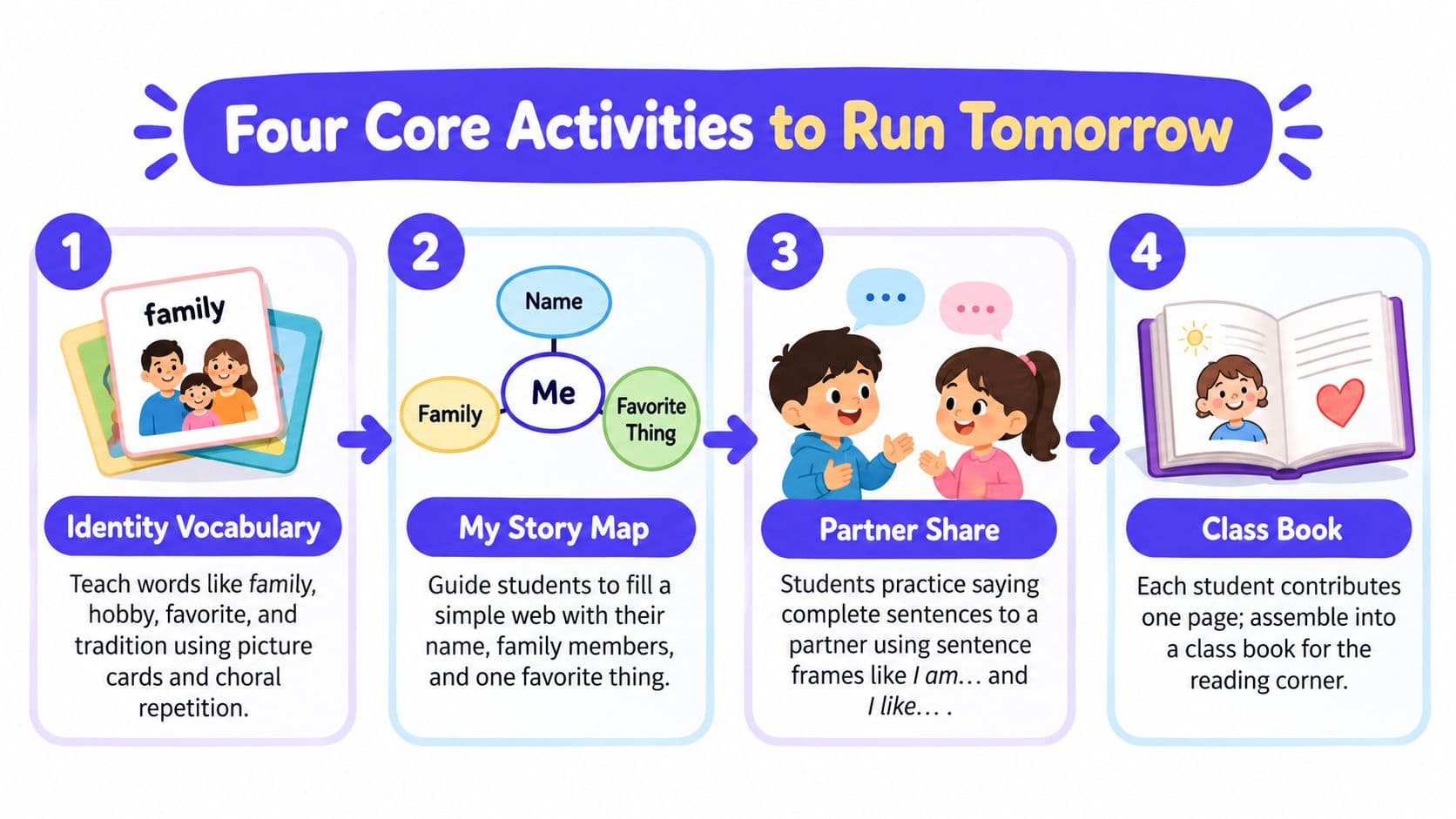
When this lesson works, it feels calm. Children know what to do, and nobody gets pushed into oversharing. I keep the sequence the same across grade levels and adjust the level of language, not the structure.
A visual overview helps before you gather materials.
Activity 1, teach identity vocabulary
Time: about 10 minutes
Materials: picture cards, chart paper, read-aloud or simple prompts
I start with words students can use right away, such as name, interest, tradition, language, family, community, and strength. For younger students, I define each with plain language and a visual. “A tradition is something people do again and again because it matters to them.” “A strength is something you're getting good at.”
Expected student language is short and concrete. “I like soccer.” “I speak Spanish with my grandma.” “I am good at building.”
Activity 2, model a low-risk example
Time: about 5 minutes
Materials: teacher sample, document camera or chart
Your model should be personal, but not intimate. I might share my favorite read-aloud, the language I heard growing up, and that I like gardening. I don't model painful family history or anything a child might feel pressured to match.
Share something true, ordinary, and bounded. Children need to see that personal doesn't have to mean exposed.
Activity 3, rehearse with a partner
Time: about 5 to 10 minutes
Materials: sentence frames, partner cards
Sentence frames help, especially in the first week:
- I am...
- I like...
- One thing that matters to me is...
- One thing we have in common is...
I tell students they can speak, point, whisper, or ask me to scribe. Public sharing is not the goal here. Rehearsal is.
Later in the year I may draft these frames myself, but if I'm short on planning time, I might use a tool like Kuraplan to generate the sentence frames, a model script, and a printable identity template from the same lesson objective. That saves setup time without deciding the lesson for me.
Before the final share, I sometimes use a short modeled example like the one in this classroom video:
Activity 4, create the identity artifact and close with reflection
Time: about 15 minutes for creation, then 3 to 5 minutes for reflection
Materials: paper, crayons, collage pieces, labels, optional digital tools
Give at least two response options. A child can make an identity map, a self-portrait with labels, or a symbol collage. All three meet the same target if the student communicates meaningful details about self.
The gallery walk needs structure. I use one sentence only: “One thing I noticed was...” or “One way we are alike is...” That keeps the room respectful and stops the random blurting that can make quieter children disappear. The same four activities flex well into grades 3 to 5, where students can add longer writing and more complex categories of identity.
Differentiation That Keeps One Target for Every Learner
A child may understand the task but struggle with the way it is presented. One learner talks easily, another points to a picture, and a third needs time to type. The lesson can still measure the same understanding when access and response options change. UDL organizes those choices through Engagement, Representation, and Action and Expression. CAST's UDL Guidelines offer a useful reference for designing those options.
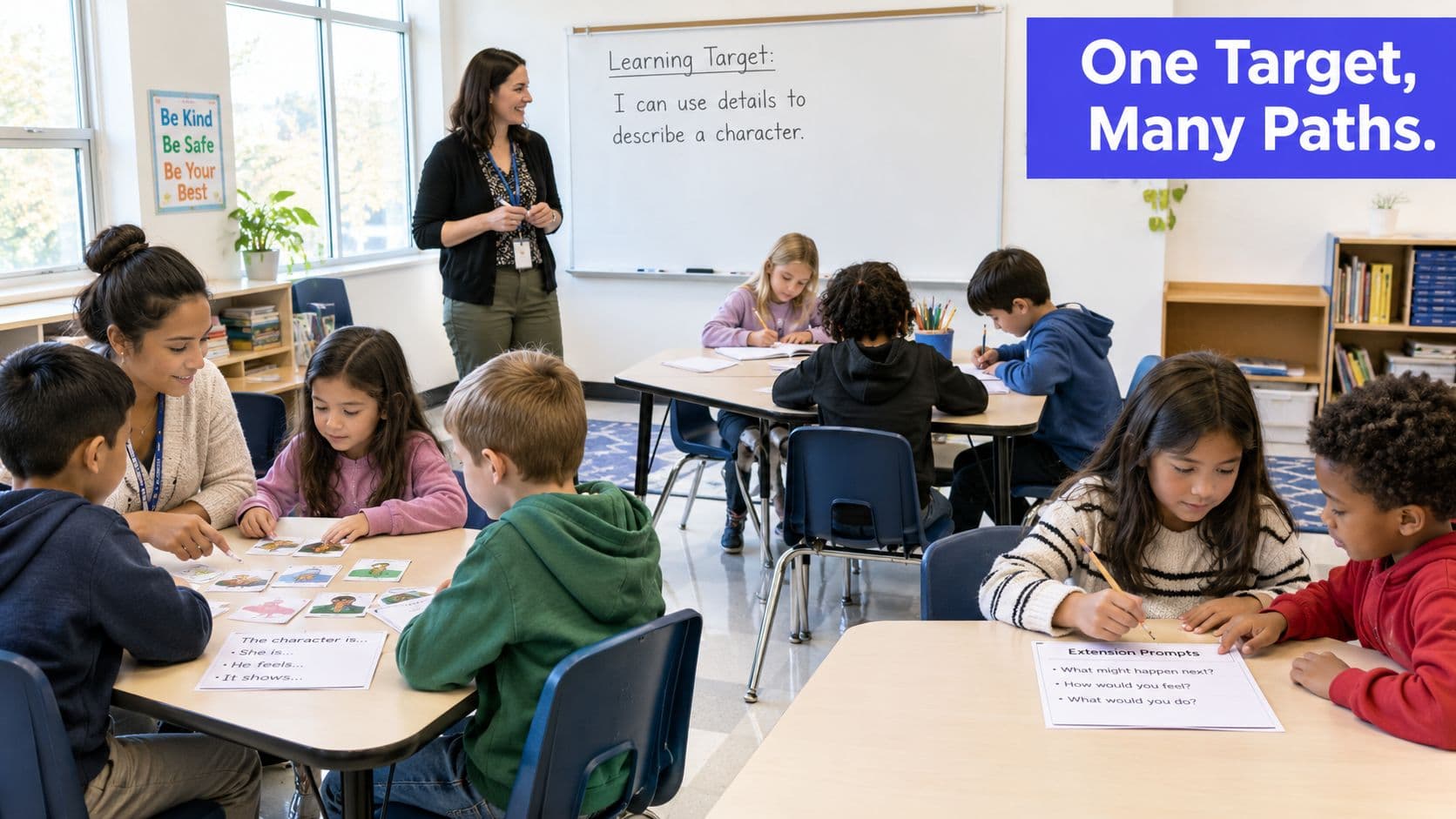
Keep one learning target for the whole class: identify and communicate three aspects of self. Differentiate the route, not the standard.
Three routes, one lesson
| Route | Engagement | Representation | Action and Expression |
|---|---|---|---|
| Support | Choose one familiar topic at a time | Picture cards, translated words, teacher modeling | Point, match, collage, dictate, type |
| On-level | Choose from several identity categories | Visual sequence, sample artifact, oral directions | Draw, write, label, partner share |
| Extension | Add reflection or interview detail | Example paragraph, discussion prompts | Paragraph, audio reflection, small-group identity map |
An identity map shows how this works. On the support route, students may use pre-cut icons, sentence frames, and a teacher or peer scribe. A multilingual learner can label in a home language, English, or both. A student with speech or language differences can point to symbols, type words, or record a private response.
The on-level route keeps the same map but opens the choices. Students might draw, add labels, and share one selected detail with a partner. The extension route adds a short reflection or a home connection, such as asking someone who knows the student well what strength they notice. That extra layer increases thinking without changing the goal.
Accessibility moves that matter
Many all about me lessons assume that every child can draw a self-portrait, list family members, and speak to the class. Those assumptions can exclude multilingual learners, autistic students, children with selective mutism, students who use AAC, and children whose home lives do not match familiar prompts. The TeachingEnglish primary activity page on All About Me provides another starting point for adapting this type of activity.
Use practical supports:
- For multilingual learners: picture supports, translated key vocabulary, and permission to use a home language
- For students with speech or language differences: typed responses, symbols, pointing, or prerecorded audio
- For autistic students: private rehearsal, reduced turn-taking pressure, no forced eye contact, and predictable visual steps
- For students with selective mutism: nonverbal sharing, teacher conferencing, or private submission instead of public speaking
A child can meet the objective without saying a word to the whole class.
Kuraplan's guide to differentiation teaching strategies can speed up the sorting of support, on-level, and extension options. Use it to prepare variations, then apply your knowledge of the students, their communication preferences, and the cultural assumptions inside each prompt.
Assessment That Respects Privacy and Still Measures Learning
Assessment should show what a child understood, not how closely their work matches an adult's idea of a polished page. For this unit, the rubric measures two learning outcomes: whether the student communicated identity-related meaning and whether they used respectful response behaviors. Drawing skill, handwriting, and comfort with public speaking stay outside the score.
A practical rubric also makes expectations visible before students begin. Use four criteria, each scored from 0 to 2:
Identifies a personal characteristic
0 not yet shown, 1 shows one with support, 2 shows one independentlyExplains one preference or family or cultural connection
0 unclear, 1 partial explanation, 2 clear explanationRecognizes a similarity or difference respectfully
0 not yet, 1 attempted, 2 accurate and respectfulReflects on learning
0 no reflection, 1 simple reflection, 2 clear reflection
For “One thing that matters to me is...,” a 0 could be blank or off-topic. A 1 might be “My grandma,” with no explanation. A 2 might be, “Cooking with my grandma matters to me because we make food together.” The example clarifies the difference between naming an idea and explaining its meaning.
Participation protocol that lowers pressure
Use the same sequence consistently:
- Private identity card first
- Partner rehearsal
- Public sharing is optional
- Peer response is required, but it can be spoken, written, drawn, or private
This sequence gives students a smaller rehearsal space before any wider audience. Research from a middle-school science field test on belonging and participation found that belonging was associated with oral contribution and with students' belief that their contributions influenced others. The study also offers three useful measures: percentage completing an identity artifact, percentage contributing in any mode, and percentage accurately using respectful comparison language.
Review those measures as design feedback. Low participation may indicate that a prompt demands too much disclosure, a response mode is too narrow, or the visual directions need clarification. Change the task before judging the learner.
For planning, Kuraplan's collection of formative assessment examples can help you create a one-page tracker. Keep the record focused on observable evidence, student choice, and the learning target.
Five Common Pitfalls and Safer Prompt Swaps
The weak version of this lesson asks children to fill in a worksheet and hopes community magically appears. That's where problems start. Most aren't dramatic. They're quiet design mistakes.
1. Forced disclosure of family details
A prompt like “Draw your family” sounds harmless until you have a child who lives across households, a child in foster care, or a child who doesn't want to explain their home life.
Swap it to: “Draw or show people who care for me” or “Show one part of my life that feels important.”
2. Deficit framing of differences
When teachers overfocus on “how we're different,” children sometimes hear difference as a problem to explain. The Human Rights in U.S. Grades K-2 resource from The Advocates for Human Rights is a useful reminder that identity work needs safety, dignity, and careful language, especially when family structures and cultural norms vary.
Swap it to: “One thing I noticed” or “One respectful question I can ask” instead of “Who is different from you?”
3. Single-trait identity summaries
Children are more than one label. If the worksheet leaves space for only one “about me” box, it teaches a narrow idea of identity.
Swap it to: an identity map with several optional categories such as interests, languages, traditions, communities, abilities, and hopes.
Children should be able to skip a category without feeling like they failed the assignment.
4. Pressure to present publicly
Some students know the answer and still won't speak to the whole class. That isn't the same as not learning. Small-group formats also create more SEL opportunities than whole-group formats, as noted earlier from the classroom research on lesson structure.
Swap it to: a pass card, partner rehearsal, private recording, or teacher conference.
5. No follow-through after the lesson
This is the most common mistake. Teachers collect pages, hang them up, and move on. Then all that student information sits on the wall instead of feeding instruction.
Swap it to: a next-day listening task, a descriptive writing lesson, a class graph of shared interests, or a reflection on respectful language. The same rubric still works, and the same opt-in structure still protects privacy.
A stronger all about me lesson plan gets safer and more interesting when it revisits the same target over several days.
Adapting the Same Unit for Grades 3–5 and a Teacher Checklist
By upper elementary, I don't replace the lesson. I stretch it. The four core activities still hold. Students just handle more complex thinking and more layered identity categories.
For grades 3 to 5, I keep the original objective language and add three pieces: a paragraph reflection, a respectful-question card, and a small-group identity map that includes personal, cultural, and community categories. That makes the lesson feel older without turning it into forced autobiography.
What changes in grades 3 to 5
Students can move from “I like soccer” to “Playing soccer matters to me because it connects me to my cousin and my neighborhood team.” They can compare experiences without ranking them. They can also practice consent-aware listening by asking, “Would you like to share more about that?” instead of demanding details.
The CAST FAQ on UDL implementation is helpful here because it keeps the focus on one target with multiple access routes rather than creating separate lessons for every learner. In practical terms, older students can choose to draw, write, build a symbolic collage, or record an audio explanation while still being assessed on the same success criteria.
Morning-of checklist
Before students walk in, I run through this short list:
- Targets posted and worded in student language
- Three response modes ready, such as drawing, writing, and speaking or recording
- Sentence frames printed for students who need them
- Rubric and quick tracker nearby
- Pass cards and opt-out choices visible
- A follow-up lesson planned for the next day
What I'd keep if I had to strip it down
If time is tight, I keep the parts that protect dignity and preserve the learning:
- One clear target
- One low-risk teacher model
- At least two response modes
- Optional public sharing
- A respectful peer response
- A quick reflection
That combination gives the lesson shape. It also gives you something worth assessing.
When teachers tell me their first-week lessons felt scattered, this is usually the fix. Not more decorations. Not more prompts. Just a better structure. Build the all about me lesson plan like a real unit opener, and children have a safer way into the class community and you have better information to teach from tomorrow.
If you want to turn this into a ready-to-teach sequence without building every template by hand, Kuraplan can help you generate standards-aligned lesson steps, differentiated worksheets, visuals, and rubrics from the same objective set. It's a practical way to keep the teacher judgment that matters while cutting the formatting and prep work that usually eats your planning time.