You've got standards in one document, unit plans in another, assessment dates in a calendar, and a growing suspicion that students are repeating some skills while missing others entirely. That's the problem curriculum mapping solves. A useful map gives teachers a visible structure for what students learn, when they encounter it, how the learning develops, and what evidence will show progress. Research defines curriculum mapping as a visual representation of courses and outcomes that helps teams identify gaps, excessive overlap, and alignment problems, with matrices commonly recording whether an outcome is introduced, reinforced, advanced, or not addressed (curriculum mapping research).
The following curriculum mapping examples move from a single unit to whole-program planning. Each one includes a practical classroom scenario, teacher notes, and ways Kuraplan can reduce the repetitive planning work without replacing professional judgment.
1. Unit Map The Foundation of Focused Learning
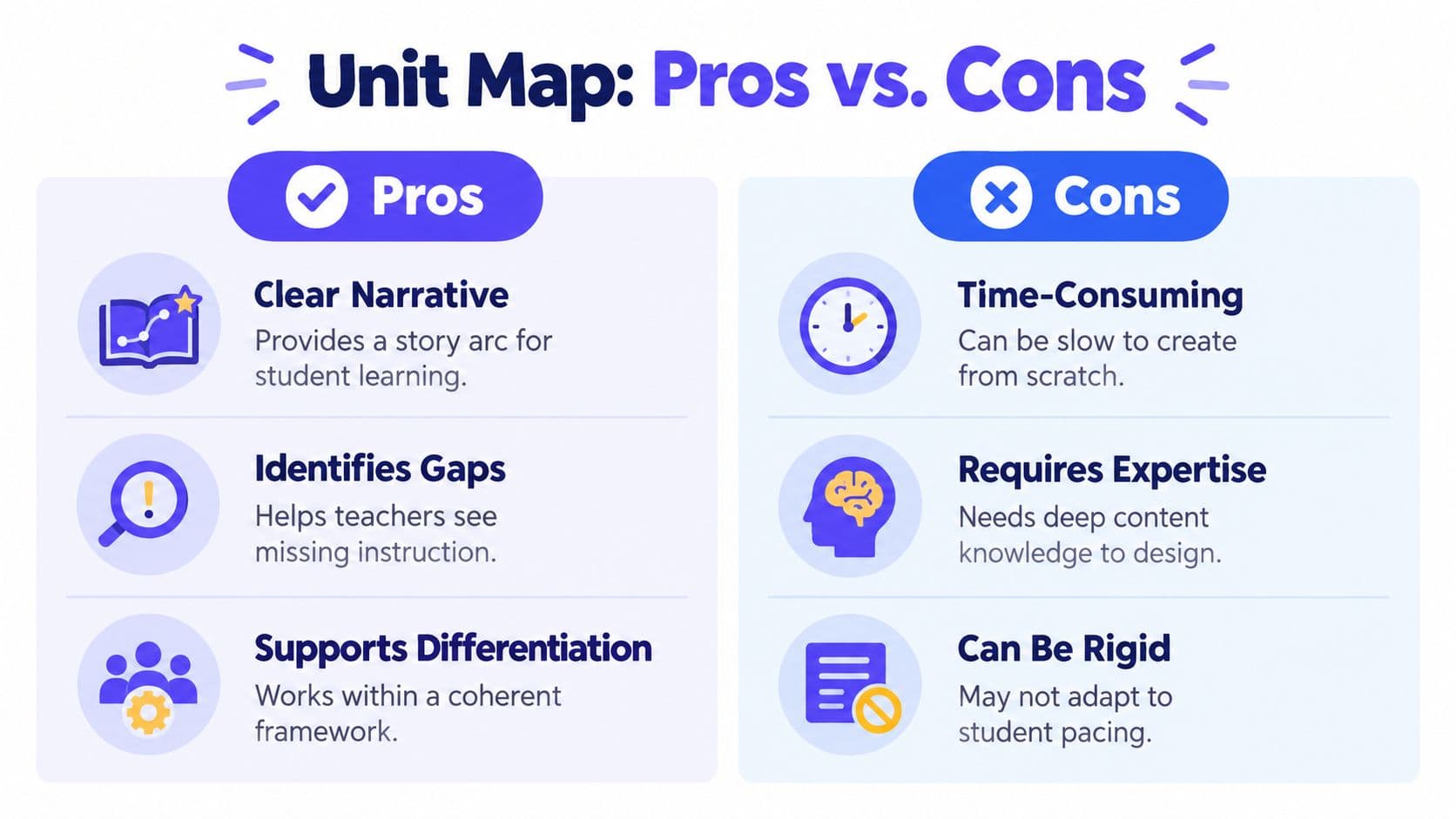
A unit map organizes related lessons around one central idea, standard, or question. Instead of treating every lesson as a separate event, it shows the instructional arc, from the opening hook through guided practice and formative checks to the final demonstration of learning.
Consider a middle school science unit on photosynthesis. Students might begin by observing how plants respond to light, conduct daily labs, interpret evidence, and build toward a final project presentation. An elementary class could study community helpers through field trips, guest speakers, informational reading, and reflection journals. In high school American literature, students might explore identity across several texts, discussions, and analytical writing tasks.
Teacher notes that keep the unit coherent
Start with the summative task. Ask what students must know, understand, or produce at the end, then work backward to identify the knowledge and practice they'll need. This approach prevents engaging activities from taking over the unit without contributing to the intended outcome.
Build checkpoints into the map rather than waiting for the final assessment.
- Use quick evidence: Exit tickets, short explanations, annotated work, and conferences can reveal misconceptions early.
- Protect flexibility: Mark places where you may reteach, extend, or compress learning based on student evidence.
- Create an entry point: A demonstration, puzzling image, short investigation, or authentic problem gives students a reason to care about the unit.
A unit map isn't a pacing script. It's a planning frame that helps you see whether each lesson earns its place. Kuraplan's unit plan generation feature can help produce a standards-aligned structure, progressive objectives, and assessment opportunities, so you can spend more time refining the learning experience than formatting a template.
2. Scope And Sequence The Year-Long Roadmap
A scope and sequence gives you the wide-angle view. The scope identifies the standards, topics, and skills students should encounter, while the sequence places those elements in an intentional order across the year or course. PowerSchool describes a basic curriculum map as including standards and sequence, with sequence meaning the order in which teachers teach those standards (PowerSchool's beginner guide).
A K–12 mathematics sequence might show how students move from counting and operations toward algebra, geometry, and calculus. An elementary language arts map can coordinate phonics, fluency, comprehension, vocabulary, and writing. A science map for the primary grades might spiral life science, earth science, and physical science so students revisit ideas with increasing complexity.
The roadmap needs room for real school days
Don't fill every available day with new content. Assemblies, field days, testing windows, absences, intervention, and unexpected reteaching all affect the calendar. A usable scope and sequence includes breathing room and identifies priority learning when time becomes tight.
Before finalizing the sequence, ask colleagues:
- Check prerequisites: What did students learn last year, and what will the next teacher assume?
- Compare calendars: Are major projects or assessments competing across classrooms?
- Review actual pacing: Which units regularly run long, and which consistently finish early?
- Mark flexibility: Where can enrichment, intervention, or review fit without disrupting the progression?
A scope and sequence should support coordination, not force every teacher into identical daily lessons. Tools such as Kuraplan can help connect the sequence to standards while leaving teachers room to respond to the students in front of them.
3. Standards-Aligned Map Ensuring Rigor And Accountability
A standards-aligned map places learning expectations at the center of planning. Each lesson objective, activity, and assessment should have a genuine relationship to a standard, but that relationship needs to be more meaningful than copying a standard into a planning box.
A third-grade reading map might connect a unit to literature standards, informational text analysis, and evidence-based writing. A seventh-grade mathematics map could trace how algebraic reasoning develops across a series of lessons. In high school biology, the map might connect investigations and performance tasks to NGSS performance expectations and disciplinary dimensions.
The most common mistake is artificial alignment. If students complete a colorful activity that doesn't require the targeted reasoning, the activity isn't aligned solely because the standard appears beside it. Remove it, revise it, or identify the actual learning it supports.
Use the map to inspect cognitive demand
Look at what students are being asked to do, not only what topic they're studying. Color-coding or tagging objectives by cognitive demand can reveal a sequence filled with recall when students are expected to analyze, model, argue, or apply knowledge.
Practical rule: A standard belongs on the map only when students have a real opportunity to demonstrate the skill it names.
State progression documents are particularly useful here because standards rarely stand alone. They show how expectations develop across grades and can prevent a teacher from reteaching an earlier skill without deliberately extending it.
Kuraplan's Australian Curriculum alignment tools offer one way to connect lesson objectives with curriculum expectations. Whether you use software or a shared team document, review every alignment for authenticity. The map should make instructional decisions clearer, not create a compliance exercise.
4. Vertical Alignment Map Building Coherence Across Grade Levels
A vertical alignment map follows a skill or concept across grades. It exposes the points where students should first encounter an idea, practise it with support, and eventually apply it independently in more complex contexts. The matrix commonly places grade levels along one axis and skills or outcomes along the other, making gaps and unnecessary repetition easier to spot.
A writing progression might trace sentence combining from the early grades through increasingly advanced sentence control in upper elementary. A K–5 phonics map could show how decoding instruction develops alongside reading demands. A grades 3–8 fractions map might follow the progression from parts of a whole to equivalence, comparison, and operations.
Start with one strand, not the entire program
Teams often make vertical mapping too ambitious. Begin with one high-priority skill that affects later learning, such as evidence-based writing, fraction reasoning, decoding, or scientific explanation. Invite teachers from each grade, along with special education and inclusion staff where relevant. Classroom teachers know which prerequisites students possess and where the written progression doesn't match classroom reality.
For each grade, record:
- First exposure: What does introduction look like at this readiness level?
- Reinforcement: Where do students practise the skill in new contexts?
- Advancement: What makes the next stage more complex?
- Evidence: What student work demonstrates development?
- Support: What scaffolds or alternate access points are needed?
A vertical map shouldn't dictate one method for every grade. It should clarify the destination and the progression while preserving age-appropriate instruction and differentiation. Review it annually, especially after examining student work from transitions between grades. A map becomes valuable when teachers use it to adjust the next opportunity, not when it sits unchanged in a shared drive.
5. Subject-Specific Curriculum Map Deepening Content Expertise
A subject-specific map goes deeper than a general standards list. It shows how concepts, practices, vocabulary, and disciplinary ways of thinking connect within mathematics, science, English, music, or another field.
An AP Biology map might organize learning around investigation, data analysis, ecology, and systems thinking. A middle school English map could develop students' ability to read like writers, analyze craft, and study how authors make deliberate choices. An elementary science map might begin with phenomena, then guide students toward models and explanations of systems.
Victoria Boler's elementary music example illustrates why disciplinary concepts matter. Her curriculum outline organizes learning around transferable musical ideas such as rhythm and pitch, rather than treating songs as isolated activities. The map identifies broad content, while the teacher still decides how students will sing, listen, perform, compose, and discuss (elementary music curriculum mapping example).
Let the discipline shape the sequence
Start with three to five big ideas or essential questions that give the subject coherence. Then connect standards to those ideas instead of allowing the standards list to become the entire vision. In science, students should investigate and explain phenomena. In English, they should read, write, speak, and revise as language users. In mathematics, they should reason, represent, justify, and apply.
Include authentic practices in the map:
- Read like a scientist: Interpret data, evaluate sources, and construct explanations.
- Write like an author: Study craft, draft deliberately, and revise for effect.
- Think like a mathematician: Represent relationships, test strategies, and explain reasoning.
Kuraplan can support these tasks by generating inquiry-based lesson structures, age-appropriate scaffolds, and differentiated activities aligned to the subject's purpose. The teacher still decides whether the task reflects authentic disciplinary thinking. That judgment can't be outsourced to a template.
6. Interdisciplinary Curriculum Map Connecting Learning Across Subjects
An interdisciplinary map brings several subjects together around a meaningful theme, problem, or question. The strongest versions do not merely attach a writing assignment to a science topic. They give each discipline a genuine role in understanding the problem.
A grade five water systems unit could combine science learning about the hydrologic cycle, mathematics involving measurement and data, social studies focused on global water access, and persuasive writing about conservation. A middle school sustainable design project might involve material science, energy, scaling, budgeting, engineering, and design thinking. High school students could study social justice through history, literature, sociology, and argument writing.
Give every subject an authentic job
Begin with the essential question, not a collection of standards you hope to squeeze together. Assign each standard to the discipline best positioned to teach it, and don't force every subject to appear in every lesson. One teacher or coordinator should manage the shared timeline, materials, and communication, especially when several classrooms are involved.
Build checkpoints that make learning visible:
- Subject checkpoint: Students demonstrate the discipline-specific skill.
- Integration checkpoint: Students use knowledge from more than one subject.
- Final application: Students solve, explain, design, or argue in an authentic format.
Kuraplan can help teams identify standards that naturally connect and generate lessons that address more than one expectation without reducing either subject to decoration. Review the proposed connections carefully. Integration is useful when it deepens understanding, not when it merely makes a unit sound more engaging.
A short visual explanation can help teams discuss how integrated learning should work in practice.
7. Assessment-Aligned Curriculum Map From Learning Goals To Evidence
An assessment-aligned map starts with evidence. Instead of listing activities first, identify the performance or understanding students must demonstrate, then design formative checks and instruction that prepare them for that evidence. This reflects backward design and makes assessment part of the curriculum rather than an event added at the end.
In a grade four fractions unit, students might complete a performance task involving a fair recipe, while number talks, exit tickets, and teacher observations reveal how their reasoning develops. A persuasive writing unit could build toward a final essay through peer review, evidence-gathering checks, and observation protocols. In high school chemistry, a culminating lab design project might be supported by quizzes, problem-solving exit tickets, and peer assessment.
Map evidence, not just assessment titles
For each outcome, specify what students will produce or do and what the teacher will look for. A study of curriculum mapping in medical education found that not all expected outcomes were assessed equally, and self-directed learning had no direct assessment in the mapped curriculum. The researchers also reported that more than 75% of students achieved passing scores in most assessments, while problem-based learning scores showed weak or no correlation with several other assessment modes (medical curriculum mapping study). The practical lesson is clear. A map can reveal that students are passing assessments while some important outcomes still lack direct evidence.
Share rubrics and success criteria from the beginning. Use varied evidence, including:
- Formative checks: Questions, conferences, quick writes, demonstrations, and exit tickets.
- Performance evidence: Designs, investigations, presentations, models, and authentic products.
- Student reflection: Self-assessment and explanations of strategy or decision-making.
- Differentiated access: Alternate formats that preserve the intended outcome without lowering expectations.
Kuraplan's formative assessment examples can support the planning of quick checks, rubrics, and differentiated versions. The map should show what each assessment tells you and what instructional decision follows. If a check produces information you won't use, it may not belong in the sequence.

7 Curriculum Map Types Compared
| Map Type | Implementation Complexity 🔄 | Resource Requirements ⚡ | Expected Outcomes ⭐/📊 | Ideal Use Cases 💡 | Key Advantages ⭐ |
|---|---|---|---|---|---|
| Unit Map: The Foundation of Focused Learning | 🔄🔄 Moderate, 2–4 week arc | ⚡ Moderate time; teacher content knowledge | ⭐ Coherent learning arc; 📊 clearer pacing & differentiation | 💡 New topic introduction; short-term unit planning | ⭐ Clear narrative; identifies gaps; supports differentiation |
| Scope & Sequence: The Year-Long Roadmap | 🔄🔄🔄 High, year-long coordination | ⚡ High (team planning, pacing) | ⭐ Full-year coherence; 📊 prevents redundancy & gaps | 💡 School/grade-level annual planning; vertical alignment | ⭐ Consistency; aids resource allocation & long-term planning |
| Standards-Aligned Map: Ensuring Rigor & Accountability | 🔄🔄🔄 High, precise standards mapping | ⚡ High (standards expertise, documentation) | ⭐ Transparent standards coverage; 📊 accountability evidence | 💡 Compliance, evaluations, standards-based reporting | ⭐ Clear standard ties; supports walkthroughs & communication |
| Vertical Alignment Map: Building Coherence Across Grades | 🔄🔄🔄 High, cross-grade collaboration | ⚡ High (PLCs, release time) | ⭐ Smooth progression; 📊 reduced repetition & gaps | 💡 Department/cluster planning; grade transitions | ⭐ Clarifies skill ownership; improves K–12 coherence |
| Subject-Specific Curriculum Map: Deepening Content Expertise | 🔄🔄🔄 Moderate–High, depth over breadth | ⚡ Moderate–High (specialized resources, expertise) | ⭐ Deep disciplinary mastery; 📊 stronger transfer within subject | 💡 AP/advanced courses; strengthening disciplinary literacy | ⭐ Authentic practices; rich, meaningful instruction |
| Interdisciplinary Curriculum Map: Connecting Across Subjects | 🔄🔄🔄🔄 Very High, integrated planning | ⚡ High (scheduling, cross-subject coordination) | ⭐ Greater relevance & engagement; 📊 improved transfer | 💡 Project-based learning; thematic, real-world problems | ⭐ Integrated learning; efficient use of instructional time |
| Assessment-Aligned Curriculum Map: From Goals to Evidence | 🔄🔄🔄 High, backwards-design rigor | ⚡ High (assessment design, rubrics, training) | ⭐ Measurable mastery; 📊 actionable formative data | 💡 Outcomes-based units; progress monitoring & interventions | ⭐ Evidence-driven instruction; clear success criteria |
Putting These Maps Into Practice
You don't need to map the entire curriculum before the work becomes useful. Choose the problem that is costing students or teachers the most. If lessons feel disconnected, start with a unit map. If content is missing across the year, build a scope and sequence. If students arrive in the next grade without essential prerequisites, map one strand vertically. If assessment results don't show whether important outcomes were learned, begin with an assessment-aligned map.
Keep the first version deliberately usable. A Massachusetts Model Curriculum Map template uses columns for Time, Standard, Curriculum Unit Connections, and Assessments, and recommends deciding the map elements and column headings before drafting (Massachusetts curriculum map guide). That simple design is a useful reminder that more columns don't automatically produce better planning. Add resources, differentiation notes, vocabulary, or interdisciplinary links only when they help a teacher make a real decision.
Curriculum mapping is also different from pacing documentation. A map can list standards, skills, and assessments for each unit, while a pacing guide breaks those units into weeks or smaller time segments (curriculum map and pacing guide comparison). Keep those tools connected, but don't ask one document to do every job.
Use the map in team meetings, planning sessions, and assessment reviews. Assign ownership when a gap appears. Decide what gets revised first, which teacher or team will make the change, what evidence will be collected, and when the map will be reviewed again. This decision stage is where many examples stop, but diagnosis without action won't improve alignment.
Kuraplan can help teachers turn standards into unit structures, sequential lessons, worksheets, visuals, and assessment rubrics. Use it to reduce template hunting and repetitive formatting, then apply your knowledge of students, readiness levels, inclusion needs, and available time. The best map gives teachers shared direction while preserving the flexibility to teach real children rather than an imaginary average class.
Visit Kuraplan to create standards-aligned unit plans, differentiated learning materials, and formative or summative assessments that support curriculum mapping. Start with one unit or skill strand, use the generated structure as a draft, and refine it with your team around the evidence your students produce.