The most popular advice on differentiation tells you to make three versions of everything, offer nine choices, and level every text. Don't. That version burns your Sunday and still leaves half the class doing easier science. Differentiated instruction in science that holds up under lab conditions starts smaller. You keep one phenomenon, one target every student has to defend with evidence, and you change only the route into it. Two levers moved well beat five moved badly.
Four Levers and Five Elements You Can Change
Say you're running a grade 7 density lab tomorrow. A third of the class already separates mass from volume cleanly. Another third still says the heavier block must be denser, even when it's twice the size. The rest can do the calculation but can't tell you what the number means. One worksheet at one pace won't touch all three problems, and three unrelated labs will eat your prep period.
Start with the rule, because everything else hangs on it. Differentiation keeps one disciplinary target and changes the route. It doesn't hand some students easier science. The National Science Teaching Association guidance on differentiated instruction in science describes adapting content, process, and product to students' readiness, interests, and learning profiles while preserving access to challenging science. The toolkit is familiar, flexible grouping, cooperative learning, stations, tiered assignments, multimedia, inquiry, problem-based learning, and alternative assessments. What matters is that students investigate the same phenomenon while getting different scaffolds, data representations, or ways to communicate an explanation.
The Four-Lever Card
Fill this in before you rewrite anything. It takes five minutes and it stops the usual drift, where you change the task so much that one group ends up coloring a diagram while another reasons.
| Lever | What you change | What stays fixed | Density example |
|---|---|---|---|
| Content | Text, diagram, or video | The concept itself | Labeled diagram or short reading of mass divided by volume |
| Process | Prompts, data complexity, or grouping | The question the data must answer | Highlighted axes versus a raw data table |
| Product | Paragraph, model, or talk | Claim, evidence, and reasoning | Labeled model or written explanation |
| Assessment | Timing and format of the check | Shared success criteria | Oral check or written exit ticket |
Content may swap a dense paragraph for a labeled diagram or a two-minute clip. Density still stays mass divided by volume. Process may change the prompt, the data complexity, or who's grouped with whom. The data still has to answer the same question about why one block sinks and the other floats. Product may be a claim-evidence-reasoning paragraph, a labeled model, or a short explanation to a partner. Assessment may change timing and format, an oral check today instead of a written one. The success criteria don't move.
Practical rule: If you can't state the fixed target in one sentence, you're not differentiating yet. You're just making versions.
The Five Elements Behind the Levers
The card tells you what you can change. It doesn't tell you what a particular student needs changed. That's where Carol Ann Tomlinson's framework in Science Scope helps, because it widens the list to five elements teachers can adjust: content, process, product, affect, and learning environment. Each one can be varied by readiness, interest, or learning profile.
- Content: Leveled text, a diagram with the axes labeled, or the same reading with two terms pre-taught.
- Process: Stations, guided inquiry, or a partially completed data table that still requires a decision.
- Product: A model, a written explanation, or a presentation, all judged on the same criteria.
- Affect: Confidence and belonging. This matters more than it sounds. A student who's been told, directly or not, that they're not a science kid will pick the safest product every time unless you change how risk feels in the room.
- Learning environment: Seating, materials, lab partners, noise. Who handles the balance and who records is an environment decision, and it decides who thinks.
Two parts of that framework deserve underlining. Respectful tasks sit slightly above a learner's current comfort level, not at it and not below it. And continual assessment, not a September placement test, decides when you reteach a prerequisite for some students while extending others. Formative checks can happen at different times or with different frequencies. That's a lever too, and it's the cheapest one you own.
Don't change all five at once. You'll never know which one worked, and you'll be up late rebuilding materials you didn't need to build. I'd start with process and product for most labs, because they're fast to adjust and they don't require new readings. Content changes cost the most time and usually deliver the least, since the barrier is rarely the paragraph itself. It's what students have to do with the paragraph.
Before your next lesson, pick two elements and leave the other three alone. Write the unchanged target in one sentence at the top of your plan. Then check both versions against that sentence and cut anything that drifts away from it.
Scaffold One Investigation Without Lowering It
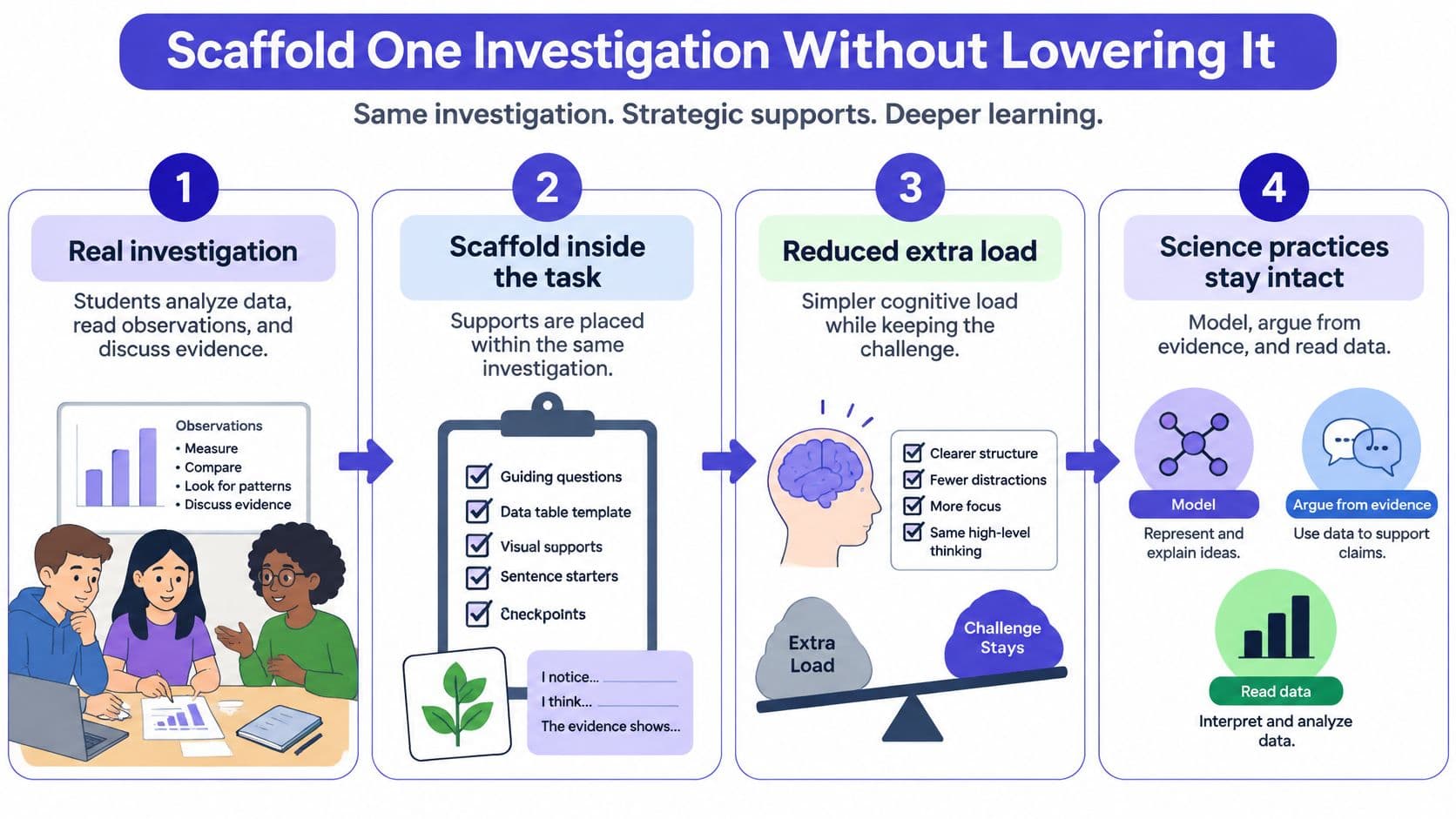
A scaffold earns its place by doing one job. It removes load that isn't the science, so the student can spend effort on the science. When it removes the science instead, you've built a shortcut that looks like support and behaves like a lowered goal.
Why the Support Sits Inside the Task
The National Academies guidance on science learning recommends embedding scaffolds within authentic investigations rather than bolting easier work onto the side. Prompts can highlight decision points, make data patterns more visible, structure inquiry steps, and require students to check whether claims are supported by evidence. The mechanism is straightforward cause and effect. Temporary cognitive supports reduce extraneous task demands, and that reduction lets students with different prior knowledge or language proficiency take part in modeling, argument from evidence, and data interpretation instead of watching a partner do it.
So plan one phenomenon and one investigation for everybody. Then vary the representation, the procedural prompt, the vocabulary support, the complexity of the data, or the response format. You're changing access, not ambition. If you want the longer version of this logic, the guide to scaffolding in education lays out how to layer and withdraw support across a unit.
Match One Scaffold to One Barrier
Vague support helps nobody. Name the barrier in plain words, pick the smallest scaffold that addresses it, and write down when it comes off.
- Diagnose the barrier: Say it's graph reading. The student stares at the plot and describes its shape instead of pulling values from it.
- Add the matching scaffold: Highlight the axes, add one prompt asking what changes and what's measured, and require two data features in writing before any claim.
- Set the removal condition: The highlight disappears once the student independently cites two relevant data features in a written explanation.
- Check the goal survived: The student still has to connect those features to a claim. Nothing about the reasoning got easier.
That last step is where most scaffolding fails. Support that never fades replaces reasoning rather than bridging to it. A sentence frame that a student fills in for three months is no longer a scaffold. It's a form. Put the removal condition on your planning notes, not in your head, because in a busy lab you'll forget which student was supposed to lose which prompt.
A scaffold without a removal condition is a permanent crutch with good intentions.
Accommodation Is Not Modification
Keep these two separate or your grades stop meaning anything. An accommodation changes access. A modification changes the goal. A multilingual learner gets a word bank and a sentence frame, and still must cite evidence and link it to the claim. A student who needs access support gets a larger data table, higher contrast print, or a tactile model of the same pattern, and still interprets that pattern. Neither student gets excused from reasoning.
Modification has a legitimate place for individual students under formal plans, but it isn't differentiation for a whole group. When you drop the reasoning requirement for your lowest table, you've changed what's being learned, and you can't score the work against the same criteria.
Kuraplan can draft graduated prompts from a shared objective, which saves the typing. You still check every version by hand and confirm each one demands evidence. That check takes two minutes and it's the difference between access and dilution.
Build an Ecosystems Unit with All Most Few
Unit planning is where differentiation usually collapses into three parallel courses that never meet. You end up maintaining three sets of materials, three pacing problems, and no common conversation at the end of the week. There's a tidier structure.
What the Three Tiers Actually Mean
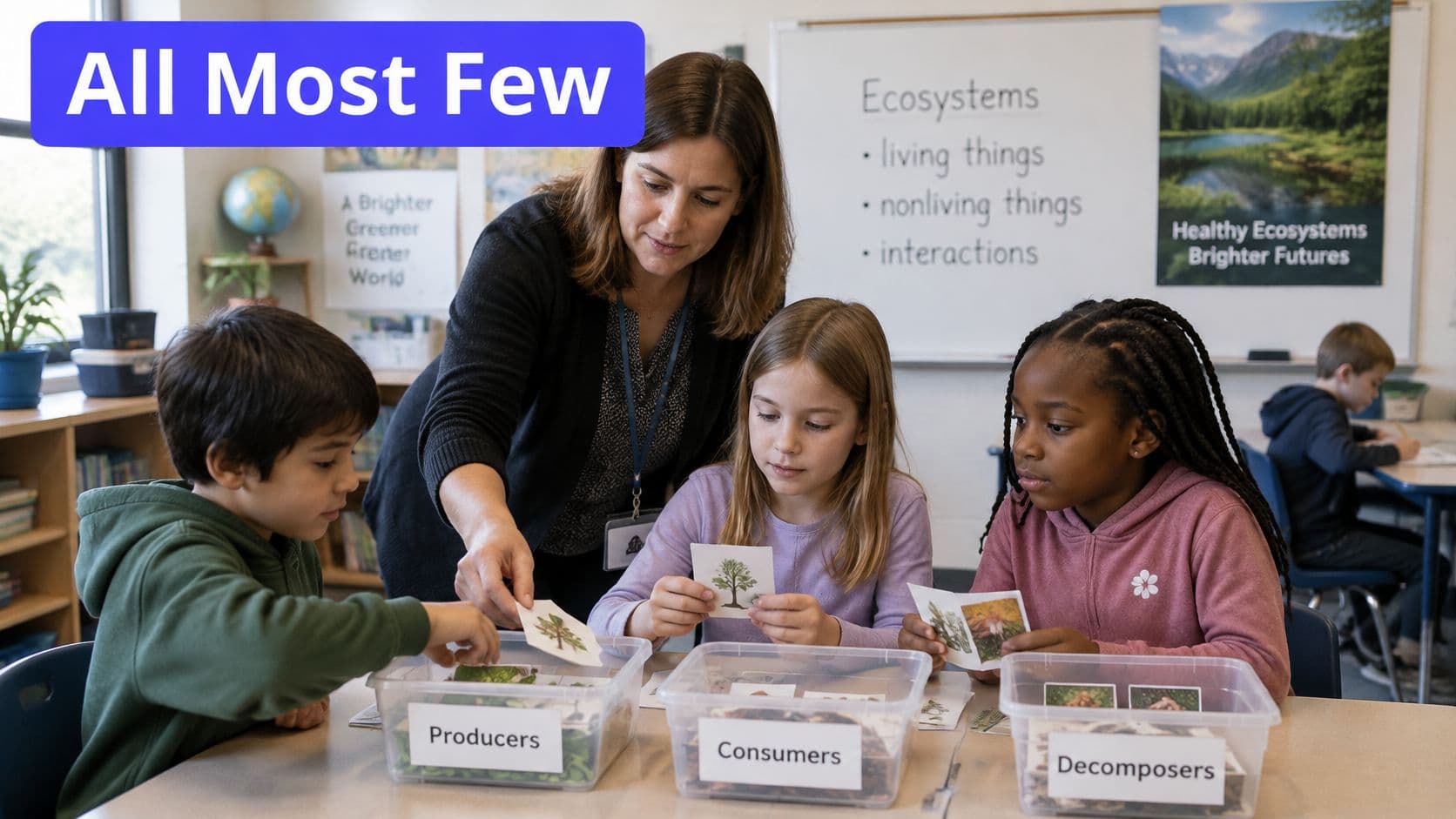
The National Science Teaching Association model for three-dimensional planning uses All, Most, Few to keep one unit intact. All identifies the concepts and skills every student must develop. Most adds higher-level concepts or skills expected for the majority. Few provides extension work for students with advanced skills or strong interest. The tiers sit alongside two to four essential questions, explicit connections to Crosscutting Concepts, Disciplinary Core Ideas, and Science and Engineering Practices, and daily formative assessment.
Read that carefully. Few is not a reward packet for fast finishers, and All is not the watered-down lane. All is the floor nobody skips. Few is depth in the same idea, not extra volume. A student who finishes early and gets twenty more vocabulary words has been given more work, not better work.
A Grade 5 Pond Unit
Take a pond food web. Start by connecting the pond to places students already know, a drainage ditch, a park, a fish tank, so the system feels observable rather than textbook. It's worth having students find ecosystems in everyday places before you hand them a diagram, because a system they've stood next to is far easier to reason about than an abstract web of arrows.
All students interpret evidence about the pond food web and state one energy-transfer claim. Most students explain an interaction using two variables, such as light and population, so algae growth isn't just a story, it's a relationship they can point to. A few students test a competing model or design a small follow-up investigation, asking what would happen to the heron if the minnows dropped for a reason other than food. Same phenomenon, same core idea, different depth.
| Tier | Student task | Unchanged target |
|---|---|---|
| All | Interpret pond evidence and state one energy claim | Energy moves through feeding relationships |
| Most | Explain an interaction using two variables such as light and population | Same energy-transfer idea with variable reasoning |
| Few | Test a competing model or design a small follow-up | Same energy-transfer idea at greater depth |
Before the unit opens, pre-assess the misconception you're most likely to meet. In ecosystems it's often the idea that bigger animals always hold more energy, so the heron must contain more energy than all the algae combined. Three short items will surface it. Then group students only for that reasoning need, and only for as long as it takes. A group built around one misconception should dissolve once the misconception does.
Daily exit tickets do double duty here. Score the shared objective, can the student state and support an energy-transfer claim, and score the barrier separately, does the student still equate body size with total energy. Then regroup tomorrow based on what you saw. The ecology worksheets collection is a reasonable starting point for food web practice sets if you need tiered prompt cards quickly, but adapt the questions so they hit your specific misconception rather than generic recall.
The Version a Substitute Can Run
If your differentiation can't survive your absence, it's too fragile. Build one period that runs on a single page of instructions. Same water-sample data for everyone, three prompt cards matched to All, Most, and Few, and one shared rubric. The substitute doesn't need to know your grouping logic. Students pick up the card color you assigned yesterday, and the work still points at the same target. That constraint is useful even when you're present, because it forces you to write prompts a student can follow without you translating them across the room.
Score the Explanation Not the Product
Choice in product only works if the scoring ignores the product. The moment a polished poster outscores a plain paragraph with better reasoning, students learn the lesson, which is that presentation beats thinking. They learn it fast.
One Rubric for Every Format
Score claim, evidence, and reasoning and nothing else on the main rubric. The same rows apply whether the student hands you a paragraph, a labeled model, or a short recorded explanation.
| Level | Claim | Evidence | Reasoning |
|---|---|---|---|
| 4 | Matches the phenomenon | Two or more relevant data features | Names the science idea that links them |
| 3 | Mostly matches the phenomenon | One relevant feature | Link is partial |
| 2 | Vague or off target | Weak or irrelevant feature | Restates an observation |
| 1 | Missing or copied from the prompt | None | No link between evidence and claim |
At level 4 the claim matches the phenomenon, at least two data features are cited, and the reasoning names the science idea connecting them. Level 3 mostly matches, uses one relevant feature, and links it only partially. Level 2 goes vague, reaches for a weak or irrelevant feature, and restates an observation as if that were an explanation. Level 1 copies the prompt, cites nothing, and makes no link at all.
Add one separate narrow row only for the scaffold you're currently fading, graph reading, for instance. Score it, track it, and stop scoring it once the student works independently. Keeping that row on the main rubric forever punishes students for a support you've already withdrawn.
Don't award extra points for a longer lab report when the extra length isn't new evidence. Length is the easiest thing to inflate and the least informative thing you can grade. If you need models of quick checks that feed this kind of scoring, these formative assessment examples show formats short enough to mark between periods.
Two Responses, Same Lab
Compare two density answers. The strong one says the aluminum block is less dense than the steel block of the same volume. It cites the measured masses at equal volume and states that density is mass per unit volume, so less mass packed into the same space means lower density. Claim, two features, named idea, link. That's a 4, even if it's four lines long and the handwriting is rough.
The other response completed every procedural step. It lists the equipment, records the masses, fills the table neatly, and concludes that the experiment worked and the results were interesting. It never connects evidence to a claim. Every box ticked, no explanation. That's a 1 on reasoning and it should be, however tidy the page looks.
Mark the claim and the evidence link first. Comment on grammar afterward, if there's time and if it still matters.
That order matters for multilingual learners especially. Correcting articles and verb endings before you've responded to the reasoning tells the student their thinking was the least important part of the page. Kuraplan can attach a standards-aligned rubric to a lesson, which is handy when you're building materials at speed. Edit it before you print. If task completion sits anywhere in the rubric with points attached, pull it out, or completion will outrank reasoning by the third week of term.
What Science Studies Do and Do Not Prove
Here are the numbers first, because they're stronger than most teachers expect. Then the caveats, because they matter more than the numbers.
What the Results Actually Say
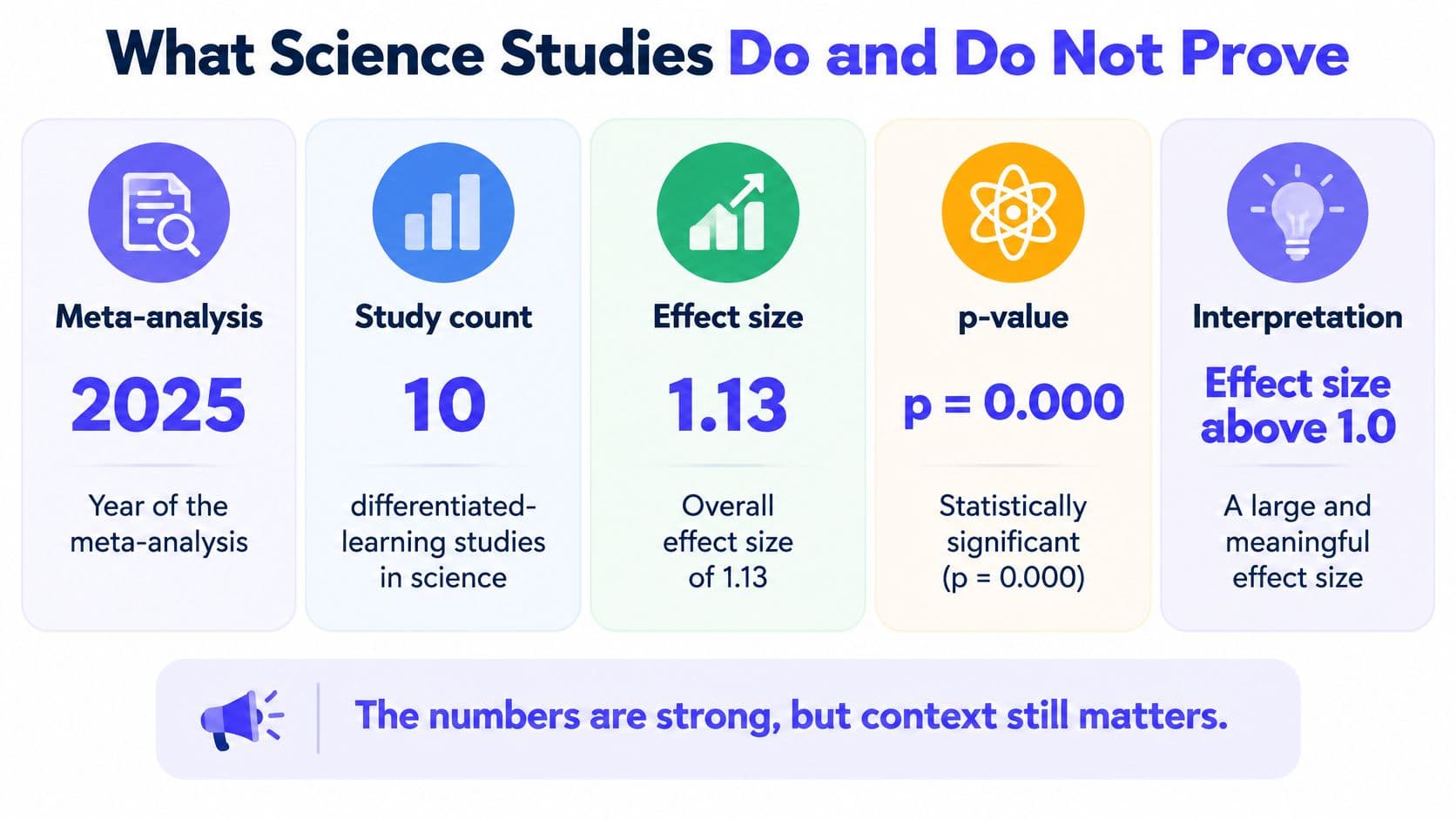
A 2025 meta-analysis of 10 studies of differentiated learning in science reported an overall effect size of 1.13, with statistical significance at p = 0.000, below the conventional 0.05 threshold. An effect size above 1.0 is generally considered large. Interpretation still depends on study quality, design, sample characteristics, and the specific differentiation methods used, which is why a single headline number shouldn't settle your planning decisions.
A separate science intervention in the same report gives the result a classroom shape. The differentiated-instruction group increased its mean score from 69.33 on the pretest to 86.17 on the posttest, a gain of 16.84 points. The comparison group rose from 70.83 to 80.83, a 10-point gain. The between-group result was statistically significant, with t = 2.104, 58 degrees of freedom, and p = 0.04. Both groups improved, which is what you'd hope from teaching at all. The differentiated group improved more.
| Source | Scores or effect size | Change | Note |
|---|---|---|---|
| 2025 meta-analysis, 10 science studies | Overall effect size 1.13 | p = 0.000 | Large above 1.0, depends on study quality |
| Science intervention, differentiated group | 69.33 pretest to 86.17 posttest | +16.84 points | Differentiated tiers with the same concept |
| Science intervention, comparison group | 70.83 pretest to 80.83 posttest | +10 points | Conventional instruction |
| Between-group result | t = 2.104, df = 58 | p = 0.04 | Significant, so implement with care |
What This Does Not License
Treat those findings as a reason to implement carefully, not as proof that any choice board works. The gains belong to instruction that responded to differences in readiness, learning needs, or participation. They don't transfer automatically to anything labeled differentiated.
Four versions waste the effect. Permanent ability groups freeze a September judgment for a full year. A thinner textbook for some students cuts the concept rather than the barrier. Twenty individual lesson plans collapse by Wednesday and take your feedback quality down with them. A worksheet that only changes the font isn't a tier, it's decoration. If you want the reasoning side pushed further, particularly for older students, it helps to teach critical thinking in AP classrooms as an explicit skill rather than assuming tiered tasks produce it on their own.
The version that matches the evidence is narrower and less glamorous. Pre-assess the misconception. Form a short flexible group around that specific need. Tier the complexity while the concept stays put. Then regroup. Apply one final test to anything you've built. If a tier cannot produce a comparable evidence-based explanation, it isn't differentiation. It's a different goal wearing differentiation's name.
Start the Next Unit from One Phenomenon
Decide your next unit by writing three things on one sticky note. One phenomenon. One standard. One sentence every student must defend with evidence by the end. If you can't write that sentence, no tiering strategy will rescue the unit, because you don't yet know what the tiers are tiers of.
Build access after that, not a second curriculum. Keep the sequence short enough to run on a tired Thursday.
- Pre-assess the likely misconception with three short items, scored the same day.
- Lock All, Most, and Few so All is the explanation nobody skips and Few is depth, not volume.
- Draft two scaffolds, each tied to a named barrier with a written condition for removal.
- Choose products that all feed the same claim, evidence, and reasoning rubric.
- Plan the exit ticket that will regroup the class tomorrow, before you plan anything decorative.
Kuraplan fits after the target is written, not before. It maps objectives to standards, generates differentiated materials, and can turn the lesson into worksheets with age-appropriate questions, so the drafting stops eating your evening. Treat it as a draft partner rather than an authority. AI-generated tiers can lower the very goal you're trying to protect, and they won't flag it when they do.
Audit the output before you print. Does the standard still match what you wrote on the sticky note? Did a lower reading level delete the science idea along with the hard vocabulary? Do the diagrams work for a student who needs larger print or can't rely on color to read a legend? Are the group labels neutral, or have they turned into deficit tags a student could read over your shoulder? Is the ambitious outcome still sitting in the All tier?
Override any suggestion that drops the goal, and keep student data out of tools where it doesn't belong. A busy week doesn't need a rewrite of your whole year. It needs one investigation, built once, with access thought through. Start there and let it be enough.
Open Kuraplan, enter your phenomenon and standard, and generate one science lesson with tiered prompts, lab worksheets, and a shared rubric built around a single target. Audit the draft against your removal conditions, edit anything that lowers the goal, and print materials your whole class can reason from tomorrow.