You know the moment. One student finished in two minutes and is already looking around, another is frozen on the first problem, and the rest are somewhere in the middle, trying to stay with you while the room pulls in three directions. That's exactly where math differentiation strategies earn their keep, because the point isn't to create a separate lesson for every child, it's to make the same mathematical goal reachable from different starting points.
The best part is that differentiation doesn't have to become another planning mountain. A strong approach starts with a few smart moves, uses student data to guide the next step, and keeps the work focused on the same concept. If you're looking for maths practice for top grades, this maths practice for top grades resource can sit alongside the classroom routines below, but the lift still happens in how you structure the lesson.
1. Tiered Assignments and Tasks
Tiered work is one of the cleanest ways to differentiate without fragmenting the class. Everyone works toward the same standard, but the task is shaped to match readiness, so the content stays aligned while the supports change.
A fraction lesson is a good example. One group compares halves and fourths with visual models, another finds equivalent fractions on number lines, and a third adds and subtracts unlike denominators. A geometry lesson can work the same way, with one group sorting 2D shapes, another classifying by properties, and a third proving angle relationships.
Build tiers from the objective backward
Start with the learning goal, then design versions of the same task at different levels of scaffolding. The mistake I see most often is building an “easy” worksheet and a “hard” worksheet that barely connect. That turns differentiation into sorting instead of teaching.
A tighter approach keeps the standard fixed and changes the entry point. In an elementary multiplication lesson, every student can still solve the same 10 problems, but one tier may use arrays and manipulatives, another may use partial products, and another may use the standard algorithm with multi-digit numbers. Kuraplan's differentiation features can help generate these tiered versions faster, especially when planning gets squeezed. See Kuraplan's differentiation guidance for a practical example of how planning can stay standards-aligned.
Practical rule: tier the path, not the destination. If the concept changes from group to group, you're not differentiating, you're teaching different lessons.
Color-coding materials also helps students move through the room without feeling publicly ranked. Rotating tiers periodically keeps one group from living in the same version all year, and letting students choose the strategy or representation inside a tier adds a welcome layer of ownership.
2. Flexible Small Group Instruction
Small groups work best when they're temporary, focused, and based on what students need right now. A group of 3 to 6 students is usually small enough to notice misconceptions quickly and large enough to keep the lesson moving.
Formative data matters most. Exit tickets, quick observations, and yesterday's work tell you who needs reteaching, who needs practice, and who's ready for extension. The value comes from how quickly you can pivot.
A 4th grade teacher might pull a group for multi-digit subtraction while the rest of the class works at stations. A middle school teacher might meet with advanced learners to extend algebraic thinking while others practice linear equations. In kindergarten, a teacher might work with a small group on subitizing while the rest of the class explores patterns and shapes.
Keep the group time short and intentional
Small-group instruction loses power when it becomes a long mini-lesson for a few students. Ten to 20 minutes is usually enough for one clear target, and then the group should dissolve or shift based on new evidence. That rhythm keeps the group responsive rather than fixed.
Independent work has to be independent, though. If the rest of the class needs constant help, the small-group structure collapses. Math centers, digital practice, or partner tasks can fill that gap, and Kuraplan's group generator can reduce the planning burden by helping you produce varied practice sets while you teach.
- Use exit tickets first: Group students from the evidence, not from habit.
- Keep groups fluid: Revisit every 2 to 3 weeks so the list stays current.
- Protect your focus: One small-group goal per session is usually enough.
3. Multiple Means of Representation
Some students need concrete objects first. Others can move straight to symbols. The strongest classrooms make both paths available without pretending they're interchangeable.
A fraction lesson can begin with physical fraction circles, move to drawn fraction models, and then land on notation like 1/4. Place value can follow the same pattern with base-10 blocks, quick sketches of tens and ones, and finally 40 + 7 or 47. That concrete, pictorial, abstract progression gives students more than one doorway into the same idea.
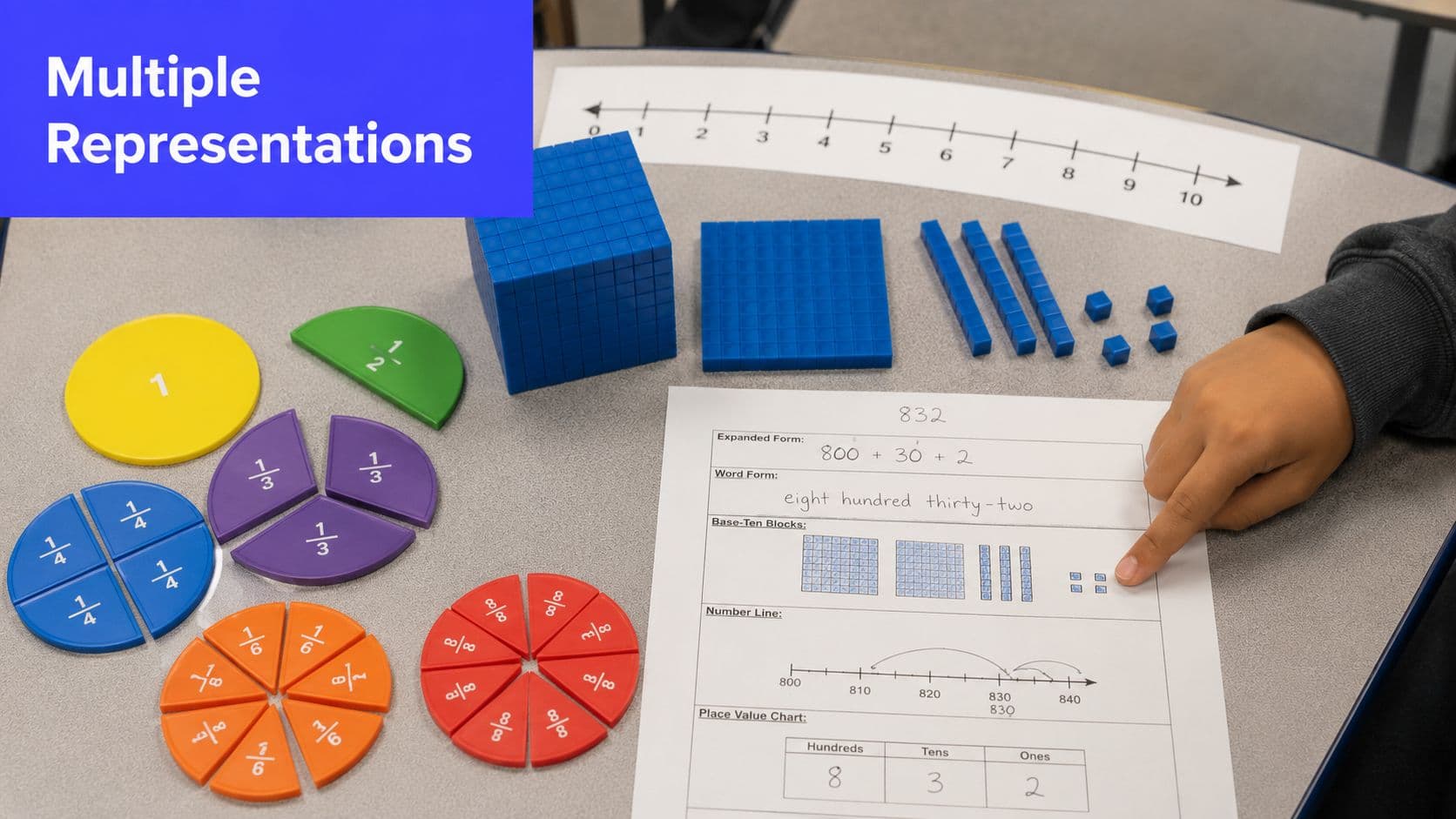
Teachers sometimes rush the abstract step because it feels cleaner. In practice, that shortcut can leave struggling learners guessing at symbols they don't yet own. The concrete and pictorial stages matter, especially when the math is new or the language load is high.
Make the movement between models explicit
Students don't always transfer on their own. If they can build 47 with blocks but can't explain 47 as 40 + 7, the representation work isn't finished yet. Ask them to explain the same idea in more than one form, because that translation is where understanding deepens.
Kuraplan's graphic organizers can help you build that bridge with custom visuals and age-appropriate diagrams. Label manipulatives, charts, and model cards clearly so students can access the representation they need without waiting for you to rescue them.
A useful habit: let students choose their entry point, but don't remove the other entry points. Choice is support, not a shortcut around the concept.
Later in the lesson, a short video can reinforce the same sequence.
4. Student Choice and Autonomy in Problem-Solving Strategies
Choice changes the tone of math class fast. When students can select a strategy that makes sense to them, the room feels less like a compliance exercise and more like actual thinking.
For multi-digit addition, one student might use place value columns, another might decompose into tens and ones, and another might count on. For fraction comparison, some students use benchmarks, others find common denominators, and others convert to decimals. They can all be right, and they don't need to solve the problem the same way to prove understanding.
Teach the menu before you hand over the menu
Choice only works when students know what the options are. Model multiple strategies first, then create a visible strategy menu or anchor chart so students can see how each one looks. Once they've practiced, ask a simple question like, “Why did you choose this method?” That turns strategy choice into reflection instead of guessing.
Strategy diversity builds flexibility. If every student always reaches for the same procedure, many of them are copying efficiency they don't understand.
There's a real trade-off here. Too much freedom too early can create messy work and inconsistent reasoning, especially for students who are still shaky with the concept. Too little freedom, though, teaches students that math is only about following the teacher's script. The middle ground is to keep the mathematical goal fixed and let the pathway vary.
For multi-step word problems, some students may draw, some may use bar models, some may write equations, and some may combine approaches. Kuraplan can generate varied practice problems with multiple solution routes, which makes it easier to rehearse flexibility before independent work begins. For a useful companion read, see problem solving methods.
5. Anchor Charts and Graphic Organizers with Multiple Entry Points
A good classroom reference wall does more than decorate the room. It gives students a way to keep going without stopping the lesson to ask for help every two minutes.
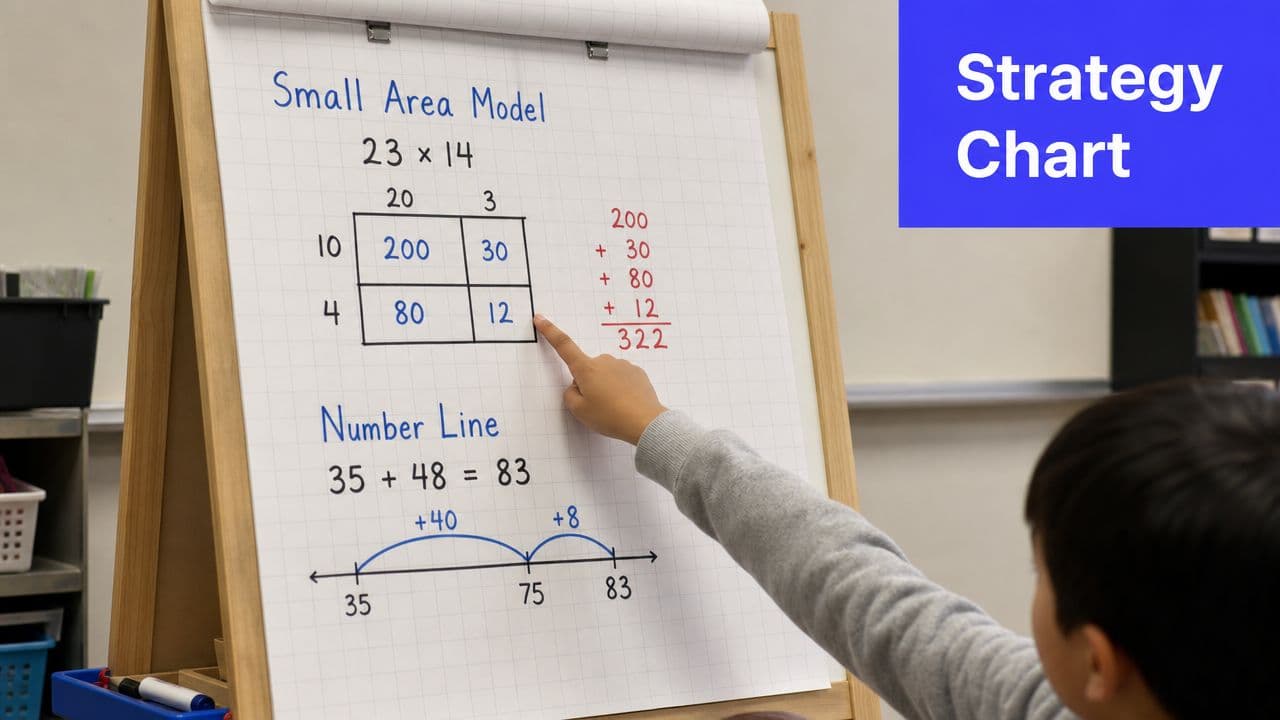
A multi-digit multiplication chart might show the area model, partial products, the standard algorithm, and a sample of student work. A problem-solving organizer might give space for drawings, equations, and written explanations, so students can use the section that matches how they're thinking. That kind of structure makes the environment itself part of the support system.
One reason this works is that it shifts some of the differentiation load away from the teacher. If the chart is clear and students know how to use it, they can self-select support instead of waiting for a prompt. That saves time and lowers friction.
Keep the visuals useful, not crowded
The most helpful charts are usually simple. If every corner is packed, the chart becomes wallpaper. Co-create them with students when possible, because student-created references tend to get used more often and remembered better.
- Use one purpose per chart: A chart that does everything usually helps no one.
- Update as the unit changes: Static charts stop matching the thinking in the room.
- Teach the habit of use: Say, “Check the strategy chart,” and model how.
Kuraplan's visual generation tools can speed up the production of polished diagrams and kid-friendly graphics, which is especially useful when you need a clean visual by tomorrow morning. Laminate key charts so students can annotate with dry-erase markers, then reuse them across lessons.
6. Learning Stations and Math Centers
Stations work when they're purposeful, not when they're busywork in disguise. Each station should give students a slightly different way to practice, explore, or apply the same mathematical idea.
One fraction station might use manipulatives, another might use pictorial comparison tasks, and a third might use a digital tool for equivalent fractions. In measurement, one station might focus on non-standard units, another on rulers and standard units, and another on measurement word problems. The point is to vary the task, the materials, and the support level without changing the underlying goal.
Start small and train the routines hard
Teachers often try to launch too many stations at once. That's where the management problems begin. Two or three stations is enough at first, especially if students are still learning the routines.
Spend several weeks teaching what station work looks like, how to transition, and what to do when finished early. Rotation charts help, and so do visual labels that reduce repeated questions. Kuraplan can rapidly generate differentiated task cards and independent practice activities for stations, which is a major time saver when you're trying to build several versions of the same center.
Stations run smoothly when students know the routine before the content gets difficult.
A strong station set should also include at least one low-entry, high-ceiling task. Pattern blocks, open math games, or puzzle-based tasks let every student engage at some level while leaving room for deeper thinking. Add a reflection prompt or quick data check at each station, even if it's as simple as noting which strategy they used.
7. Process Differentiation Through Scaffolding and Prompting
Sometimes the task should stay exactly the same, while the support changes. That's process differentiation, and it's one of the most elegant forms of math differentiation because it protects the rigor of the problem.
One student solving a word problem may get a diagram and guiding questions, while another gets only the prompt. In equation solving, one student may work from a worked example, another may reorder solution steps, and another may start from scratch. The difference is not the math, it's the level of support along the way.
Fade support on purpose
Scaffolds should be temporary. If the same support stays in place forever, students can become dependent on it and never build independence. Sentence frames, visual reminders, manipulatives, and question prompts should all be used with the expectation that they'll be removed as students gain control.
This is also where peer support can be useful, as long as it stays structured. Pair a stronger problem-solver with a classmate who needs more guidance, but don't let the stronger student take over the task. Teach students to ask for the kind of help they need, like “Can you ask me a question to help me think?” instead of “I don't know.”
- Use side-by-side task cards: Same problem, different levels of scaffolding.
- Keep supports visible: If students can't see the scaffold, they can't use it.
- Name the purpose: Students should know why a scaffold exists and when they can move on.
Kuraplan can generate multiple scaffolded versions of the same problem, including varying question prompts, visual supports, and worked examples. That makes it easier to prepare a response-ready lesson before the bell rings.
8. Differentiated Assessment and Flexible Pace Through Spiraling Content
A spiraled curriculum returns to important ideas several times, and each revisit asks students to do a little more with them. That structure makes differentiation feel built into the lesson design, not added at the end when students are already stuck.
Fractions might first appear through simple models, then later through equivalency, and later still through operations. Place value can expand from ones and tens to hundreds, thousands, and beyond. Geometry can move from naming shapes to classifying by properties to measuring and calculating.
The practical benefit is pace. A student who shows mastery early does not have to sit idle, and a student who needs more time is not treated as if they have fallen out of the class. Everyone keeps moving through the same big ideas, but the route can be faster, slower, or more supported depending on what the student needs.
Track progress inside the spiral
A scope and sequence map helps you see where each skill returns and how the level of thinking changes each time. That planning takes work up front, yet it saves time once the year gets busy because you are not rebuilding the roadmap every week. Mixed review also matters, since students need repeated retrieval to keep earlier learning available.
A simple tracking system, digital or paper, lets you see who has a firm grasp, who needs another pass, and who is ready for a harder version of the same idea. That record is especially useful when you are deciding whether to reteach, extend, or just give a quick check-in during class. If you want concrete examples of formative assessment, they fit naturally here, because short checks during the spiral show you what students can do before the next revisit.
Kuraplan's unit and lesson planning features can help map that progression and generate sequenced lessons that build on one another. It can also handle much of the material creation, which saves time when you need several versions of the same review task or exit ticket. Be transparent with families, too, because returning to a topic is intentional. It shows the class is revisiting content on purpose, not stalling on it.
Math Differentiation: 8-Strategy Comparison
| Strategy | 🔄 Implementation Complexity | ⚡ Resource Requirements | ⭐ Expected Outcomes | 💡 Ideal Use Cases | 📊 Key Advantages / Impact |
|---|---|---|---|---|---|
| Tiered Assignments and Tasks | Medium, significant upfront planning; easier reuse | Moderate, varied task sets, planning time | High, maintained rigor with accessible entry points | Whole-class lessons addressing one standard across readiness levels | Keeps all students on grade-level standards; efficient reuse; inclusive |
| Flexible Small Group Instruction | High, scheduling, frequent regrouping, strong classroom management | High, teacher time, assessment data, independent tasks for others | Very high, immediate feedback and accelerated growth | Targeted remediation or extension; classrooms with wide readiness gaps | Responsive instruction; individualized attention; fast diagnostic adjustment |
| Multiple Means of Representation | Medium, prepare manipulatives/visuals and explicit bridges | Moderate–High, materials, teacher training/time | High, stronger conceptual understanding and transfer | New concept introductions; ELs and students with learning differences | Multiple entry points reduce barriers; improves retention and reduces anxiety |
| Student Choice & Autonomy in Strategies | Medium, requires modeling and norms for strategy use | Low–Moderate, strategy menus, anchor charts, examples | High, increased ownership, metacognition, engagement | Developing reasoning, strategy flexibility, and student agency | Natural differentiation; validates diverse thinking; boosts motivation |
| Anchor Charts & Graphic Organizers | Low–Medium, design and regular updating required | Low, materials, display space, occasional design time | Moderate, greater independence and on-demand scaffolding | Practice routines, reference during independent work, visual learners | Reduces teacher dependency; makes thinking visible; scalable classroom resource |
| Learning Stations & Math Centers | High, setup, routines, transitions, and monitoring | High, multiple materials, space, prep time | High, varied practice, engagement, simultaneous differentiation | Rotational practice, guided group instruction, hands-on exploration | Allows parallel differentiation; builds independence; engaging modalities |
| Process Differentiation (Scaffolding & Prompting) | Medium–High, teacher skill to calibrate and fade supports | Low–Moderate, scaffold cards, prompts, worked examples | High, maintains cognitive demand while building independence | Inclusive classrooms where everyone solves same task with varied support | Keeps learning goals intact; supports special education and gradual release |
| Differentiated Assessment & Spiraling Content | High, curriculum mapping, pacing, and tracking systems | Moderate, formative assessments, planning tools, tracking | Very high, improved long-term retention and flexible pacing | Long-term unit planning, mastery-based progression across grades | Reduces “falling behind”; distributed practice; enables individualized pace |
Make Differentiation Manageable, Not Monumental
Effective math differentiation is about being strategic, not superhuman. You don't need to do everything at once. Pick one strategy, like offering choice in problem-solving or creating a tiered task for an upcoming lesson, and try it out. The goal is progress, not perfection.
The biggest mistake teachers make is treating differentiation like a separate full-time job. It works better when it's embedded into planning, grouping, and assessment. Tools like Kuraplan can take some of the most time-consuming parts of the process, including tiered worksheets, center activities, and visual aids, and turn them into something you can use without spending your evening rebuilding every resource from scratch.
That matters because your real work happens in the room. You notice who's stuck, who's ready, and who needs a different kind of support. Strong math differentiation strategies give you the structure to respond without constantly reinventing the lesson.
If you're ready to make your next math block easier to plan and easier to teach, visit Kuraplan and see how it can help you build differentiated lessons, visuals, and practice materials that fit the way your students learn. You'll spend less time formatting and more time teaching the math in front of you.