Monday morning hits, and the gradebook tells a messy story. You've got zeros from missing work, a few late penalties, some participation points, maybe an extra credit worksheet or two, and a parent email waiting that asks the one question grades rarely answer cleanly, can my child do the work? That's the moment a lot of teachers start wanting a better system, because the number in the gradebook often says more about compliance than learning.
Standards Based Assessment gives you a different lens. Instead of sorting students by points, it asks a cleaner question, did the student meet the standard, and if not, where's the gap? If you've ever wanted your report card to mean something closer to actual mastery and less like a pile of classroom noise, you're in the right place. For a quick way to sanity-check how point totals are affecting your gradebook, Kuraplan's grade calculator is a handy reference point when you're comparing old habits to a standards-based setup.
The Monday Morning Gradebook Problem
By Monday at 7:15 a.m., most teachers can already feel the tension. One student has a high average because every worksheet got turned in, another has a low average because of missing homework but strong quiz performance, and a third has a grade that's been dragged down by a zero from the first week of school. None of that answers the parent question in a useful way.
That's the frustration. Traditional gradebooks often mix achievement, effort, behavior, and timing into one number, then ask families to treat that number like a clear measure of learning. It isn't clear, and teachers know it. You can spend hours explaining why a 78 doesn't mean the same thing across two students, or why a student who talks too much might still understand the math.
Practical rule: If your gradebook can't separate “did the work” from “can do the work,” it's not helping you teach.
Standards based assessment changes the conversation by making the standard the unit of meaning. A missing assignment can still matter for follow-through, but it doesn't get to masquerade as a content score. That distinction is why many teachers feel relief the first time they see a report organized by learning target instead of by assignment stack.
For a curriculum-planning system that can help you build assessments around the target instead of the points, Kuraplan's learning intentions and success criteria guide fits naturally into the work. The larger point is simple, if the grade is supposed to describe learning, the evidence has to be about learning too.
What Standards Based Assessment Actually Means
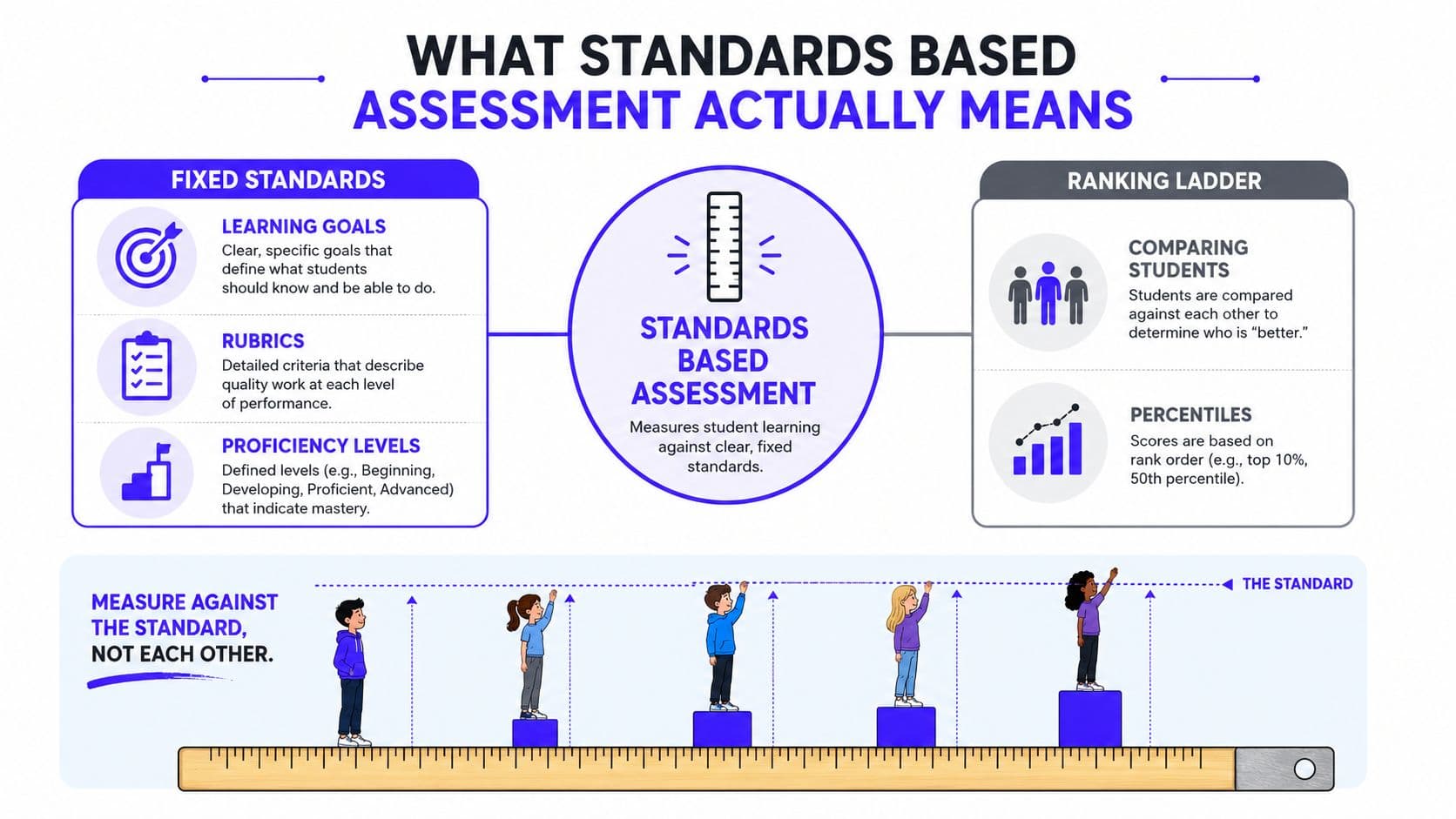
A useful way to explain standards based assessment is to start with the measuring stick in the teacher's hand, not the stack of papers on the desk. Students are measured against a fixed criterion, the agreed-upon standard, instead of being compared with one another. That is why the system is criterion-referenced, not norm-referenced. The work either shows the standard or it does not, and the score reflects the level of mastery the student has reached.
The three parts that make it real
The system becomes easier to use once you separate its parts. First, there are assessment criteria, the knowledge and skills that will be measured. Second, there are pre-defined statements of achievement, the descriptions of what success looks like at different levels. Third, there is the evidence itself, student work that shows whether the learner reached the target.
That structure is why broad standards need to be turned into observable indicators before anyone scores them. A math standard about fraction reasoning, for example, is too vague to use fairly if it stays as one broad statement. A teacher needs to know whether the student can identify equivalent fractions, justify reasoning, or apply the idea in a word problem. Those are different kinds of evidence, and they do not always show up together in the same piece of work.
A rubric only works when the descriptors point to something you can see in student work.
Teachers often keep Kuraplan's guide to success criteria nearby while planning lessons and checks because it keeps the target visible. When the target is visible, students can aim at it, and teachers can score it without guessing what “pretty good” means. The heart of standards based assessment is a fixed performance expectation that lets teachers say, with more honesty, what students can do right now.
Standards Based Assessment vs Traditional Grading
The cleanest contrast is this, traditional grading often rewards behavior around learning, while standards based assessment reports the learning itself. That difference shows up fast in everyday decisions about late work, extra credit, reassessment, and behavior.
| Decision Point | Traditional Grading | Standards Based Assessment |
|---|---|---|
| Late work | Often lowers the average directly | Can be tracked separately from mastery |
| Extra credit | Can inflate grades unrelated to the standard | Usually kept away from academic evidence |
| Behavior | Often folded into the grade | Separated from content performance |
| Reassessment | Often limited or inconsistent | Common when more evidence is needed |
A traditional gradebook can be convenient, but it hides too much. A student may be compliant, organized, and still shaky on the content, or messy, late, and proficient. Families deserve a report card that doesn't blur those differences.
Standards based assessment asks teachers to grade the standard, then handle practice work and behavior in other ways. That doesn't mean everything becomes easier. It means the teacher has to explain the system more carefully, especially at the start, because parents are used to one number standing in for everything. The workload shifts too, since teachers have to think more intentionally about evidence and less about point accumulation.
Here's the honest trade-off. Traditional grading feels faster when you're building the gradebook. Standards based assessment feels slower at first because you're naming targets, aligning tasks, and separating signals that used to get mixed together. But once the categories are clear, parent conferences get more specific, intervention becomes more targeted, and the student conversation changes from “Why is my grade a C?” to “Which standard do I still need to show?”
Designing Aligned Assessments Step by Step
The actual build starts with the target, not the test. If the standard is the destination, the assessment has to collect the right evidence along the way. That means teachers need a design cycle that's disciplined enough to avoid vague scoring, but practical enough to use on a Tuesday night.
A workable sequence
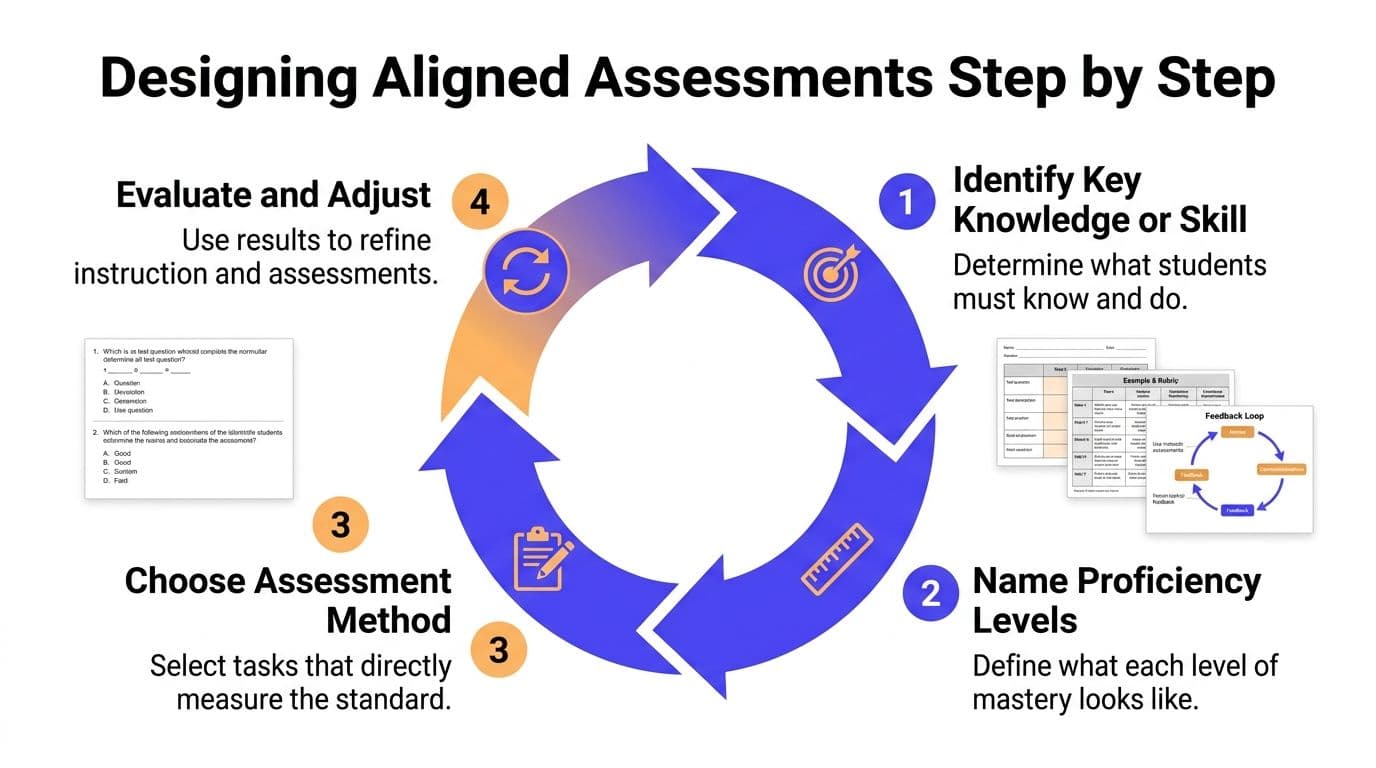
Start by identifying the key knowledge or skill. In an upper elementary science unit on ecosystems, that might mean students need to explain how organisms depend on one another in a system. In secondary argumentative writing, the target might be constructing a claim supported by evidence and reasoning.
Next, name observable indicators of understanding. In science, you might look for correct use of vocabulary, accurate cause-and-effect reasoning, and a clear explanation of interactions in the ecosystem. In writing, indicators might include a defensible claim, relevant evidence, and explanation that connects the evidence back to the claim.
Then choose the assessment method that elicits those indicators. A multiple-choice item can check prerequisite knowledge, but it won't carry the whole standard for higher-order work. Constructed response, teacher observation, and performance evidence give you a stronger picture, especially when the standard asks students to explain, justify, or create.
Finally, build the rubric or scale that judges proficiency against the standard. That's where Kuraplan's rubric generator can save time when you already know what you want measured and just need a clean, standards-aligned structure.
The useful habit here is to ask, “What would count as evidence?” before you ask, “What test should I give?” That one move keeps the assessment tied to the work you want students to do. It also keeps you from falling into the trap of scoring a broad standard with one thin item and pretending that's enough.
Sample Rubrics and Items You Can Adapt
Teachers usually don't need another theory talk. They need something they can shape into their own unit without starting from scratch. A strong rubric does that job because it turns the standard into visible, scoreable language instead of a general impression.
Primary literacy
For a primary reading standard about retelling a story, the rubric can track whether the student names the beginning, middle, and end, uses key details, and stays in logical order. A constructed-response prompt might ask, “Tell me what happened in the story in your own words.” A performance task might have the student retell the story to a partner using picture cards as support.
The indicator here is sequence and comprehension, not memorized wording. If a child can retell the plot but misses minor details, the score should reflect that exact level of mastery.
Upper elementary math
For a math standard about solving multi-step word problems, one item stem could be, “Show how you figured out the answer, and explain why your steps make sense.” Another could be a performance task where the student chooses the operation, solves, and labels the reasoning on chart paper. The rubric should separate the answer from the reasoning, because a lucky answer without explanation isn't the same as understanding.
Secondary science
For a science standard about using evidence to explain a claim, the constructed-response prompt might be, “Write a claim about the investigation, then support it with evidence from the data.” The performance task could be a brief lab presentation or poster defense. The rubric should distinguish claim quality, evidence selection, and explanation.
Moderation matters here. When teachers score against exemplars together, they calibrate what “meets” and “exceeds” look like in student work. For a useful resource on tightening item design, especially if you want to create randomized multiple-choice sets for practice, Coachful's guide on how to create randomized assessments in 2026 is worth a look, even if the core scoring still rests on teacher judgment.
Using Standards Based Assessment Data Without Over Reading It
A single score can help, but it can also mislead. Standards based assessment is strongest when it sits inside a multi-measure system, not when it gets treated like the final word on a child's ability. That's the difference between a useful report and an overconfident one.
The National Academies guidance says reports of student performance should show status against standards, include multiple indicators, and, when districts combine indicators into one index, explain how that index was computed. It also says reports should include statistical uncertainty such as a confidence interval or the probability of misclassification. That's a lot more honest than pretending every cut score is absolute.
What to ask when the data surprises you
If a student's score looks lower than expected, ask which evidence points were used, whether the task matched the standard, and whether the student had a fair chance to show mastery in that format. If the score looks higher than the classroom work suggests, check whether the task was narrow enough to miss part of the standard. In both cases, the point is to use the result as a conversation starter, not a verdict.
The best classroom use is formative. Teachers look at patterns, identify gaps, and plan the next lesson, small group, or reassessment. The report card can still serve summative purposes, but daily teaching shouldn't wait for the end-of-unit number to tell the whole story.
Don't let one end-of-unit score do the job of three different assessments.
That's where standards based assessment becomes more useful than traditional averages. It lets you separate learning from timing and then respond to the evidence you have, instead of arguing with a grade that's already mixed too many things together. If your district combines indicators, make sure families can see the pieces, not just the final total.
Equity Pitfalls and Common Mistakes to Avoid
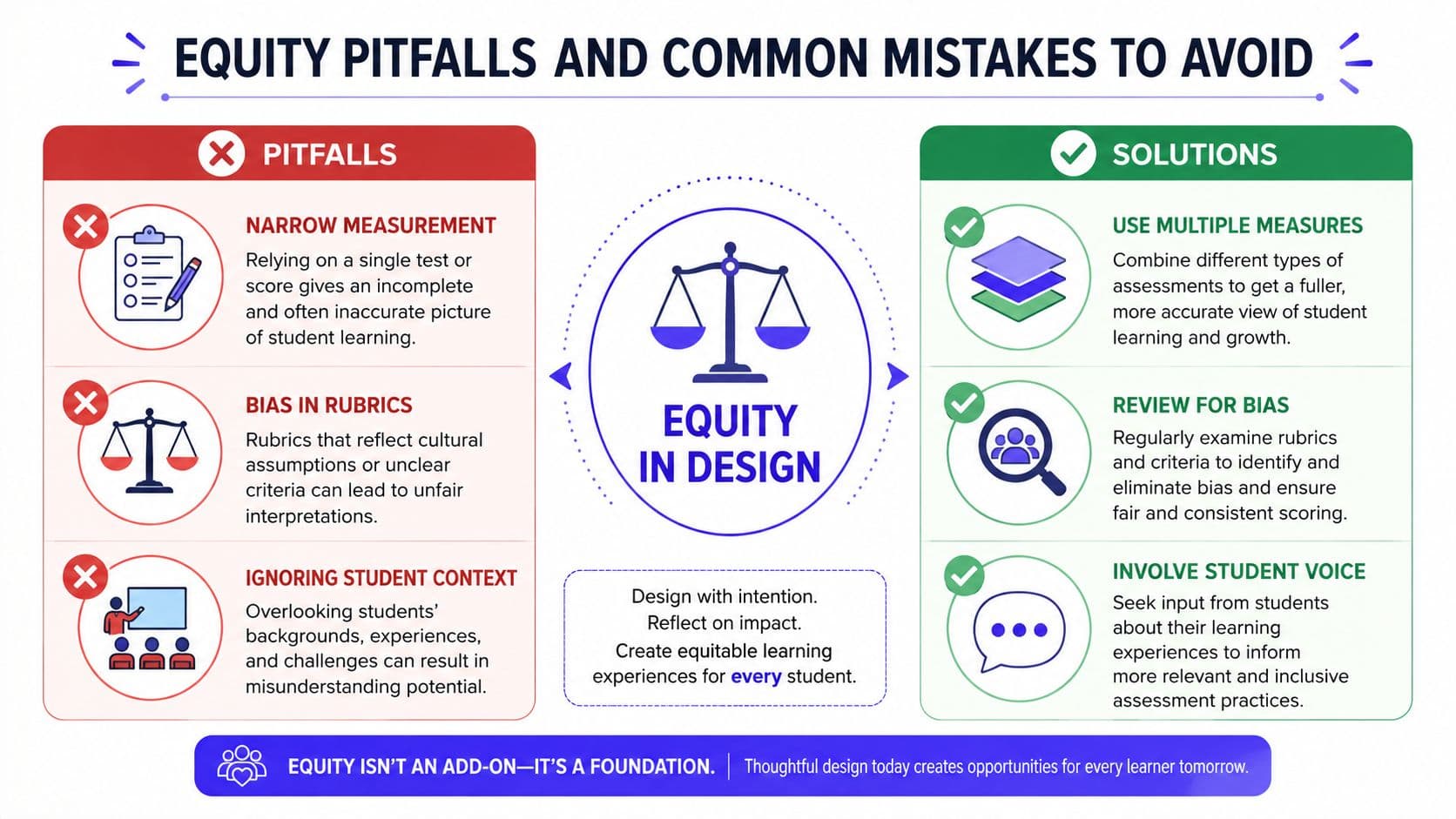
A standards-based system can still be unfair if the design is sloppy. Alignment drift is one of the first places it goes wrong. Standards-based assessments may cover only part of the state standards, and they can also bring in content that is not named in the standards, so alignment has to be checked instead of assumed. If the task and the standard do not match, the score is shaky no matter how polished the rubric looks.
Where systems can break
Students with disabilities and multilingual learners get hit hardest when access is treated as an afterthought. Inclusivity has to be built into item writing, administration, scoring, and reporting. A generic accommodation list bolted on at the end does not fix a task that was written in a way that blocks the skill you are trying to measure. If the rubric rewards language complexity when the target is science understanding, the system is measuring the wrong thing.
Another common mistake is turning standards based grading into a compliance ritual. Teachers end up entering categories, but the categories do not improve instruction, which defeats the point. Moderation and exemplars matter because they keep judgment honest and help teams agree on what the rubric means in real student work.
The wider fix is simple in principle and hard in practice. Use multiple measures, check for bias, involve student voice where appropriate, and keep the standard visible at every step. If you are looking for a planning tool that can generate standards-aligned lessons, worksheets, and assessment rubrics in one place, Kuraplan fits naturally into that workflow without turning the teacher into a bystander.
Good equity work asks not just “Did we accommodate?” but “Did we design for access from the start?”
That question keeps the system grounded. It also protects teachers from mistaking a neat-looking report card for a fair one.
Putting It All Together in Your Classroom
Start small, because standards based assessment gets messy fast when you try to convert everything at once. A sensible rollout has three phases. Prepare one standard, one rubric, and one unit. Pilot it with a single class or grade band. Scale only after you've compared scoring and talk through the evidence with colleagues.
A realistic next-week checklist
- Pick one standard: Choose a target you already teach, not a brand-new unit you're still inventing.
- Write clear indicators: List what students will say, do, or produce when they meet the standard.
- Build one rubric: Keep the language tight, and make sure every level describes visible evidence.
- Collect multiple pieces of evidence: Don't rely on one task if the standard asks for deeper thinking.
- Score together once: Sit with a colleague and compare a few student samples before you trust the scale.
- Separate behavior from mastery: Keep the academic signal clean.
That's the point where many teachers start asking for tools that reduce prep without taking over the thinking. A platform like Kuraplan can generate standards-aligned lesson plans, worksheets, and rubrics, which is useful when the actual work is your professional judgment and not your formatting time. It's a support tool, not a substitute for the teacher's eye.
Thirty days in, success looks like one clean rubric and one unit that families can understand. Sixty days in, you should have a few reassessment opportunities and a better sense of where the class is stuck. Ninety days in, the staff conversation should sound less like “How many points is this worth?” and more like “What evidence do we need for the standard?”
If you're ready to make your gradebook say something more honest about learning, start with one standard and one rubric this week. Kuraplan can help you draft standards-aligned lessons, worksheets, and assessment rubrics so you can spend less time formatting and more time teaching, scoring, and giving feedback that students can use.