PEFreePrintable

Energy Balance and Calories

A free pe worksheet ready for your classroom. Open in Kuraplan to grab the print-ready PDF, customize it for your students, or generate a fresh version in seconds.
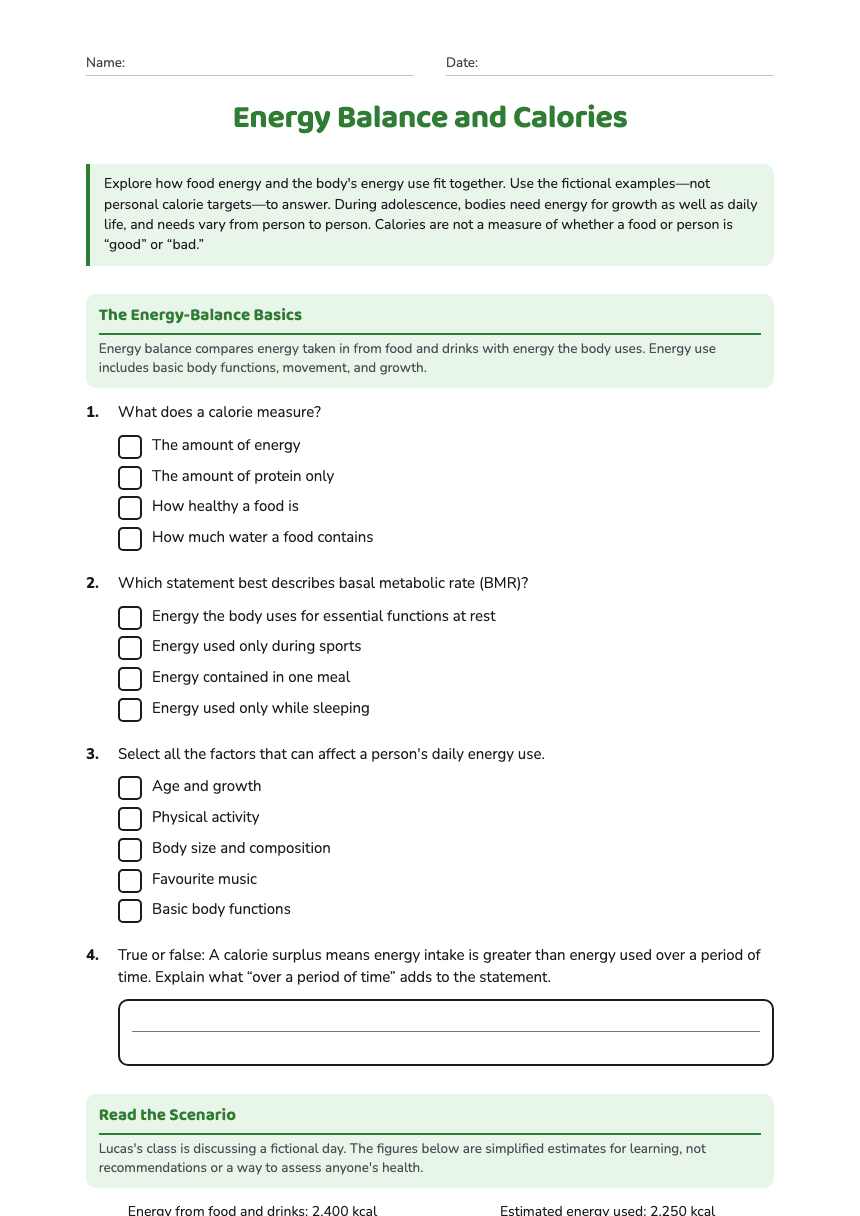
Energy Balance and Calories worksheet preview
Name:Date:

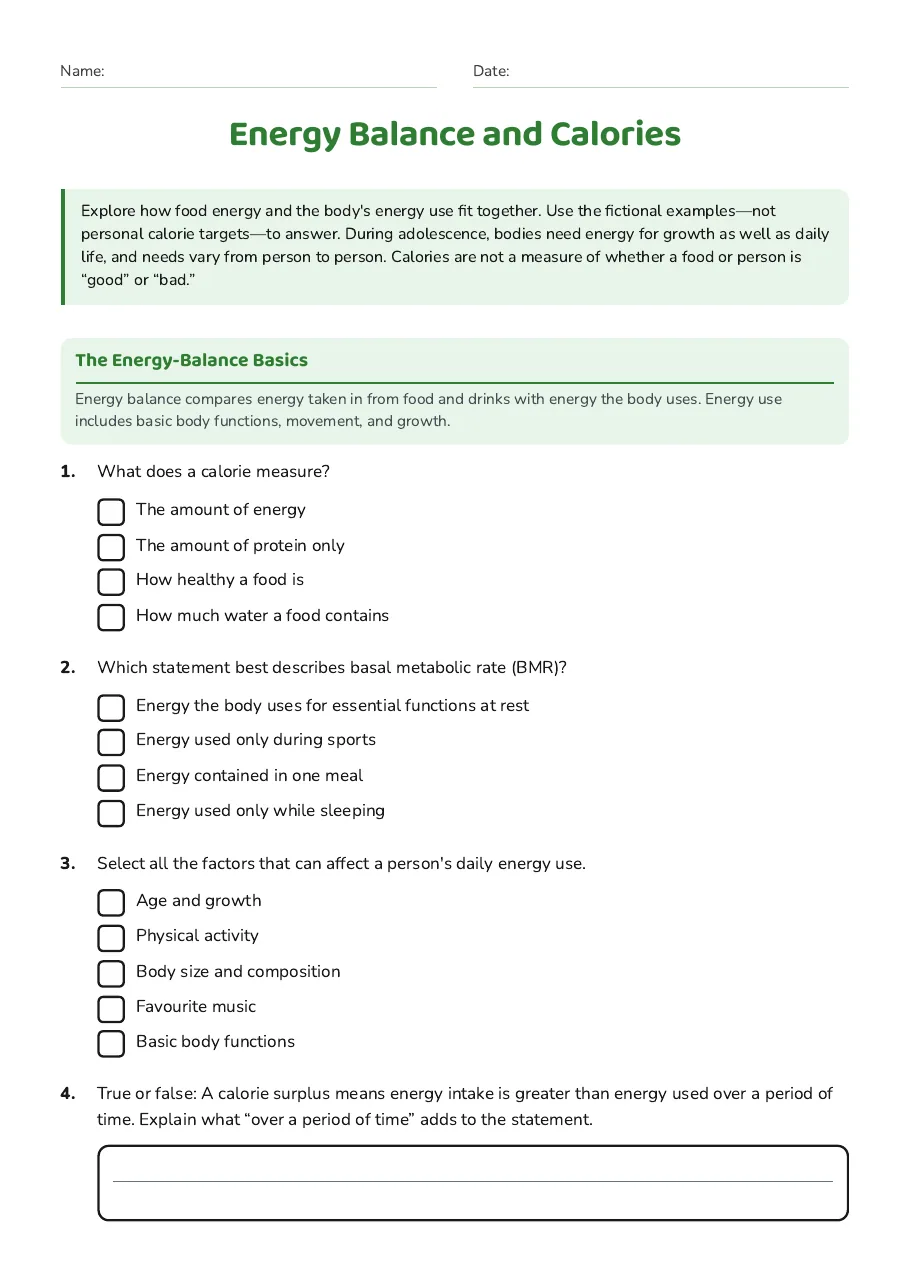
Energy Balance and Calories

Explore how food energy and the body's energy use fit together. Use the fictional examples—not personal calorie targets—to answer. During adolescence, bodies need energy for growth as well as daily life, and needs vary from person to person. Calories are not a measure of whether a food or person is “good” or “bad.”

The Energy-Balance Basics

Energy balance compares energy taken in from food and drinks with energy the body uses. Energy use includes basic body functions, movement, and growth.

1.What does a calorie measure?
  • The amount of energy
  • The amount of protein only
  • How healthy a food is
  • How much water a food contains
2.Which statement best describes basal metabolic rate (BMR)?
  • Energy the body uses for essential functions at rest
  • Energy used only during sports
  • Energy contained in one meal
  • Energy used only while sleeping
3.Select all the factors that can affect a person's daily energy use.
  • Age and growth
  • Physical activity
  • Body size and composition
  • Favourite music
  • Basic body functions
4.True or false: A calorie surplus means energy intake is greater than energy used over a period of time. Explain what “over a period of time” adds to the statement.

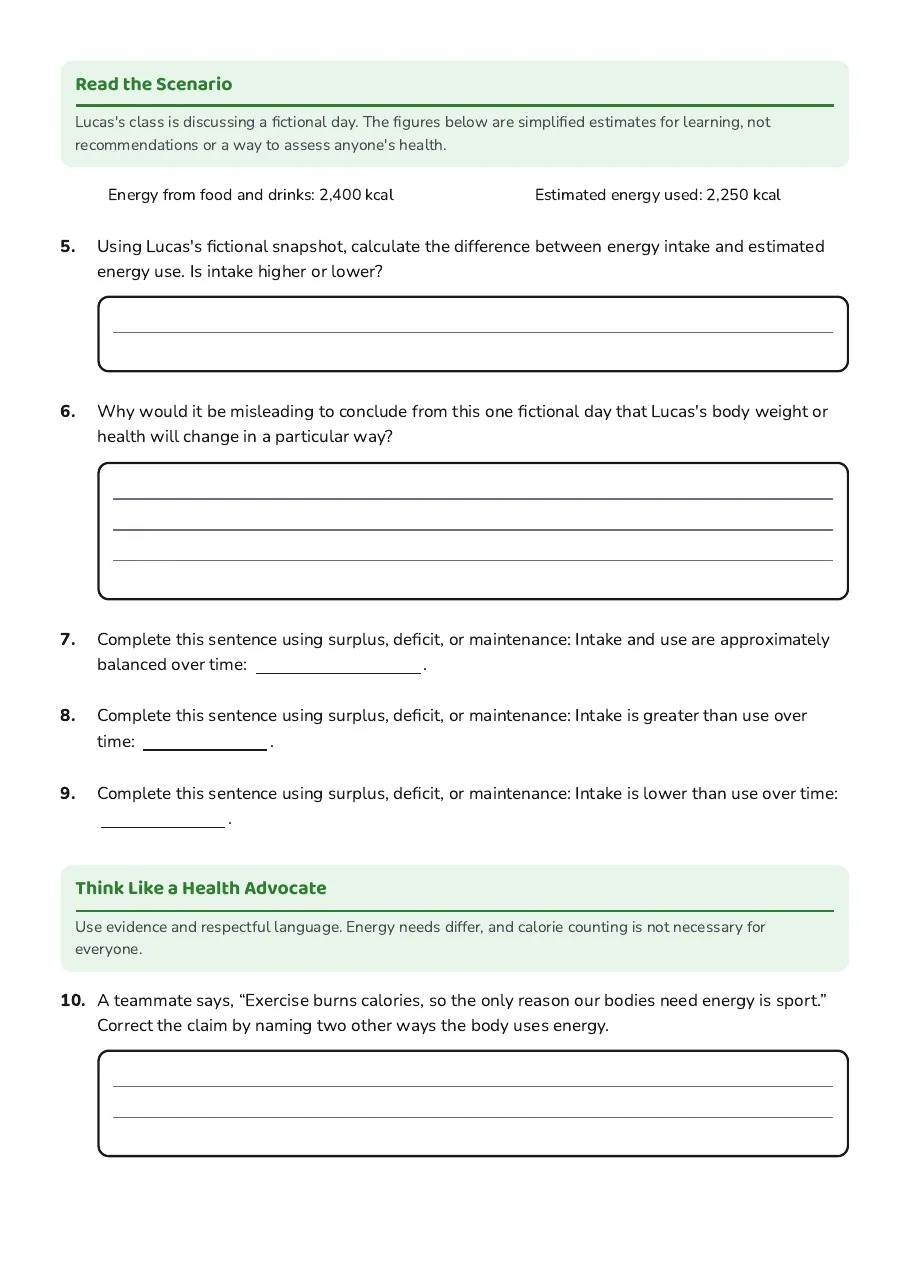
Read the Scenario

Lucas's class is discussing a fictional day. The figures below are simplified estimates for learning, not recommendations or a way to assess anyone's health.

Energy from food and drinks: 2,400 kcal

Estimated energy used: 2,250 kcal

5.Using Lucas's fictional snapshot, calculate the difference between energy intake and estimated energy use. Is intake higher or lower?
6.Why would it be misleading to conclude from this one fictional day that Lucas's body weight or health will change in a particular way?
7.Complete this sentence using surplus, deficit, or maintenance: Intake and use are approximately balanced over time: .
8.Complete this sentence using surplus, deficit, or maintenance: Intake is greater than use over time: .
9.Complete this sentence using surplus, deficit, or maintenance: Intake is lower than use over time: .

Think Like a Health Advocate

Use evidence and respectful language. Energy needs differ, and calorie counting is not necessary for everyone.

10.A teammate says, “Exercise burns calories, so the only reason our bodies need energy is sport.” Correct the claim by naming two other ways the body uses energy.
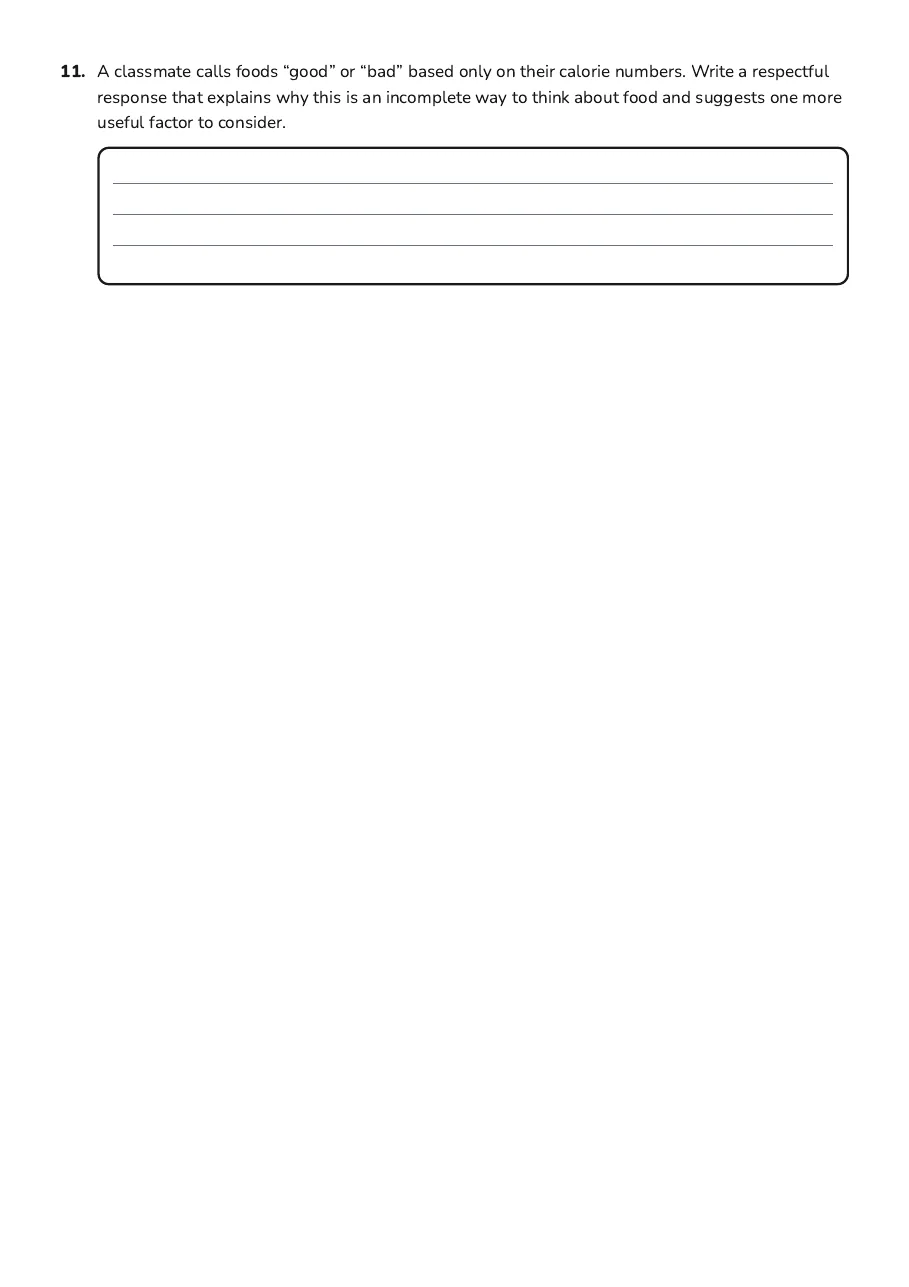
11.A classmate calls foods “good” or “bad” based only on their calorie numbers. Write a respectful response that explains why this is an incomplete way to think about food and suggests one more useful factor to consider.

3 printable pages

  • Energy Balance and Calories, page 1 of 3: The Energy-Balance Basics

    Page 1

  • Energy Balance and Calories, page 2 of 3: Read the Scenario, Think Like a Health Advocate

    Page 2

  • Energy Balance and Calories, page 3 of 3: 11. A classmate calls foods “good” or “bad” based only on their calorie numbers. Write a…

    Page 3

About This Worksheet

Free in Kuraplan

Sign up free, grab the PDF, and customize it for your class.

Print-Ready

Formatted for standard paper. Clean layout, easy to read.

AI-Generated

Created with Kuraplan's AI, designed for real classroom use.

For Teachers & Parents

Use in classrooms, for homework, tutoring, or homeschool.

Need a custom version of this worksheet?

Kuraplan's AI generates custom worksheets in seconds — differentiated for every learner, aligned to your curriculum.

Generate Custom Worksheets — Free
No credit card Curriculum-aligned Under 60 seconds

Explore more free resources