ScienceFreePrintable

Organic Functional Groups

A free science worksheet ready for your classroom. Open in Kuraplan to grab the print-ready PDF, customize it for your students, or generate a fresh version in seconds.

Organic Functional Groups worksheet preview
Name:Date:

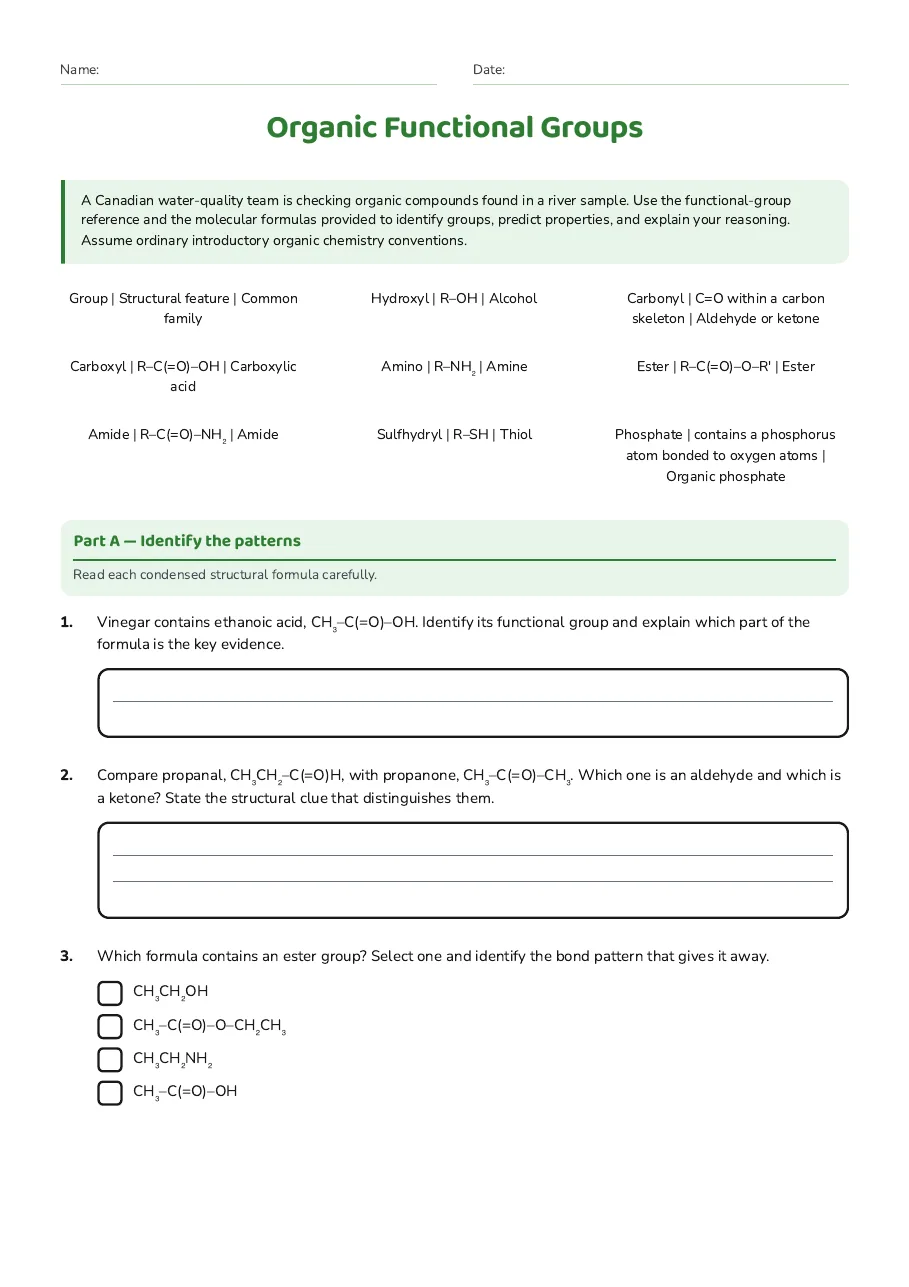
Organic Functional Groups

A Canadian water-quality team is checking organic compounds found in a river sample. Use the functional-group reference and the molecular formulas provided to identify groups, predict properties, and explain your reasoning. Assume ordinary introductory organic chemistry conventions.

Group | Structural feature | Common family

Hydroxyl | R–OH | Alcohol

Carbonyl | C=O within a carbon skeleton | Aldehyde or ketone

Carboxyl | R–C(=O)–OH | Carboxylic acid

Amino | R–NH₂ | Amine

Ester | R–C(=O)–O–R′ | Ester

Amide | R–C(=O)–NH₂ | Amide

Sulfhydryl | R–SH | Thiol

Phosphate | contains a phosphorus atom bonded to oxygen atoms | Organic phosphate

Part A — Identify the patterns

Read each condensed structural formula carefully.

1.Vinegar contains ethanoic acid, CH₃–C(=O)–OH. Identify its functional group and explain which part of the formula is the key evidence.
2.Compare propanal, CH₃CH₂–C(=O)H, with propanone, CH₃–C(=O)–CH₃. Which one is an aldehyde and which is a ketone? State the structural clue that distinguishes them.
3.Which formula contains an ester group? Select one and identify the bond pattern that gives it away.
  • CH₃CH₂OH
  • CH₃–C(=O)–O–CH₂CH₃
  • CH₃CH₂NH₂
  • CH₃–C(=O)–OH
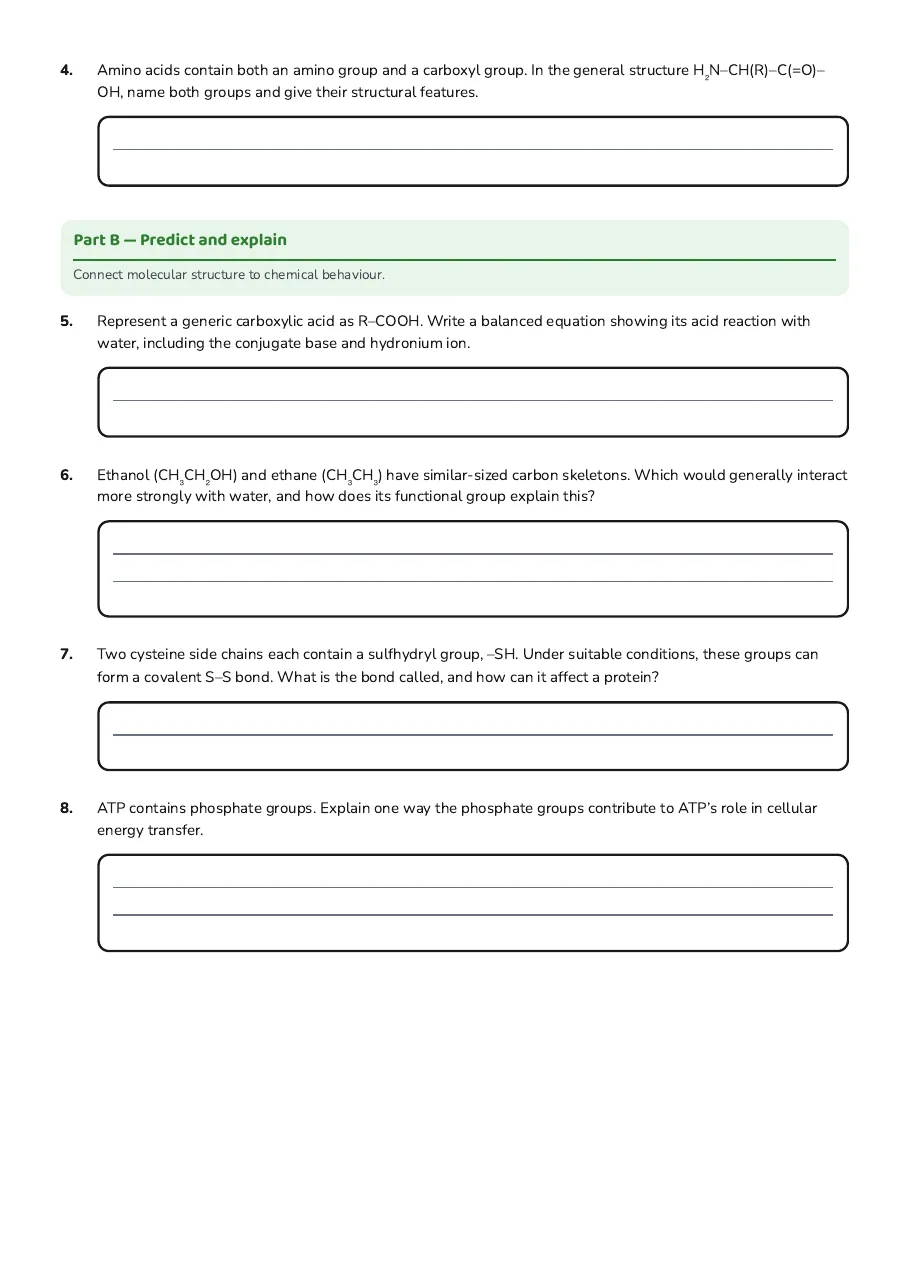
4.Amino acids contain both an amino group and a carboxyl group. In the general structure H₂N–CH(R)–C(=O)–OH, name both groups and give their structural features.

Part B — Predict and explain

Connect molecular structure to chemical behaviour.

5.Represent a generic carboxylic acid as R–COOH. Write a balanced equation showing its acid reaction with water, including the conjugate base and hydronium ion.
6.Ethanol (CH₃CH₂OH) and ethane (CH₃CH₃) have similar-sized carbon skeletons. Which would generally interact more strongly with water, and how does its functional group explain this?
7.Two cysteine side chains each contain a sulfhydryl group, –SH. Under suitable conditions, these groups can form a covalent S–S bond. What is the bond called, and how can it affect a protein?
8.ATP contains phosphate groups. Explain one way the phosphate groups contribute to ATP’s role in cellular energy transfer.

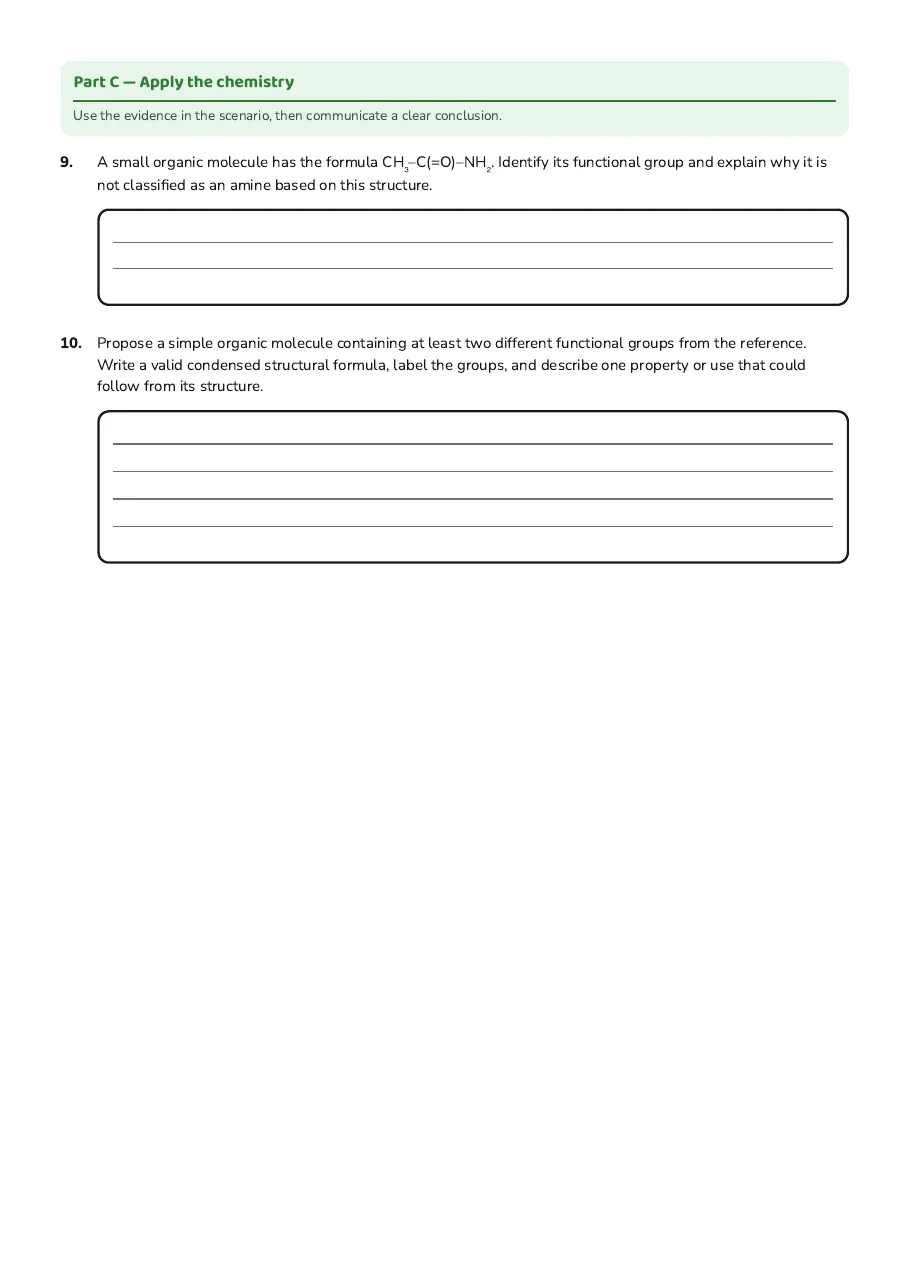
Part C — Apply the chemistry

Use the evidence in the scenario, then communicate a clear conclusion.

9.A small organic molecule has the formula CH₃–C(=O)–NH₂. Identify its functional group and explain why it is not classified as an amine based on this structure.
10.Propose a simple organic molecule containing at least two different functional groups from the reference. Write a valid condensed structural formula, label the groups, and describe one property or use that could follow from its structure.

3 printable pages

  • Organic Functional Groups, page 1 of 3: Part A — Identify the patterns

    Page 1

  • Organic Functional Groups, page 2 of 3: Part B — Predict and explain

    Page 2

  • Organic Functional Groups, page 3 of 3: Part C — Apply the chemistry

    Page 3

About This Worksheet

Free in Kuraplan

Sign up free, grab the PDF, and customize it for your class.

Print-Ready

Formatted for standard paper. Clean layout, easy to read.

AI-Generated

Created with Kuraplan's AI, designed for real classroom use.

For Teachers & Parents

Use in classrooms, for homework, tutoring, or homeschool.

Need a custom version of this worksheet?

Kuraplan's AI generates custom worksheets in seconds — differentiated for every learner, aligned to your curriculum.

Generate Custom Worksheets — Free
No credit card Curriculum-aligned Under 60 seconds