Biochemistry Vocabulary Introduction
A free science worksheet ready for your classroom. Open in Kuraplan to grab the print-ready PDF, customize it for your students, or generate a fresh version in seconds.
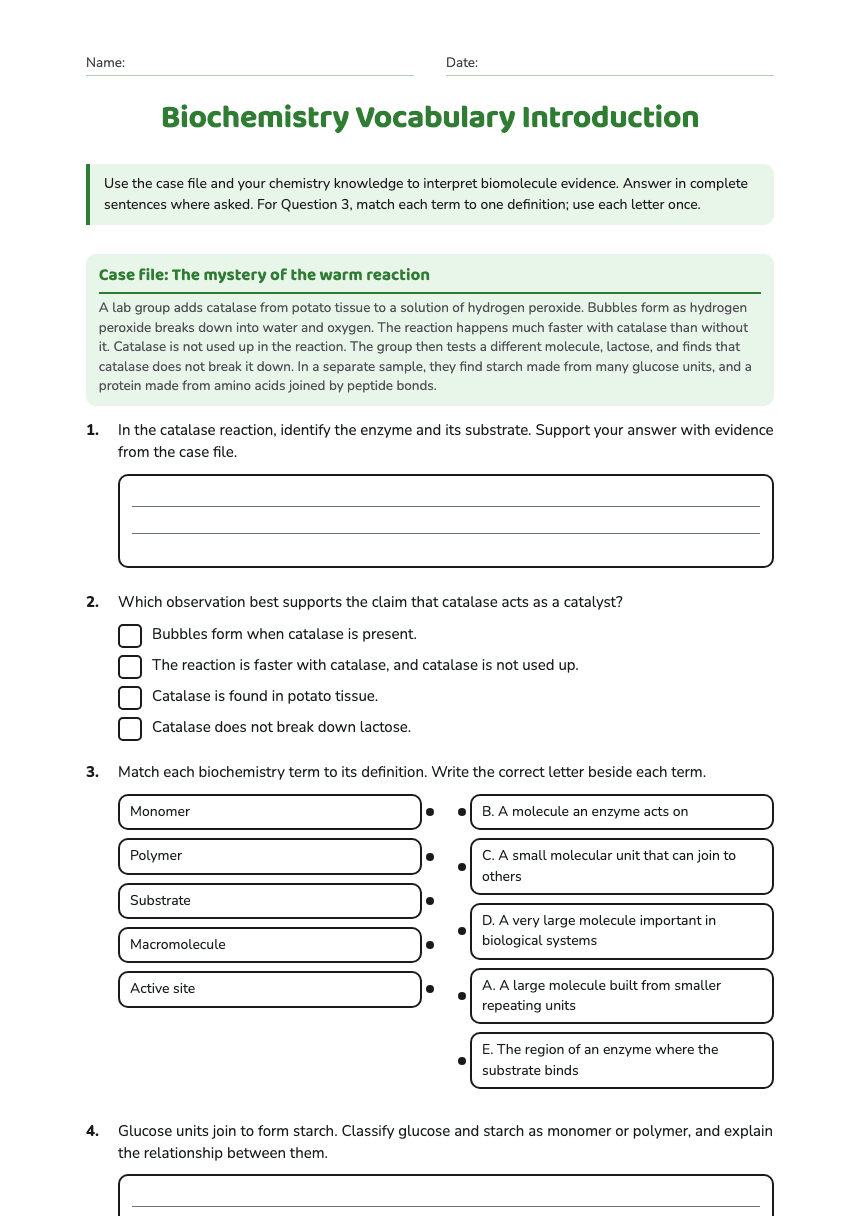
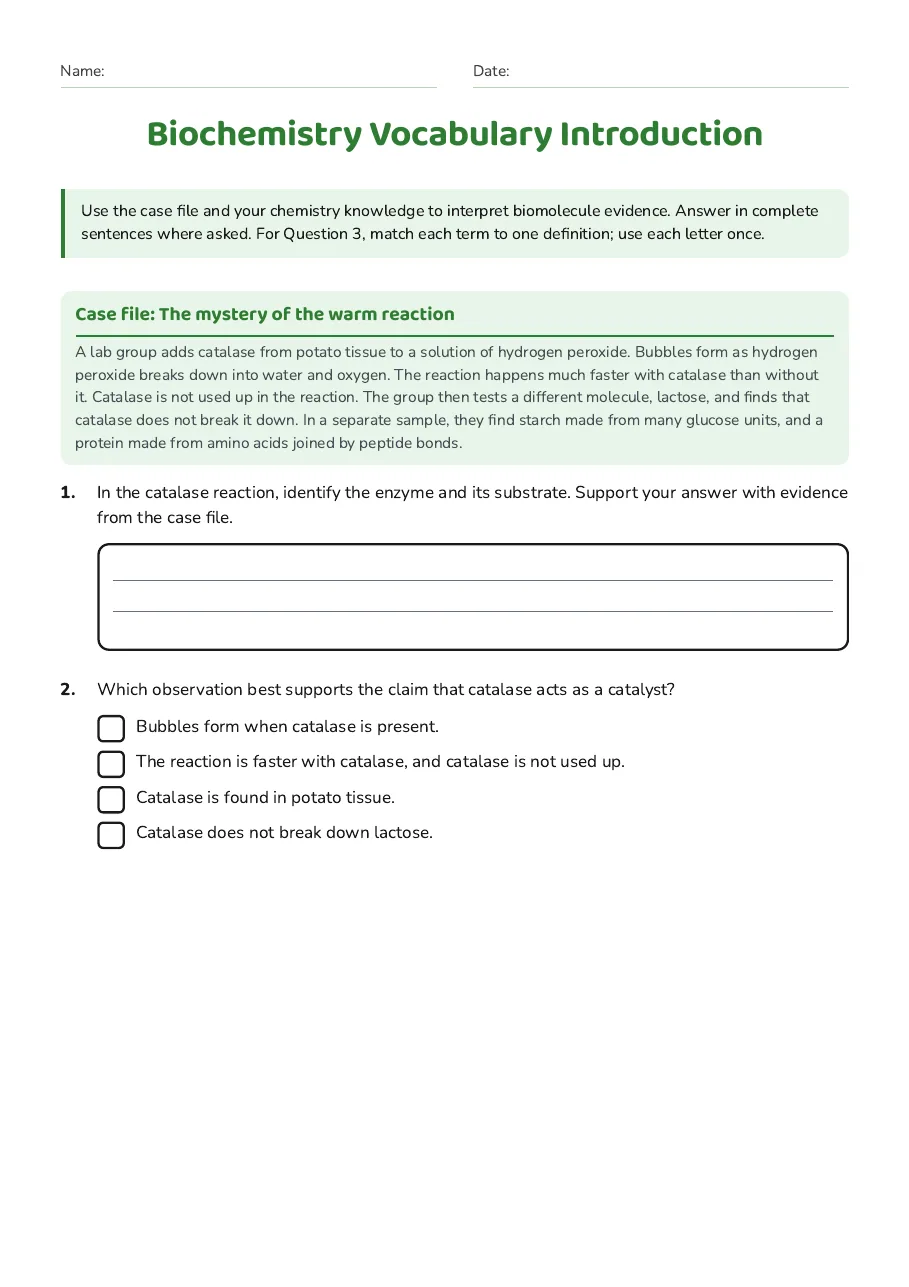
Biochemistry Vocabulary Introduction
Case file: The mystery of the warm reaction
A lab group adds catalase from potato tissue to a solution of hydrogen peroxide. Bubbles form as hydrogen peroxide breaks down into water and oxygen. The reaction happens much faster with catalase than without it. Catalase is not used up in the reaction. The group then tests a different molecule, lactose, and finds that catalase does not break it down. In a separate sample, they find starch made from many glucose units, and a protein made from amino acids joined by peptide bonds.
- Bubbles form when catalase is present.
- The reaction is faster with catalase, and catalase is not used up.
- Catalase is found in potato tissue.
- Catalase does not break down lactose.
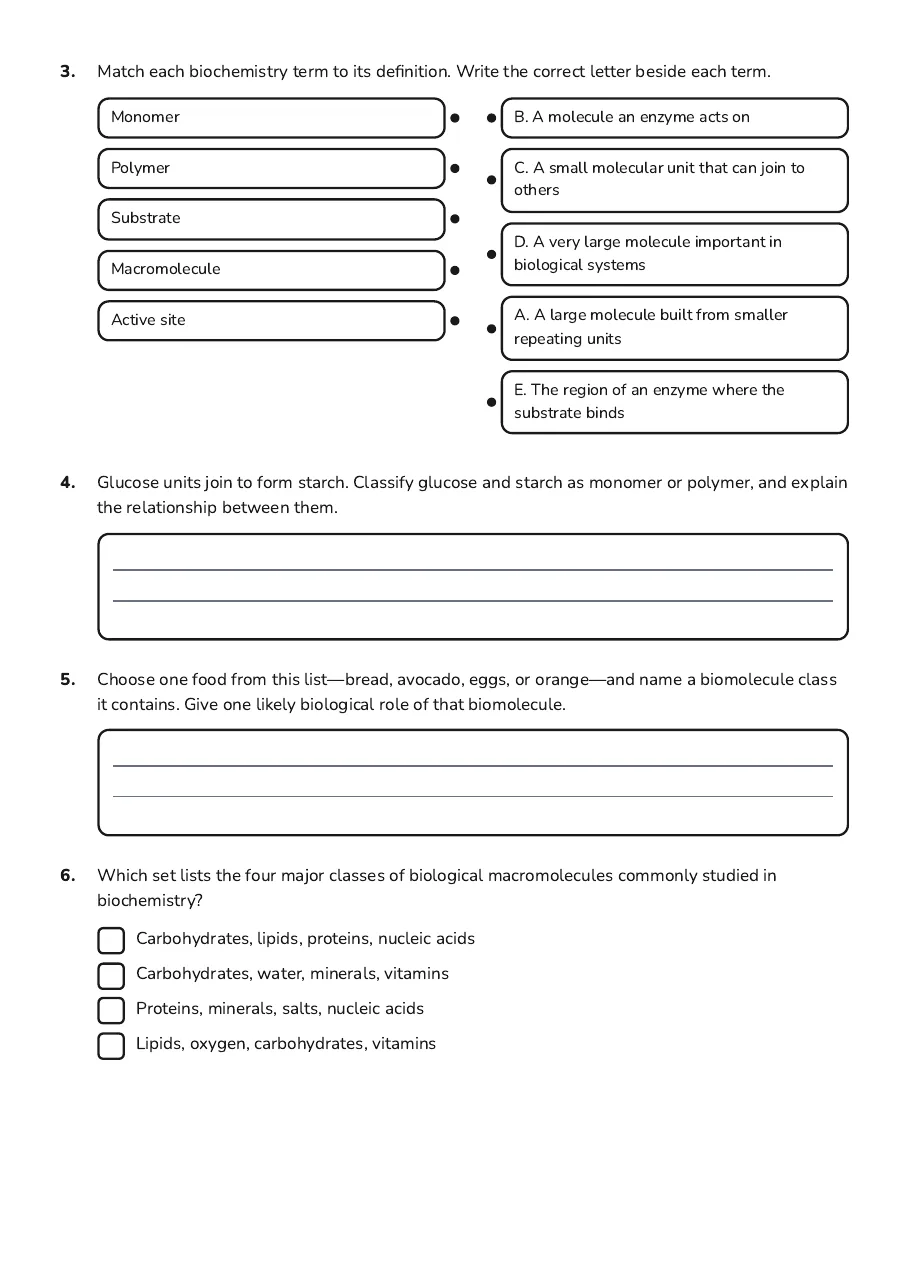
- Monomer
- Polymer
- Substrate
- Macromolecule
- Active site
- B. A molecule an enzyme acts on
- C. A small molecular unit that can join to others
- D. A very large molecule important in biological systems
- A. A large molecule built from smaller repeating units
- E. The region of an enzyme where the substrate binds
- Carbohydrates, lipids, proteins, nucleic acids
- Carbohydrates, water, minerals, vitamins
- Proteins, minerals, salts, nucleic acids
- Lipids, oxygen, carbohydrates, vitamins
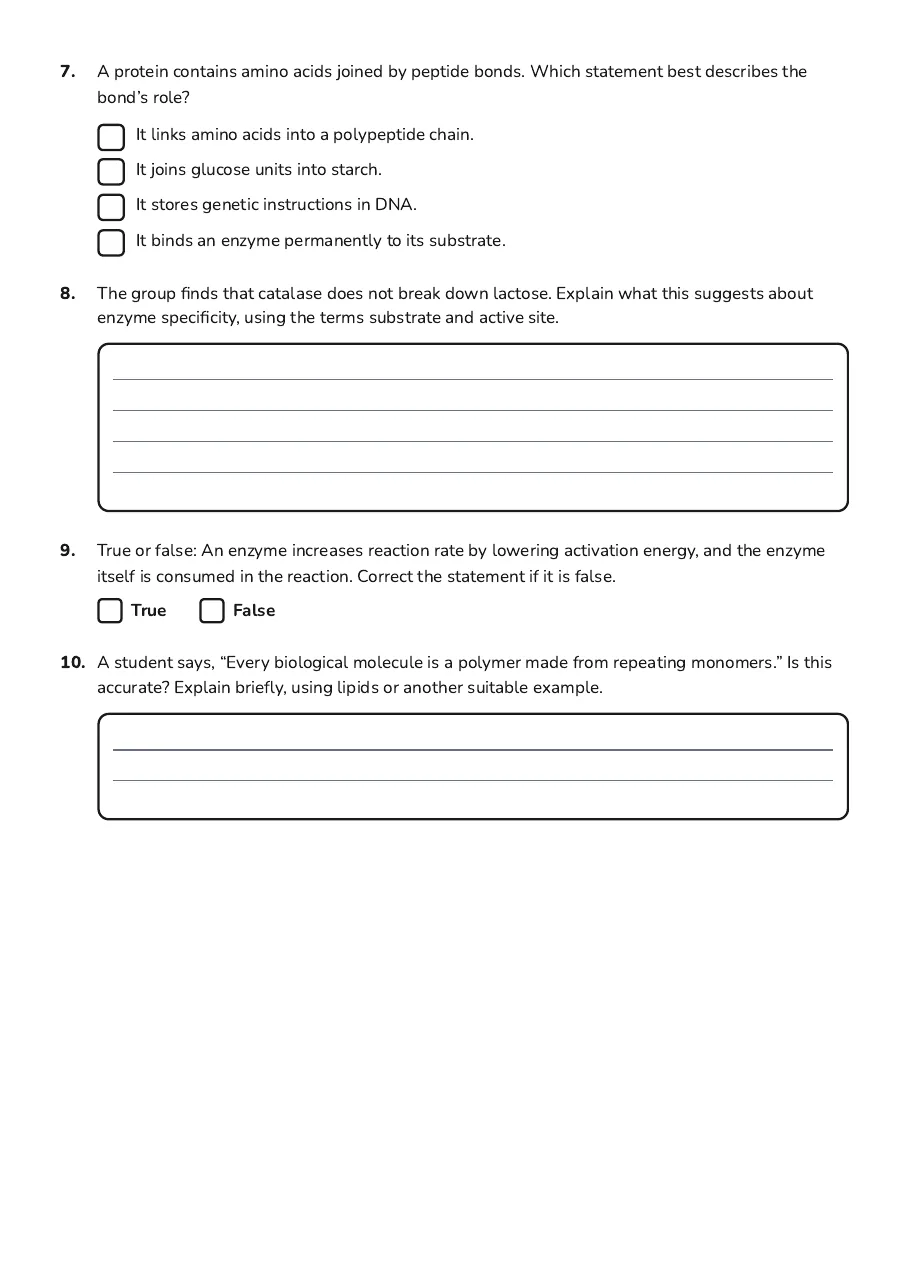
- It links amino acids into a polypeptide chain.
- It joins glucose units into starch.
- It stores genetic instructions in DNA.
- It binds an enzyme permanently to its substrate.
3 printable pages
Page 1
Page 2
Page 3
About This Worksheet
Free in Kuraplan
Sign up free, grab the PDF, and customize it for your class.
Print-Ready
Formatted for standard paper. Clean layout, easy to read.
AI-Generated
Created with Kuraplan's AI, designed for real classroom use.
For Teachers & Parents
Use in classrooms, for homework, tutoring, or homeschool.
Need a custom version of this worksheet?
Kuraplan's AI generates custom worksheets in seconds — differentiated for every learner, aligned to your curriculum.
Generate Custom Worksheets — Free