It's the middle of the day, and the wiggles are setting in. You see tapping pencils, shifting seats, and the look that says half the class has left the room mentally, even though they're still in their seats. That's usually the moment teachers either clamp down harder or change the energy of the lesson.
Kinesthetic learning activities give you that second option. They let students handle, build, sort, move, act out, and test ideas instead of only hearing or reading them. That's not a niche strategy. A long-cited early Dunn and Dunn finding suggested about 30 to 40% of school-age children may be tactile or kinesthetic learners, though other education references summarize the share closer to 15 to 20%, which tells you the exact proportion depends on definition and source rather than one settled number (National Math Foundation on kinesthetic learning history).
That spread matters less than the classroom reality. Plenty of students think better when their hands are busy and their bodies are part of the lesson. If you teach younger children, you'll also find overlap with fun motor skill activities for young children, especially when you're building routines for movement with purpose.
The activities below aren't just idea starters. They're practical, teachable formats you can run in real classrooms, with grade-band suggestions, materials, steps, assessment options, and honest notes on what works and what usually falls apart.
1. Project-Based Learning
Project-based learning works well for kinesthetic learners because students have to make something, test something, present something, or solve something tangible. Sitting through a lecture about water systems is one experience. Designing a model city that has to manage runoff, waste, and energy is another.
This format is especially useful when your class feels disconnected from why the content matters. Students move around, gather materials, build drafts, revise plans, and present finished work. That physical involvement gives the thinking somewhere to land.
Best fits by grade band
- K to 2: Build a classroom garden plan, a weather station model, or a neighborhood map with labeled features.
- Grades 3 to 5: Create a habitat model, a community helper exhibit, or a simple invention that solves a classroom problem.
- Grades 6 to 8: Design a documentary, museum display, or prototype tied to history, science, or civics.
- Grades 9 to 12: Tackle engineering challenges, policy proposals, product design, or service-learning projects.
Materials and setup
Use chart paper, sticky notes, cardboard, markers, recycled materials, tablets or laptops if available, and a simple project calendar. Students also need planning sheets, checkpoints, and clear quality criteria.
Kuraplan is useful here because it can generate project briefs, standards-aligned rubrics, and scaffolded planning pages fast. That cuts down the part teachers usually avoid, which is turning a good project idea into something assessable.
Practical rule: If the final product is exciting but the checkpoints are fuzzy, the project usually turns into craft time.
How to run it
Start with a driving question students can answer through action. Then map the project into stages: research, planning, first draft, feedback, revision, and presentation. Keep each stage visible on the wall or in your LMS.
What doesn't work is giving full freedom too early. Open-ended projects need structure. Strong PBL has choice inside a frame, not chaos disguised as creativity.
Assessment ideas
Assess both the process and the product. I'd include planning notes, collaboration, content accuracy, revision, and the final presentation.
Peer critique also helps, but it needs sentence stems and a deadline. Without those, you get vague praise and very little revision.
2. Manipulatives and Concrete Materials
Monday morning, a student stares at 3/4 + 1/8 and freezes. Hand that same student fraction strips, and the conversation changes fast. Abstract ideas become visible, students have something to test, and you can spot confusion before it hardens into a wrong procedure.
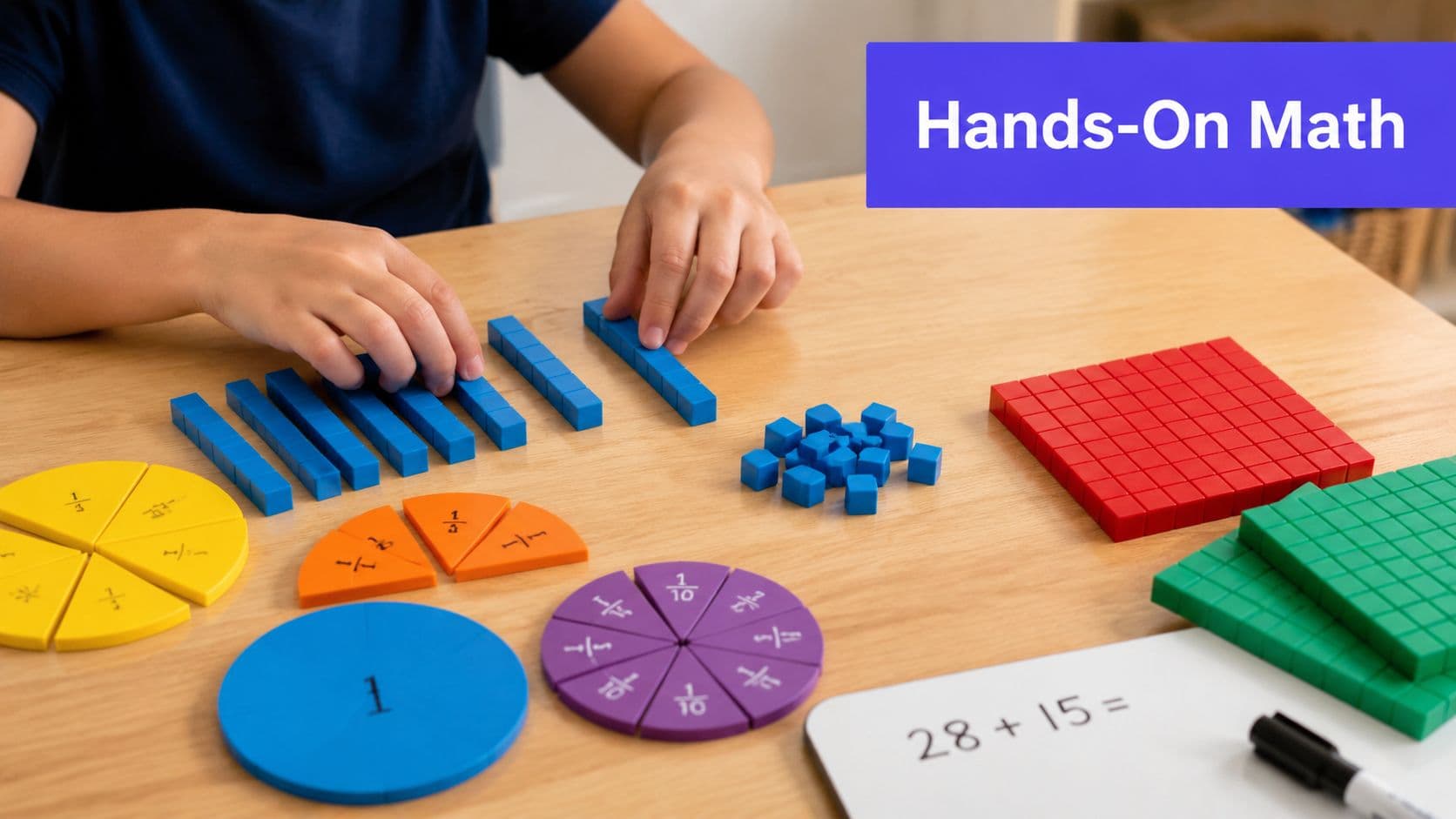
Manipulatives work best when the goal is specific. Students should build, compare, sort, measure, or represent something concrete, then connect that model to a drawing and finally to symbols or academic language. That sequence takes more setup than a worksheet, but it usually saves reteaching time later.
Grade-band examples, materials, and goals
Grades K to 2
- Objectives: Count with one-to-one correspondence, compose and decompose numbers, build letter and sound patterns.
- Materials: Counting bears, snap cubes, ten frames, pattern blocks, letter tiles.
- Use them for: Showing number combinations, building repeating patterns, matching sounds to printed letters.
Grades 3 to 5
- Objectives: Compare fractions, model place value, tell time, solve money problems.
- Materials: Fraction circles, fraction bars, place value disks, clocks, play money.
- Use them for: Equivalent fractions, regrouping, elapsed time, real-world problem solving.
Grades 6 to 8
- Objectives: Represent integers, solve simple equations, classify shapes, plot points.
- Materials: Algebra tiles, integer chips, geometric solids, coordinate plane mats.
- Use them for: Zero pairs, distributive property, surface area discussions, graphing practice.
Grades 9 to 12
- Objectives: Visualize abstract systems, test models, connect formulas to physical relationships.
- Materials: Molecular model kits, graphing tools, vector models, physics apparatus.
- Use them for: Bonding structures, force diagrams, function behavior, measurement-based analysis.
How to run it without wasting time
Start with one tight task and one success criterion. “Build 247 in two different ways” gives students a target. “Use the blocks” does not.
Then teach through a repeatable routine:
- Model the representation. Show what the pieces mean.
- Give a short task. One question is enough for the first round.
- Require a transfer step. Students draw what they built and write the matching equation, definition, or explanation.
- Listen before correcting. Student language tells you whether the model makes sense to them.
Kuraplan helps with the transfer step, which is where many lessons break down. A ready-made set of addition and subtraction with manipulatives worksheets can give students the model, drawing space, and written response frame in one place.
Storage matters more than many teachers admit. If materials are buried in mixed bins, you will stop pulling them out. This guide to organizing math manipulatives is useful if setup and cleanup are eating your lesson time.
Assessment ideas
Ask students to answer three ways: build it, sketch it, explain it. That gives you a quick read on whether the hands-on work is supporting understanding or covering up a gap.
For a fast check, use a clipboard list with prompts such as:
- Can the student choose the right tool?
- Can the student explain what each piece represents?
- Can the student connect the model to symbols correctly?
One trade-off is pace. Manipulatives slow the lesson at first, especially if routines are weak. The payoff is better accuracy and clearer student thinking, which usually makes independent practice much stronger.
3. Simulations and Role-Playing
Some content makes more sense when students step into it. A mock trial, constitutional convention, ecosystem simulation, or marketplace game gives students a reason to speak, decide, react, and revise. That's different from passively recalling facts.
This strategy works especially well in social studies, ELA, health, and science. It also helps quieter students when the role card does some of the heavy lifting and gives them a reason to contribute.
Strong classroom examples
A third grade class can role-play community helpers solving a town problem. Middle school students can run a mock senate hearing on a school policy issue. High school students can simulate a diplomatic summit or act out competing perspectives in a novel.
The best simulations have tension. Students need a decision to make, limited information, and consequences they can discuss afterward.
Don't skip the debrief. The learning often becomes visible after the movement stops.
Materials and steps
Prepare role cards, background sheets, discussion prompts, and an observation checklist. Arrange the room around the simulation, not your usual seating chart. Space matters here.
Run it in four parts:
- Set context: Explain the scenario and define success.
- Assign roles: Give students a perspective, motive, or task.
- Act and decide: Let them negotiate, debate, build, or respond.
- Debrief: Pull out what happened, why it happened, and what content it connects to.
Kuraplan can help generate role cards, rubric language, and reflection prompts when you don't want to create them from scratch.
What usually goes wrong
If you launch with weak background knowledge, students perform without understanding. If you over-script it, they just read lines. The sweet spot is enough structure to keep the task academic, but enough freedom that their decisions matter.
Assess with observation notes, written reflection, short content questions, or a claim-evidence response after the simulation. That last step separates fun from learning.
4. Hands-On Science Experiments and Investigations
Science is one of the most natural homes for kinesthetic learning activities. Students observe, predict, test, adjust, and record. They aren't just hearing about how science works. They're doing it.
Before anything else, teach the routine. Lab movement gets chaotic fast if students don't know how to collect materials, clean up, or ask for help. Good science management looks boring at first, and that's why it works.
Reliable examples by grade band
- K to 2: Sink-or-float tests, shadow tracking, plant observation, simple mixing investigations.
- Grades 3 to 5: Ramps and motion, weather tools, erosion models, magnet investigations.
- Grades 6 to 8: Variables in plant growth, thermal energy tasks, density labs, ecosystem observations.
- Grades 9 to 12: Titration practice, reaction investigations, physics design labs, field sampling.
A useful benchmark often cited in training discussions is that active participation can support much stronger retention than passive methods, with National Training Laboratories materials commonly summarizing retention as up to 75% for active participation versus 10% for reading or lecture. Whether or not you build instruction around that exact benchmark, it captures what most teachers see in practice. Students remember the lab they ran.
Here's a classroom example worth showing before students start investigating:
How to keep experiments academic
Use a lab sheet with a prediction, materials list, steps, observation table, and conclusion prompt. That structure matters because without it, students often remember the exciting part and forget the concept.
Always test the experiment yourself first. If it fails in your kitchen or classroom, it'll absolutely fail harder with twenty-five students trying it at once.
Assessment ideas
Use notebook checks, verbal conferences, diagram labeling, or CER writing. If needed, photograph the experiment so students who need accommodations can revisit what happened later.
Kuraplan is handy for generating age-appropriate lab sheets with the right vocabulary level. That's one of the easiest ways to save prep time without lowering rigor.
5. Station Rotations and Carousel Learning
The last ten minutes before lunch are a good test of any lesson design. If half the class is drifting and the other half is already done, station rotations usually bring the room back under control. Students have a job, a place to go, and a shorter stretch of focus at each stop.
Used well, this structure does more than add movement. It lets you reteach one group, stretch another, and keep everyone working on the same objective without making the differentiation obvious. That trade-off is why I keep rotations in regular use. Setup takes planning up front, but the lesson usually runs more smoothly once the routine is established.
A practical model is four stations tied to one clear target. For example, in a fractions lesson for grades K to 2, students might rotate through matching picture cards to fractions, building wholes with manipulatives, solving two teacher-led problems, and drawing their own fraction model. In grades 3 to 5, a reading rotation could include vocabulary sorting, a short close-reading task, partner discussion, and a written response. In middle and high school, carousel learning works well for review. Students move in groups through quote analysis, data interpretation, problem solving, or source evaluation, leaving evidence of their thinking at each stop.
How to set it up so it actually works
Keep each station narrow. One task, one product, one direction sheet.
Here is a reliable frame:
- Teacher station: Reteach, confer, or check for misconceptions
- Hands-on station: Sort, build, label, sequence, or manipulate
- Application station: Solve, write, annotate, or complete a short practice task
- Reflection station: Summarize learning, self-assess, or answer an exit prompt
For elementary students, I usually plan 6 to 10 minutes per station. Older students can handle longer blocks if the task has enough substance. Any longer than that, and the pace starts to sag.
What to prepare by grade band
K to 2
- Objective card with a picture cue
- Simple materials in labeled bins
- One recording sheet with minimal writing
- Visual rotation chart
Grades 3 to 5
- Task card at each station
- Response sheet students carry with them
- Early-finisher extension
- Timer students can see from anywhere in the room
Grades 6 to 12
- Clear content goal for each station
- Group roles if discussion is part of the task
- Written accountability piece at every stop
- Rotation map to prevent traffic jams
The biggest failure point is transition time. If students do not know where to go next, station learning turns into noise and waiting. Post the order, practice the movement, and keep materials at the station instead of passing them out mid-rotation.
Assessment ideas
Use one collection tool across all stations. That might be a recording sheet, a checklist, a digital form, or a carousel chart paper response. One place to gather evidence makes grading faster and helps students stay accountable.
Assessment can stay light but still be useful. Check one station closely for accuracy, use the teacher table for quick conferences, or end with a two-minute written reflection that asks which station helped most and why. That answer often tells you whether the task was productive or just busy.
Kuraplan is especially useful here because each station usually needs a different format. A matching task, a short response page, a discussion prompt, and an exit check all take time to build from scratch. If you want ready-to-customize templates for transition routines and quick movement tasks, brain break activity worksheets from Kuraplan can support the flow between rotations without adding much prep.
6. Movement-Based Learning and Brain Breaks
Not every movement activity needs a big setup. Sometimes the best kinesthetic lesson is a five-minute burst that directly reinforces content. Students sort themselves on a timeline, step to true or false corners, build sentences with cards, or use gestures to memorize vocabulary.
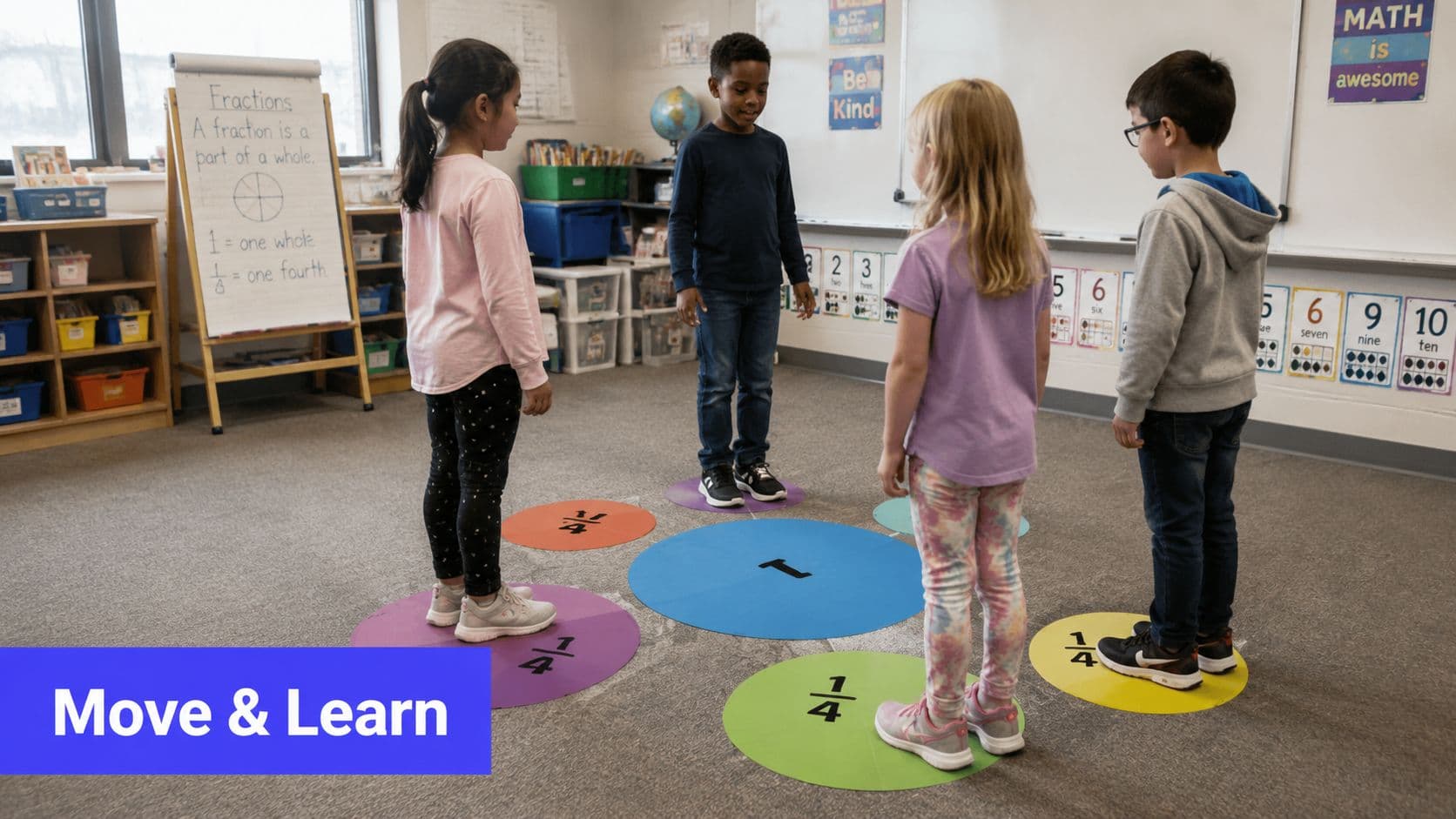
The trap is treating movement as automatically good. It isn't. Some students focus better after moving. Others get overstimulated, fatigued, or frustrated if the task is too loud, too fast, or too public.
Better ways to use movement
- Embodied concepts: Students form angles, molecule shapes, punctuation marks, or number lines.
- Response corners: Label areas of the room A, B, C, D or agree, disagree, unsure.
- Gesture routines: Attach a simple motion to a vocabulary word, math process, or grammar concept.
- Quick resets: Use structured brain break cards between demanding tasks.
For printable prompts, transition cards, and simple movement options, brain break activity worksheets from Kuraplan can save time.
Inclusion matters here
Careful planning is essential for many kinesthetic learning activities. Existing guidance often assumes more movement is always better, but that leaves out students with motor limitations, sensory differences, fatigue, or trauma-related needs (SimpleK12 discussion of kinesthetic learning and inclusion gaps).
Offer standing or seated versions. Let students point, place cards, or direct a partner if a full-body version isn't accessible. If participation requires public performance, build in a lower-risk option.
A movement activity only works if students can join it without feeling exposed.
Assessment ideas
Use movement to reveal understanding quickly. A corner choice, gesture response, or card sort can show you who's getting it before you assign independent work.
Keep the academic question at the center. If students remember the game but not the concept, the movement was just noise.
7. Maker Spaces and STEM or STEAM Projects
Maker work gives kinesthetic learners a reason to iterate. Students cut, tape, wire, test, rebuild, and troubleshoot. That physical cycle is where a lot of the thinking happens.
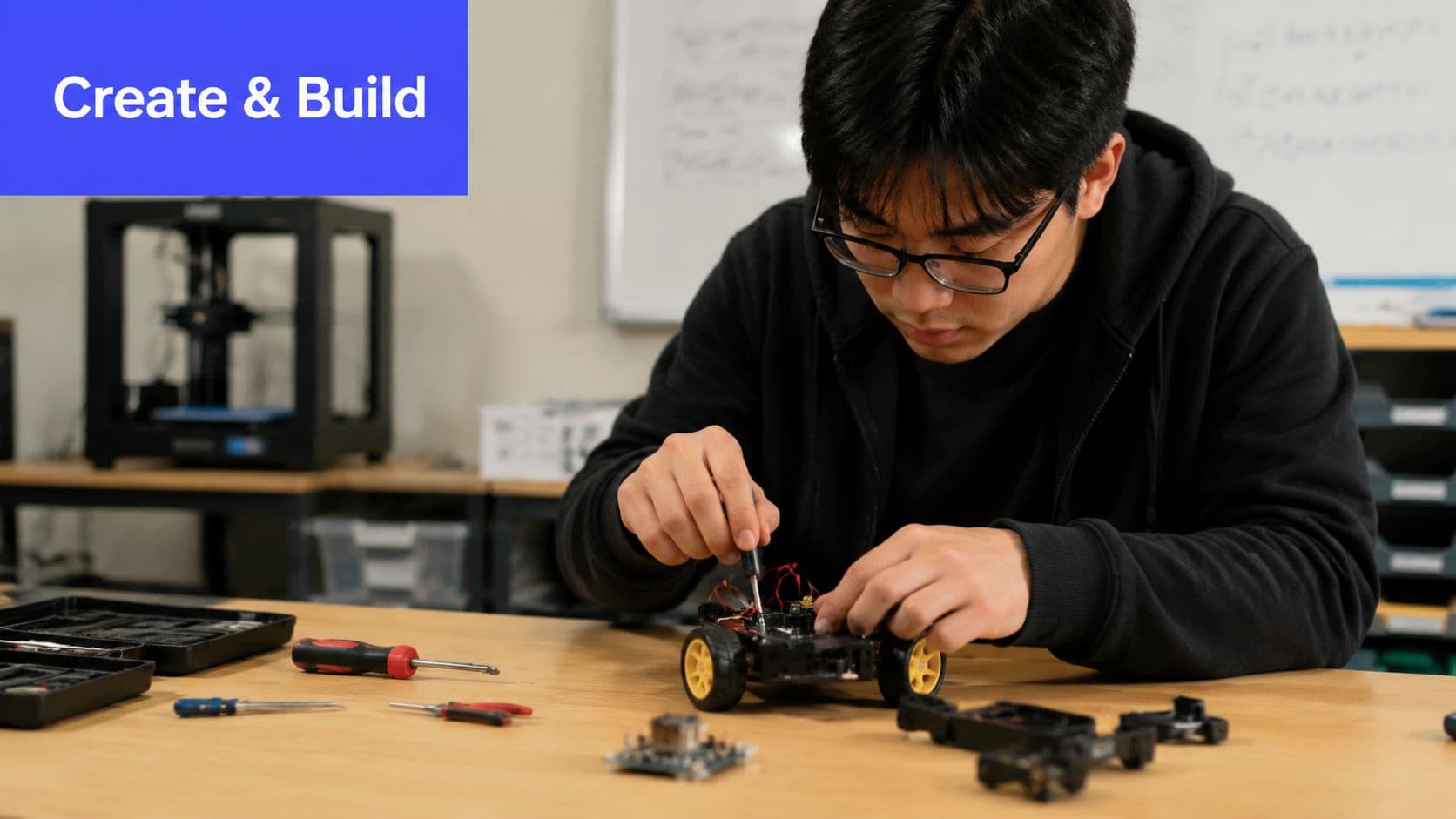
You don't need a flashy maker lab to do this well. Cardboard, tape, straws, index cards, recyclables, rulers, and a clear design challenge are enough for strong classroom engineering.
Good maker tasks by age
- Elementary: Build a bridge for toy cars, design a wind-resistant house, create a marble run.
- Middle school: Prototype a water filter, build a simple machine, design assistive tools.
- High school: Create robotics challenges, structural tests, coded models, or product redesign tasks.
The best projects have a real constraint. Budget, material limit, size rule, load requirement, or testing condition keeps students from making random crafts and calling it engineering.
How to keep it from becoming chaos
Give students a design brief, planning sketch, materials limit, and test criteria before they touch supplies. Then build in time for redesign. The first version is rarely the point.
For ready-to-use planning pages, design criteria, and student recording sheets, Kuraplan's bridge-building STEM packet is the kind of tool that saves you an hour of formatting before school.
Assessment ideas
Assess the design process, not just the finished object. I'd look for evidence of planning, testing, revision, and explanation.
What doesn't work is grading only whether the object “won.” A weak build can still show strong thinking if the student can explain what failed and how they'd improve it.
8. Outdoor and Nature-Based Learning
When students go outside with a clear academic task, the room changes. Attention often improves, discussion gets more natural, and students notice details they'd miss on a slide deck. Outdoor learning is especially strong for science, writing, math measurement, and observation-based social studies.
Short, repeated trips work better than occasional big events. A ten-minute data collection walk every week usually produces more learning than one ambitious field day that's hard to manage.
Simple outdoor lessons that transfer well
A primary class can sort natural objects by attribute, track weather, or sketch plant changes. Upper elementary students can measure perimeter on the playground, map habitats, or do a sound inventory. Secondary classes can collect environmental observations, write place-based reflections, or study local infrastructure.
What to bring
Clipboards, pencils, observation sheets, a class boundary plan, and one clear task. That's enough to start.
Kuraplan can help you generate field notes, nature journals, species observation sheets, and data trackers quickly. The key is making the outdoor task specific enough that students know what to notice.
What works and what doesn't
What works is giving students a narrow focus. “Find three examples of erosion evidence” gets better results than “Look around and write what you see.” What doesn't work is trying to run too many materials outdoors at once.
A second issue is accessibility. Outdoor kinesthetic learning can be excellent, but only if the route, pacing, and sensory demands are considered in advance. Sometimes the right adaptation is taking a smaller group, using photo observation, or bringing natural materials inside for the same lesson objective.
9. Collaborative Games and Competitive Challenges
Games can create strong academic movement when students have to retrieve information, move pieces, solve clues, or collaborate under time pressure. A scavenger hunt, relay sort, review circuit, or escape-room style task can turn a sleepy review lesson into one students care about.
That said, competition is useful only when the class culture can handle it. In some rooms, competition energizes. In others, it shuts students down fast.
Formats that tend to work
- Collaborative escape tasks: Groups solve content-based clues and reveal the next prompt.
- Relay sorts: Teams classify terms, equations, historical events, or scientific processes.
- Board or card games: Students answer, move, build, or match to review content.
- Academic scavenger hunts: Students move around the room finding and solving posted tasks.
A fifth grade class might run a fraction relay with comparison cards around the room. A middle school ELA class might solve figurative language clues in teams. A high school biology class might complete a taxonomy challenge using specimen cards and movement stations.
Guardrails that matter
Keep teams small. Give everyone a role. Make sure success depends on thinking, not just speed.
This is also one of the biggest implementation gaps in online advice. Plenty of resources list movement games, but they rarely help teachers decide which activities support learning under real constraints like large classes, limited space, or assessment-heavy pacing (Brain Balance note on implementation quality gaps)).
If one student can dominate the game while three others watch, it isn't really collaborative.
Assessment ideas
Use score sheets, solved clue logs, or a quick written reflection after play. Students should have to explain at least one strategy or answer after the game ends.
Kuraplan is useful for making custom clue cards, game prompts, and answer sheets that match your standards instead of generic trivia.
10. Art Integration and Creative Response Activities
Art integration works because students have to turn knowledge into something visible, performable, or buildable. They draw, stage, compose, design, model, and explain. That physical making process helps many students organize their thinking better than a worksheet alone.
This isn't about making every lesson cute. It's about using artistic processes to deepen content understanding.
Strong examples across subjects
- ELA: Character tableaux, comic summaries, scene staging, symbolic collage
- Math: Symmetry art, geometric sculpture, pattern design, scale drawing
- Science: Scientific illustration, labeled diagrams, model-building, visual explanations
- Social studies: Timelines, protest poster analysis, museum labels, historical monologues
A second grade class might create a habitat mural with evidence labels. A seventh grade class might choreograph the water cycle. A high school history class might produce a gallery walk of propaganda analysis with visual commentary.
How to keep rigor high
Require an artist statement, explanation card, or short reflection tied to the content. Students should name the concept, defend their choices, and use subject vocabulary.
What doesn't work is grading artistic polish more than understanding. Some of the strongest thinking comes from very plain-looking work. Keep the rubric focused on content, communication, and decision-making.
Assessment ideas
Use gallery walks, performance reflection, or short conferences while students work. Kuraplan can help generate prompt cards, planning sheets, reflection questions, and simple rubrics so you're not building the framework from nothing each time.
Art integration is also one of the safest entry points for teachers who want more kinesthetic learning activities but aren't ready for full simulations or large-scale projects. It gives students movement and creation without requiring the whole room to turn upside down.
10-Point Comparison: Kinesthetic Learning Activities
| Approach | Implementation Complexity 🔄 | Resource Requirements ⚡ | Expected Outcomes 📊 | Ideal Use Cases 💡 | Key Advantages ⭐ |
|---|---|---|---|---|---|
| Project-Based Learning (PBL) | High, requires extended planning, milestones, assessment design | Moderate–High, materials, time, community/collaboration supports | Deep conceptual understanding; collaboration; authentic products | Interdisciplinary units, capstones, real-world problem solving | Authentic application of learning; student agency; transferable skills |
| Manipulatives and Concrete Materials | Low–Medium, routines and CRA progression needed | Low–Moderate, physical sets, storage, organization systems | Faster concept acquisition; concrete-to-abstract transfer; reduced anxiety | K–5 math, introductory science, supports for ELLs and struggling students | Tangible representations; multisensory access; accessible entry point |
| Simulations and Role-Playing | Medium–High, scenario design and skilled facilitation required | Moderate, prep time, props/technology, space for enactment | Empathy, perspective-taking, applied decision-making, retention | Social studies, civics, ethics, complex systems exploration | Immersive engagement; safe risk-taking; social skill development |
| Hands-On Science Experiments & Investigations | Medium, safety planning and lab management essential | Moderate–High, materials, safety equipment, prep/cleanup time | Scientific reasoning, data literacy, inquiry skills, curiosity | NGSS-aligned science units, inquiry investigations, citizen science | Authentic scientific practice; memorable, evidence-based learning |
| Station Rotations & Carousel Learning | Medium, logistics, transitions and clear procedures required | Low–Moderate, varied activities, materials, timers/labels | Increased active engagement; targeted differentiation; efficient practice | Mixed-ability classrooms, literacy/math workshops, centers | Simultaneous differentiation; flexible grouping; sustained engagement |
| Movement-Based Learning & Brain Breaks | Low–Medium, establish routines and safety boundaries | Low, minimal materials but requires adequate space | Improved attention, alertness, memory encoding, physical health | Elementary classes, transitions, kinesthetic learner support | Boosts focus and retention; embeds concepts in embodied memory |
| Maker Spaces & STEM/STEAM Projects | High, tool safety, space management, teacher expertise needed | High, equipment (3D printers, tools), consumables, secure space | Design thinking, technical skills, creativity, resilience | STEM electives, engineering challenges, innovation projects | Authentic STEM practice; iterative prototyping; high engagement |
| Outdoor & Nature-Based Learning | Medium, logistics, permissions, safety and weather planning | Low–Moderate, access to outdoor sites, data sheets, sampling tools | Environmental literacy, observation skills, improved well-being | Ecology units, place-based projects, outdoor field investigations | Real-world context; attention restoration; stewardship development |
| Collaborative Games & Competitive Challenges | Low–Medium, clear rules and balance required | Low–Moderate, game materials or digital platforms | Increased motivation, recall practice, teamwork, strategic thinking | Review sessions, formative practice, team-building activities | High engagement; rapid feedback; adaptable difficulty levels |
| Art Integration & Creative Response Activities | Medium, deliberate alignment of arts and standards | Low–Moderate, art supplies, time for creation and display | Deepened retention, multimodal expression, alternative assessment | Literature, history, cross-curricular synthesis, SEL activities | Supports creativity and expression; strengthens memory via multimodal encoding |
Making Movement a Meaningful Part of Your Classroom
Kinesthetic learning doesn't require a total curriculum rewrite. Most teachers get the best results by picking one routine, using it consistently, and refining it instead of trying ten new things in a week. A quick card sort, a structured lab, a station rotation, or a role-play debrief can shift the energy of a class without blowing up your planning time.
The bigger point is intentionality. Kinesthetic learning activities work best when the movement matches the objective. If students are building a model, sorting evidence, acting out a process, or manipulating tools in a way that clarifies the concept, the activity is doing academic work. If they're just moving because the class feels restless, you may get compliance or excitement, but not necessarily understanding.
That trade-off matters. Movement can focus students, but it can also distract them if the directions are loose, the materials are messy, or the task is too performative. Inclusion matters too. Some students thrive with full-body activities. Others need seated options, quieter versions, partner support, or reduced sensory load. The strongest kinesthetic classrooms aren't the loudest ones. They're the ones where movement has a clear purpose and every student has a realistic way to participate.
One reason hands-on instruction has lasted is that it's grounded in experiential teaching traditions, not just trend cycles. Role-playing, model-building, experiments, games, and tactile tasks have stayed in classrooms because teachers keep finding that students understand more when they do more. And while the exact proportion varies by source, the long-running argument for these strategies has always been that a substantial group of learners benefits from physical engagement as part of instruction.
Start small. Pick one lesson next week that students usually struggle to hold onto. Turn it into a station sequence, a build task, a simulation, or a movement-based review. Watch what changes. Usually, you'll notice better attention first, then better talk, then better recall.
The biggest barrier is rarely willingness. It's prep. Teachers often skip the strongest kinesthetic ideas because creating the directions, visuals, student handouts, and rubrics takes longer than the lesson itself. That's where a tool like Kuraplan earns its place. If it can generate standards-aligned worksheets, support materials, visuals, and assessment rubrics in minutes, you get to spend your time on classroom execution instead of formatting documents at night.
Use movement because it helps students think. That's the version that lasts.
If you want to use more kinesthetic learning activities without adding hours to your prep, try Kuraplan. It helps K to 12 teachers create standards-aligned lessons, worksheets, visuals, and rubrics quickly, which makes hands-on teaching much easier to plan and much more realistic to sustain.