You're halfway through a lesson on fractions when a student confidently adds the numerators and denominators, writes an answer, and insists it makes sense. Across the room, another student can calculate volume with the formula but can't explain what the dimensions represent. You have 28 students, 45 minutes, and a standards document that seems to ask for everything at once.
That's the daily challenge of Common Core math 5th grade. The work isn't just about covering fractions, decimals, multiplication, division, measurement, and geometry. It's about identifying which earlier misunderstanding is blocking a current standard, then giving students enough concrete reasoning to make the procedure useful. The Common Core mathematics standards place fifth grade at a key point, where arithmetic begins connecting directly to algebraic thinking, ratios, and spatial reasoning.
Why 5th Grade Math Feels Different
A fifth-grade class can look calm until students meet a fraction problem in a new setting. One student follows the demonstrated steps and gets an answer. Another pauses because the fraction represents a length, a comparison, or part of a measurement. With 28 students and 45 minutes, those two students need different next lessons, even when their papers show the same topic.
Fifth grade asks students to connect numerical expressions, fractions, decimals, volume, unit conversion, data, and shape reasoning. These ideas do not stay in separate textbook chapters. A gap in fraction equivalence can block fraction operations, while weak place-value understanding can make decimal computation look like a problem with misplaced digits.
The first shift is from whole numbers to multiple representations
Students coordinate quantities, symbols, diagrams, and units more often. A child may know that tenths are smaller than ones but still line up decimal digits incorrectly because place value remains a memorized rule rather than a structure. Another may identify equivalent fractions with a visual model but fail to use that relationship when adding fractions with unlike denominators.
The grade 5 Common Core standards organize expectations into five domains: Operations and Algebraic Thinking, Number and Operations in Base Ten, Number and Operations, Fractions, Measurement and Data, and Geometry. Their sequence points to dependencies. Place value supports decimal computation, fraction equivalence supports fraction operations, and measurement ideas support volume and conversion reasoning.
A quick diagnostic helps separate a prerequisite gap from a fifth-grade misunderstanding. Before reteaching decimal addition, ask students to label the value of each digit. Before beginning fraction multiplication, ask them to build equivalent fractions with a model. Their responses show whether the next lesson should address the current procedure or an earlier concept.
The second shift is from answers to explanations
Fifth graders often imitate a demonstrated procedure quickly. Transfer is harder. A student may multiply fractions correctly on a worksheet yet fail to interpret a fraction in a recipe, length model, or comparison problem. Ask, “What does this number describe?” and “How could you show it another way?” A correct answer without a meaningful representation signals procedural success, not finished understanding.
The third shift is from isolated skills to connected reasoning
Volume shows the change clearly. Students calculate the volume of a right rectangular prism, but they also need to understand why multiplying its dimensions describes the space inside. They are connecting multiplication, measurement units, arrays, and spatial structure.
Pacing by topic alone can hide these dependencies. A week called “fractions” may include equivalent fractions, fraction addition, and multiplication or division, each requiring different evidence of readiness. Plan from the prerequisite gap to the target standard, then choose a short model, task, and exit question that reveal whether students can transfer the idea.
Planning rule: If students can perform a step but cannot represent the quantity, explain the relationship, or use the idea in a new setting, the lesson is not finished.
The standards were published in 2010, and states adopted them rapidly. The National Center for Education Statistics adoption record documents state adoptions from Kentucky on February 10, 2010, through Alabama on November 18, 2010. Those shared expectations made decimals, fractions, place value, and volume common reference points across much of the United States.
Breaking Down the Five Core Domains
The five domains work like connected strands. A gap in one can interrupt progress in another, so plan each standard with its prerequisite ideas in view.
Operations and Algebraic Thinking
Students write and interpret numerical expressions, using parentheses, brackets, or braces when appropriate. Meeting the standard means more than evaluating an expression correctly. Students should explain what (3 \times (4 + 2)) represents and connect it to a situation, diagram, or grouping of quantities.
A common gap appears when symbols become directions without meaning. Ask students to write a story for an expression, then write an expression for a story. If the two do not match, check their understanding of grouping and multiplication before assigning more practice.
Number and Operations in Base Ten
This domain includes multi-digit multiplication and division, place value, and decimal computation to hundredths. Students need to understand why regrouping works and how a digit's value changes with its position.
For (3.4 + 2.75), lining up decimal points aligns units with units, tenths with tenths, and hundredths with hundredths. Have students name each digit's value before calculating. If a student cannot explain that structure, revisit place value before treating the error as an addition problem.
Number and Operations, Fractions
Fractions include equivalence, addition and subtraction, and multiplication and division. These standards depend on earlier understanding of equal parts, unit fractions, and multiplication. A student who can execute an algorithm may still need models and language to explain what the operation means.
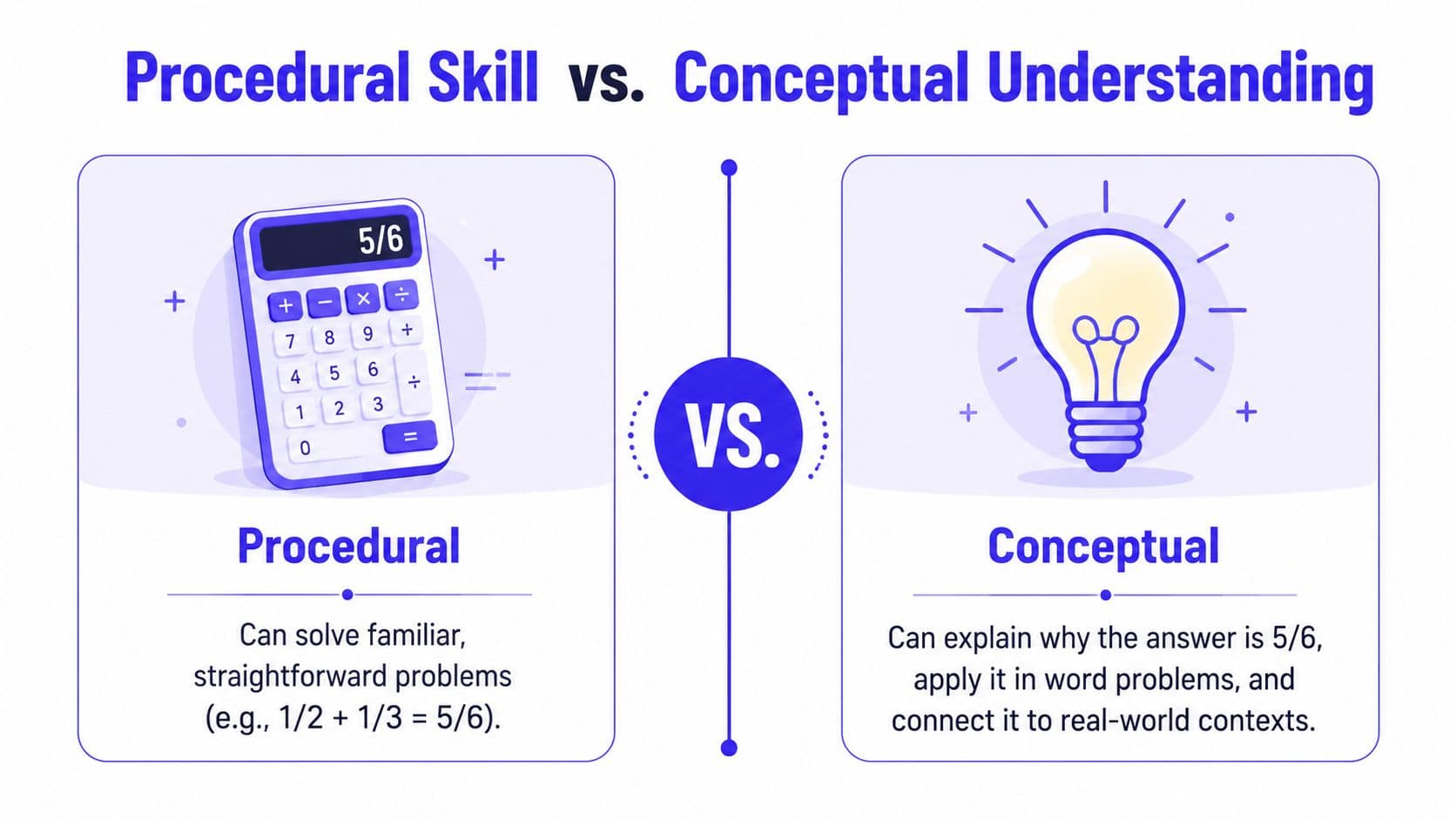
For ( \frac{1}{2} + \frac{1}{3} ), students must find a common unit rather than combine the visible numerators and denominators. A fraction strip can show why sixths work. A student who explains the model and records ( \frac{3}{6} + \frac{2}{6} = \frac{5}{6} ) is connecting representation to procedure.
Measurement and Data
Students convert measurements within a system, represent data, and solve measurement problems. Diagnose the choice behind the calculation by asking, “Which unit makes sense?” and “How will the numerical value change?”
Converting a larger unit into a smaller unit should increase the numerical value, because more smaller units fit the same measurement. That relationship offers a quick check before students use a formal conversion rule.
Geometry and volume
Students classify figures by properties and reason about volume. Ask them to name equal sides, parallel sides, and right angles rather than sort shapes by appearance. If a student calls a figure a rectangle because it “looks like one,” return to its defining attributes.
Volume connects geometry to multiplication. For a rectangular prism, students can find the number of unit cubes in one layer, then determine how many layers fill the prism. The formula records that structure. If a student remembers (V = l \times w \times h) but cannot predict what happens when one dimension changes, revisit arrays, layers, and multiplication before expecting independent formula use.
The grade 5 standards document shows these relationships across domains. Use it to map a prerequisite gap to the target standard, then select one model, one task, and one exit question that reveal whether students can transfer the idea. With 28 students and 45 minutes, that focused evidence is more useful than a broad review worksheet.
Procedural Success vs Conceptual Understanding
A student can produce a correct answer and still have an incomplete understanding. That's uncomfortable to acknowledge because completed worksheets look reassuring, especially during a busy week. But familiar formatting can hide whether students know what they're doing.
Consider fraction multiplication. A student may multiply numerators, multiply denominators, simplify, and arrive at a correct result. Then you ask, “Why is the product smaller than the whole number you started with?” The student may repeat the steps without connecting multiplication by a fraction to taking part of a quantity.
Look for transfer, not just repetition
Give students a familiar problem first, then change the representation. If they solve a symbolic problem, follow it with a diagram or short situation. For example:
- ( \frac{2}{3} \times \frac{3}{4} )
- Find three-fourths of two-thirds of a rectangle.
- A student uses two-thirds of a container, then uses three-fourths of that amount. How much of the whole container remains in use?
The numbers can stay the same while the thinking changes. A student with conceptual understanding can connect the symbolic answer to an area model or quantity. A student relying on memorized steps often searches for familiar visual cues.
Volume reveals the same problem
Students frequently remember (V = l \times w \times h) but don't know what happens when one dimension changes. Ask, “If the height becomes larger while the base stays the same, what should happen to the volume, and why?” A student who understands the model can describe additional layers of unit cubes. A student with only procedural success may say, “I multiply the three numbers,” without predicting the effect.
Use questions that require a representation before a calculation:
- “What does each factor describe?”
- “Can you draw or build the quantity?”
- “How do you know the answer is reasonable?”
- “Would the result get larger or smaller if this dimension changed?”
- “Can you solve it a different way?”
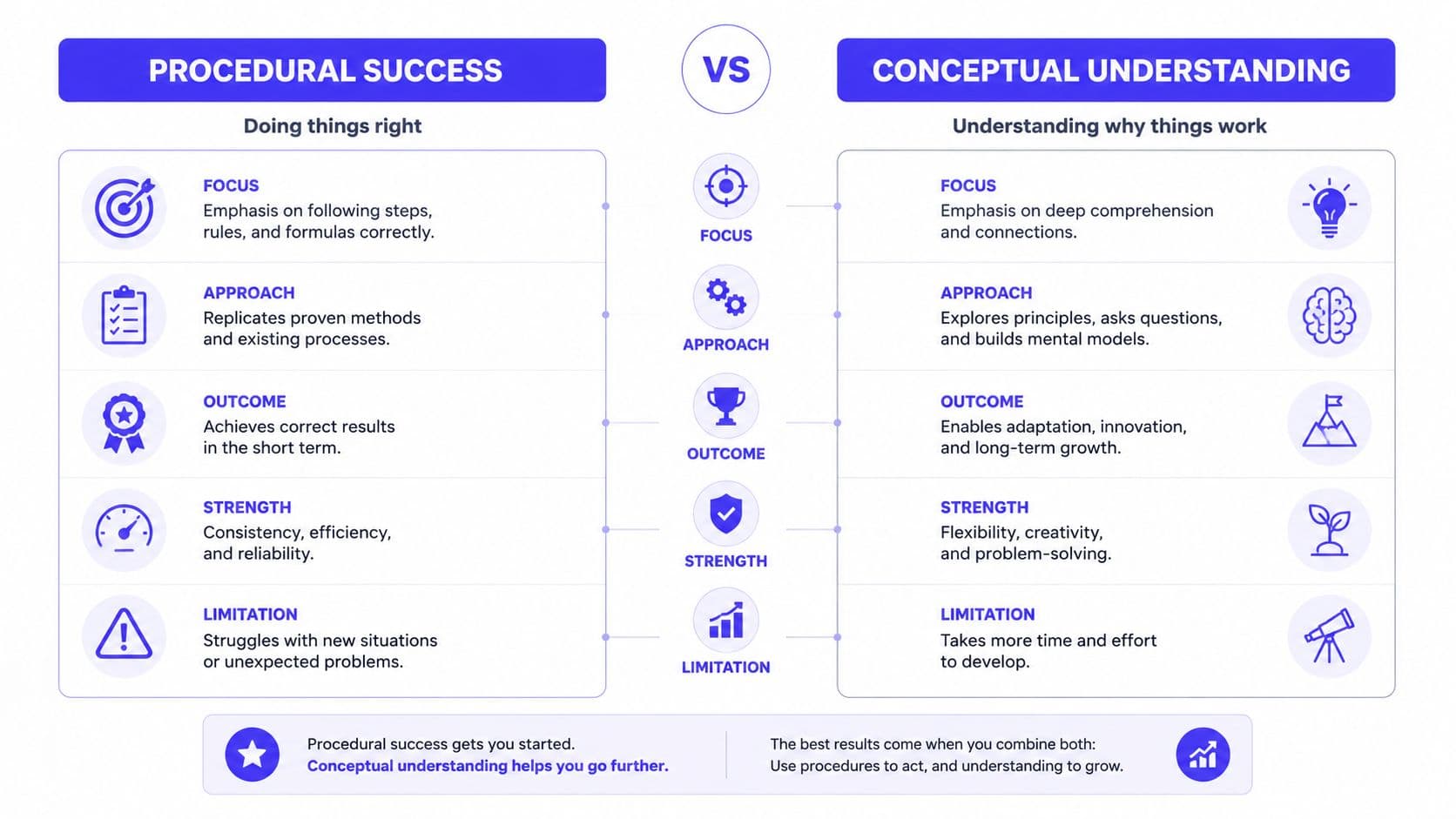
A practical assessment should include both an item and a reason. After a short computation, ask students to draw a model, write a sentence, or identify an error in someone else's work. You don't need a long test. One well-chosen explanation often tells you more than several repetitive problems.
Classroom test: Ask students to solve the problem, represent it another way, and explain why their answer fits the situation. Missing any one of those pieces gives you useful information.
This approach also changes how you respond to errors. If a student makes a denominator mistake but can model the quantities accurately, the reteaching target differs from that of a student who cannot identify what the fractions represent. Diagnose the reasoning, not just the final mark.
Diagnosing Prerequisite Gaps That Block Progress
Generic review wastes time because it treats every struggle as if it came from the same place. A more useful approach maps the current fifth-grade standard to the earlier idea students need in order to access it.
The Louisiana Department of Education grade 5 gap document models this kind of mapping by connecting grade 4 prerequisite weaknesses to grade 5 standards. That perspective matters because place value, fraction equivalence, and measurement conversions can act as upstream barriers across several lessons.
Use a three-question diagnostic
Start with the target standard, then ask:
- What must students already understand? For fraction addition, check whether students recognize equivalent fractions and understand that the denominator names the unit.
- What would the error look like? Predict the misconception before reviewing student work. A student might add unlike denominators, align decimal digits by appearance, or select a volume formula without identifying the dimensions.
- What is the smallest task that separates the possibilities? Use a brief prompt with a representation and an explanation, not a full review packet.
A student who can identify equivalent fractions but struggles to add them needs a different response from a student who sees ( \frac{1}{2} ) and ( \frac{2}{4} ) as unrelated quantities. Keep a simple record by standard and prerequisite. That record can guide small groups while the rest of the class works on grade-level tasks.
Common prerequisite gaps and their impact
| Prerequisite Gap | 5th Grade Standards Affected | Quick Detection Method |
|---|---|---|
| Place value confusion | Decimal computation and comparison | Ask students to explain the value of each digit in a decimal and estimate the result before calculating. |
| Weak fraction equivalence | Adding, subtracting, multiplying, and dividing fractions | Give two equivalent fractions and ask students to prove the relationship with a model. |
| Unclear measurement relationships | Unit conversion, measurement problems, and volume | Ask whether converting to a smaller unit should increase or decrease the numerical value, then explain why. |
| Weak multiplication structure | Multi-digit computation and volume reasoning | Represent a product with an array or partial products and ask students to connect each part to place value. |
Use a quick formative assessment examples guide to build short checks that reveal the specific misconception. The goal isn't to stop grade-level instruction for a long remediation unit. Use a brief warm-up, a targeted small group, or a worked-example discussion while keeping students connected to the current standard.
Building a Realistic Pacing Guide
A pacing guide should help you make decisions, not pretend that every week will behave. Assemblies, absences, weather, testing windows, and unfinished prerequisite work all take instructional time. Fractions may require more revisiting than your first draft allows, while geometry may become an opportunity to reinforce multiplication and measurement.
Begin with the standards that have the most dependencies. Place value supports decimal work, fraction equivalence supports later fraction operations, and multiplication supports volume. Sequence related ideas close enough together that students can reuse representations and vocabulary.
Give every unit a working purpose
Instead of assigning equal space to every domain, ask what students must be able to do by the end of the unit and what evidence will prove it. A flexible framework might look like this:
- Opening phase: Establish routines, inspect prerequisite knowledge, and begin place value and expression work.
- Whole-number and decimal phase: Connect multi-digit computation to place value and estimation.
- Fraction phase: Spend sustained time on equivalence, operations, models, and contextual problems.
- Measurement and volume phase: Use conversions, arrays, layers, and real objects to connect units to multiplication.
- Geometry and integration phase: Classify shapes by properties and combine domains in multi-step tasks.
- Buffer points: Reserve opportunities throughout the year for reteaching, reassessment, and unfinished essential work.
These aren't rigid calendar promises. They're decision points. If students still can't explain decimal alignment, move a planned application lesson into a short place-value workshop rather than racing ahead and hoping the issue disappears.
Plan for evidence, not completion
Choose one or two essential pieces of student evidence per unit. A fraction explanation, a volume model, or an error analysis may reveal more than a large stack of completed exercises. Keep a weekly note of which standards are secure, developing, or blocked by prerequisites.
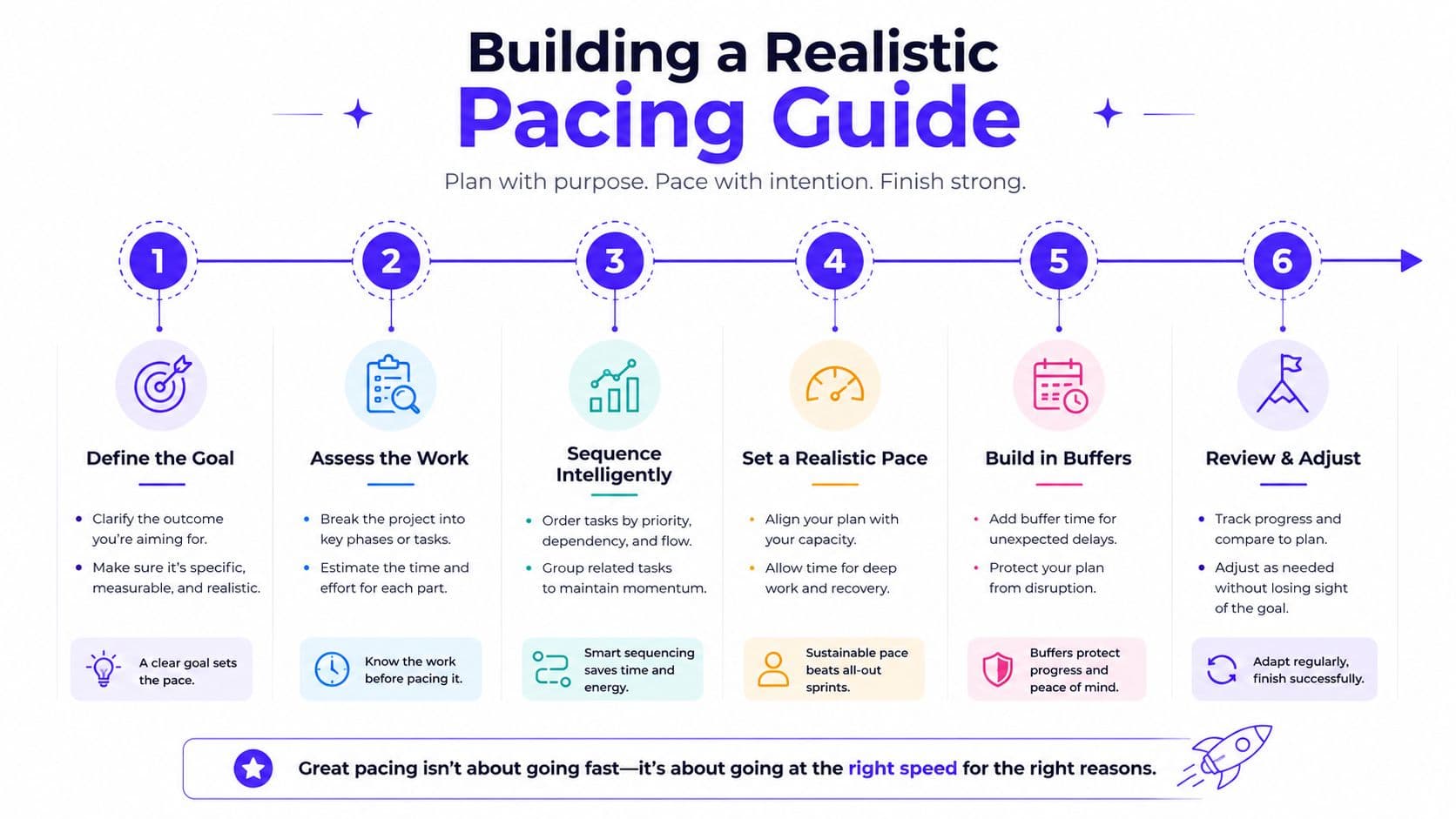
A digital unit planning workspace can help you arrange standards, lesson goals, practice, and assessment evidence in one place. Whether you use a platform, a spreadsheet, or a paper calendar, build in room to respond to what students show you. The strongest pacing guide is the one you can revise without losing the instructional thread.
Using AI Tools to Streamline Standards-Aligned Planning
AI can save planning time when you give it a narrow instructional job. It shouldn't decide what your students need. You still have to interpret their work, choose the essential idea, and check every generated task for mathematical accuracy and accessibility.
Start with a standard and a known misconception. A useful request might ask for fraction addition problems that require visual models, include an error-analysis item, and offer a supported version for students who need more scaffolding. Another request can generate a volume task that asks students to label dimensions, draw unit layers, calculate, and explain how changing a dimension affects the result.
Keep the teacher in the decision loop
A productive workflow looks like this:
- Name the objective. Specify the exact skill and the evidence students should produce.
- Add the misconception. Tell the tool what students are getting wrong, such as treating denominators as quantities to add.
- Request varied representations. Ask for equations, diagrams, tables, and short contexts.
- Review the mathematics. Check models, wording, units, and answer keys yourself.
- Adjust for your class. Replace unfamiliar contexts, reduce language load, or add manipulatives.
- Convert the material into classroom form. Prepare a warm-up, guided practice, exit ticket, or printable worksheet.
Platforms such as Kuraplan can generate standards-aligned lesson materials, worksheets, educational visuals, differentiated practice, and assessment rubrics. A teacher might use it to draft fraction-operation practice, create a kid-friendly volume diagram, or turn a lesson into a printable worksheet, then revise the output to match the students in front of them. Explore AI tools for lesson planning when you need a starting point for material creation rather than another broad source of ideas.

The best use of AI is often the least glamorous one. Let it handle formatting, alternate versions, practice sets, and visual drafts so you can spend your limited preparation time examining student reasoning and planning the next intervention. Never upload identifiable student information, and never hand generated work to students without reviewing it.
Your Action Plan for a Successful Math Year
Start small and make the plan visible.
- At the beginning: Give short diagnostic tasks tied to prerequisite ideas, especially place value, fraction equivalence, multiplication structure, and measurement relationships.
- During each unit: Teach the representation and meaning before expecting efficient procedures. Require students to explain at least some answers, not only record them.
- Every week: Review student work by standard. Separate a calculation error from a prerequisite gap and regroup accordingly.
- Midyear: Compare your pacing guide with actual evidence. Protect time for concepts that still block later work, even if that means compressing routine practice.
- As the year continues: Watch for students who succeed only when the problem format looks familiar. Ask them to model, justify, estimate, or solve in a new context.
- With families: Share the current learning goal, a sample student strategy, and one question families can ask, such as “How do you know?” rather than focusing only on the final answer.
A successful year doesn't require perfect coverage. It requires a clear map from prerequisite knowledge to grade-level standards, deliberate attention to conceptual transfer, and a pacing guide flexible enough to respond to evidence. Your students should leave fifth grade not only able to calculate, but able to explain what their calculations mean.
Kuraplan helps teachers create standards-aligned fifth-grade math lessons, worksheets, visuals, unit plans, and assessments while keeping teacher judgment at the center. Visit Kuraplan to turn a specific prerequisite gap or Common Core objective into classroom-ready material and reclaim planning time for student thinking.