You ask, “What did you think of the story?” The middle school ELA class looks back at you. Three students shrug. One starts describing the bus ride home. The rest keep their hands down.
The problem usually isn't that students have nothing to say. The question gives them no clear place to begin, no evidence to use, and no reason to listen to one another. Learning how to write discussion questions means treating each prompt as a designed part of the lesson, not as a last-minute invitation to talk.
The Moment a Discussion Goes Flat and Why
“What did you think of the story?” sounds friendly, but it puts too much work on students at once. They have to decide whether you're asking about the plot, their feelings, the author's message, or a personal connection. A confident student may talk, but the answer can drift far from the text. A quieter student may have a useful interpretation and still say nothing because the question offers no structure for sharing it.
The question also asks for a reaction before students have established a common understanding. A useful discussion often moves from what the text says, to what it means, to what judgment students can defend. Guidance on Socratic Seminar describes this three-tier progression as literal questions first, interpretive questions next, and evaluative questions last, because students need to verify evidence before interpreting it or expressing an opinion (peer-reviewed guidance on data-centered seminars).
The hidden planning problem
Teachers often begin discussion before deciding what students should accomplish through the conversation. If the purpose is unclear, every answer seems acceptable, and students can't tell whether a good response should summarize, interpret, challenge, or apply an idea.
A broad theme such as identity isn't enough. “Discuss identity” names a topic, not observable thinking. A stronger aim might be: Students will explain how the protagonist's choice changes the reader's understanding of belonging, using two details from the story.
That aim gives the class a route. Students can locate details, interpret the choice, and respond to one another's reasoning.
Practical rule: If you can't describe what evidence you'll listen for, the question isn't ready.
The fix isn't only more wait-time, a new seating chart, or a livelier teacher voice. Those moves can help, but they can't rescue a prompt that asks for an unbounded feeling. Design the question first, then plan the routine that gives students access to it.
Start With the Goal Before the Question
Before drafting a stem, write the discussion purpose in one sentence. Choose a purpose that describes student thinking, such as explore an interpretation, surface a misconception, rehearse an argument, or check comprehension. A 2013 Oxford Academic account of question-driven history instruction describes courses organized around authentic, open-ended questions at several levels, from the course itself to individual class days.
Next, connect the purpose to a learning target or standard. Don't stop at “students will analyze.” Name what they'll analyze and what will count as evidence. A statistics-education framework from the American Statistical Association also emphasizes using a small number of concept questions with a clear purpose and intentional placement in the lesson.
A worked planning example
Vague goal: Students will discuss the novel.
More useful goal: Students will evaluate whether the protagonist's final decision is an act of courage or an act of self-protection, then defend their position with textual evidence.
Check the question against three points:
- Content alignment: Does the prompt address the character's final decision rather than the novel in general?
- Cognitive alignment: Must students evaluate competing interpretations, not recall events?
- Conversation alignment: Will students need to compare and respond to positions?
Avoid goals that only name a theme, such as “explore identity,” or describe an activity, such as “participate in a seminar.” Also avoid a target that names a cognitive level but leaves out the content. “Students will evaluate” tells you how they should think, but not what they should evaluate.
The one-page planning sheet
A simple planning page can include four boxes:
- Purpose: What should the conversation accomplish?
- Learning target: What will students know or do?
- Evidence: What words, details, calculations, or sources will reveal mastery?
- Conversational move: Should students clarify, cite, challenge, compare, or revise?
That page prevents a common mistake: writing attractive questions that don't produce useful evidence of learning. Once the purpose is fixed, Bloom's levels give you a practical vocabulary for choosing the right mental demand.
Match the Stem to the Cognitive Level
Bloom's Taxonomy works best as a drafting tool, not as a ladder students must climb mechanically. Each level suggests a different kind of work. The key is to match the stem to the content and require students to do something visible with their thinking.
Remember and understand questions establish shared ground. Try “What did the character decide when the conflict began?”, “How would you summarize the process?”, or “Which detail introduces the problem?” A weak prompt says, “What happened in the story?” An upgraded version asks, “What decision does Maya make after she reads the letter, and which detail shows why she makes it?”
Apply questions move an idea into a new situation. Use “How would you use this strategy to solve a different problem?”, “Where else could this principle work?”, or “What would change if you applied this rule here?” Instead of “Can you use the formula?”, ask, “How would you use the formula to find the missing side if the shape were rotated and one measurement were represented by a variable?”
Analyze questions separate parts, relationships, and evidence. Useful stems include “What evidence supports the claim that…?”, “How does this detail change the meaning of…?”, and “What relationship do you notice between…?” Replace “Analyze the story” with “What evidence supports the claim that the narrator is unreliable, and how does each detail affect your interpretation?”
Evaluate questions ask students to judge alternatives. Try “Which argument is stronger and why?”, “What is the most convincing explanation?”, or “Which decision creates the fairest outcome?” “Do you agree with the character?” becomes “Which position is stronger, the character's justification or the community's criticism, and what evidence makes it stronger?”
Create questions require a designed response with constraints. Use “Design a rule that would…”, “How could you revise the system so that…?”, or “What would you create to solve…?” “Write an alternative ending” becomes “Design an alternative ending in which the protagonist keeps the secret, but preserve the story's central conflict and show its consequence through two details.”
| Bloom's Level | Starter Stems | Weak Question | Upgraded Question |
|---|---|---|---|
| Remember and understand | What happened when...? How would you summarize...? Which detail shows...? | What happened in the story? | What decision does Maya make after reading the letter, and which detail shows why? |
| Apply | How would you use...? Where else could...? What changes if...? | Can you use the formula? | How would you use the formula if the shape were rotated and one measurement were a variable? |
| Analyze | What evidence supports...? How does this detail...? What relationship...? | Analyze the story. | What evidence supports the claim that the narrator is unreliable? |
| Evaluate | Which argument is stronger...? What is most convincing...? Which decision...? | Do you agree? | Which position is stronger, and what evidence makes it stronger? |
| Create | Design a rule that...? How could you revise...? What would you create...? | Write an alternative ending. | Design an ending that preserves the central conflict and shows its consequence through two details. |
A useful planning rule is to include at least one Analyze or Evaluate stem in a discussion planned for 25 minutes, otherwise the exchange can remain at recall (Bloom's taxonomy verbs and examples). The right level still depends on the objective. A difficult question about irrelevant content is not rigorous instruction.
Scaffold Questions Across Grade Levels
The same intellectual task can sound completely different in a kindergarten room and a senior literature seminar. Younger students need visible referents, familiar vocabulary, oral rehearsal, and sentence frames. Older students can carry more of the reasoning independently, but they still need a precise text, source, data set, or problem to discuss.
K-2
For a character-motivation lesson, ask: “Why did the rabbit hide? Point to the picture that gives you a clue.” Display two or three illustrations, rehearse with a partner, and offer the frame, “I think the rabbit hid because ___.” The question remains interpretive, but the visual support reduces memory and language demands.
Grades 3-5
For an upper-elementary science lesson, ask: “What caused the plant near the window to grow differently from the plant in the cupboard? Use one observation from the investigation.” Students can name a cause, identify an effect, and connect the claim to an observation. Vocabulary such as light, growth, compare, and evidence should appear in the prompt or on the board.
Grades 6-8
For a middle school social studies lesson, ask: “Which source gives the more reliable explanation for the policy, and what does each source's purpose reveal?” This is stronger than “What does the source say?” because students must consider sourcing, compare accounts, and defend a judgment. Seventh graders often reject “How do you feel about this?” but will debate “Which source would you trust if you had to explain the policy to someone who disagreed?”
Grades 9-12
For high school literature, ask: “How does the novel's final image revise the meaning of the opening scene, and which interpretation best accounts for both?” Students should be expected to build an unprompted argument, cite precise passages, and address an alternative reading. You can still provide optional stems such as “The final image complicates the opening because…” for students who need access without lowering the demand.
| Grade Band | ELA Example Stem | Science Example Stem | Social Studies Example Stem | Complexity Note |
|---|---|---|---|---|
| K-2 | Why did the character act that way? Show a picture clue. | What do you notice? What might have caused it? | Who is in the picture, and what do you see? | Use visuals, gestures, partner talk, and short sentence frames. |
| 3-5 | What detail shows how the character changed? | What caused the result? Use an observation. | What does this source tell us about the event? | Add content vocabulary and require one piece of evidence. |
| 6-8 | Which choice reveals the character's motivation? | Which variable best explains the pattern? | Which source is more reliable, and why? | Expect comparison, sourcing, and a connected explanation. |
| 9-12 | How does the ending revise the opening's meaning? | Which model best explains the evidence? | How do competing accounts construct different arguments? | Expect independent claims, precise evidence, and counterarguments. |
A scaffolding guide for education is useful when you need to vary language, supports, or task complexity without changing the central learning target. The scaffold should fade as students gain control. Sentence starters are access tools, not permanent substitutes for student-authored reasoning.
Build One Question That Demands a Defense
A high-impact prompt usually has three parts:
- Opening prompt: Present a focused claim, scenario, problem, or interpretive choice.
- Evidence demand: Tell students what they must use, such as a quotation, source detail, observation, or calculation.
- Accountability probe: Ask them to explain why the evidence supports the answer or how they would respond to another position.
This structure follows practical discussion guidance from the University of Michigan Center for Research on Learning and Teaching, which recommends an open prompt followed by a commitment and evidence-based defense. Follow-up probes such as “Why do you say that?” and “How did you come to that conclusion?” keep students from stopping at a one-word response.
See the difference in the rewrite
Weak: “Did the character make the right choice?”
Stronger: “Was the character's choice justified, given what the character knew at the time? Cite one detail, then explain what someone who disagrees might point out.”
Weak: “What do you think about the experiment?”
Stronger: “Which explanation best accounts for the result? Use one observation and explain why a competing explanation is less convincing.”
The stronger versions don't ban opinion. They make opinion accountable to evidence.
In a live classroom, ask the question once, display it, and give students time to locate evidence before calling on anyone. Vary the routine. Students might write a claim first, compare it with a partner, then respond to a classmate rather than always answering the teacher. If a student says, “It was unfair,” press gently: “Which moment makes you say that?” If the response remains thin, ask, “What would the other side use as evidence?”
For a video example of discussion-question design and inquiry prompts, watch the classroom discussion video. The aim isn't to manufacture noise. It's to make each contribution add reasoning, evidence, or a meaningful challenge.
Adapt Questions for Live and Online Discussion
A question that works around a table can collapse in a discussion board. In person, a teacher can notice confusion, redirect a tangent, and ask a follow-up immediately. Online, the prompt must carry more of the structure, and students need a clear reason to return to the thread.
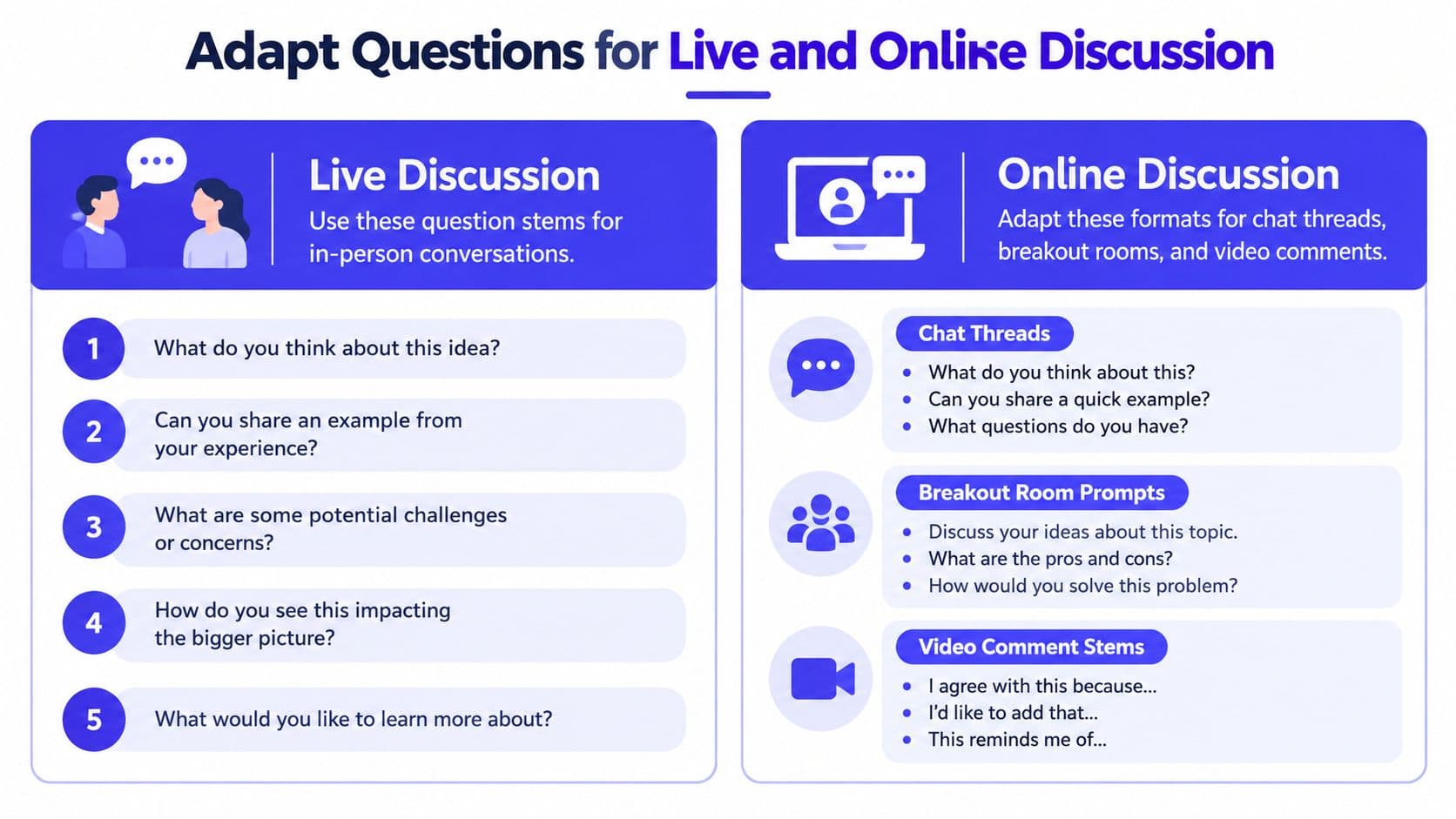
Consider the live question: “Which source best explains the protest, and what evidence supports your choice?” In a Google Doc thread, write: “Choose Source A or Source B. Post a claim, cite one phrase, and reply to a classmate by identifying one point of agreement or tension.” The added directions replace some of the teacher's live facilitation.
For a Padlet board, shorten the visible prompt and separate the actions: “Post your source choice and evidence. Then comment on one post that changed, strengthened, or complicated your thinking.” For a synchronous Zoom breakout, give groups the same question plus roles, such as evidence finder, challenger, and reporter. The roles prevent one student from doing all the talking.
Match the platform to the thinking
- Live discussion: Use one question at a time, pause after asking it, and keep a visible follow-up such as “How do you know?”
- Breakout room: Give students a decision to reach and a reporting format, not just a broad topic.
- Google Doc thread: Require a claim, evidence, and response so posts don't become isolated answers.
- Padlet board: Use a short prompt with a required comment on another student's reasoning.
- Video comments: Ask students to reference a specific moment, quote, or visual detail.
Live guidance often recommends asking one question at a time and allowing 10–30 seconds of wait time before moving on (Cornell guidance on facilitating discussions). Asynchronous work needs a different kind of patience. Students need the evidence source, response expectations, and follow-up probes preloaded because the teacher isn't present at every moment to repair an unclear prompt.
Use Questions as Formative Assessment
A discussion becomes formative assessment when the question reveals the thinking students need to develop. Listen for evidence connected to the objective, rather than treating the number of raised hands as proof of understanding. A quiet student with a precise explanation may show more learning than several quick volunteers.
Use this four-part loop:
- Launch a stem tied to the learning target.
- Listen for evidence of the intended thinking.
- Record a quick score against a rubric criterion, using a 0–2 or 1–4 scale when that fits your school's system. See these formative assessment examples for rubric-ready checks.
- Choose the response: reteach, re-question, provide a scaffold, or advance.
In an elementary ELA discussion, mastery may sound like an accurate explanation of a character's motivation supported by a specific detail. With seventh graders, discourse quality also means responding directly to a peer and extending the interpretation. In high school, listen for students qualifying a claim when the text supports more than one reading.
Math requires the same discipline. A correct answer does not automatically show a sound explanation. Listen for the model, the strategy, and the connection between the calculation and the claim.
| Bloom Level | ELA Evidence to Listen For | Math Evidence to Listen For | Next-Step Action |
|---|---|---|---|
| Remember and understand | Accurate retelling and relevant vocabulary | Correctly identifies known quantities and the task | Clarify missing content or vocabulary. |
| Apply | Transfers a reading strategy to a new passage | Uses a known method in a changed context | Model one example, then offer a parallel problem. |
| Analyze | Connects a claim to several precise details | Explains relationships among quantities or representations | Ask for a second piece of evidence or a diagram. |
| Evaluate | Compares interpretations and addresses a counterpoint | Compares methods and justifies the more efficient one | Re-question students who state preferences without reasons. |
| Create | Constructs a defensible interpretation or revision | Designs a model, rule, or solution and tests it | Ask students to identify constraints and revise the design. |
A Monday planning checklist can stay small:
- Objective link: Write one launch question for each objective.
- Participation read: Plan one cold-call prompt for each student during the week.
- Written check: Align one exit ticket to the same cognitive verb.
- Rubric evidence: Prepare one row with sentence starters for citing evidence.
Students can generate questions too, provided they have examples, non-examples, a definition of open-ended questioning, and time to peer-check and revise their drafts, as described in discussion strategy guidance from Washington University. Their revisions give you another window into what they understand.
For fast drafting, Kuraplan generates standards-aligned lesson materials and discussion question sets organized around Bloom's levels. Kuraplan can also generate differentiated scaffolds and assessment rubrics to pair with each question set, while you keep the final judgment on whether a prompt fits the text, grade level, and available evidence.
Name the goal, choose the cognitive demand, require evidence, and decide what you will listen for. Kuraplan helps draft and align question sets quickly, so visit Kuraplan when you need a practical, evidence-focused discussion plan.