You're staring at a planning document with a topic at the top, a list of standards in the margin, and no clear idea what students should be able to explain by the end. The temptation is to fill the empty boxes with activities until the calendar looks complete. I've done that, and so has nearly every science teacher I know.
A strong unit plan in science isn't a longer lesson plan or a content checklist. It's a map of how students' thinking changes, from their starting ideas to a performance that shows what they understand. That map still has to work when class time is short, equipment is missing, students need different kinds of support, and an AI tool produces something that looks polished but contains a scientific error.
What a Science Unit Plan Looks Like
A useful unit plan in science shows how students move from an initial idea to a defensible explanation. Four questions keep that movement visible: What should students understand? What evidence will show it? What experiences will help them get there? What support will make participation possible?
Suppose you are planning an ecosystems unit. The anchoring phenomenon might be a pond where one population changes after a resource disappears. Students could develop the enduring understanding that organisms depend on relationships and available resources, guided by the question, “How does a change in one part of an ecosystem affect the rest?” The question gives the unit a scientific problem to investigate instead of a parade of vocabulary terms.
The pieces that belong on the page
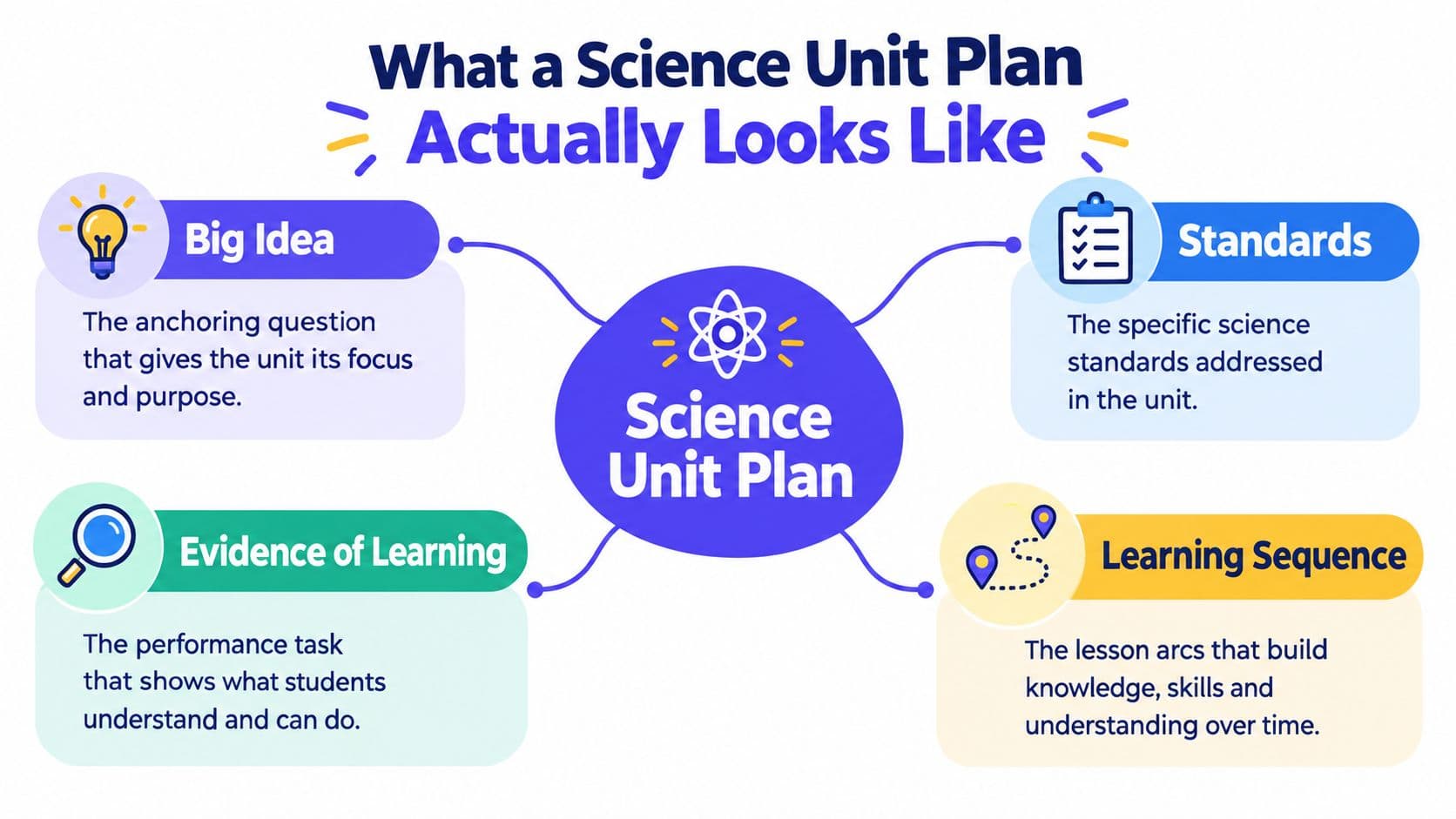
A finished plan will usually include:
- A big idea: The scientific understanding students should carry beyond the unit.
- Standards: The disciplinary ideas, practices, and crosscutting concepts being coordinated.
- A learning sequence: Lessons arranged so each one prepares students for the next.
- Evidence of learning: Models, data interpretations, explanations, arguments, or performance tasks.
- Differentiation notes: Planned changes to language, materials, grouping, representations, or response modes.
The National Research Council describes learning progressions as useful at lesson, unit, course, and K–12 levels because they connect prior knowledge with longer-term expectations and make changes in understanding visible (National Research Council learning progression resource).
Start with what students think they know. They might draw a food web, then interpret population data, revise the model, and argue what could happen if a resource is removed. Each task should supply a reason and a tool for the next task. If students can complete a lesson anywhere in the sequence without affecting later work, the unit may be a collection of activities rather than a learning progression.
The same test applies to media. If students examine a generated image or diagram, they should check whether it represents the science accurately and explain any misleading feature. A classroom lesson on spotting AI-generated images in class can build that media literacy while keeping the scientific question at the center.
Backward Design for Beginners
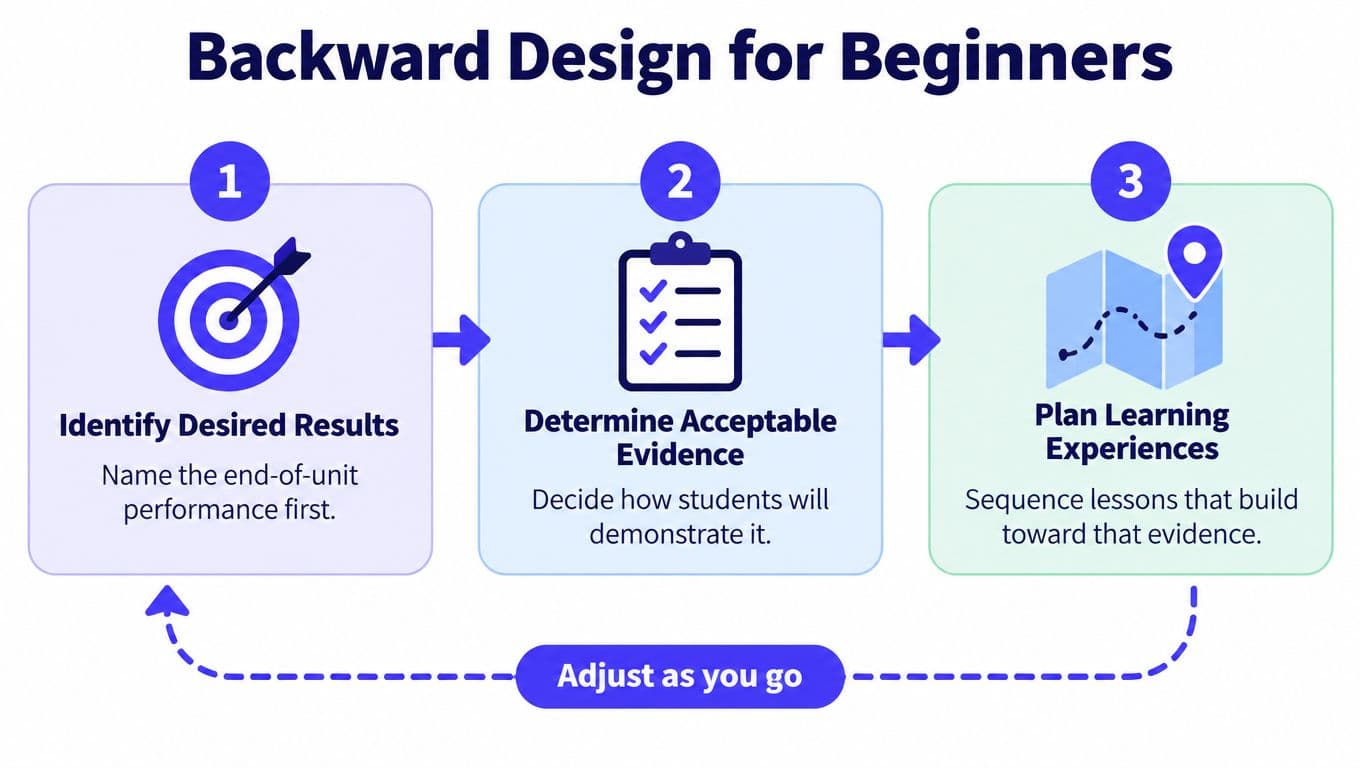
A class reaches the final ecosystems task, and students can name a limiting factor but cannot explain what happens when a resource disappears. The problem often began before instruction: the unit was built around activities rather than the understanding students needed to demonstrate. A more reliable planning move is simple, start at the end.
Name the performance first. Students might construct an evidence-based argument about a population after a resource is removed. That task calls for more than recalling a definition. Students must interpret data, use an ecosystem model, connect cause and effect, and explain why their evidence supports the claim.
Then define acceptable evidence. A rubric could look for a clear claim, relevant data, reasoning that connects the data to the model, and a revision that responds to new evidence. Investigations, readings, discussions, and modeling tasks come after those decisions, because each activity should prepare students for a visible part of the final performance.
Build the sequence around observable actions
Three-dimensional science instruction brings together science and engineering practices, crosscutting concepts, and disciplinary core ideas. In a population-change lesson, students might interpret data, use patterns to identify a relationship, and explain an ecosystem concept in the same task. The dimensions should work together, rather than sit in separate boxes. The NGSS discussion of three-dimensional science design describes this kind of connection across science learning.
Write objectives as actions you can see or hear:
- Constructing a model: Students represent relationships among organisms and resources.
- Interpreting data: Students identify a pattern in population data and describe its limits.
- Arguing from evidence: Students support a claim with selected evidence and reasoning.
- Revising an explanation: Students change their model after encountering conflicting evidence.
Before teaching, draw arrows between lessons. Ask what each lesson supplies to the next. If students later interpret a graph, have they learned the relevant graph features? If they revise a model, have they first created one that exposes their original thinking? A short check at each handoff can reveal a missing bridge while there is still time to repair it.
A unit plan is easier to revise when every objective points to an observable student action. That structure also leaves room to protect inquiry when equipment, time, or budget limits the available activities.
Embedding Assessment at Decision Points
A class is midway through a population unit. Several students can recall the vocabulary, yet their models show that they think food availability affects only individual organisms. A final test may reveal that pattern after instruction ends. A decision-point assessment exposes it while the next lesson can still respond.
Use a three-part rhythm:
- Diagnostic before instruction: Find out what students currently think.
- Checkpoints during the sequence: Examine the model or practice under development.
- Performance task at the end: Ask students to apply the same success criteria in a richer context.
Students might begin with a short explanation of why a population changes. Midway through the unit, they build a model showing how resources affect that population. At the end, they use unfamiliar data to construct an argument. The products differ, but together they trace connected understanding through the learning progression.
Turn answers into decisions
Assessment becomes formative when student evidence changes the next teaching move. A misconception may require a particulate model to be revisited, a representation to be changed, or groups to be reorganized. Missing prerequisite knowledge may call for a focused example, while secure understanding can justify a more complex application. Recording answers without adjusting instruction is measurement, not formative assessment.
Best Evidence Science Teaching uses diagnostic questions with distractors based on common misconceptions. Those choices can help distinguish a careless factual slip from a flawed underlying model. Its planning approach links learning steps with diagnostic questions and response activities, as discussed in this Best Evidence Science Teaching discussion.
Write a response pathway beside each planned check:
| Student evidence | Teacher response |
|---|---|
| Target model is present | Move to a more complex application |
| Predictable misconception appears | Revisit the model with a new representation |
| Prerequisite knowledge is missing | Provide a focused mini-lesson or supported example |
The Education Endowment Foundation evaluation of Embedding Formative Assessment reported approximately two months of additional progress relative to business-as-usual instruction, using Attainment 8 outcomes (evaluation of Embedding Formative Assessment). The practical lesson is to write the next move before teaching, rather than chase the reported figure.
Teachers can also adapt these formative assessment examples to the scientific model students are building. A useful check is one that makes the next instructional choice clearer.
Differentiation as a Design Problem
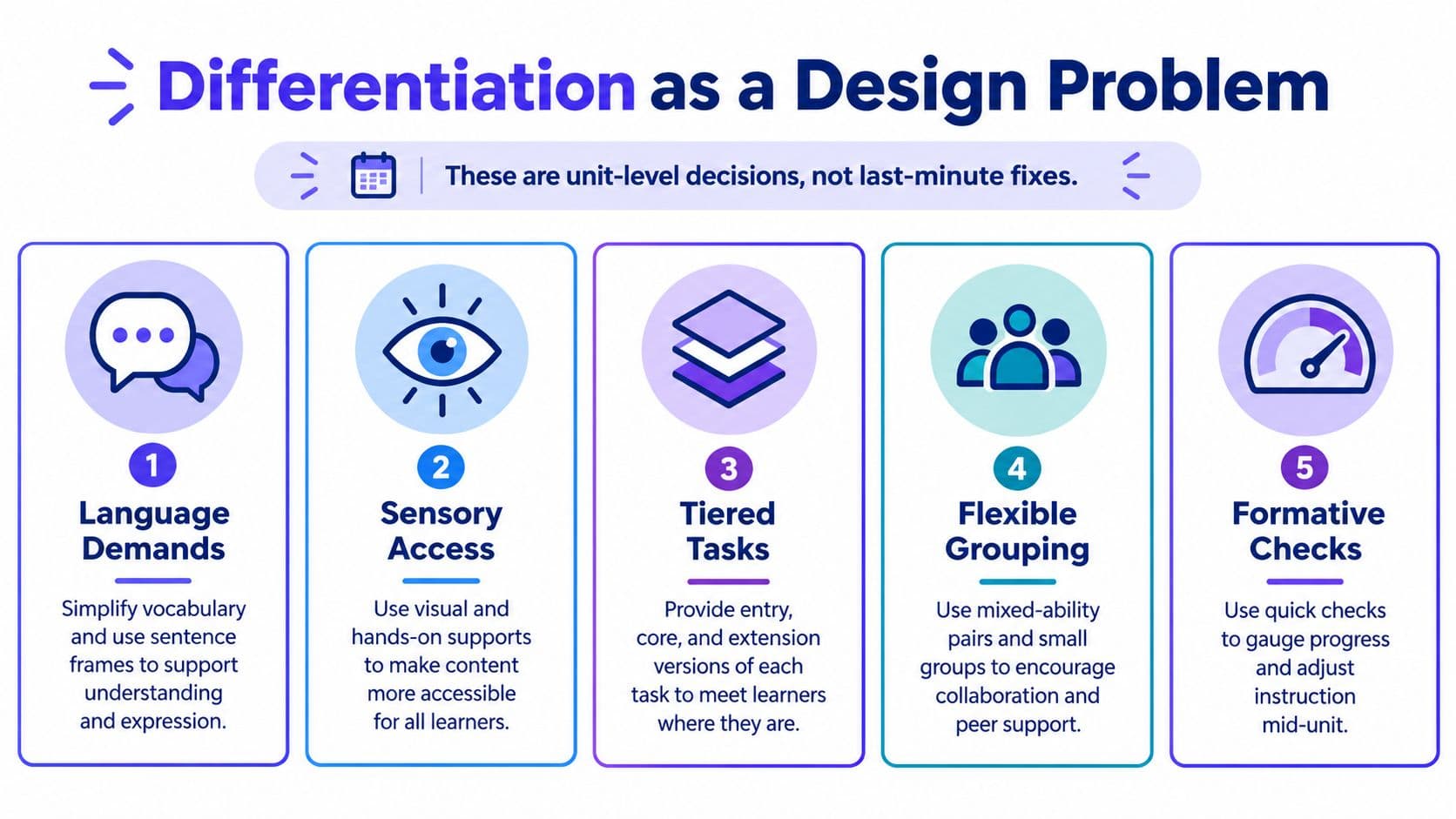
During a unit on ecosystems, one student may explain a population change clearly in conversation, while another needs a diagram, sentence frame, or model before the same reasoning becomes visible. Plan for those routes before the first lesson. Keep the scientific goal shared, then vary how students access the idea and show what they understand.
A multilingual learner might use, “The population changed because the data show…” A student who finds extended writing difficult could record an oral explanation, label a model, or complete an evidence organizer. Captioned visuals, enlarged diagrams, tactile models, and carefully described demonstrations can improve sensory access without changing the scientific question.
Keep the thinking rigorous
Access support should reduce avoidable barriers, not reduce the reasoning demand. Chunking a dense text, previewing vocabulary, or adding a diagram can leave an argument from evidence fully intact. Replacing that argument with a recall worksheet changes the learning goal.
Check the unit across these design choices:
- Language demands: Add sentence stems, vocabulary previews, and clearly separated instructions.
- Sensory access: Use captions, visual contrast, tactile representations, and verbal descriptions.
- Group roles: Assign responsibilities such as data recorder, equipment manager, model builder, and evidence checker.
- Response modes: Accept writing, speaking, drawing, modeling, or annotated data displays when each reveals the target understanding.
- Scaffolds and extensions: Provide a supported entry point and a more complex application while keeping the central question consistent.
This approach reflects universal design for learning. It treats learner variability as a design condition, rather than waiting until a student is excluded from an activity and then adding a workaround.
An inclusive differentiation guide can suggest options, but each one still needs a check against the objective. A colorful worksheet may remain difficult to access, and a simplified task may remove the scientific thinking students need to practise.
Keeping Inquiry Alive With Limited Resources
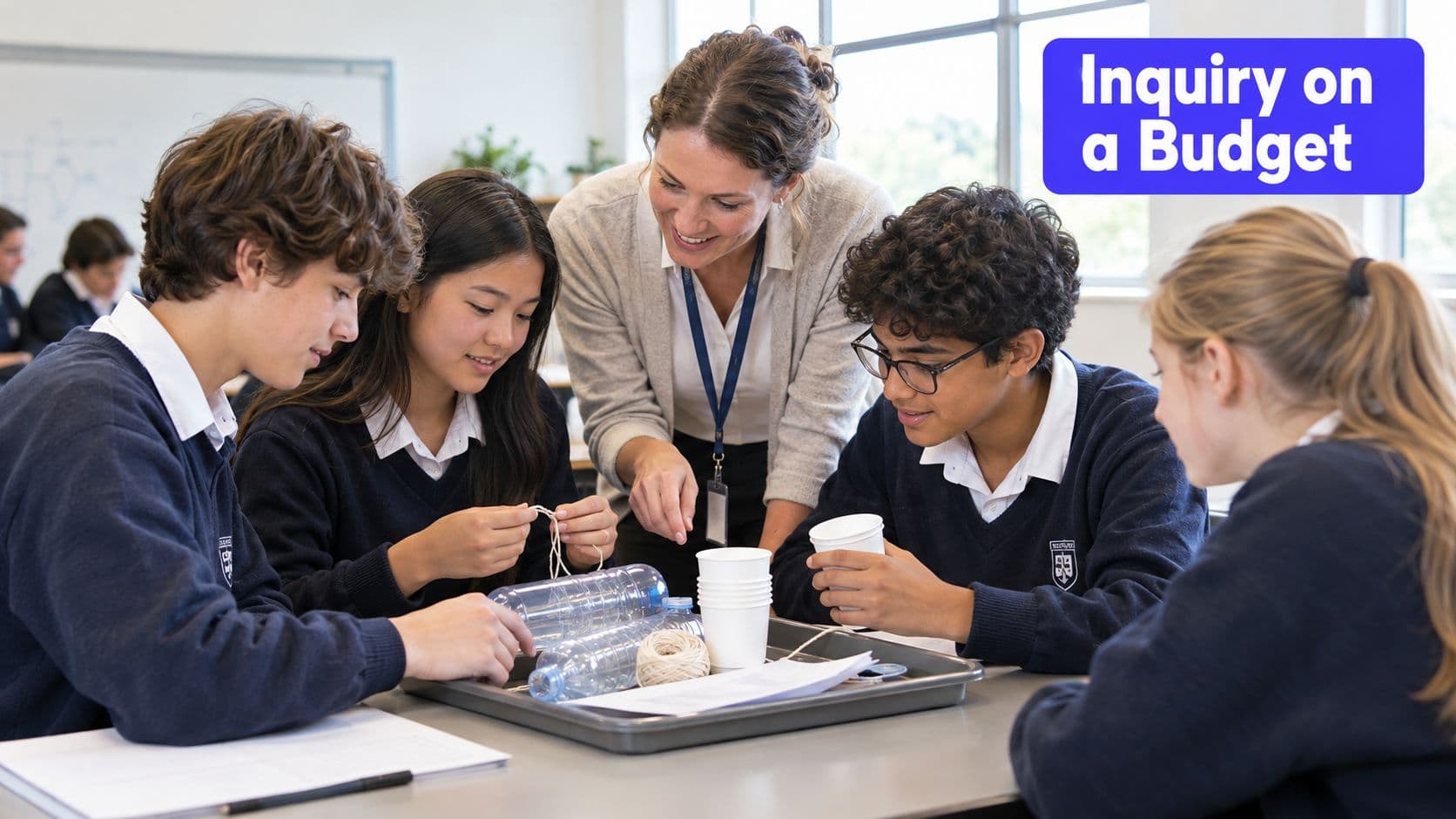
A density investigation can begin with a full laboratory setup, a few reused containers, or a teacher demonstration. The question remains scientific when students predict, examine evidence, and explain what the evidence means. Inquiry is a reasoning goal, not a particular kit of materials.
Resource limits shape that design. In the 2025 Royal Society of Chemistry Science Teaching Survey, 61% of respondents identified both the cost of consumables and chemicals and insufficient time to teach practical work alongside theory as barriers (Royal Society of Chemistry Science Teaching Survey 2025). That constraint calls for a deliberate learning progression, not a weaker version of the same lesson.
Start with the evidence students need to produce, then choose the safest workable route. In a density-column investigation, students might layer liquids, place small objects into the column, and record where each object settles.
With the hands-on version, students handle materials, observe outcomes, and collect their own data. They gain procedural experience, while the teacher manages supplies, cleanup, and supervision. A low-cost version can use accessible liquids and reused transparent containers. The reasoning target can stay intact, although measurement precision and repeatability may decline.
A teacher demonstration shifts control of the procedure to the teacher. Students still predict, observe, and analyze shared results, but they have less experience making experimental decisions. A simulation lets students change variables and repeat trials in a digital model. It supports pattern finding, though the model may conceal the uncertainty and messiness of real materials. An outdoor investigation can compare objects or materials that sink or float in a safe water setting. It offers context without reproducing the density-column phenomenon exactly.
Use a worksheet for interpreting results, not as a substitute for conducting an investigation. If students did not handle materials or control procedures, name that missing evidence and assess explanation, prediction, or interpretation instead.
Using AI Planning Tools Without Losing Teacher Judgment
AI can draft a sequence quickly. It can't take responsibility for whether the sequence teaches accurate science to the particular students in front of you.
Run every generated resource through the same review:
- Check the science: Look for incorrect definitions, oversimplified causal claims, misleading diagrams, and impossible procedures.
- Check the alignment: Confirm that the activity develops the stated standard and practice.
- Check the learner fit: Review reading level, language load, sensory access, prerequisite knowledge, and available technology.
- Check the assessment: Make sure the task measures the intended model or practice, rather than neatness or vocabulary recall.
- Check privacy: Don't place personally identifying student information into a tool without an approved, privacy-safe workflow.
A 2025 study of 383 science teachers found that inadequate training and data-privacy concerns were the most prominent barriers to integrating AI into science education, while familiarity with AI influenced readiness and AI-supported assessment and feedback (study of AI integration among science teachers). That finding matches what I see in practice. The tool can reduce formatting and planning work, but teacher verification remains essential.
Kuraplan is one option for generating standards-aligned K–12 lesson and unit materials. Its unit plan generation tool can map objectives to standards, organize a sequential lesson progression, differentiate instruction, and include integrated assessments. I'd still verify the scientific accuracy, decide whether the chosen representation fits the class, and inspect every activity for safety and feasibility.
Department-review rule: If a generated worksheet or unit plan wouldn't survive review by your science department, it doesn't reach students yet.
AI should handle repeatable planning labor where it can. The teacher must retain judgment about evidence, access, safety, accuracy, and the students' actual responses.
Converting Unit Plans Into Worksheets and Visuals
A finished unit plan still has to become something students can read, handle, discuss, and complete within the available class time. Start with one objective, not the entire unit.
For a lesson on food webs, the objective might be, “Students will revise a model to explain how removing one organism affects other populations.” A useful worksheet could include a short data set, a multiple-choice prediction, a constructed response requiring evidence and reasoning, and a food-web diagram for students to label and revise.
Build materials from the success criteria
A worksheet generator can speed up formatting, but the teacher should supply the instructional judgment. Kuraplan, for example, can convert a lesson plan into a printable worksheet with multiple-choice items, images, and age-appropriate question types. Before printing, check whether each item matches the unit's success criteria and whether students can complete it in the planned time.
Visuals need the same scrutiny. A particle model might need a simple labeled diagram rather than an elaborate illustration. A food web may benefit from a custom visual if the relationships are unfamiliar, while a clean infographic may be enough when students are organizing already-known components. The image should make the target thinking easier, not compete with it.
For more complex classroom videos, a guide to e-learning video production companies can help you think about pacing, narration, captions, and visual clarity. A video is useful only when students have a purpose for watching and a way to use what they notice.
Before releasing any generated material, ask:
- Vocabulary: Does it match the terms used throughout the unit?
- Representation: Does the image show the science accurately?
- Reading load: Can students access the reasoning without unnecessary text?
- Assessment fit: Does the task measure the intended practice?
- Timing: Can students finish and discuss it within the lesson?
Your Next Planning Session
Set a timer, open a blank unit document, and work in this order:
- Name the end performance. Write what students will construct, interpret, argue, model, or revise.
- Write the diagnostic. Ask what students might already believe, including a likely misconception.
- Sketch the sequence. Put lessons in an order where each one supplies knowledge for the next.
- Mark the checkpoints. Decide when evidence will change grouping, representation, support, or extension.
- Plan access. Note language supports, sensory options, group roles, response modes, and prerequisite bridges.
- Choose the material version. Select the hands-on, low-cost, demonstration, simulation, or outdoor option that fits your room.
If students will create physical materials or organize project work, it can also help to compare lab project binder options before the unit begins. The organization system should support evidence collection, not become another assignment students have to decode.
The most useful question before teaching is this: Does each lesson supply knowledge the next lesson depends on, and will the assessment change what happens next?
A working unit plan is rarely finished in one draft. Small revisions between lessons usually move it further than a single exhausting planning weekend.
Kuraplan helps teachers build standards-aligned science unit plans with sequential lessons, integrated assessments, differentiated supports, worksheets, and classroom visuals. Visit Kuraplan to turn your next science unit from a blank document into a teachable progression you can review and adapt.