Ages 14–17 · Year 10 to NCEA Level 3 · Economics · 6 minutes
Supply and Demand Explained
Why do concert tickets sell out while resale prices rise? And what can expensive eggs tell you about a market? Learn supply, demand, equilibrium, shortages and surpluses, then work through the crucial difference between moving along a curve and shifting it. Ticket prices in the worked example are invented.
Key terms
- Demand
- The quantities buyers are willing and able to buy at each price.
- Supply
- The quantities sellers are willing and able to offer at each price.
- Equilibrium
- The price and quantity where quantity demanded equals quantity supplied.
- Shortage
- At a given price, quantity demanded exceeds quantity supplied.
- Surplus
- At a given price, quantity supplied exceeds quantity demanded.
- Price elasticity
- How strongly quantity responds when price changes.
Transcript
You finally reach the front of the ticket queue. Sold out. Then you see resale tickets at a much higher price. What changed? The seat is still the same seat. On November fifteenth, twenty twenty two, Ticketmaster sold over two million tickets for Taylor Swift's stadium tour in one day. More than three and a half million people had registered for the presale. To understand why, follow one imaginary concert ticket from the queue to the resale market. Then we will crack a supermarket mystery: expensive eggs.
First, demand. Imagine all the buyers for our concert. Demand shows how many tickets they are willing and able to buy at each price. Wanting a front row seat is not enough; you need the money too. Put price up the vertical side and quantity across the bottom. With other things unchanged, a higher price usually means fewer tickets demanded. A lower price brings more buyers in. Join those possibilities and you get a downward sloping demand curve. One price gives one quantity demanded.
Now look from the seller's side. Supply shows how much sellers are willing and able to offer at each price. For many products, higher prices make extra production worthwhile, so the supply curve slopes upward. But here is the concert catch: for this one show, we assume exactly one hundred tickets are available. Raising the price cannot squeeze another row into the building. Our ticket supply is a vertical line. That fixed capacity is why this market can feel so brutal.
Bring the two sides together. Here are invented numbers, in United States dollars. At fifty dollars, buyers want one hundred sixty tickets, but there are only one hundred. Subtract: sixty ticket requests go unmet. That is a shortage at this price. At eighty dollars, buyers want exactly one hundred tickets. Quantity demanded equals quantity supplied. Economists call that equilibrium. It does not mean everyone is happy, or that the price is fair. It means the planned quantities match.
If sellers can change prices, a shortage creates upward pressure: buyers compete for the limited tickets. If we set the price at one hundred dollars, our example flips. Only sixty tickets are wanted, leaving forty unsold. That surplus creates downward pressure on price. At a price below equilibrium, real ticket sellers may keep the original price fixed. Then the shortage can show up as queues and disappointed fans, while resale asking prices may rise. A resale listing is only an asking price, though. It does not prove someone actually paid it.
Now the trap. If only the ticket's price rises, quantity demanded falls. Demand itself has not shifted. We moved along the same demand curve. But suppose the artist becomes more popular. At the same price, more people now want tickets. That shifts demand to the right. With our fixed ticket supply, the new equilibrium price is higher. Ask yourself: did the product's own price change, or did something else change how buyers behave? That question separates movement from shift.
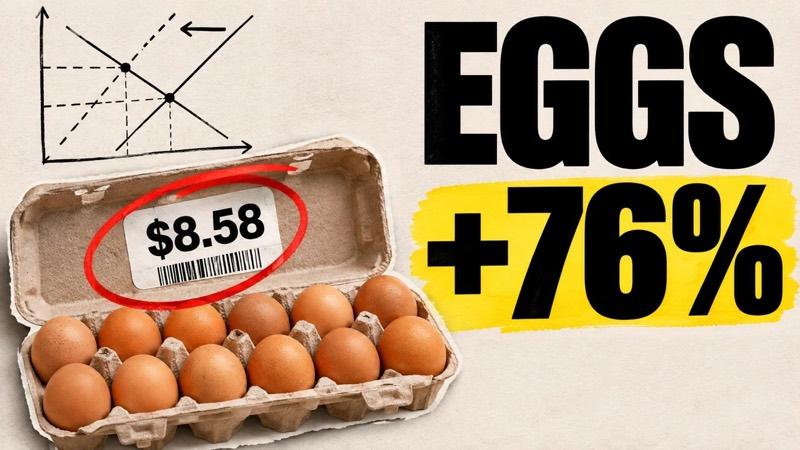
Eggs reveal the other side. In the United States, average retail egg prices were about thirty two percent higher in twenty twenty two than in twenty twenty one. Bird flu reduced egg laying flocks and production, helping push prices up. This was not simply a story of everyone suddenly wanting omelets. Losing hens meant fewer eggs could be supplied at a given price. That is a decrease in supply: the supply curve shifts left. The egg carton became a clue to trouble on farms.
Work it through in four steps. First, sketch the old demand and supply curves. Second, identify what changed: egg production fell, so supply is affected. Third, shift supply left, leaving demand unchanged to isolate this effect. Fourth, find the new crossing. Price rises and quantity falls. Notice something surprising: people buy fewer eggs even though demand has not shifted. The higher price moves them along the demand curve. Other forces also affected food prices; this model isolates one important mechanism.
Why not just produce more? Time matters. A concert cannot add seats tonight. An egg farm cannot instantly replace a flock. Over time, production may adjust, and a tour may add shows. Buyers differ too: someone happy to skip the concert reacts differently from a fan who has saved for months. Price elasticity measures how strongly quantity responds when price changes. The less quantity responds, the bigger the price change a given shift can create. Supply and demand are a model, not a mind reading machine.
So return to that sold out concert. Many buyers are competing for limited seats, and resale sellers may ask more. Now you have four tools to explain it. Demand: buyers at each price. Supply: sellers at each price. Equilibrium: the quantities match. And a crucial distinction: price changes move you along a curve; other conditions can shift it. For a clear written answer, name the change, name the curve, state its direction, then explain price and quantity. Try it next time a price surprises you.
Sources
Every fact in the video, and where it comes from.
- 1business.ticketmaster.com/press-release/taylor-swift-the-eras-tour-onsal…
- On November 15, 2022, Ticketmaster sold over two million Taylor Swift Eras Tour tickets; more than 3.5 million people had registered for the presale.
- 2openstax.org/books/principles-economics-3e/pages/3-1-demand…
- Demand means quantities buyers are willing and able to buy at each price over a defined period. Quantity demanded usually falls as price rises, other things equal.
- Supply means quantities sellers are willing and able to offer at each price. Quantity supplied usually rises with price, other things equal. Equilibrium equates quantity demanded and quantity supplied; shortages and surpluses create price pressure.
- The concert worked example is invented: fixed 100 tickets, Qd=260-2P, hence P=$50 implies Qd=160 and shortage=60; P=$80 implies Qd=100; P=$100 implies Qd=60 and 40 tickets unsold. Graphs illustrate the model and are not measured ticket or egg data.
- 3openstax.org/books/principles-economics-3e/pages/3-2-shifts…
- A product price change causes movement along a curve. Changes in tastes, income or number of buyers can shift demand; production costs and natural conditions can shift supply.
- 4openstax.org/books/principles-economics-3e/pages/3-3-change…
- The four-step method identifies the original equilibrium, affected curve, shift direction and new equilibrium. A decrease in supply raises equilibrium price and lowers quantity with demand unchanged.
- 5ers.usda.gov/data-products/charts-of-note/105676
- US retail egg prices averaged 32.2 percent higher in 2022 than in 2021, following an avian influenza outbreak.
- 6bls.gov/opub/mlr/2026/article/eating-the-cost.htm
- Avian influenza reduced US egg-laying flocks and egg production in 2022; disease was a major contributor to higher egg prices.
- 7openstax.org/books/principles-economics-3e/pages/5-1-price-…
- Price elasticity measures quantity responsiveness to price; production has more opportunity to adjust over longer periods.
- 8gao.gov/blog/what-you-should-know-about-event-ticketing
- Primary ticket prices may be below market clearing levels; popular events can sell out and resold tickets can have higher prices.
- 9openstax.org/books/principles-economics-3e/pages/5-3-elasti…
- Time horizons affect supply responsiveness and less responsive quantities can amplify equilibrium price changes from shifts, other things equal.
- 10stlouisfed.org/publications/page-one-economics/2013/04/01/pri…
- At equilibrium, planned quantities bought and sold match; shortages and surpluses produce upward and downward price pressure respectively when prices can adjust.
- 11federalreserveeducation.org/teaching-resources/economics/markets/market-eq…
- Supply schedules relate quantities producers will offer to prices; the usual supply curve slopes upward.
Image and sound credits
- “Fenway Parks "Lone Red Seat" (2630316084)” by David, CC BY 2.0 (https://creativecommons.org/licenses/by/2.0) — https://commons.wikimedia.org/wiki/File:Fenway_Parks_%22Lone_Red_Seat%22_(2630316084).jpg
- “Bolan Poultry Farm-5” by USAID Afghanistan (Public domain) — https://commons.wikimedia.org/wiki/File:Bolan_Poultry_Farm-5.jpg
- “File:Hatching a (business) plan (10692692005).jpg” by Ed Hawkesworth/DFID: DFID - UK Department for International Development, CC BY 2.0 (https://creativecommons.org/licenses/by/2.0/) — https://commons.wikimedia.org/w/index.php?curid=30786685
- “Fresh eggs, hen, farm animals” by U.S. Department of Agriculture (CC0) — https://www.rawpixel.com/image/8731953/photo-image-public-domain-food-animal
- “Janice Deynes operates the Granja” by U.S. Department of Agriculture (CC0) — https://www.rawpixel.com/image/3259502/free-photo-image-chicken-farm-poultry-production-poultry
- “Thousands chickens live this large” by Carol M Highsmith (CC0) — https://www.rawpixel.com/image/421771/free-photo-image-chicken-farm-poultry
- “Friendly Express Supermarket El Socorro Main Road San Juan, Trinidad” by 999real (CC0) — https://commons.wikimedia.org/wiki/File:Friendly_Express_Supermarket_El_Socorro_Main_Road_San_Juan,_Trinidad.jpg
- “Shopper using smartphone while leaning on shopping cart in a supermarket undefined” by Shixart1985, CC BY 2.0 (https://creativecommons.org/licenses/by/2.0/) — https://commons.wikimedia.org/w/index.php?curid=191913514
- “Taylor Swift The Eras Tour Lover Set (53108817342)” by Paolo V, CC BY 2.0 (https://creativecommons.org/licenses/by/2.0) — https://commons.wikimedia.org/wiki/File:Taylor_Swift_The_Eras_Tour_Lover_Set_(53108817342).jpg
- “Taylor Swift The Eras Tour (53108806682)” by Paolo V, CC BY 2.0 (https://creativecommons.org/licenses/by/2.0) — https://commons.wikimedia.org/wiki/File:Taylor_Swift_The_Eras_Tour_(53108806682).jpg
- “Taylor Swift The Eras Tour Fearless Set Era (53109894988)” by Paolo V, CC BY 2.0 (https://creativecommons.org/licenses/by/2.0) — https://commons.wikimedia.org/wiki/File:Taylor_Swift_The_Eras_Tour_Fearless_Set_Era_(53109894988).jpg
- Paper texture: ambientCG, CC0
- Sound effects: Freesound contributors, CC0 (studio sound library)
- Music: generated with ACE-Step. Voice: Gemini TTS.
- Thumbnail illustrations: AI-generated with GPT Image 2.6.
Teaching this next week?
Kuraplan turns this topic into a lesson plan, slides and a worksheet for your class in about a minute.
Plan a lesson on this topic