MathsFreePrintable

3D Shapes Properties

A free maths worksheet ready for your classroom. Open in Kuraplan to grab the print-ready PDF, customize it for your students, or generate a fresh version in seconds.
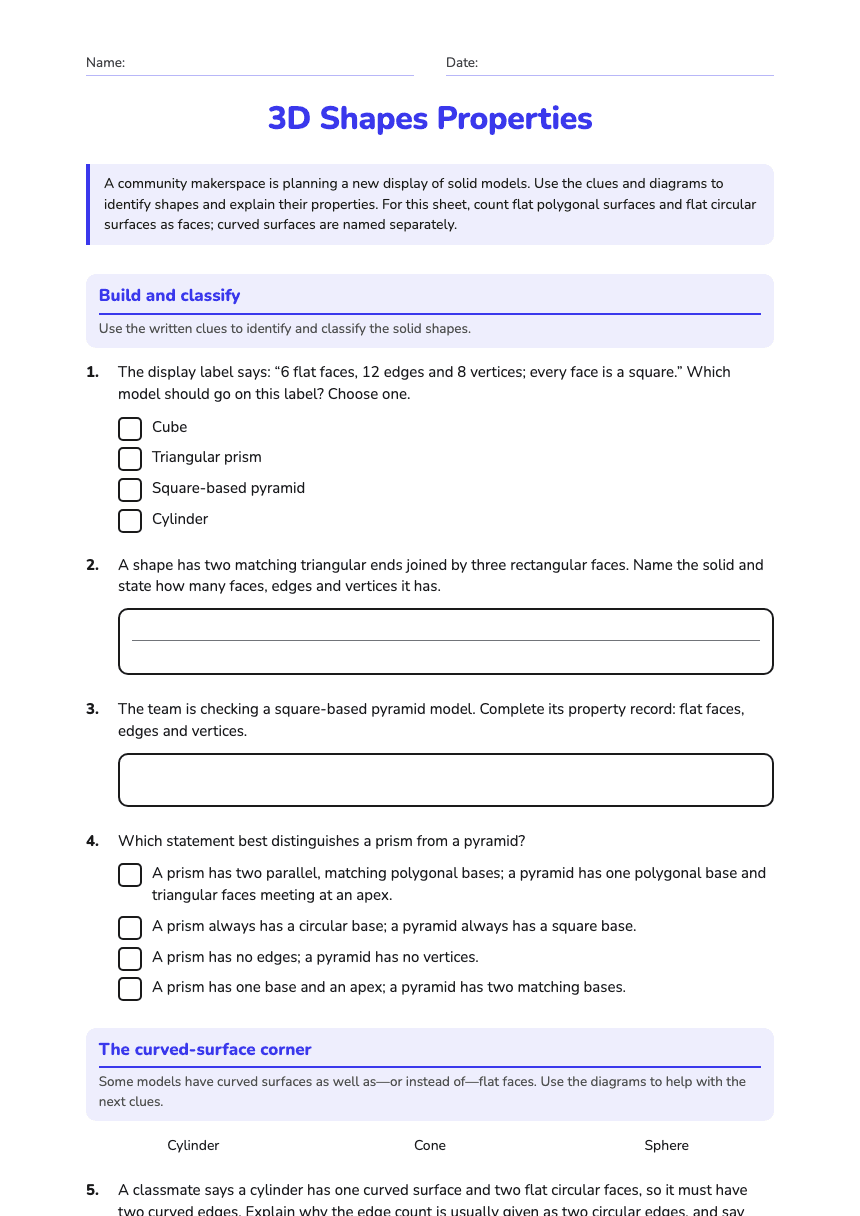
3D Shapes Properties worksheet preview
Name:Date:

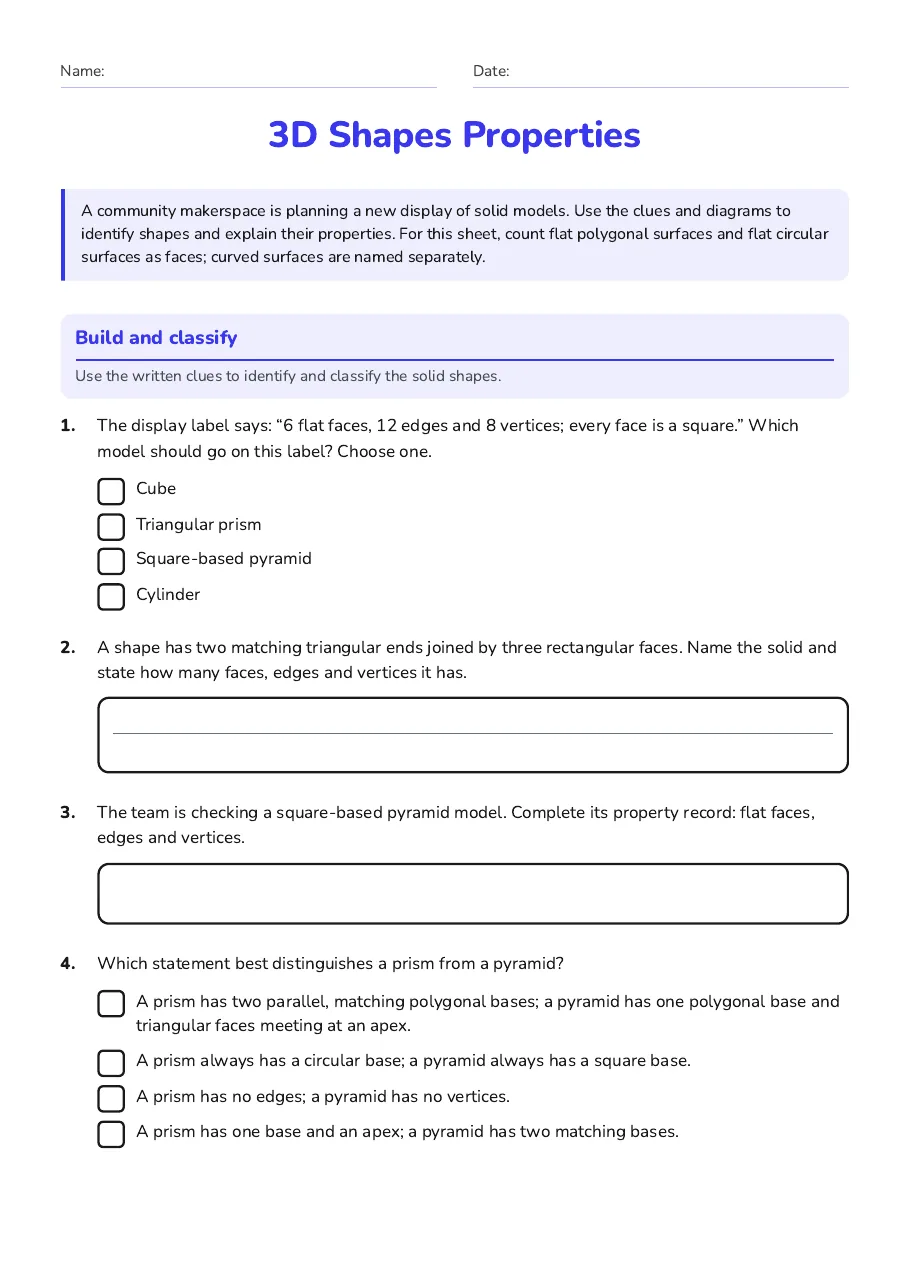
3D Shapes Properties

A community makerspace is planning a new display of solid models. Use the clues and diagrams to identify shapes and explain their properties. For this sheet, count flat polygonal surfaces and flat circular surfaces as faces; curved surfaces are named separately.

Build and classify

Use the written clues to identify and classify the solid shapes.

1.The display label says: “6 flat faces, 12 edges and 8 vertices; every face is a square.” Which model should go on this label? Choose one.
  • Cube
  • Triangular prism
  • Square-based pyramid
  • Cylinder
2.A shape has two matching triangular ends joined by three rectangular faces. Name the solid and state how many faces, edges and vertices it has.
3.The team is checking a square-based pyramid model. Complete its property record: flat faces, edges and vertices.
4.Which statement best distinguishes a prism from a pyramid?
  • A prism has two parallel, matching polygonal bases; a pyramid has one polygonal base and triangular faces meeting at an apex.
  • A prism always has a circular base; a pyramid always has a square base.
  • A prism has no edges; a pyramid has no vertices.
  • A prism has one base and an apex; a pyramid has two matching bases.

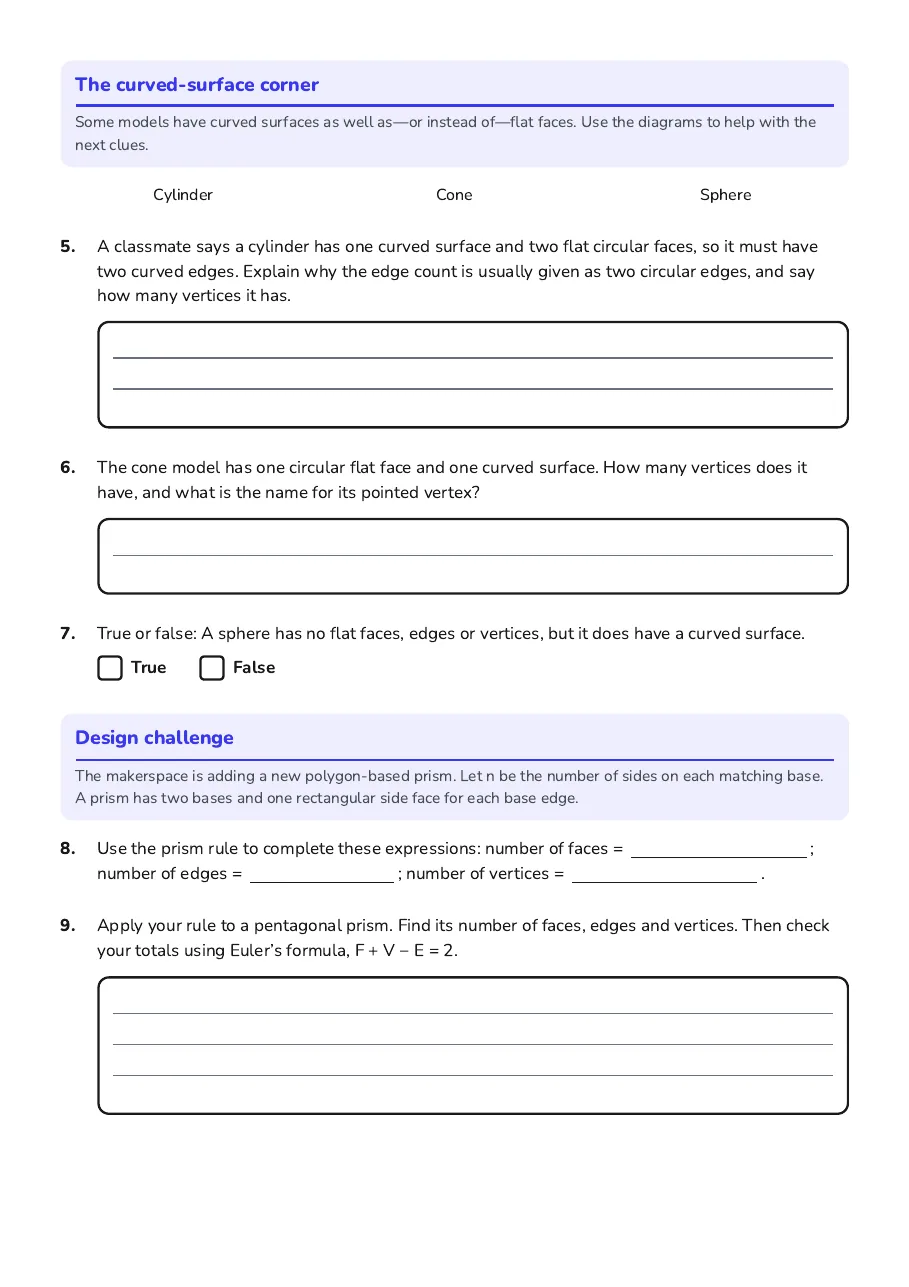
The curved-surface corner

Some models have curved surfaces as well as—or instead of—flat faces. Use the diagrams to help with the next clues.

Cylinder

Cone

Sphere

5.A classmate says a cylinder has one curved surface and two flat circular faces, so it must have two curved edges. Explain why the edge count is usually given as two circular edges, and say how many vertices it has.
6.The cone model has one circular flat face and one curved surface. How many vertices does it have, and what is the name for its pointed vertex?
7.True or false: A sphere has no flat faces, edges or vertices, but it does have a curved surface.
TrueFalse

Design challenge

The makerspace is adding a new polygon-based prism. Let n be the number of sides on each matching base. A prism has two bases and one rectangular side face for each base edge.

8.Use the prism rule to complete these expressions: number of faces = ; number of edges = ; number of vertices = .
9.Apply your rule to a pentagonal prism. Find its number of faces, edges and vertices. Then check your totals using Euler’s formula, F + V − E = 2.
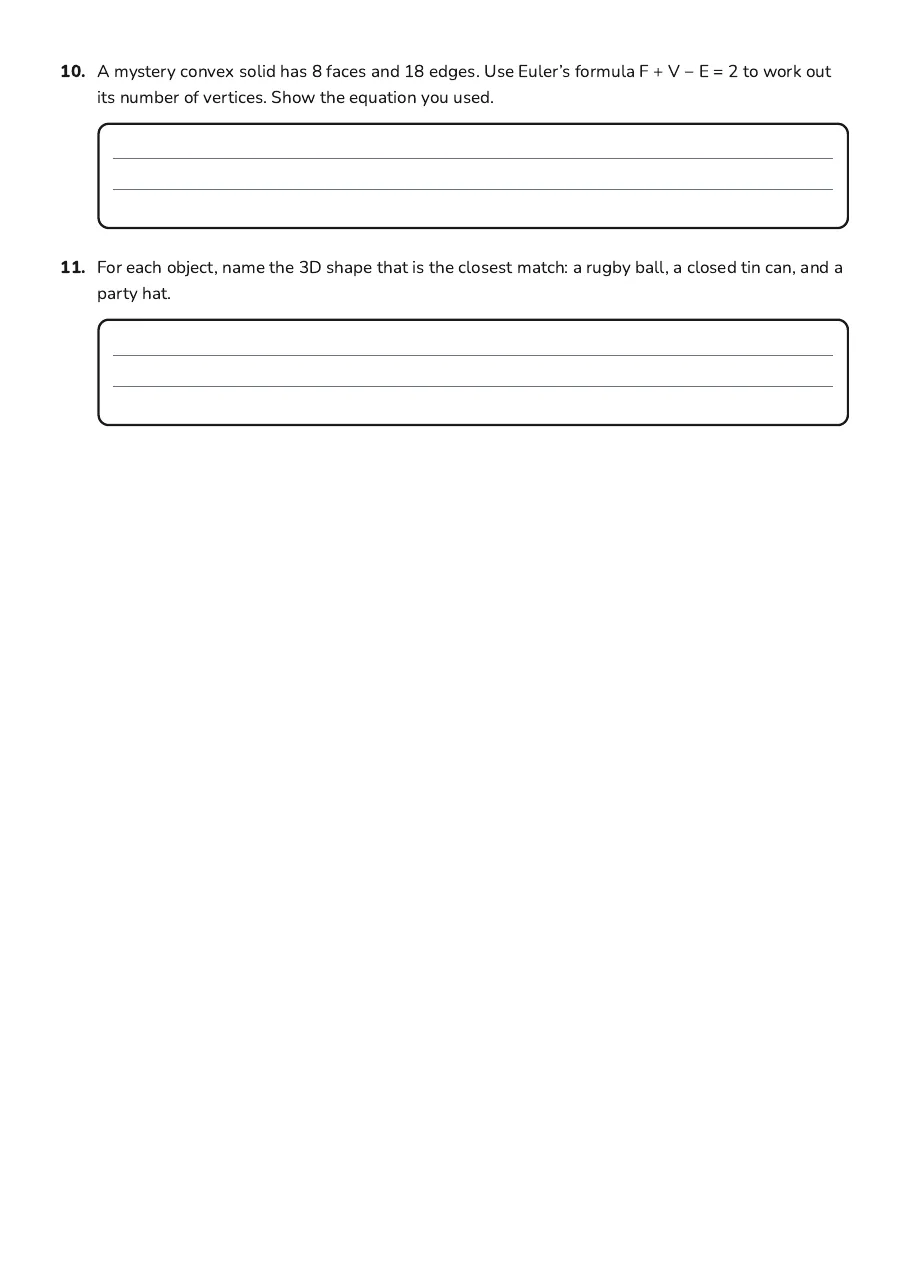
10.A mystery convex solid has 8 faces and 18 edges. Use Euler’s formula F + V − E = 2 to work out its number of vertices. Show the equation you used.
11.For each object, name the 3D shape that is the closest match: a rugby ball, a closed tin can, and a party hat.

3 printable pages

  • 3D Shapes Properties, page 1 of 3: Build and classify

    Page 1

  • 3D Shapes Properties, page 2 of 3: The curved-surface corner, Design challenge

    Page 2

  • 3D Shapes Properties, page 3 of 3: 10. A mystery convex solid has 8 faces and 18 edges. Use Euler’s formula F + V − E = 2 to…

    Page 3

About This Worksheet

Free in Kuraplan

Sign up free, grab the PDF, and customize it for your class.

Print-Ready

Formatted for standard paper. Clean layout, easy to read.

AI-Generated

Created with Kuraplan's AI, designed for real classroom use.

For Teachers & Parents

Use in classrooms, for homework, tutoring, or homeschool.

Need a custom version of this worksheet?

Kuraplan's AI generates custom worksheets in seconds — differentiated for every learner, aligned to your curriculum.

Generate Custom Worksheets — Free
No credit card Curriculum-aligned Under 60 seconds