Polygon Properties and Symmetry
A free maths worksheet ready for your classroom. Open in Kuraplan to grab the print-ready PDF, customize it for your students, or generate a fresh version in seconds.
Polygon Properties and Symmetry
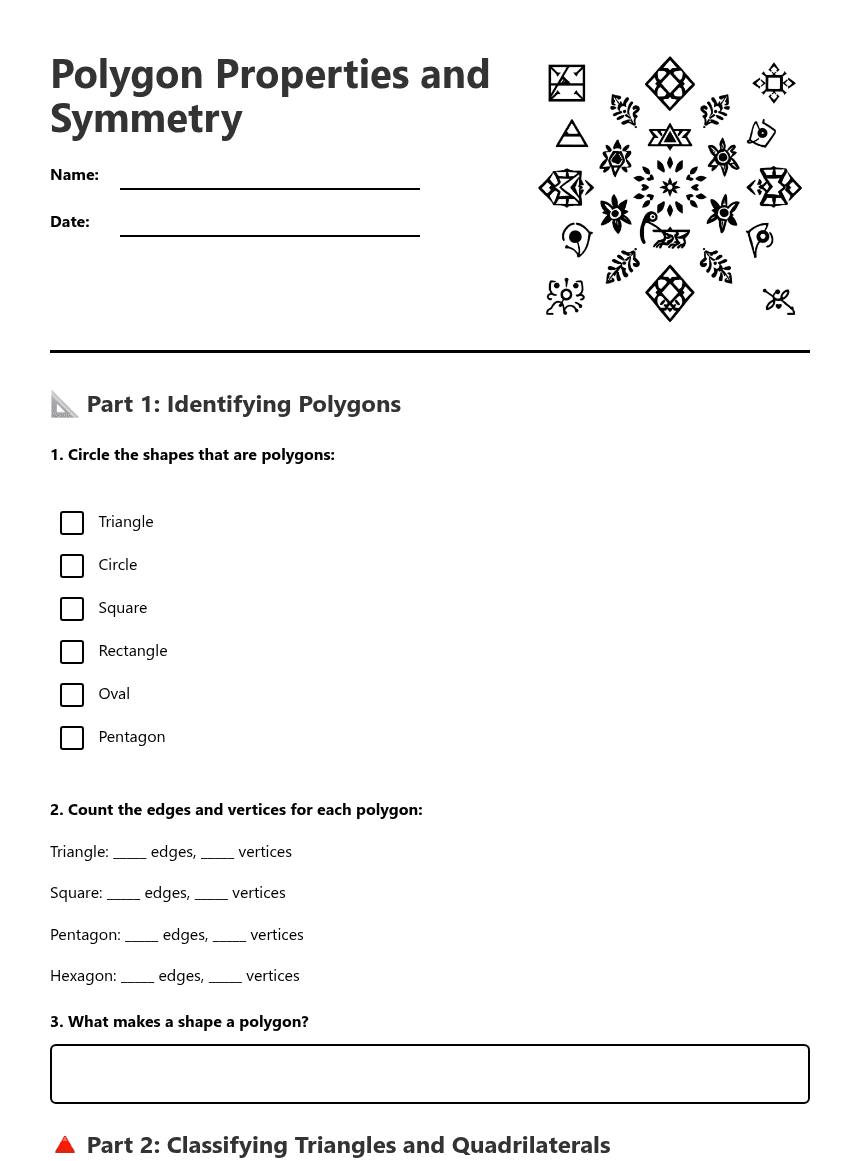
📐 Part 1: Identifying Polygons
Triangle: _____ edges, _____ vertices
Square: _____ edges, _____ vertices
Pentagon: _____ edges, _____ vertices
Hexagon: _____ edges, _____ vertices
🔺 Part 2: Classifying Triangles and Quadrilaterals
🪞 Part 3: Line Symmetry
Draw a square, rectangle, and equilateral triangle in the box above, then add their lines of symmetry.
Square: _____ lines of symmetry
Rectangle: _____ lines of symmetry
Equilateral triangle: _____ lines of symmetry
Circle: _____ lines of symmetry
🔄 Part 4: Rotational Symmetry
📏 Part 5: Angles and Properties
Parallel lines: ________________________
Perpendicular lines: ________________________
A polygon with line symmetry: ________________________
🎯 Part 6: Challenge Questions
About This Worksheet
Free in Kuraplan
Sign up free, grab the PDF, and customize it for your class.
Print-Ready
Formatted for standard paper. Clean layout, easy to read.
AI-Generated
Created with Kuraplan's AI, designed for real classroom use.
For Teachers & Parents
Use in classrooms, for homework, tutoring, or homeschool.
Need a custom version of this worksheet?
Kuraplan's AI generates custom worksheets in seconds — differentiated for every learner, aligned to your curriculum.
Generate Custom Worksheets — FreeMore Maths Worksheets
Compass Maps Worksheet
Free
3D Shape Investigation Mission
Free
Shape and Transformation Pre-Test
Free
Geometry and Angles Pre-Test
Free
Year 5–6 Geometry Diagnostic Pre-Test
Free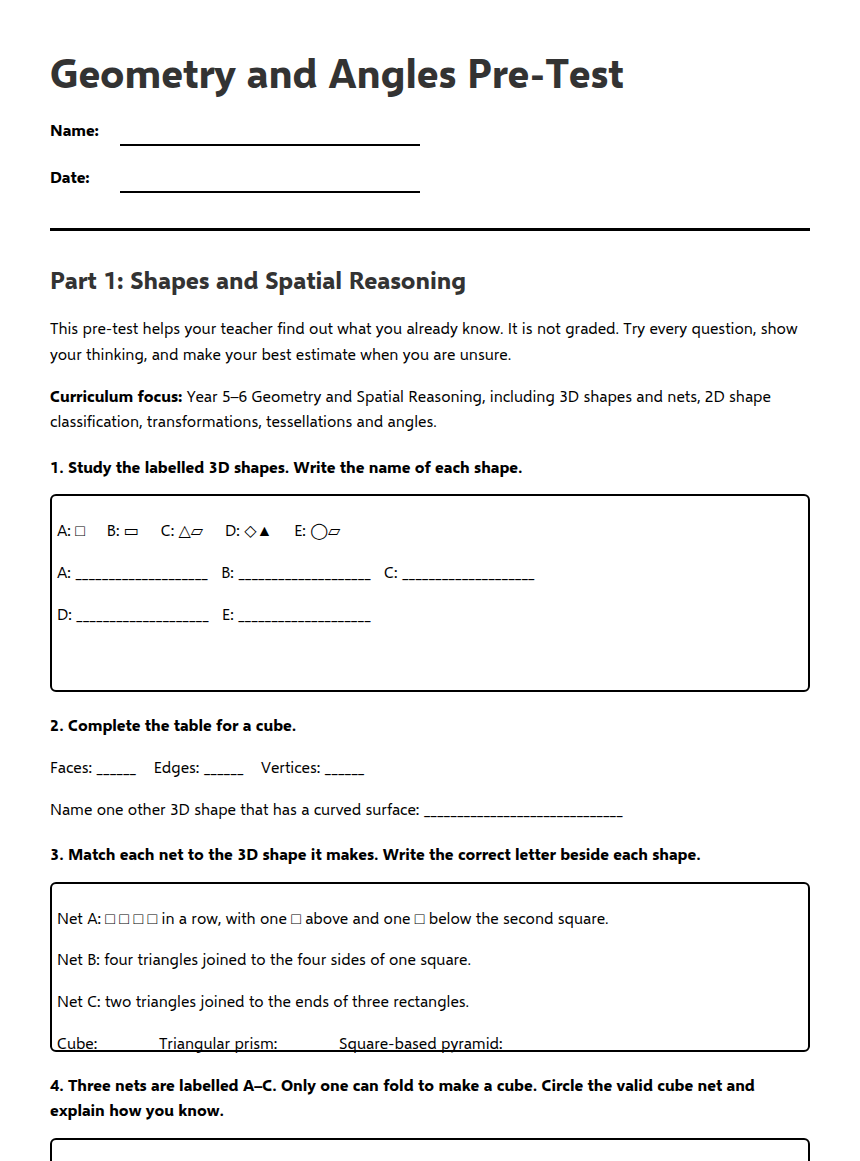
Geometry and Angles Pre-Test
Free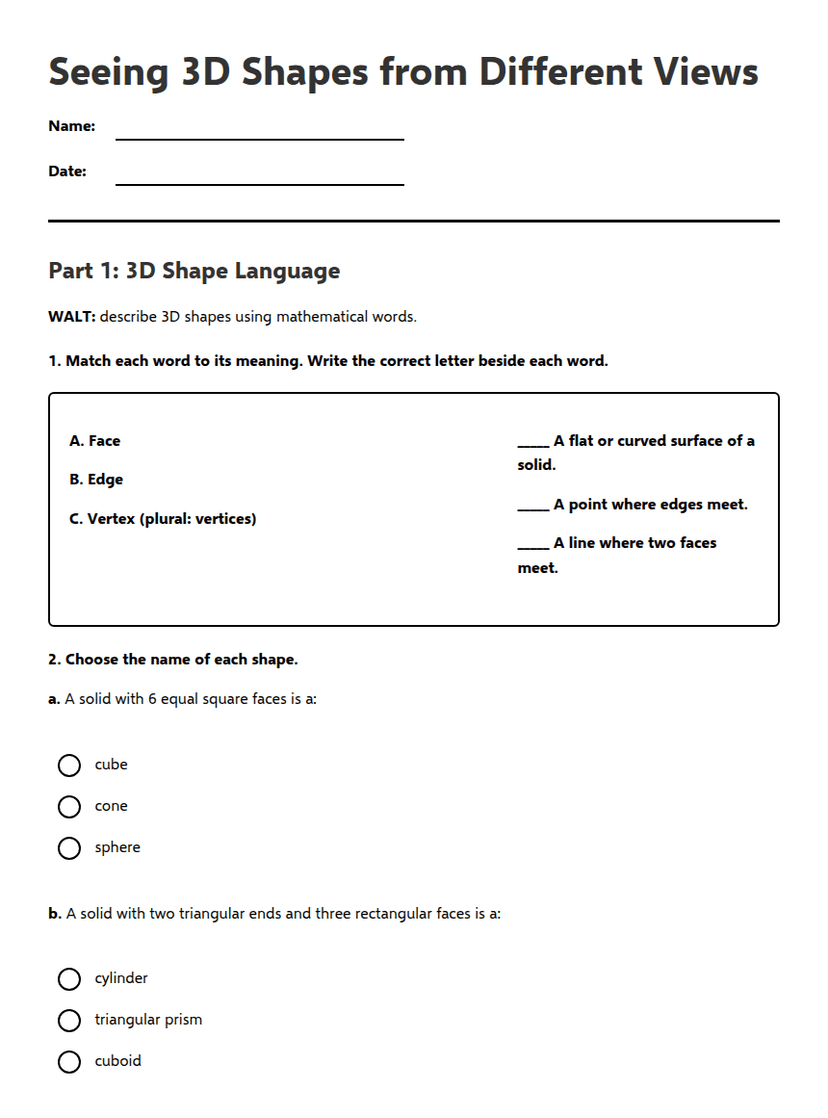
Seeing 3D Shapes from Different Views
Free