MathsFreePrintable

3D Shapes & Volume

A free maths worksheet ready for your classroom. Open in Kuraplan to grab the print-ready PDF, customize it for your students, or generate a fresh version in seconds.
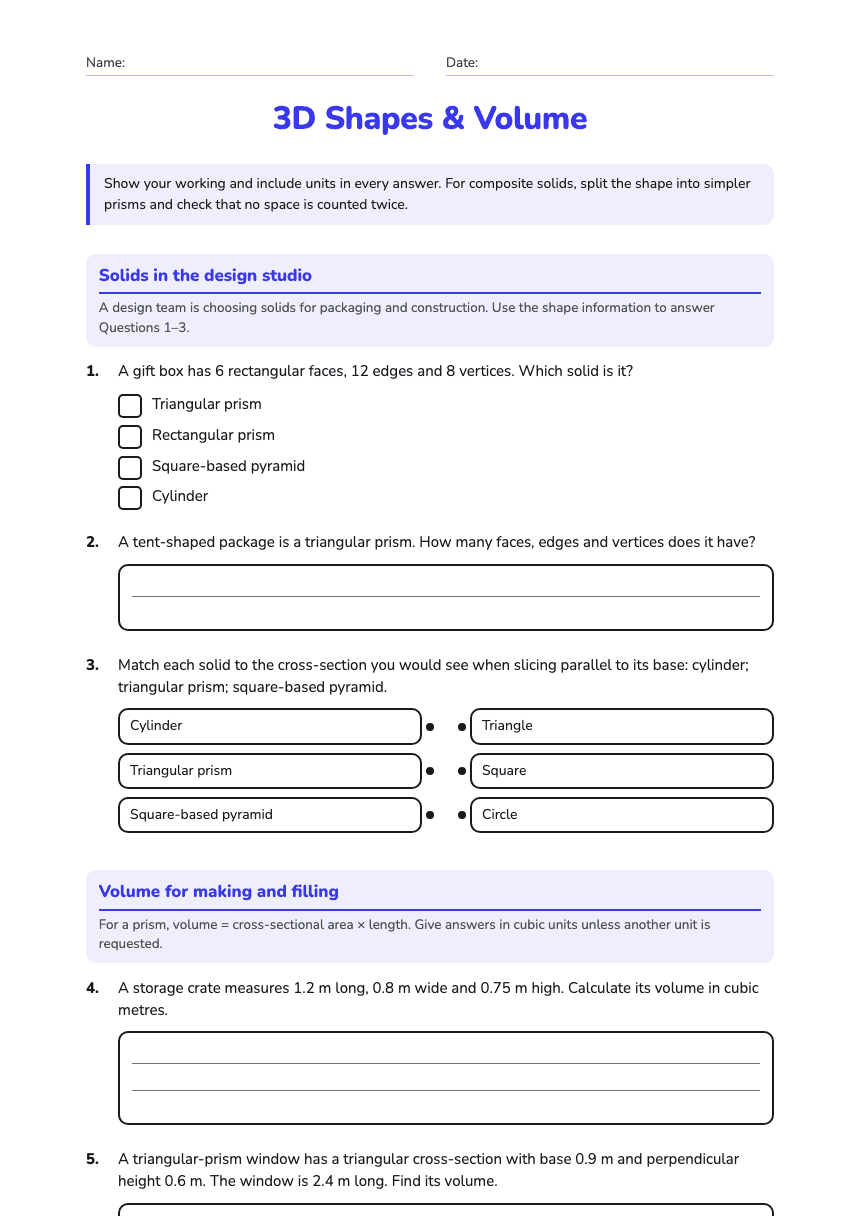
3D Shapes & Volume worksheet preview
Name:Date:

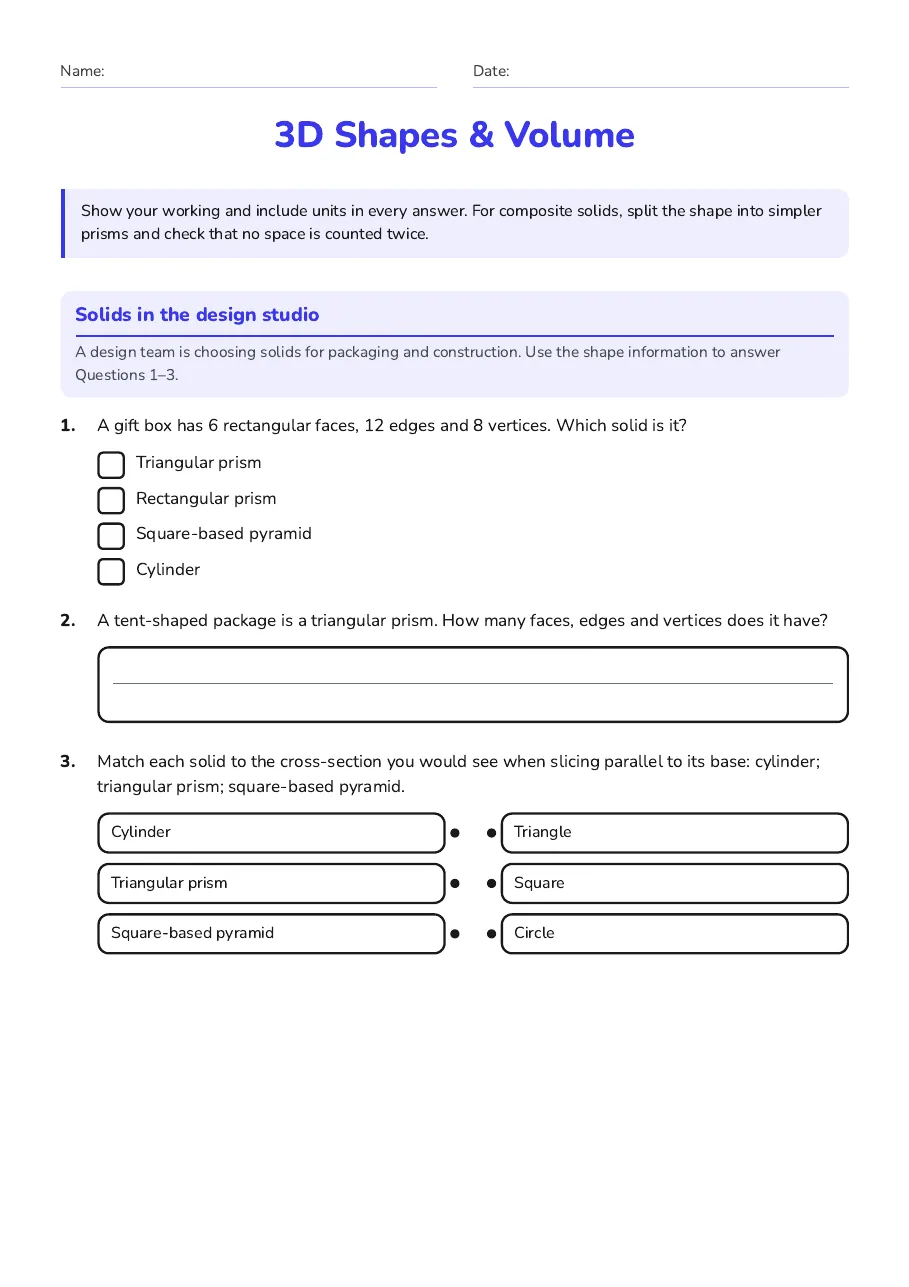
3D Shapes & Volume

Show your working and include units in every answer. For composite solids, split the shape into simpler prisms and check that no space is counted twice.

Solids in the design studio

A design team is choosing solids for packaging and construction. Use the shape information to answer Questions 1–3.

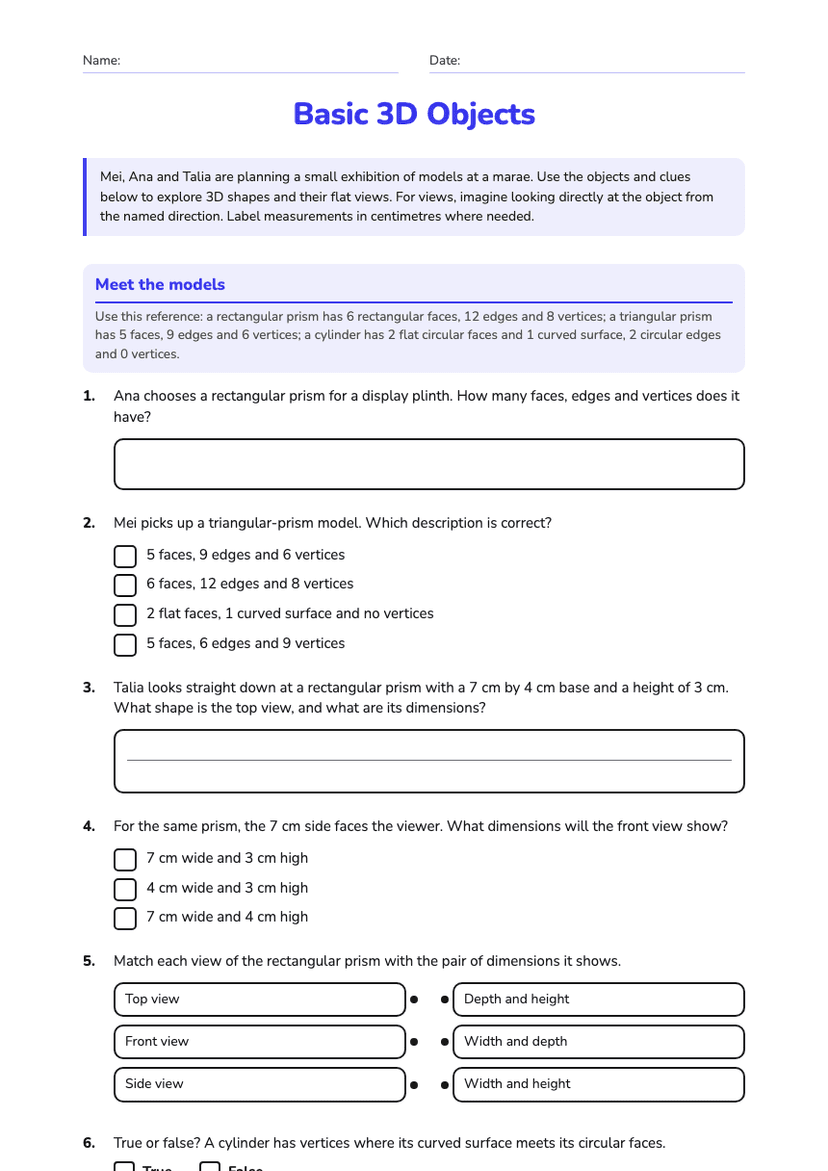
1.A gift box has 6 rectangular faces, 12 edges and 8 vertices. Which solid is it?
  • Triangular prism
  • Rectangular prism
  • Square-based pyramid
  • Cylinder
2.A tent-shaped package is a triangular prism. How many faces, edges and vertices does it have?
3.Match each solid to the cross-section you would see when slicing parallel to its base: cylinder; triangular prism; square-based pyramid.
  • Cylinder
  • Triangular prism
  • Square-based pyramid
  • Triangle
  • Square
  • Circle

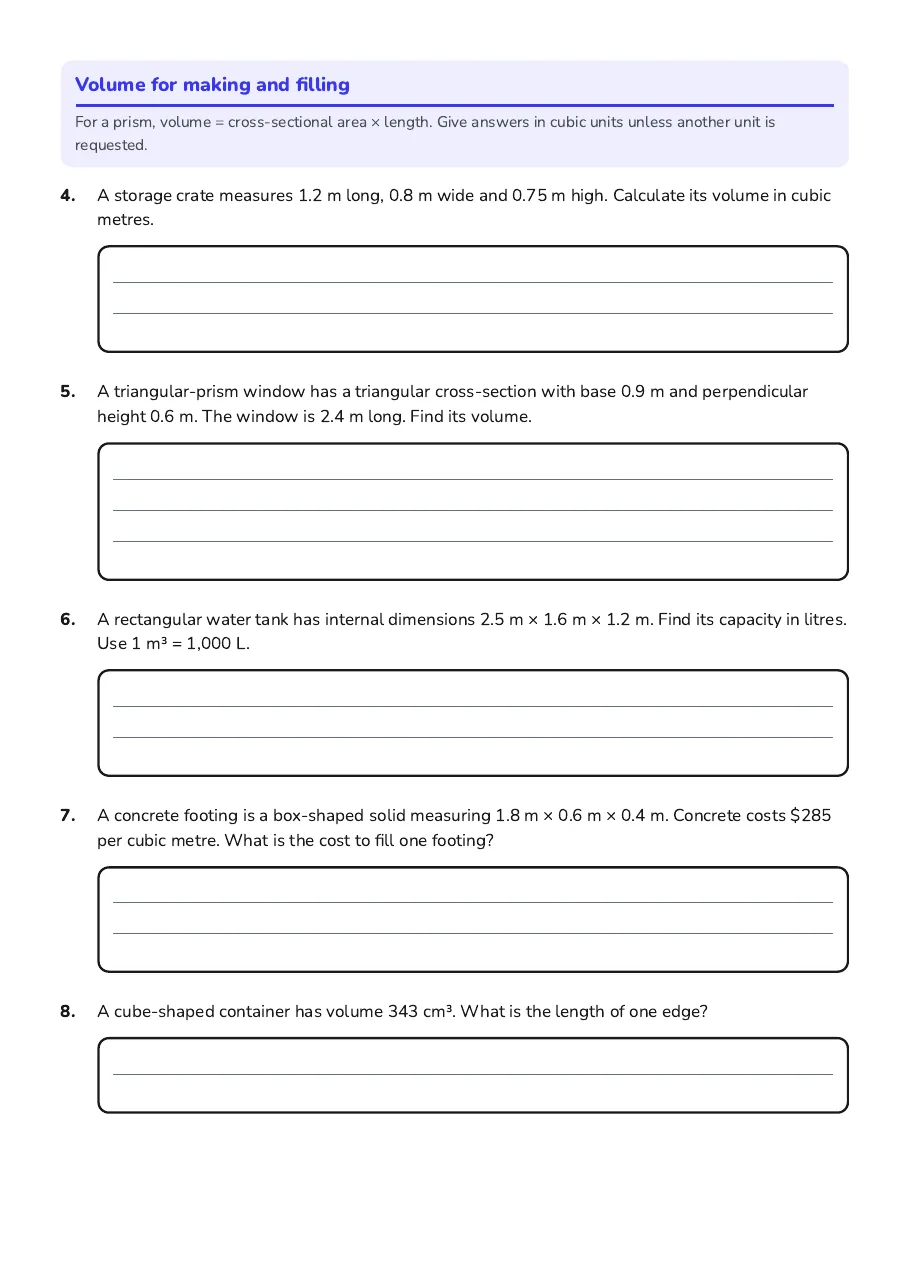
Volume for making and filling

For a prism, volume = cross-sectional area × length. Give answers in cubic units unless another unit is requested.

4.A storage crate measures 1.2 m long, 0.8 m wide and 0.75 m high. Calculate its volume in cubic metres.
5.A triangular-prism window has a triangular cross-section with base 0.9 m and perpendicular height 0.6 m. The window is 2.4 m long. Find its volume.
6.A rectangular water tank has internal dimensions 2.5 m × 1.6 m × 1.2 m. Find its capacity in litres. Use 1 m³ = 1,000 L.
7.A concrete footing is a box-shaped solid measuring 1.8 m × 0.6 m × 0.4 m. Concrete costs $285 per cubic metre. What is the cost to fill one footing?
8.A cube-shaped container has volume 343 cm³. What is the length of one edge?

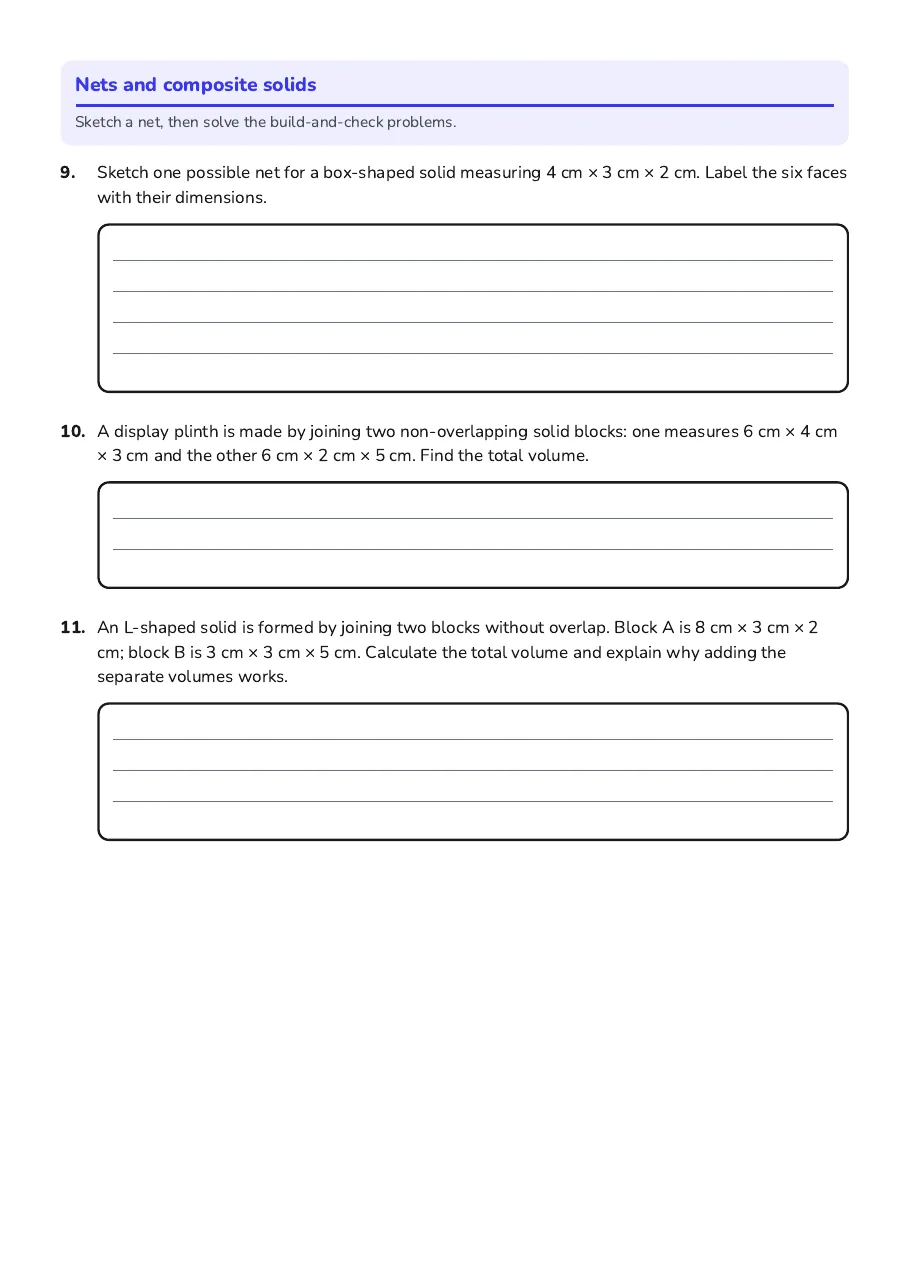
Nets and composite solids

Sketch a net, then solve the build-and-check problems.

9.Sketch one possible net for a box-shaped solid measuring 4 cm × 3 cm × 2 cm. Label the six faces with their dimensions.
10.A display plinth is made by joining two non-overlapping solid blocks: one measures 6 cm × 4 cm × 3 cm and the other 6 cm × 2 cm × 5 cm. Find the total volume.
11.An L-shaped solid is formed by joining two blocks without overlap. Block A is 8 cm × 3 cm × 2 cm; block B is 3 cm × 3 cm × 5 cm. Calculate the total volume and explain why adding the separate volumes works.

3 printable pages

  • 3D Shapes & Volume, page 1 of 3: Solids in the design studio

    Page 1

  • 3D Shapes & Volume, page 2 of 3: Volume for making and filling

    Page 2

  • 3D Shapes & Volume, page 3 of 3: Nets and composite solids

    Page 3

About This Worksheet

Free in Kuraplan

Sign up free, grab the PDF, and customize it for your class.

Print-Ready

Formatted for standard paper. Clean layout, easy to read.

AI-Generated

Created with Kuraplan's AI, designed for real classroom use.

For Teachers & Parents

Use in classrooms, for homework, tutoring, or homeschool.

Need a custom version of this worksheet?

Kuraplan's AI generates custom worksheets in seconds — differentiated for every learner, aligned to your curriculum.

Generate Custom Worksheets — Free
No credit card Curriculum-aligned Under 60 seconds