Accounting Basics Worksheet
A free business worksheet ready for your classroom. Open in Kuraplan to grab the print-ready PDF, customize it for your students, or generate a fresh version in seconds.
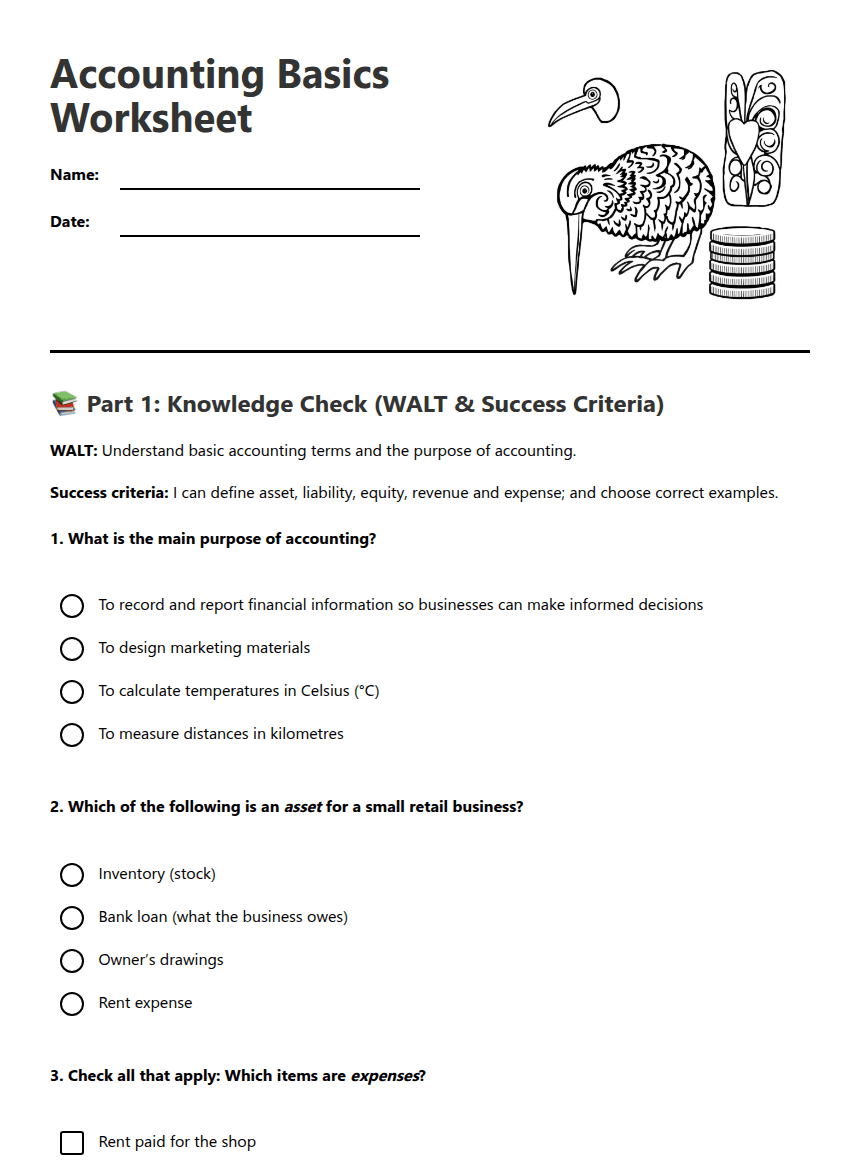
Accounting Basics Worksheet
📚 Part 1: Knowledge Check (WALT & Success Criteria)
WALT: Understand basic accounting terms and the purpose of accounting.
Success criteria: I can define asset, liability, equity, revenue and expense; and choose correct examples.
✏️ Part 2: Apply the Accounting Equation
WALT: Apply Assets = Liabilities + Equity to simple business scenarios.
Success criteria: I can calculate equity and explain how transactions affect the equation.
Example: A small café has $5,000 cash and $2,000 equipment (assets). It owes $1,500 to a supplier (liability).
a) Owner invests $2,000 cash into the business. _______
b) Business takes out a $1,200 loan from the bank. _______
Support & Challenge
Differentiation strategies: Pair work and guided scaffolding for learners who need it; use calculators as required; provide visual examples and sentence starters for EAL learners.
Extension activities: Analyse how multiple transactions affect equity over time; begin simple journal entries; research a local NZ business and list examples of assets and liabilities.
About This Worksheet
Free in Kuraplan
Sign up free, grab the PDF, and customize it for your class.
Print-Ready
Formatted for standard paper. Clean layout, easy to read.
AI-Generated
Created with Kuraplan's AI, designed for real classroom use.
For Teachers & Parents
Use in classrooms, for homework, tutoring, or homeschool.
Need a custom version of this worksheet?
Kuraplan's AI generates custom worksheets in seconds — differentiated for every learner, aligned to your curriculum.
Generate Custom Worksheets — Free