MathsFreePrintable
Advanced Geometry in the Real World
A free maths worksheet ready for your classroom. Open in Kuraplan to grab the print-ready PDF, customize it for your students, or generate a fresh version in seconds.
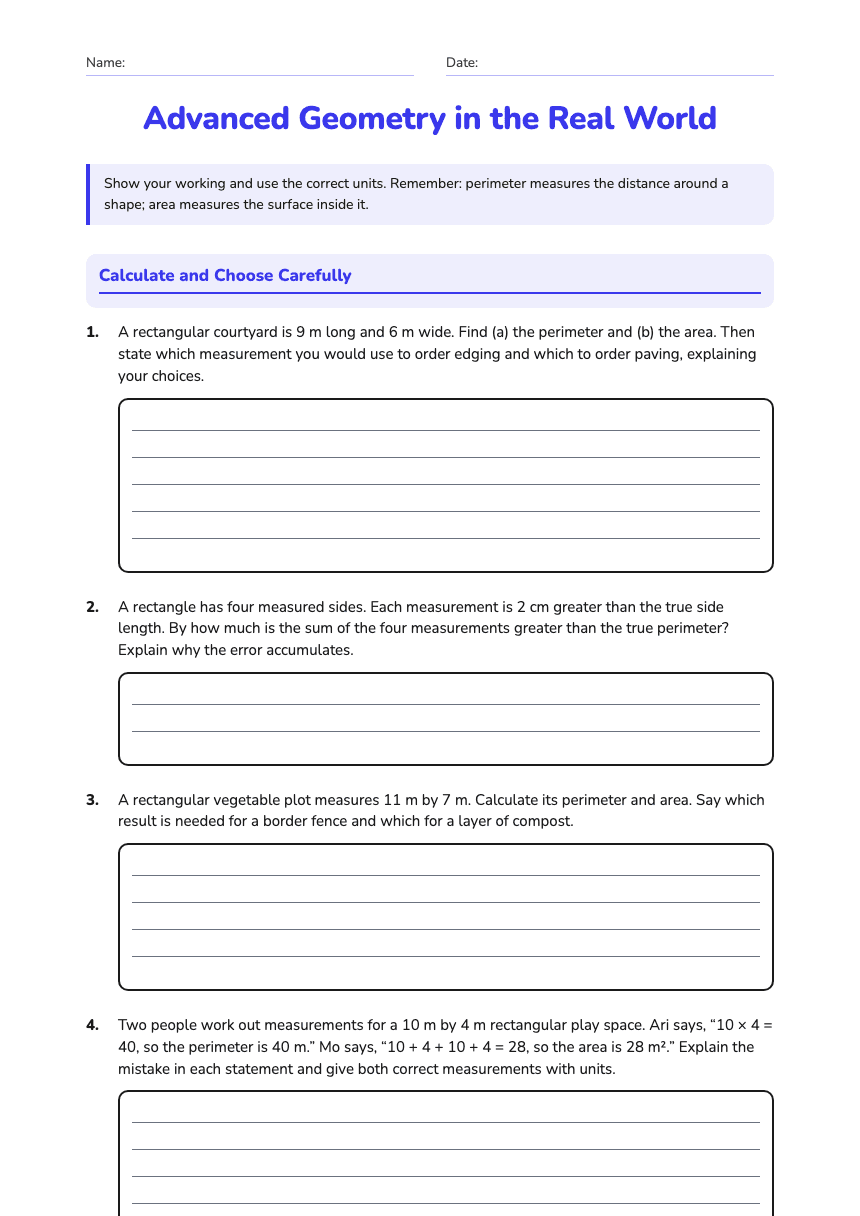
Name:Date:
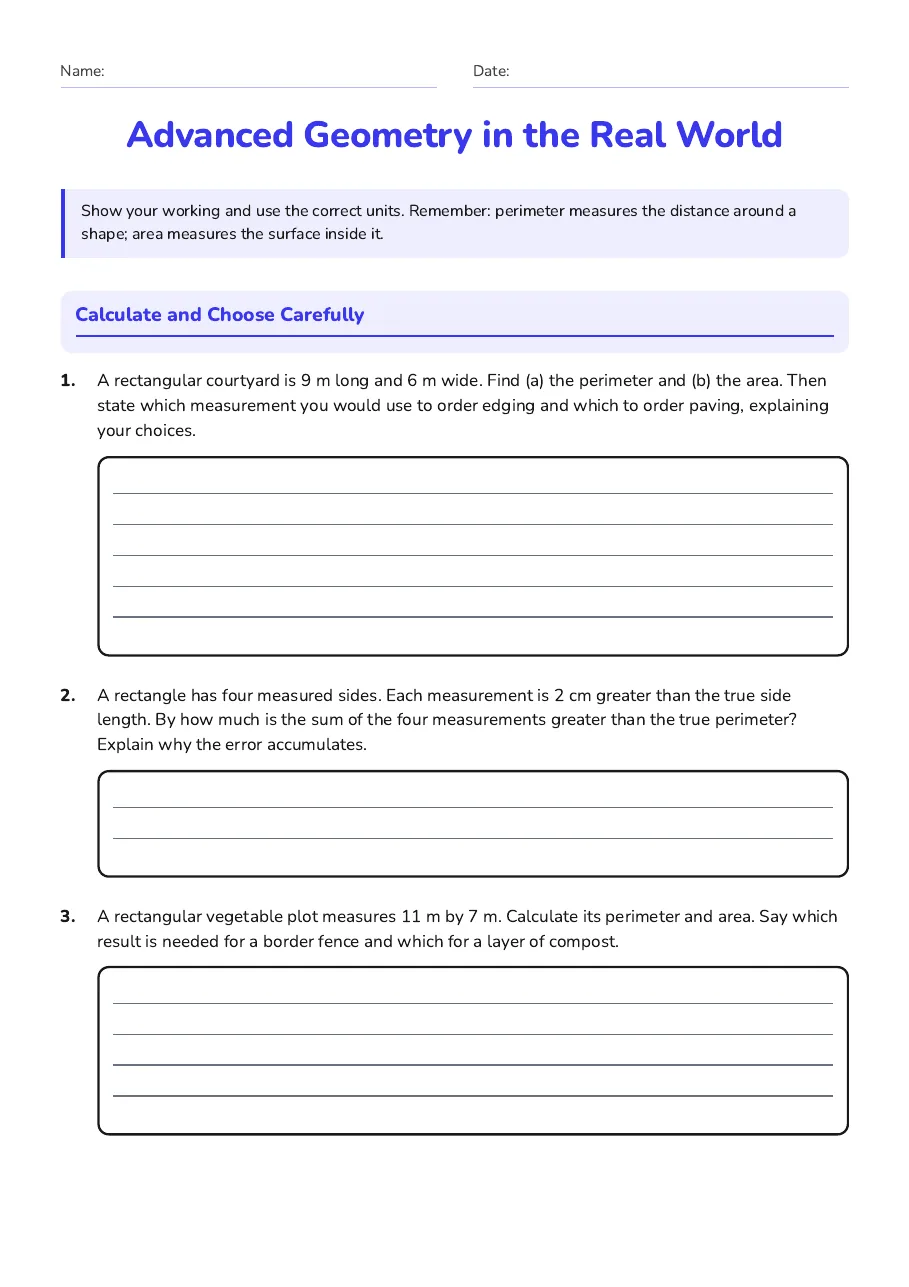
Advanced Geometry in the Real World
Show your working and use the correct units. Remember: perimeter measures the distance around a shape; area measures the surface inside it.
Calculate and Choose Carefully
1.A rectangular courtyard is 9 m long and 6 m wide. Find (a) the perimeter and (b) the area. Then state which measurement you would use to order edging and which to order paving, explaining your choices.
2.A rectangle has four measured sides. Each measurement is 2 cm greater than the true side length. By how much is the sum of the four measurements greater than the true perimeter? Explain why the error accumulates.
3.A rectangular vegetable plot measures 11 m by 7 m. Calculate its perimeter and area. Say which result is needed for a border fence and which for a layer of compost.
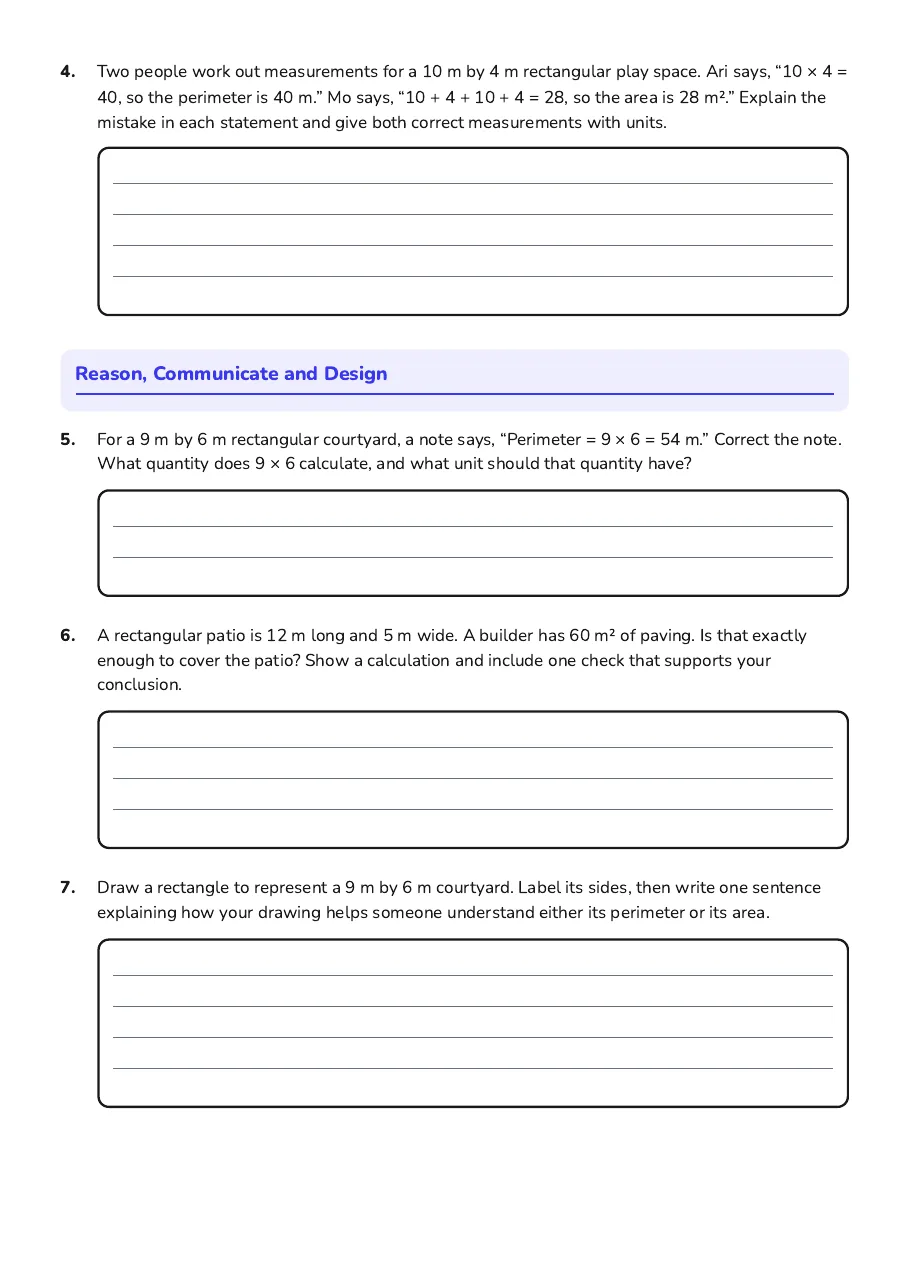
4.Two people work out measurements for a 10 m by 4 m rectangular play space. Ari says, “10 × 4 = 40, so the perimeter is 40 m.” Mo says, “10 + 4 + 10 + 4 = 28, so the area is 28 m².” Explain the mistake in each statement and give both correct measurements with units.
Reason, Communicate and Design
5.For a 9 m by 6 m rectangular courtyard, a note says, “Perimeter = 9 × 6 = 54 m.” Correct the note. What quantity does 9 × 6 calculate, and what unit should that quantity have?
6.A rectangular patio is 12 m long and 5 m wide. A builder has 60 m² of paving. Is that exactly enough to cover the patio? Show a calculation and include one check that supports your conclusion.
7.Draw a rectangle to represent a 9 m by 6 m courtyard. Label its sides, then write one sentence explaining how your drawing helps someone understand either its perimeter or its area.
8.Create a real-world problem about a rectangular space. Include two side lengths and ask for both a boundary measurement and an inside-surface measurement. Solve your problem, use suitable units, and describe a check for each result.
3 printable pages
Page 1
Page 2
Page 3
About This Worksheet
Free in Kuraplan
Sign up free, grab the PDF, and customize it for your class.
Print-Ready
Formatted for standard paper. Clean layout, easy to read.
AI-Generated
Created with Kuraplan's AI, designed for real classroom use.
For Teachers & Parents
Use in classrooms, for homework, tutoring, or homeschool.
Need a custom version of this worksheet?
Kuraplan's AI generates custom worksheets in seconds — differentiated for every learner, aligned to your curriculum.
Generate Custom Worksheets — Free No credit card Curriculum-aligned Under 60 seconds