ScienceFreePrintable

Aqueous Acids and Bases

A free science worksheet ready for your classroom. Open in Kuraplan to grab the print-ready PDF, customize it for your students, or generate a fresh version in seconds.
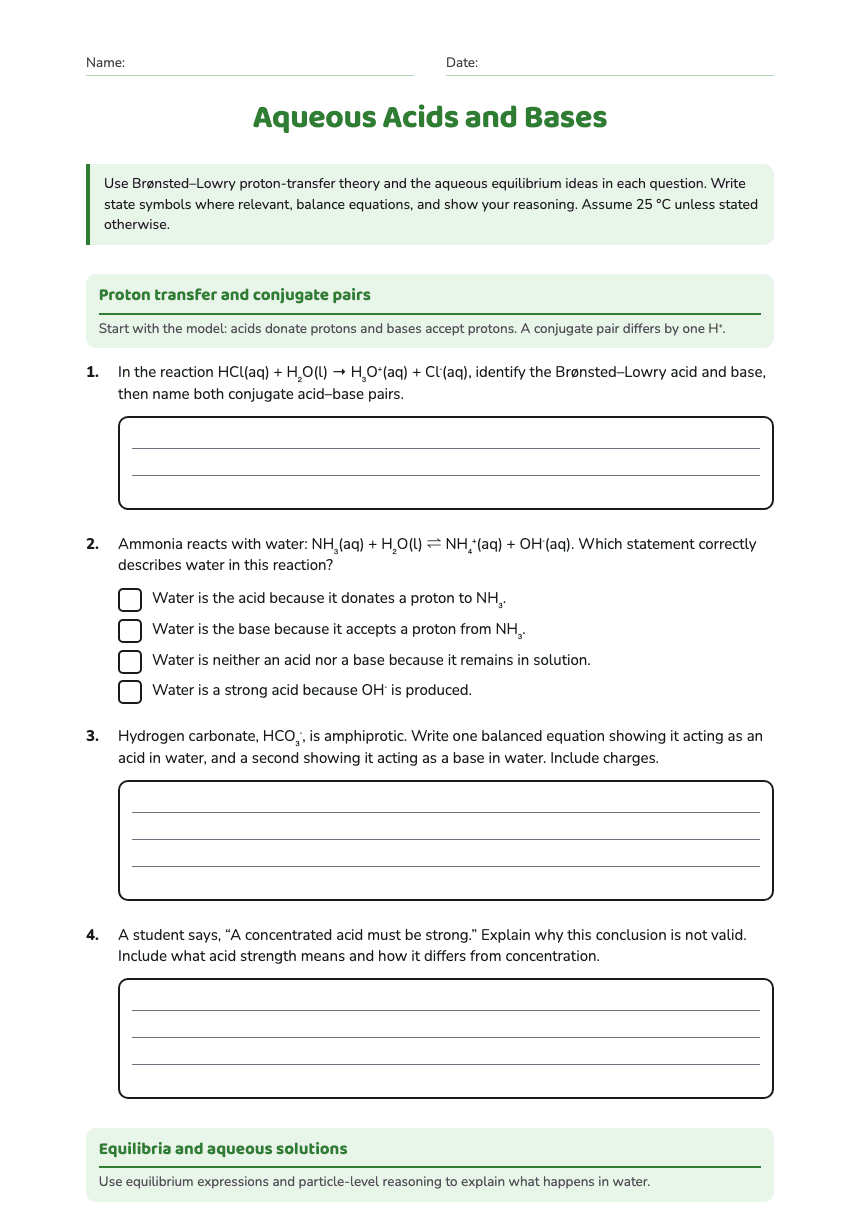
Aqueous Acids and Bases worksheet preview
Name:Date:

Aqueous Acids and Bases

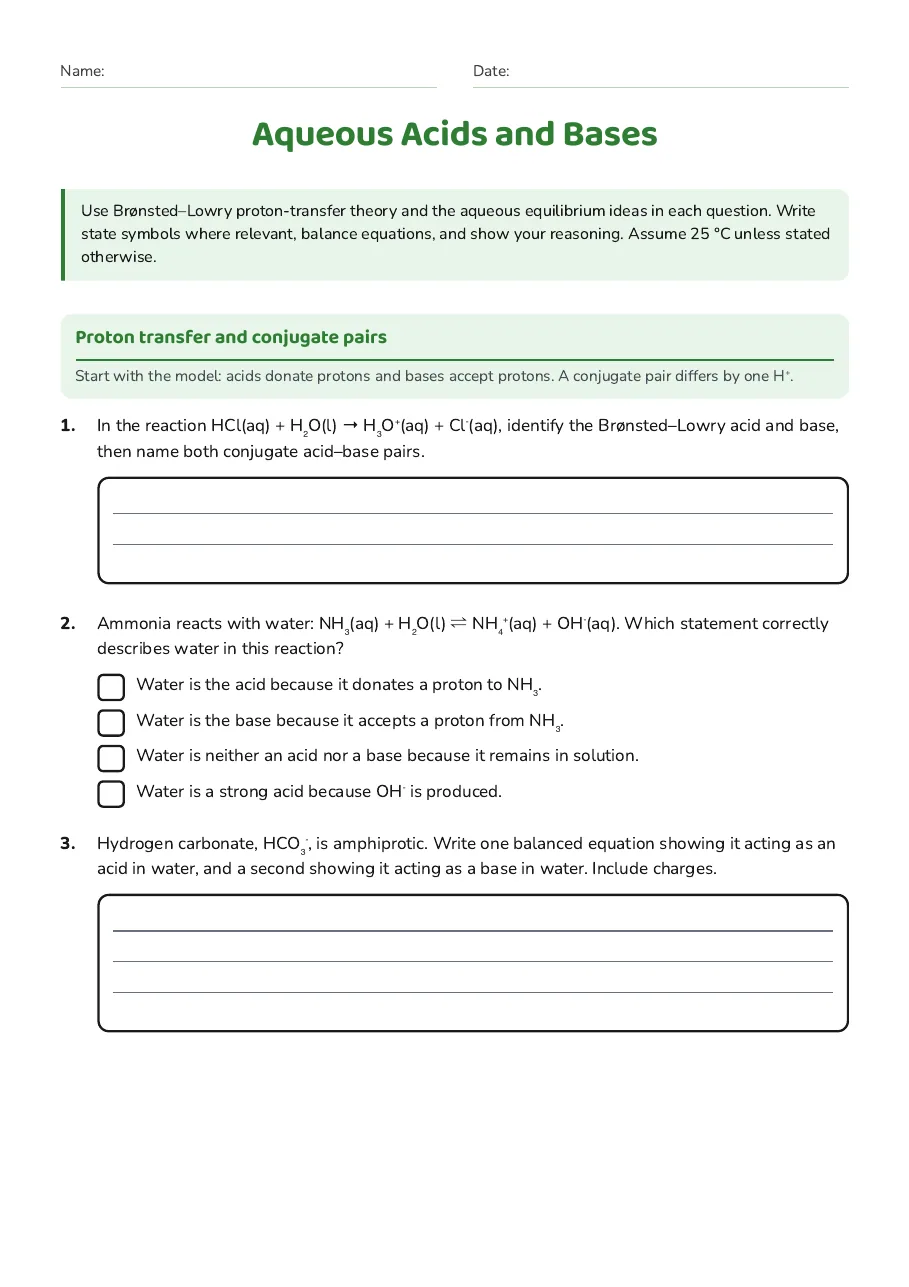
Use Brønsted–Lowry proton-transfer theory and the aqueous equilibrium ideas in each question. Write state symbols where relevant, balance equations, and show your reasoning. Assume 25 °C unless stated otherwise.

Proton transfer and conjugate pairs

Start with the model: acids donate protons and bases accept protons. A conjugate pair differs by one H⁺.

1.In the reaction HCl(aq) + H₂O(l) → H₃O⁺(aq) + Cl⁻(aq), identify the Brønsted–Lowry acid and base, then name both conjugate acid–base pairs.
2.Ammonia reacts with water: NH₃(aq) + H₂O(l) ⇌ NH₄⁺(aq) + OH⁻(aq). Which statement correctly describes water in this reaction?
  • Water is the acid because it donates a proton to NH₃.
  • Water is the base because it accepts a proton from NH₃.
  • Water is neither an acid nor a base because it remains in solution.
  • Water is a strong acid because OH⁻ is produced.
3.Hydrogen carbonate, HCO₃⁻, is amphiprotic. Write one balanced equation showing it acting as an acid in water, and a second showing it acting as a base in water. Include charges.
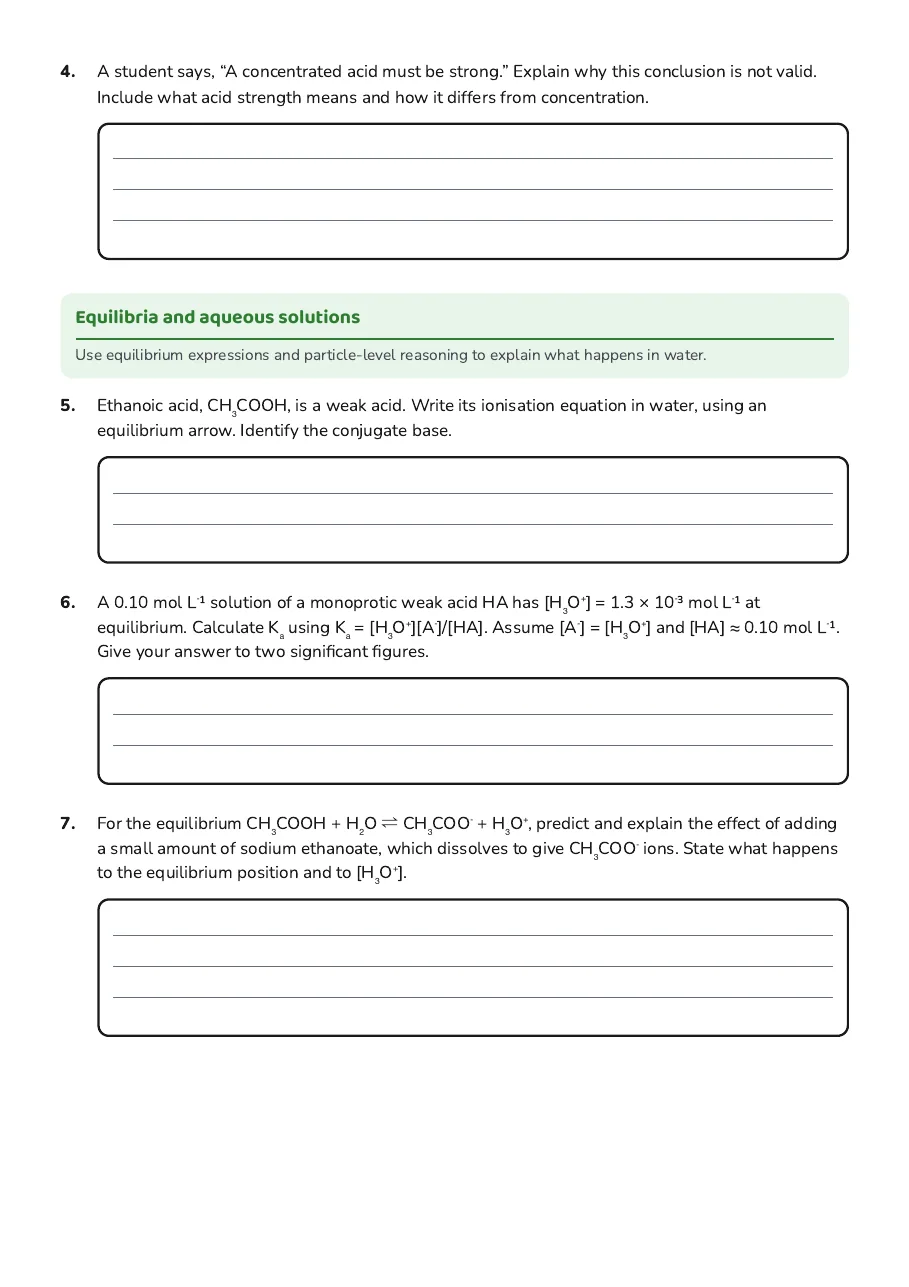
4.A student says, “A concentrated acid must be strong.” Explain why this conclusion is not valid. Include what acid strength means and how it differs from concentration.

Equilibria and aqueous solutions

Use equilibrium expressions and particle-level reasoning to explain what happens in water.

5.Ethanoic acid, CH₃COOH, is a weak acid. Write its ionisation equation in water, using an equilibrium arrow. Identify the conjugate base.
6.A 0.10 mol L⁻¹ solution of a monoprotic weak acid HA has [H₃O⁺] = 1.3 × 10⁻³ mol L⁻¹ at equilibrium. Calculate Kₐ using Kₐ = [H₃O⁺][A⁻]/[HA]. Assume [A⁻] = [H₃O⁺] and [HA] ≈ 0.10 mol L⁻¹. Give your answer to two significant figures.
7.For the equilibrium CH₃COOH + H₂O ⇌ CH₃COO⁻ + H₃O⁺, predict and explain the effect of adding a small amount of sodium ethanoate, which dissolves to give CH₃COO⁻ ions. State what happens to the equilibrium position and to [H₃O⁺].
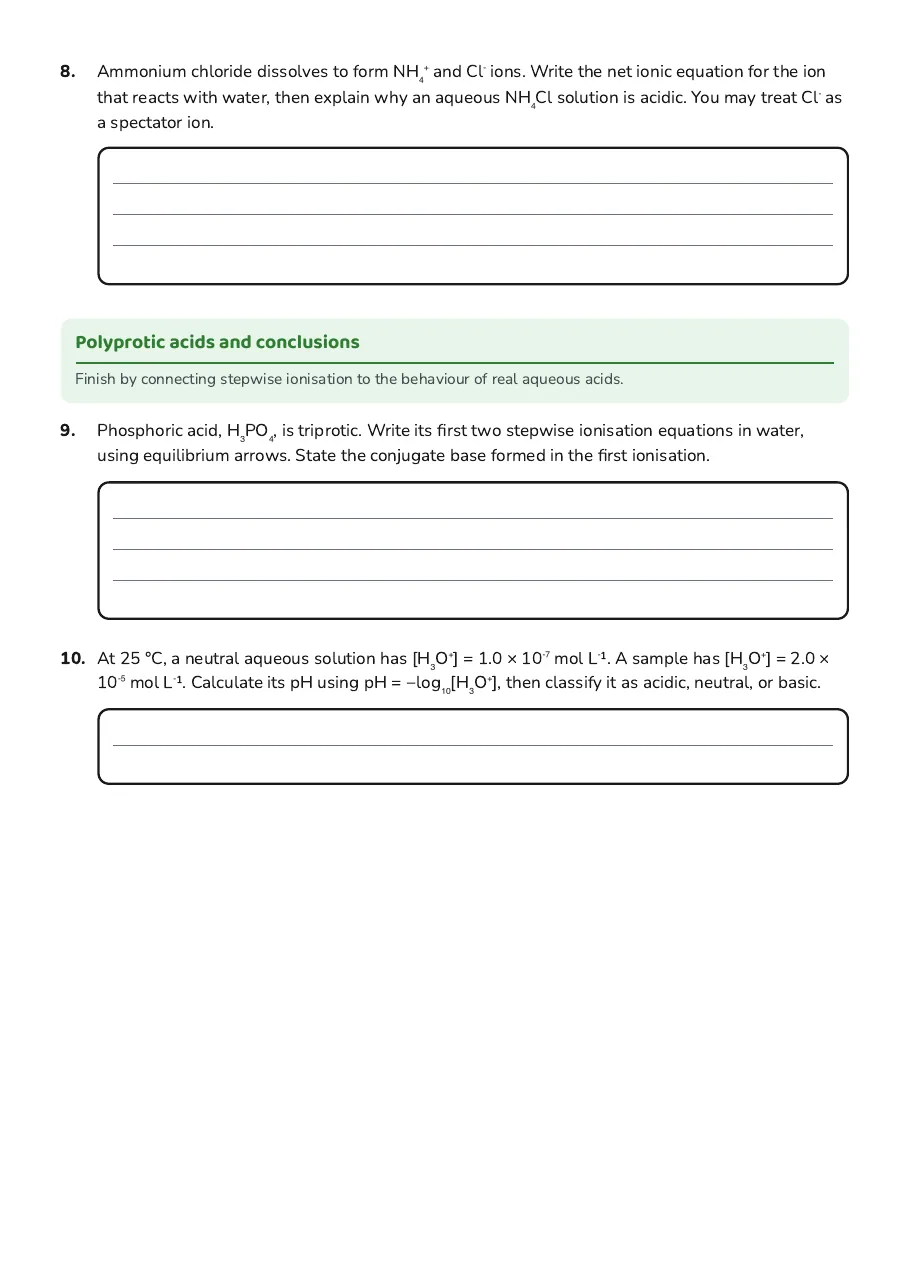
8.Ammonium chloride dissolves to form NH₄⁺ and Cl⁻ ions. Write the net ionic equation for the ion that reacts with water, then explain why an aqueous NH₄Cl solution is acidic. You may treat Cl⁻ as a spectator ion.

Polyprotic acids and conclusions

Finish by connecting stepwise ionisation to the behaviour of real aqueous acids.

9.Phosphoric acid, H₃PO₄, is triprotic. Write its first two stepwise ionisation equations in water, using equilibrium arrows. State the conjugate base formed in the first ionisation.
10.At 25 °C, a neutral aqueous solution has [H₃O⁺] = 1.0 × 10⁻⁷ mol L⁻¹. A sample has [H₃O⁺] = 2.0 × 10⁻⁵ mol L⁻¹. Calculate its pH using pH = −log₁₀[H₃O⁺], then classify it as acidic, neutral, or basic.

3 printable pages

  • Aqueous Acids and Bases, page 1 of 3: Proton transfer and conjugate pairs

    Page 1

  • Aqueous Acids and Bases, page 2 of 3: Equilibria and aqueous solutions

    Page 2

  • Aqueous Acids and Bases, page 3 of 3: Polyprotic acids and conclusions

    Page 3

About This Worksheet

Free in Kuraplan

Sign up free, grab the PDF, and customize it for your class.

Print-Ready

Formatted for standard paper. Clean layout, easy to read.

AI-Generated

Created with Kuraplan's AI, designed for real classroom use.

For Teachers & Parents

Use in classrooms, for homework, tutoring, or homeschool.

Need a custom version of this worksheet?

Kuraplan's AI generates custom worksheets in seconds — differentiated for every learner, aligned to your curriculum.

Generate Custom Worksheets — Free
No credit card Curriculum-aligned Under 60 seconds