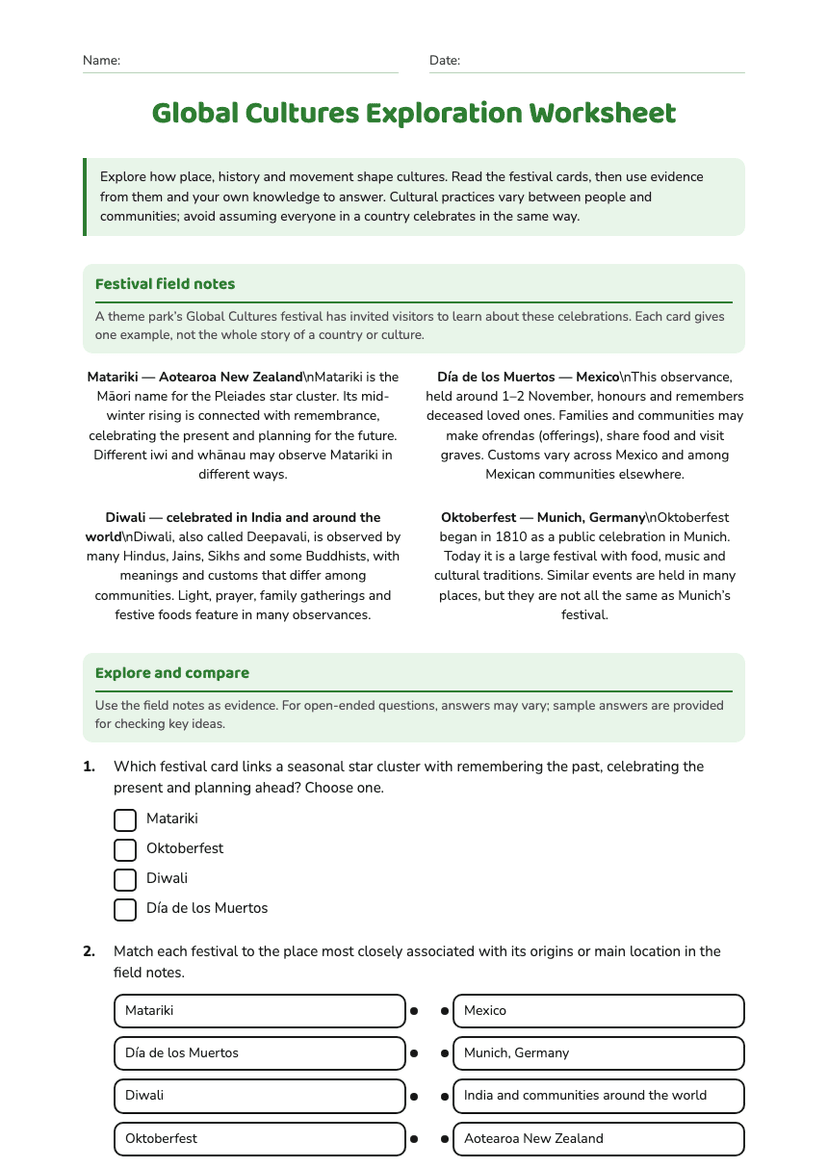
Around the World Overview
A free social sciences worksheet ready for your classroom. Open in Kuraplan to grab the print-ready PDF, customize it for your students, or generate a fresh version in seconds.
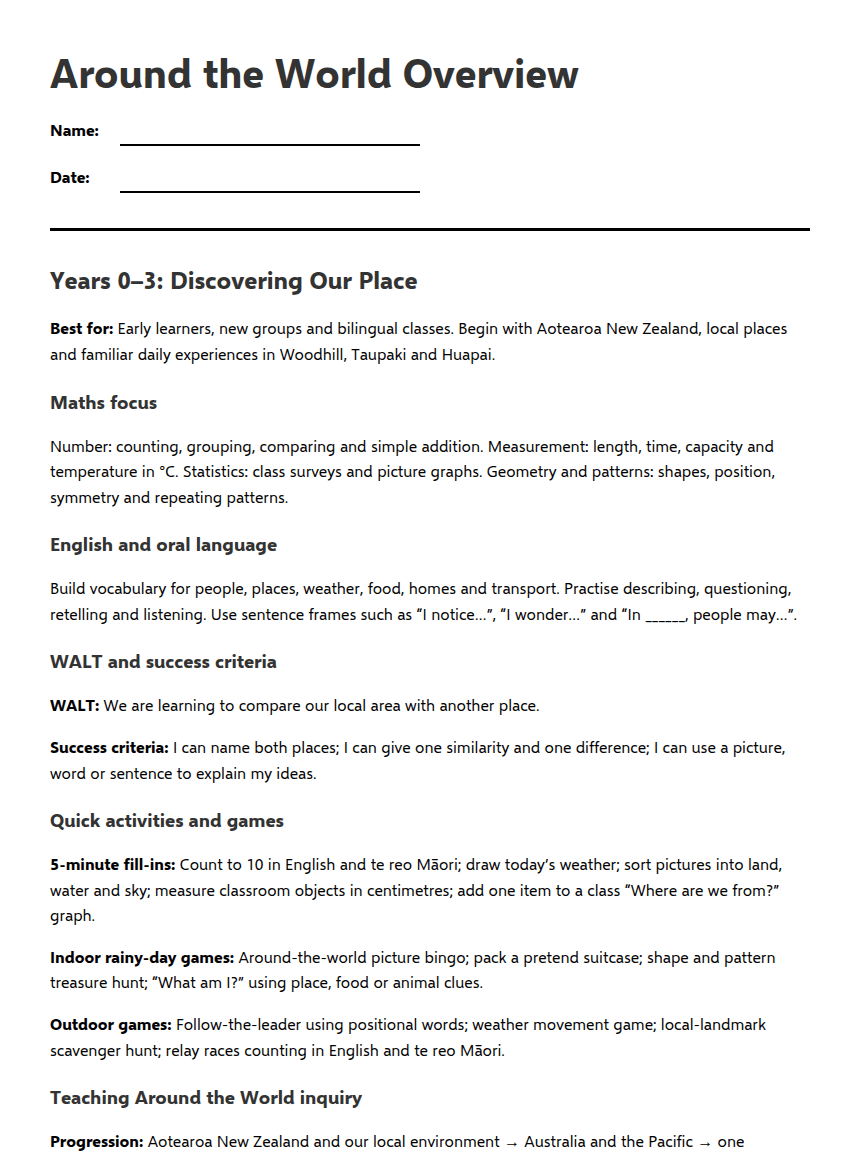
Around the World Overview
Years 0–3: Discovering Our Place
Best for: Early learners, new groups and bilingual classes. Begin with Aotearoa New Zealand, local places and familiar daily experiences in Woodhill, Taupaki and Huapai.
Maths focus
Number: counting, grouping, comparing and simple addition. Measurement: length, time, capacity and temperature in °C. Statistics: class surveys and picture graphs. Geometry and patterns: shapes, position, symmetry and repeating patterns.
English and oral language
Build vocabulary for people, places, weather, food, homes and transport. Practise describing, questioning, retelling and listening. Use sentence frames such as “I notice…”, “I wonder…” and “In ______, people may…”.
WALT and success criteria
WALT: We are learning to compare our local area with another place.
Success criteria: I can name both places; I can give one similarity and one difference; I can use a picture, word or sentence to explain my ideas.
Quick activities and games
5-minute fill-ins: Count to 10 in English and te reo Māori; draw today’s weather; sort pictures into land, water and sky; measure classroom objects in centimetres; add one item to a class “Where are we from?” graph.
Indoor rainy-day games: Around-the-world picture bingo; pack a pretend suitcase; shape and pattern treasure hunt; “What am I?” using place, food or animal clues.
Outdoor games: Follow-the-leader using positional words; weather movement game; local-landmark scavenger hunt; relay races counting in English and te reo Māori.
Teaching Around the World inquiry
Progression: Aotearoa New Zealand and our local environment → Australia and the Pacific → one contrasting country.
Compare population size using simple terms, land and water, native plants and animals, climate and weather, languages, landmarks, food, transport and daily life. Use maps, photographs, stories and classroom objects.
Language, inclusion and extension
Te reo Māori: kia ora (hello), nau mai (welcome), whakarongo (listen), titiro (look), noho (sit), tū (stand), pai mahi (good work), kotahi–tekau (one–ten), ua (rain), rā (sun), hau (wind), whenua (land), wai (water).
Differentiation: Use real objects, photographs, gestures, audio instructions, partner talk and choice of drawing, speaking or writing. Offer dyslexia-friendly texts with clear fonts, short lines, tinted paper and text-to-speech where available.
Extension: Create a simple pictograph, add a third country or explain why weather, transport or homes may differ.
Years 4–6: Comparing Communities
Best for: Learners ready to use maps, data and evidence. Connect local knowledge of West Auckland with wider Aotearoa and the Pacific.
Maths focus
Number: place value, fractions, decimals, percentages and problem-solving. Measurement: distance in kilometres, time zones, area, perimeter, mass and temperature in °C. Statistics: tables, graphs, averages and interpreting data. Geometry and patterns: coordinates, angles, transformations and tessellations.
English and oral language
Read information texts, maps, charts and short narratives. Develop note-making, summarising, persuasive language, comparison words and respectful discussion. Practise asking follow-up questions and presenting findings clearly.
WALT and success criteria
WALT: We are learning to use evidence to compare two countries.
Success criteria: I can locate both countries; I can compare at least three features; I can include accurate data or sources; I can explain one possible reason for a difference.
Quick activities and games
5-minute fill-ins: Estimate and check a distance in metres; convert a temperature from a weather card; read one graph and write a sentence; solve a currency problem using dollars ($); write three facts from a map or image.
Indoor rainy-day games: Map-symbol memory; country and capital matching; vocabulary charades; “Higher or lower?” population and land-area estimation; quiz teams with a respectful right-of-reply rule.
Outdoor games: Human compass and coordinates; climate-zone corners; transport relay; land-use mapping around the school; kilometre estimation walk.
Teaching Around the World inquiry
Progression: Local rohe and Aotearoa New Zealand → a Pacific neighbour → a country in Asia, Africa, Europe or the Americas.
Investigate population, land area, environment, climate and weather, languages, landmarks, food, transport and daily life. Ask: What is similar? What is different? What evidence supports our ideas? Include Māori place names and local stories where appropriate.
Language, inclusion and extension
Te reo Māori: mihi (greeting), kōrero (talk), pānui (read), tuhituhi (write), mahi takirua (work in pairs), āe (yes), kāo (no), he aha? (what?), kei hea? (where?), makariri (cold), mahana (warm), whenua (land), moana (ocean).
Differentiation: Provide vocabulary banks, modelled examples, partially completed maps, mixed-ability pairs and audio versions of texts. Allow speech-to-text, coloured overlays, chunked instructions and dyslexia-friendly reading choices.
Extension: Calculate percentages from population or survey data, compare time zones, or present a recommendation for sustainable transport or water use.
Years 7–8: Global Connections and Inquiry
Best for: Independent inquiry, critical thinking and respectful debate. Encourage learners to connect local decisions with global issues.
Maths focus
Number: rates, ratios, percentages, fractions, financial literacy and scale. Measurement: scale maps, area, volume, distance, time zones and climate data in °C. Statistics: sampling, data displays, averages, variation and misleading graphs. Geometry and patterns: scale, coordinates, symmetry and transformations.
English and oral language
Evaluate sources, distinguish fact from opinion, paraphrase accurately and cite information. Develop comparative reports, speeches, debates, interviews and reflective writing. Use precise language, evidence and respectful disagreement.
WALT and success criteria
WALT: We are learning to explain how geography and culture influence daily life.
Success criteria: I can use reliable evidence; I can explain connections between environment and people; I can acknowledge different perspectives; I can communicate a balanced conclusion.
Quick activities and games
5-minute fill-ins: Analyse a world map; calculate a scale distance; interpret a climate graph; compare two transport systems; write a claim and supporting evidence; identify a missing perspective in a short text.
Indoor rainy-day games: Source detective; global data challenge; landmark taboo; debate continuum; “Which country am I?” using evidence rather than stereotypes.
Outdoor games: Scale-map navigation; global time-zone relay; sustainable transport audit; school weather station comparison; human migration and trade-route simulation.
Teaching Around the World inquiry
Progression: Aotearoa New Zealand and local iwi narratives → Pacific relationships → two countries with contrasting population, land area, environment and climate.
Compare languages, landmarks, food, transport and daily life alongside geography and data. Investigate how climate, resources, colonisation, migration, technology and government can shape communities. Include questions such as: Whose voice is included? What has changed? What could be improved?
Language, inclusion and extension
Te reo Māori: tēnā koutou (greetings to three or more), ko wai koe? (who are you?), nō hea koe? (where are you from?), whakarite (compare), whakamārama (explain), taunaki (support with evidence), tika (correct), āhuarangi (climate), mahana (warm), makariri (cold), hau (wind), ua (rain).
Differentiation: Offer choice of report, podcast, presentation or visual explanation. Use explicit vocabulary teaching, graphic organisers, captioned video, read-aloud support, dyslexia-friendly layouts and flexible response methods. Check understanding privately before whole-class discussion.
Extension: Critique data reliability, investigate a sustainability issue, compare carbon or water use, or propose a fair and evidence-based action for the school or local community.
Relief-teacher reminders
Check local school expectations, tikanga and current learning programmes before beginning. Use respectful pronunciation of Māori names and place names; ask a knowledgeable colleague or local source when unsure. Welcome students’ languages and experiences, avoid stereotypes and provide clear routines for unfamiliar classes.
About This Worksheet
Free in Kuraplan
Sign up free, grab the PDF, and customize it for your class.
Print-Ready
Formatted for standard paper. Clean layout, easy to read.
AI-Generated
Created with Kuraplan's AI, designed for real classroom use.
For Teachers & Parents
Use in classrooms, for homework, tutoring, or homeschool.
Need a custom version of this worksheet?
Kuraplan's AI generates custom worksheets in seconds — differentiated for every learner, aligned to your curriculum.
Generate Custom Worksheets — FreeMore Social Sciences Worksheets
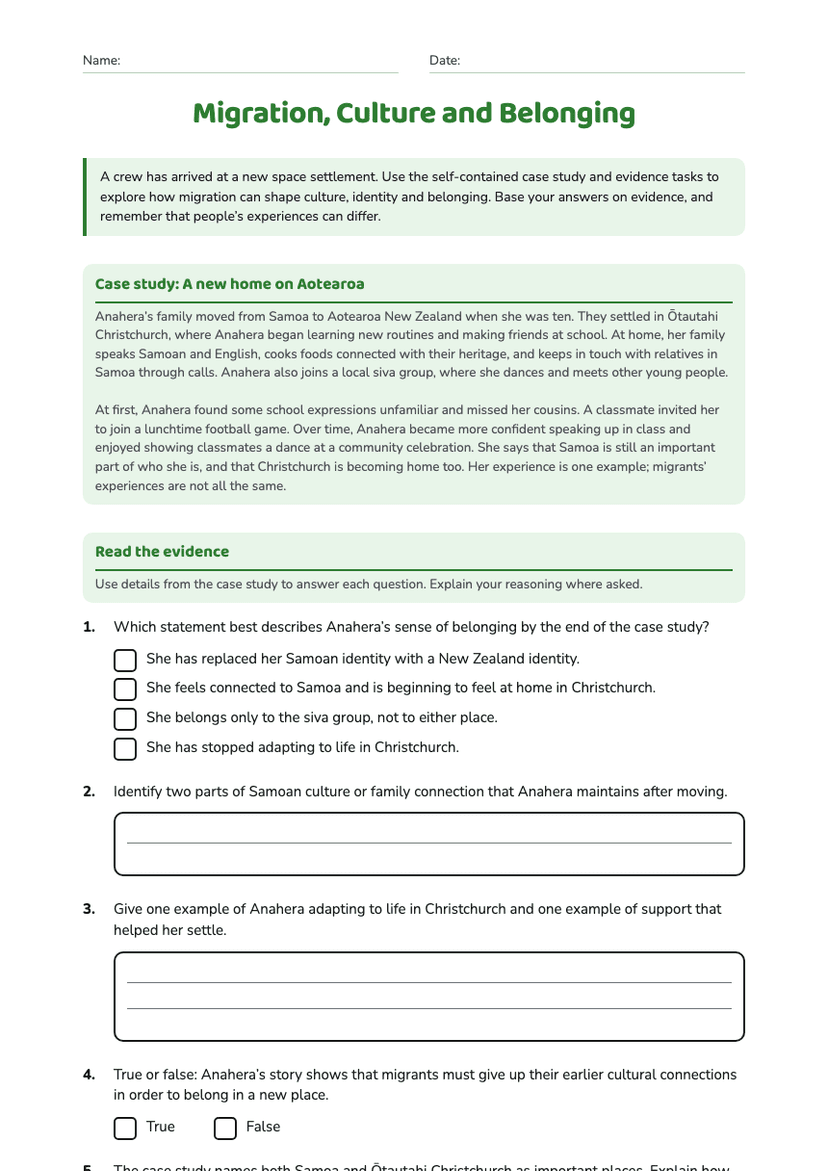
Migration, Culture and Belonging
Free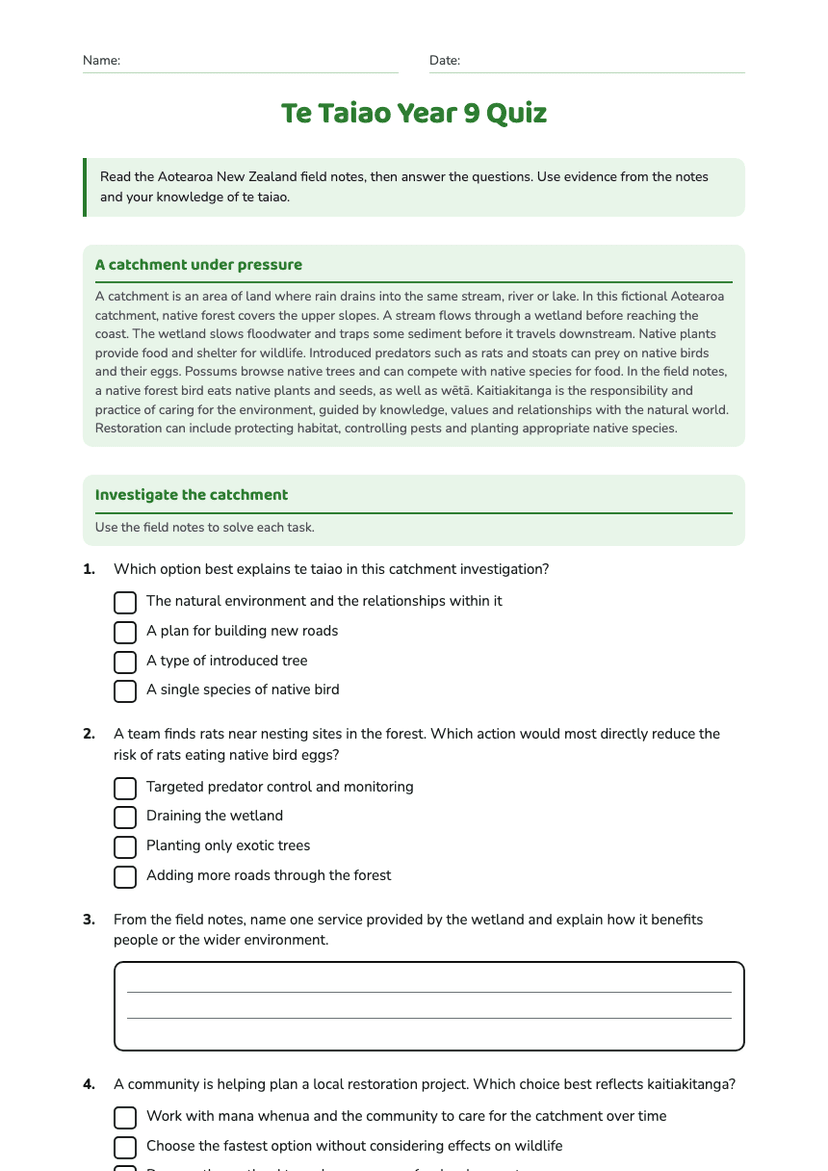
Te Taiao Year 9 Quiz
Free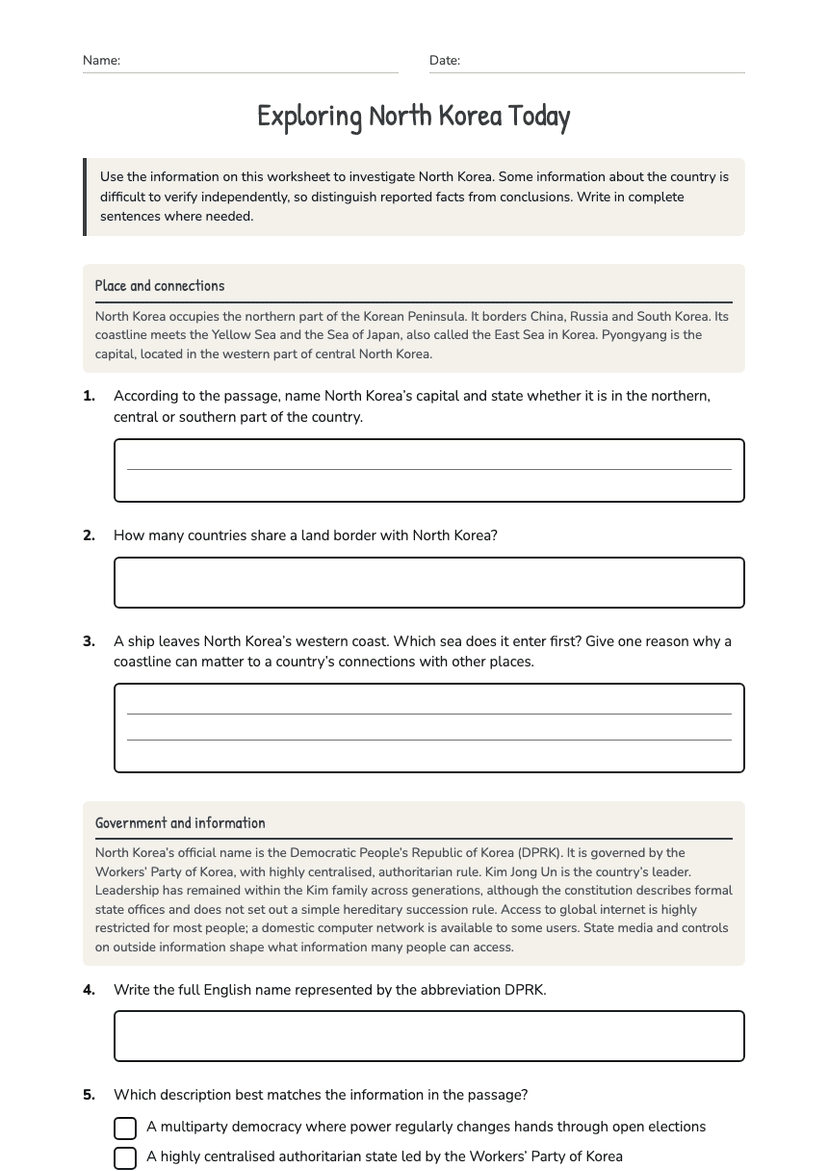
Exploring North Korea Today
Free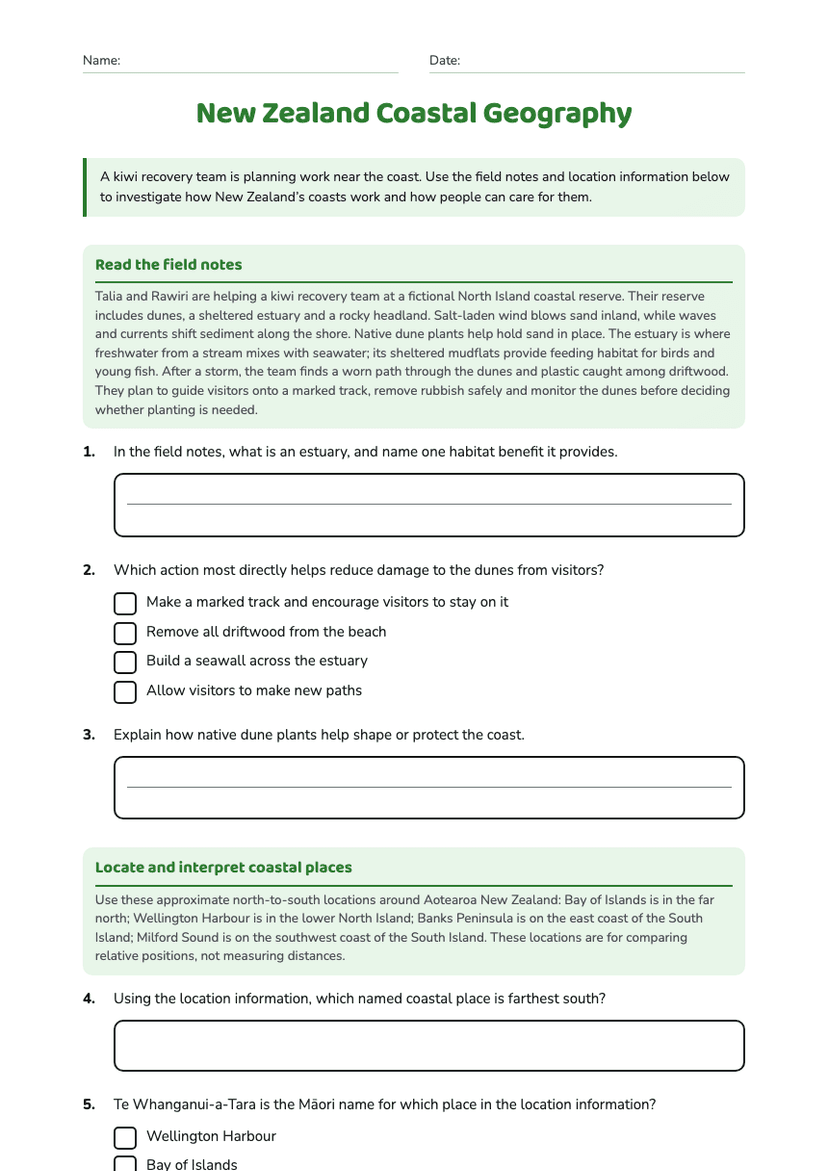
New Zealand Coastal Geography
Free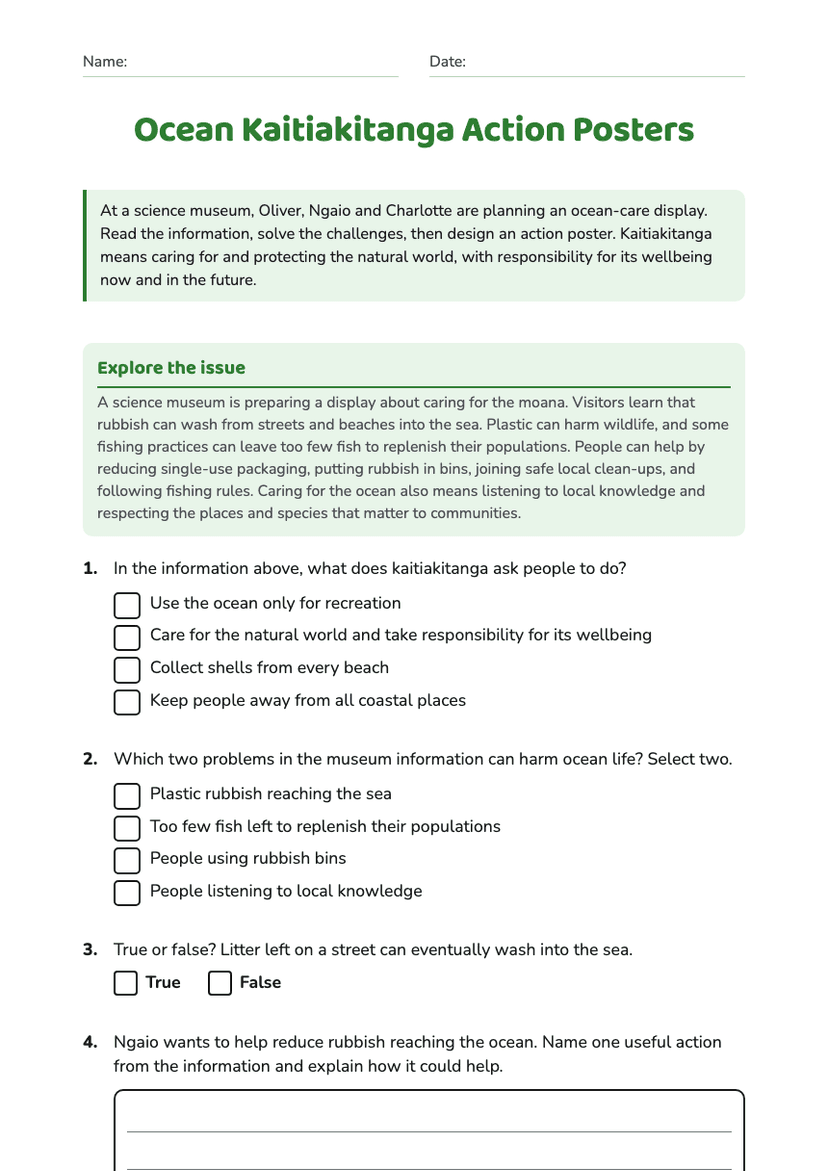
Ocean Kaitiakitanga Action Posters
Free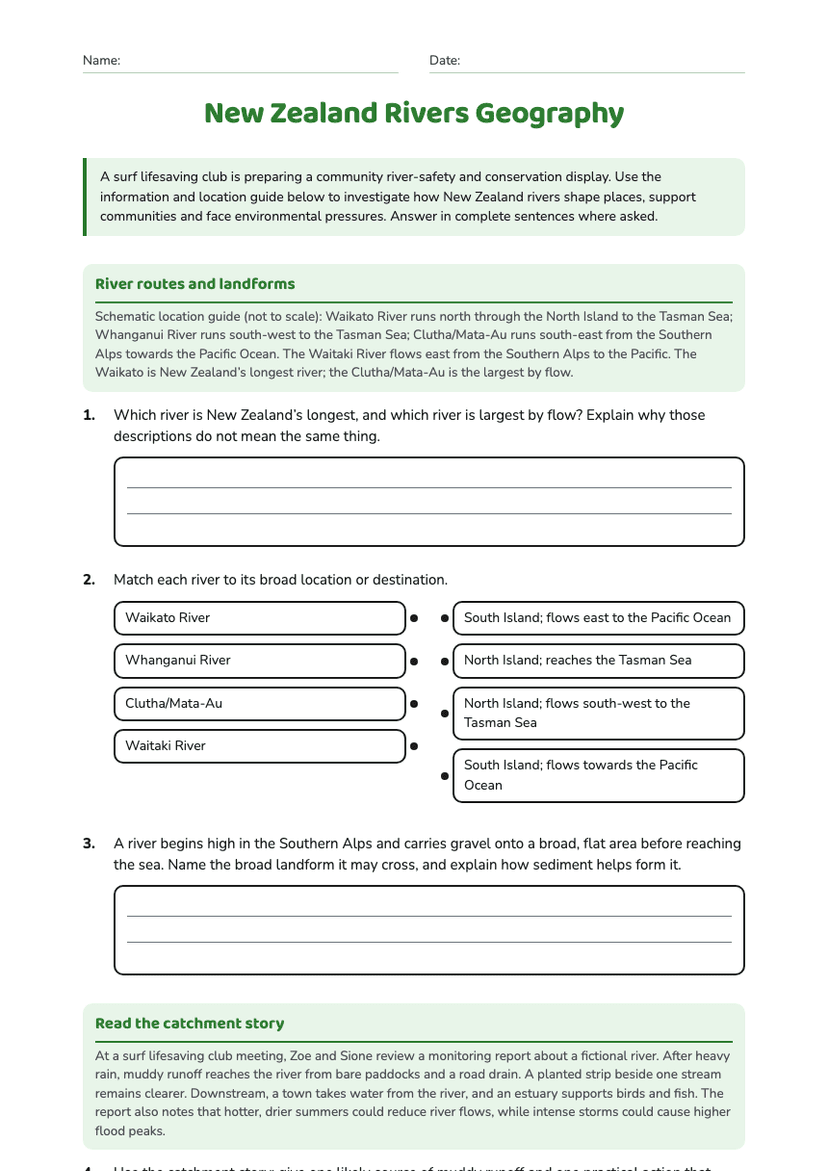
New Zealand Rivers Geography
Free
Hydrothermal Activity and Terraces
Free