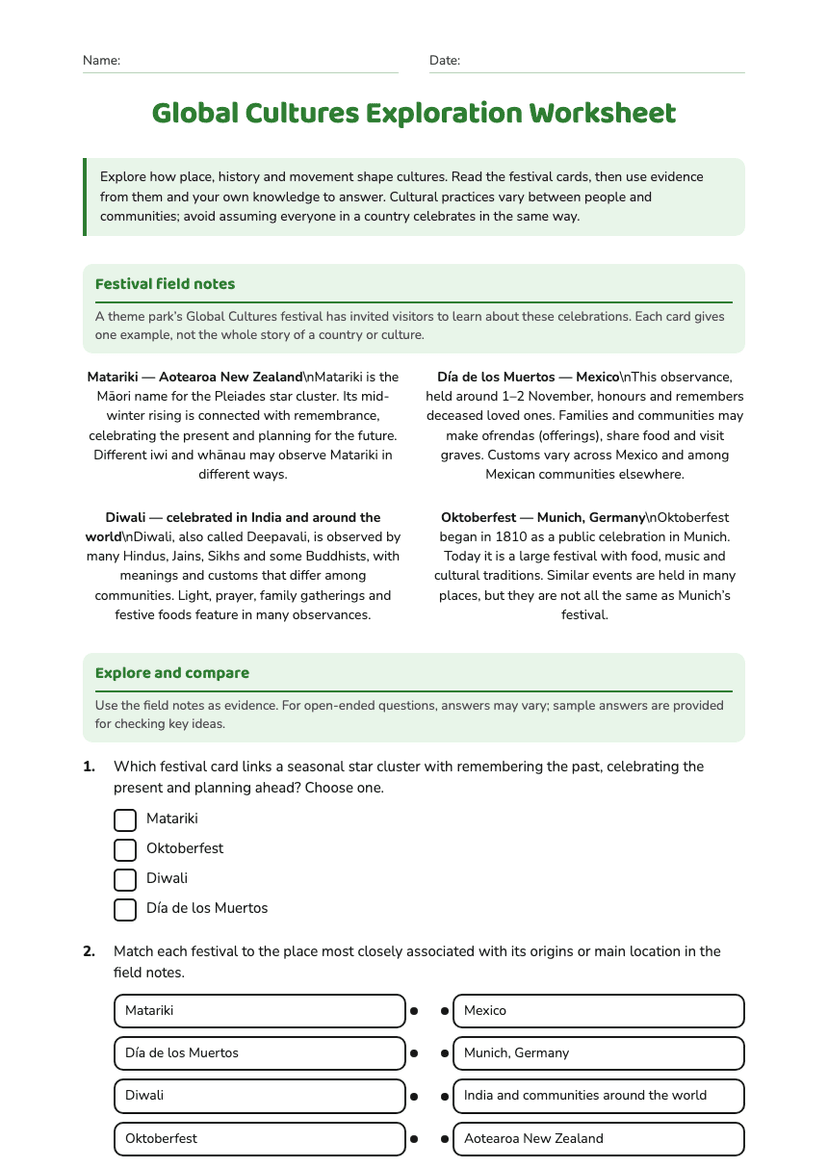
Aotearoa Comparisons Worksheet Pack
A free social sciences worksheet ready for your classroom. Open in Kuraplan to grab the print-ready PDF, customize it for your students, or generate a fresh version in seconds.
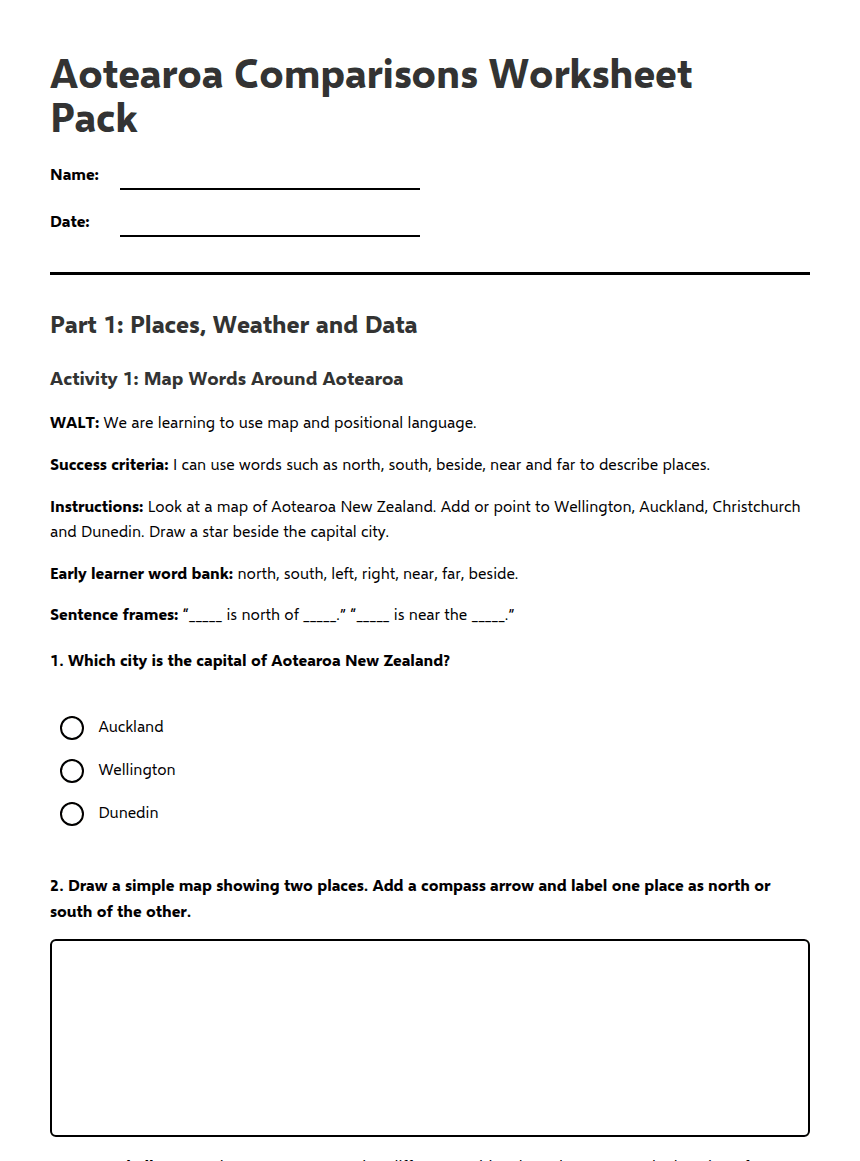
Aotearoa Comparisons Worksheet Pack
Part 1: Places, Weather and Data
Activity 1: Map Words Around Aotearoa
WALT: We are learning to use map and positional language.
Success criteria: I can use words such as north, south, beside, near and far to describe places.
Instructions: Look at a map of Aotearoa New Zealand. Add or point to Wellington, Auckland, Christchurch and Dunedin. Draw a star beside the capital city.
Early learner word bank: north, south, left, right, near, far, beside.
Sentence frames: “_____ is north of _____.” “_____ is near the _____.”
Year 2–3 challenge: Write two sentences using different positional words. Compare the location of Aotearoa with another country on a world map.
Differentiation: Use a large-print map, tactile map, place cards, partner talk and colour-coded arrows. Offer an adult scribe or oral response.
Activity 2: Weather Pictograph
WALT: We are learning to read, represent and compare simple weather data.
Success criteria: I can count symbols, say which has more or fewer, and explain one comparison.
Key: Each ☀ represents 1 day. Teacher or students may draw picture symbols instead.
Five-day weather record: Aotearoa: ☀ ☁ ☀ ☂ ☁ Japan: ☀ ☀ ☂ ☂ ☁
Word bank: sunny, cloudy, rainy, more, fewer, equal, data, compare.
Year 2–3 challenge: Make a pictograph for a six-day record. Add a title and write one question for a partner.
Differentiation: Provide counters or weather cards before recording. Read the data aloud and allow students to answer by pointing, speaking or drawing.
Part 2: Measuring, Counting and Caring for Places
Activity 3: Measure and Compare
WALT: We are learning to measure and compare lengths and distances.
Success criteria: I can measure with a ruler or informal units and use longer, shorter, closer or farther.
Instructions: Measure two classroom objects, such as a book and a pencil. Record the measurements in centimetres.
Compare places: On a map, Aotearoa is about 2,000 km long. Use a map scale or teacher-provided strips to compare Aotearoa with another country. These figures are rounded for learning.
Differentiation: Use linking cubes, metre strips or pre-marked rulers. Offer the sentence frame “_____ is longer than _____ because _____.”
Year 2–3 extension: Estimate first, then measure. Find the difference between two measurements.
Activity 4: Population Counting
WALT: We are learning to count, group and compare population information.
Success criteria: I can count in groups, use greater than or less than, and remember that people are individuals.
Learning data: These are rounded classroom numbers, not exact current populations. Aotearoa: 5 groups of 1 million. Australia: 26 groups of 1 million.
Early learner support: Use five and twenty-six counters, count aloud and match numeral cards.
Year 2–3 challenge: Write the comparison using >, < or =. Explain why rounded data is useful but not exact.
Activity 5: Environment Words and Oral Sentences
WALT: We are learning to use respectful words to describe natural and built environments.
Success criteria: I can identify an environment feature and speak in a complete sentence.
Word bank: awa (river), maunga (mountain), moana (ocean), ngahere (forest), beach, farm, city, park, protect, care.
Te Reo Māori pronunciation support: vowels are clear: a as in “car”, e as in “bed”, i as in “see”, o as in “or”, u as in “oo”. Say the words slowly and respectfully.
Differentiation: Use real photographs, gestures, objects and picture cards. Accept home-language discussion, oral recording, drawing or dictation.
Year 2–3 extension: Compare one natural feature in Aotearoa with a feature in another country. Explain one respectful way people can care for it.
Part 3: Compare and Reflect
Activity 6: Venn Diagram Comparison
WALT: We are learning to identify similarities and differences between places.
Success criteria: I can sort ideas into different and the same, and explain one comparison.
Instructions: Compare Aotearoa New Zealand with another country. In the left circle, write or draw features of Aotearoa. In the right circle, write or draw features of the other country. In the middle, write or draw what they share. Use maps, photographs or class information. Do not assume that everyone in a country lives in the same way.
Possible ideas: location, language, weather, landforms, animals, food, homes, transport, celebrations and ways people care for places.
Sentence frames: “Both places have _____.” “Aotearoa has _____, while _____ has _____.” “One question I have is _____.”
Early learner option: Sort picture cards into “Aotearoa”, “both” and “other country”. Tell a partner one idea.
Year 2–3 extension: Write three comparisons and explain which source helped you: map, data, photograph, book or class discussion.
Dyslexia-friendly options: Use a clear sans-serif font, large text, wide spacing, short instructions, read-aloud support, coloured overlays if helpful, and allow oral or scribed answers.
Teacher Guidance and Suggested Answers
Activity 1: Wellington is the correct answer. Accept accurate positional sentences based on the map used. Remind students that maps can show places from different viewpoints and scales.
Activity 2: Aotearoa has 2 sunny days and 1 rainy day. Japan has 2 sunny days and 2 rainy days. Japan has more rainy days; sunny days are equal.
Activity 3: Answers depend on classroom measurements. Check that students use cm, compare accurately and explain their thinking.
Activity 4: Australia is greater in the model. It has 21 more groups of 1 million than Aotearoa. Discuss that population figures change and rounded numbers are used only for this activity.
Activity 5: Accept drawings and sentences that show care for people, living things and places. Model correct pronunciation without requiring students to speak Te Reo Māori perfectly.
Activity 6: Answers will vary. Look for at least one similarity, one difference and respectful language. Encourage students to use evidence rather than stereotypes.
Relief-teacher preparation: Place a map, ruler, counters, weather cards, picture cards and pencils beside this pack. Let students work independently, with a buddy or in a small teacher-led group.
About This Worksheet
Free in Kuraplan
Sign up free, grab the PDF, and customize it for your class.
Print-Ready
Formatted for standard paper. Clean layout, easy to read.
AI-Generated
Created with Kuraplan's AI, designed for real classroom use.
For Teachers & Parents
Use in classrooms, for homework, tutoring, or homeschool.
Need a custom version of this worksheet?
Kuraplan's AI generates custom worksheets in seconds — differentiated for every learner, aligned to your curriculum.
Generate Custom Worksheets — FreeMore Social Sciences Worksheets
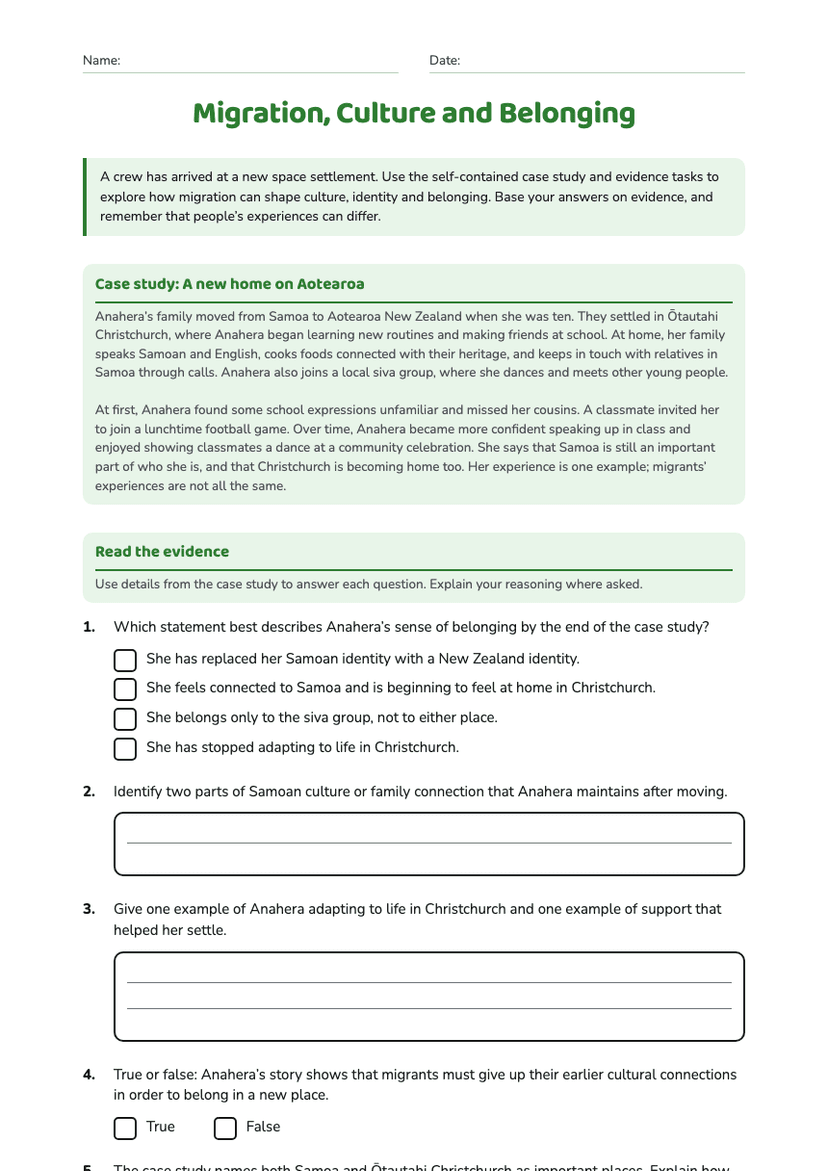
Migration, Culture and Belonging
Free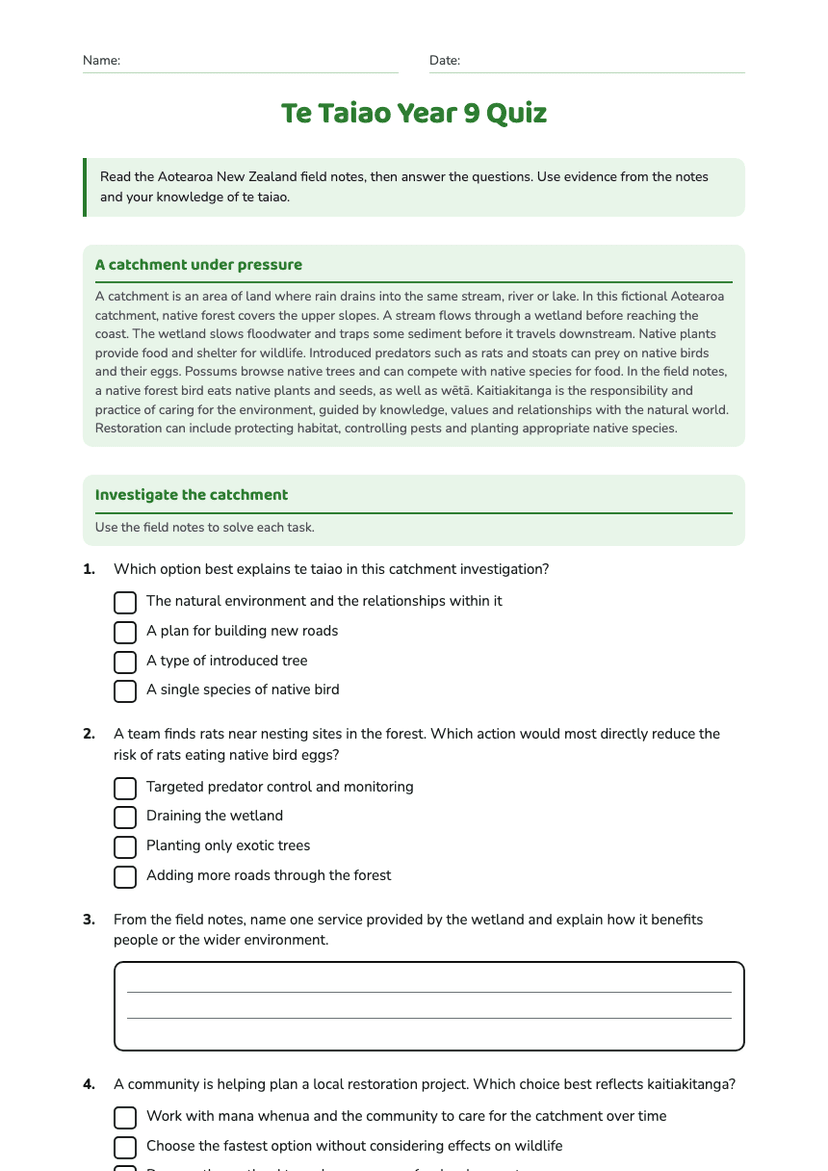
Te Taiao Year 9 Quiz
Free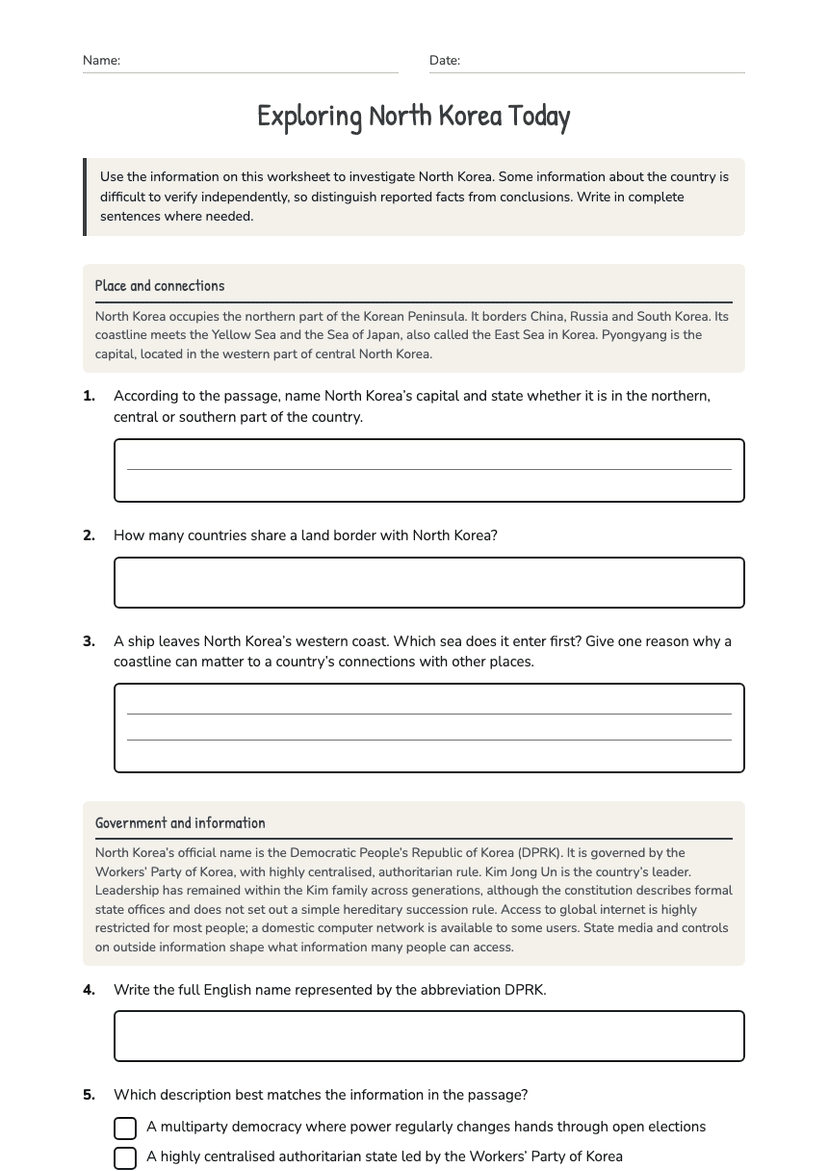
Exploring North Korea Today
Free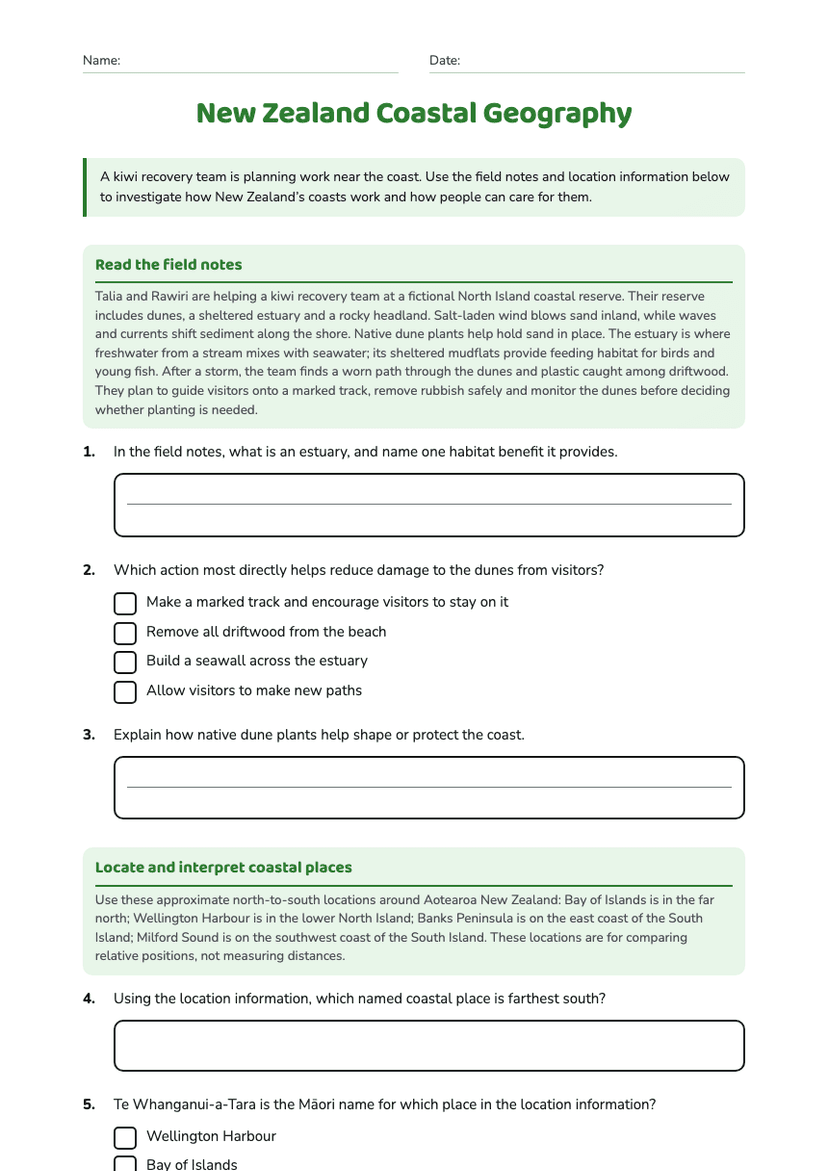
New Zealand Coastal Geography
Free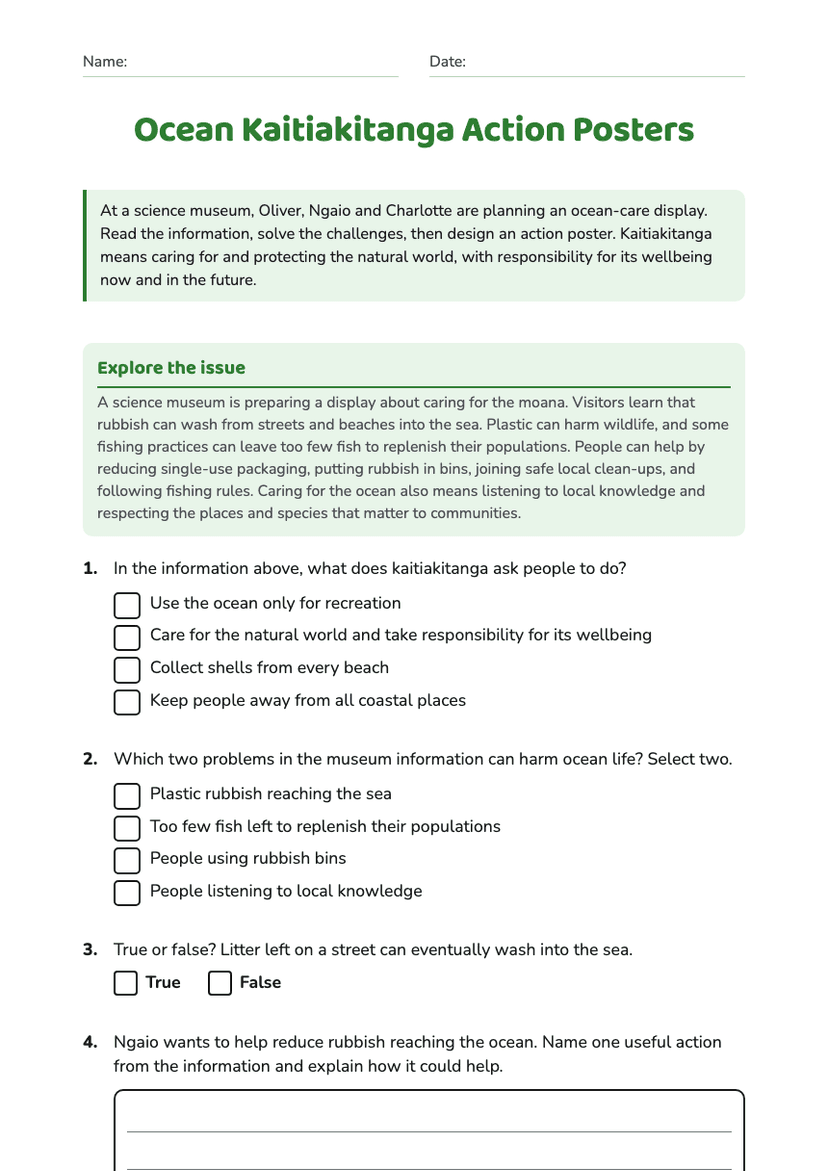
Ocean Kaitiakitanga Action Posters
Free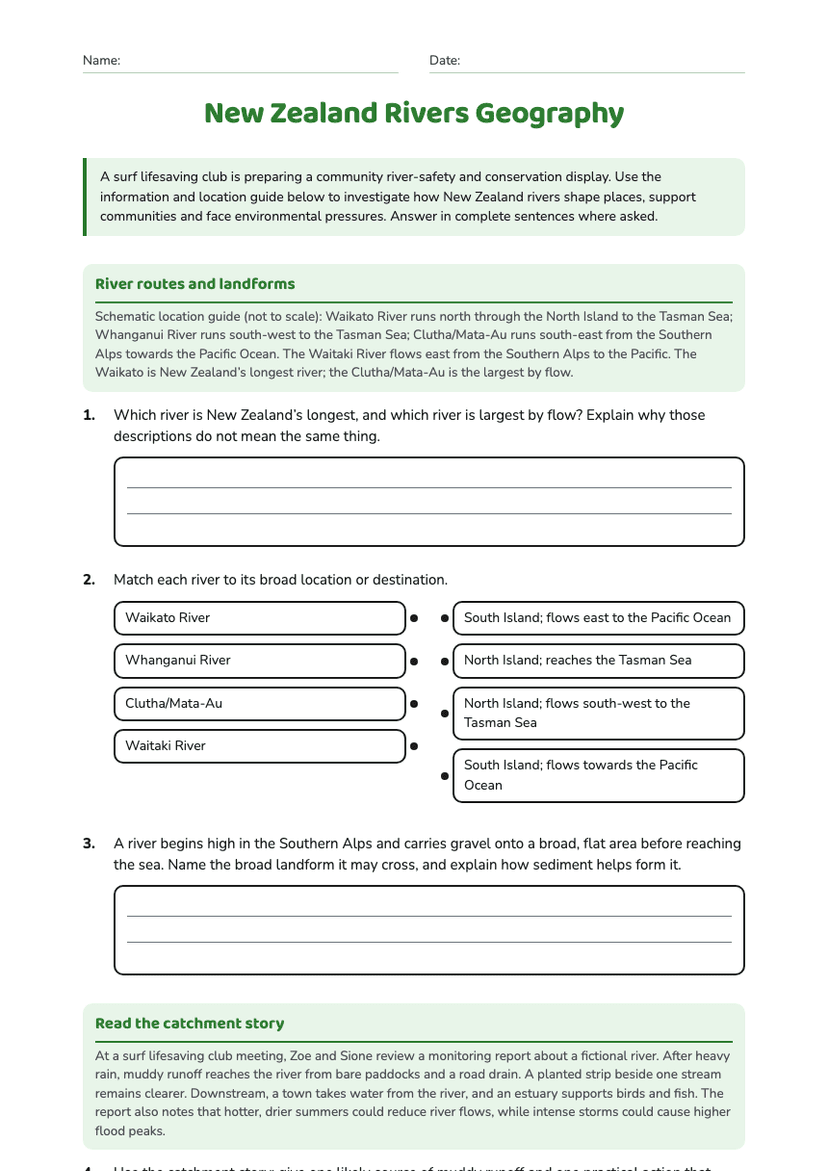
New Zealand Rivers Geography
Free
Hydrothermal Activity and Terraces
Free