Ava Bowl Symbolism
A free languages worksheet ready for your classroom. Open in Kuraplan to grab the print-ready PDF, customize it for your students, or generate a fresh version in seconds.
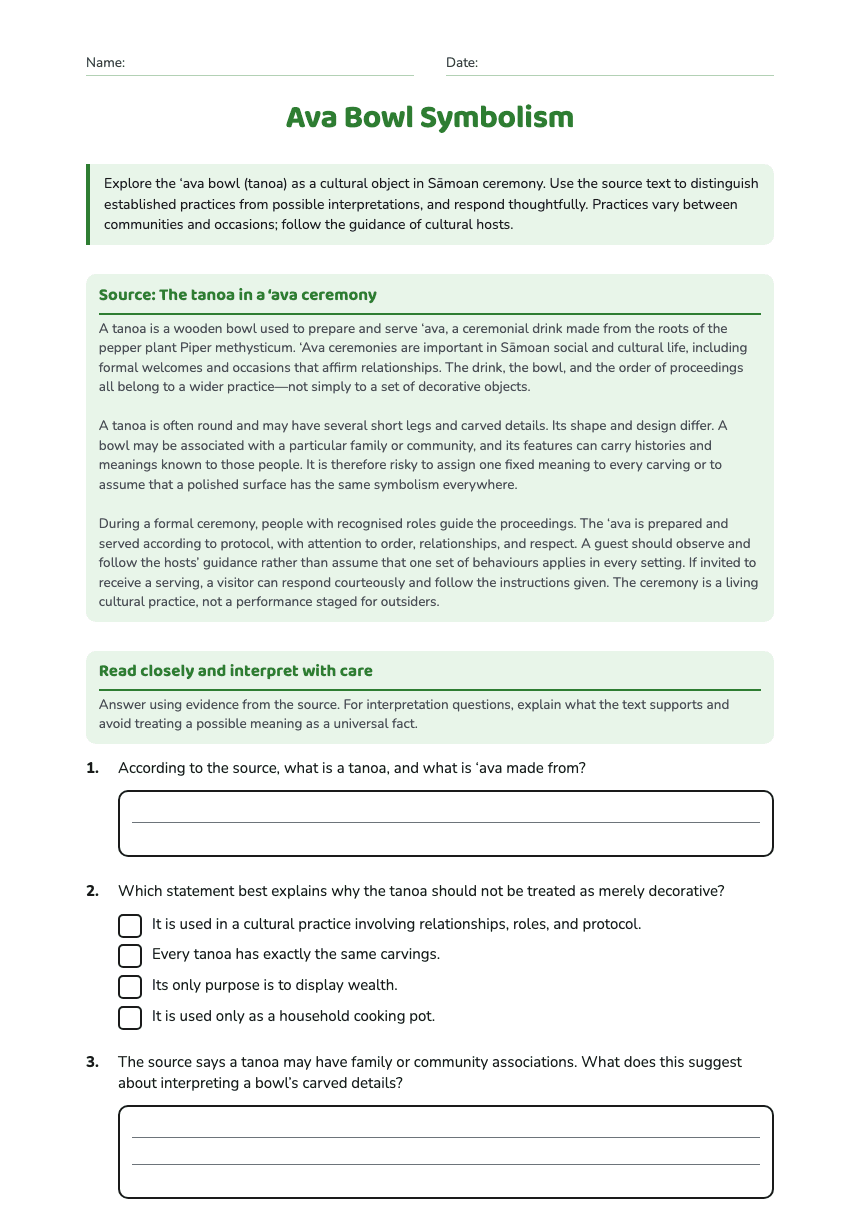
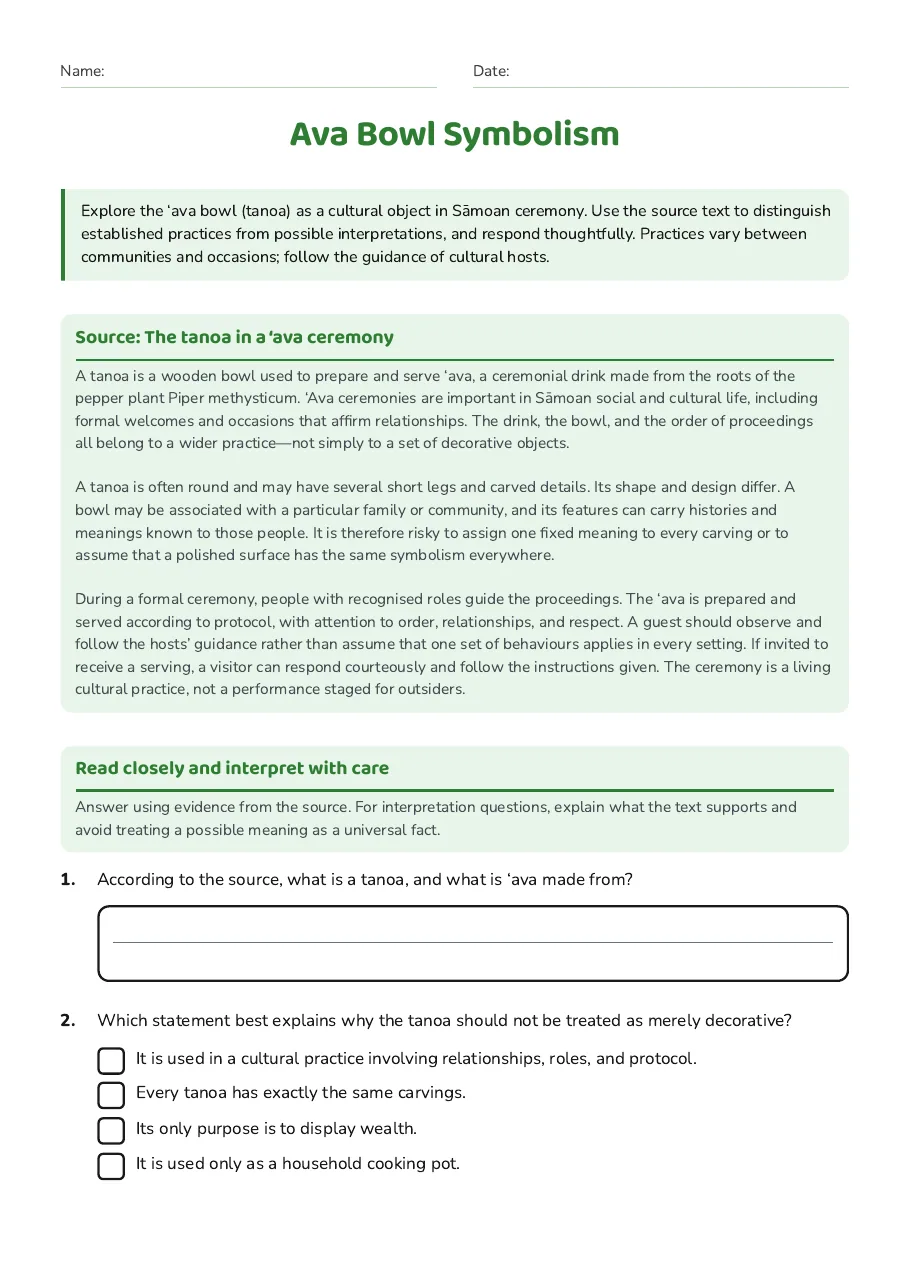
Ava Bowl Symbolism
Source: The tanoa in a ‘ava ceremony
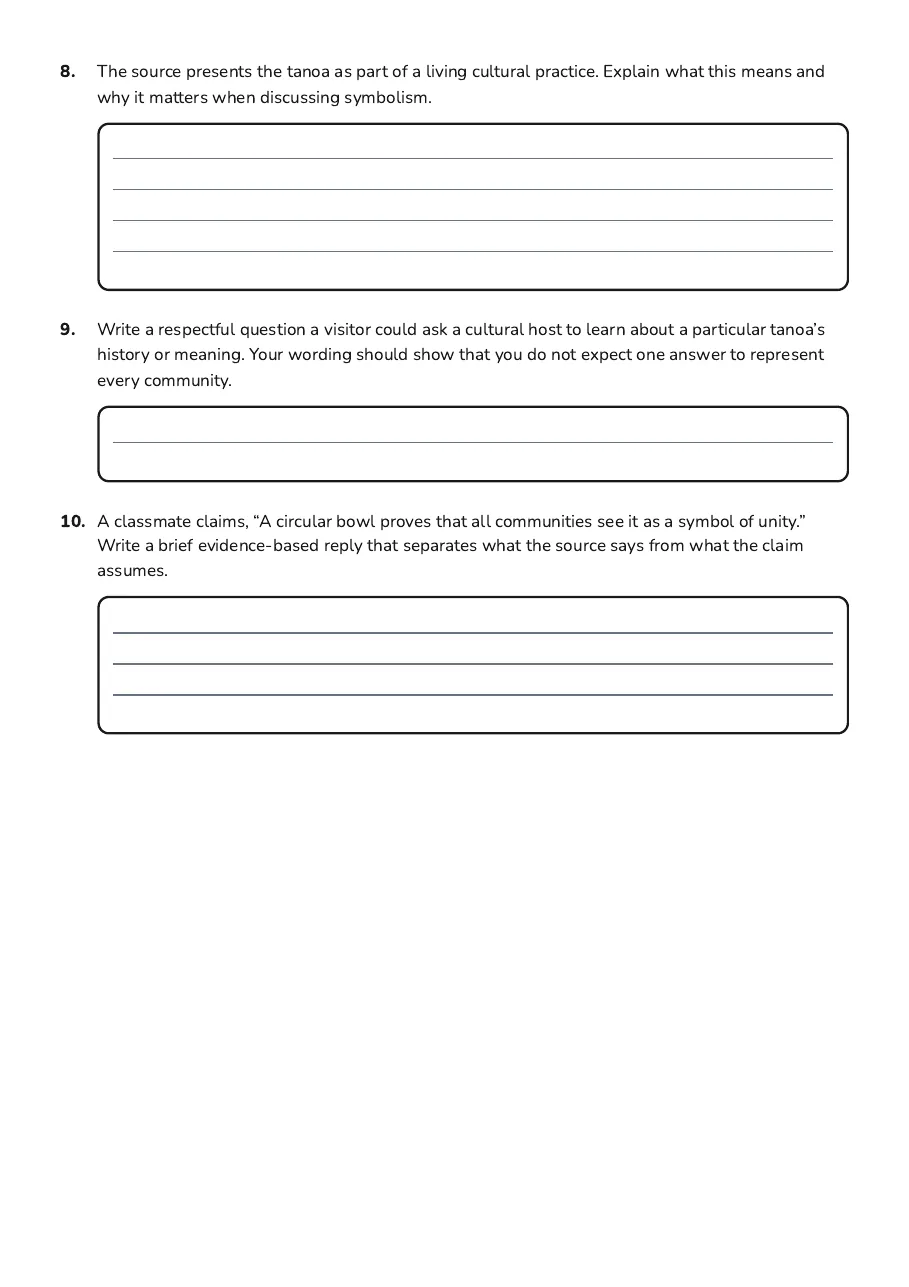
A tanoa is a wooden bowl used to prepare and serve ‘ava, a ceremonial drink made from the roots of the pepper plant Piper methysticum. ‘Ava ceremonies are important in Sāmoan social and cultural life, including formal welcomes and occasions that affirm relationships. The drink, the bowl, and the order of proceedings all belong to a wider practice—not simply to a set of decorative objects. A tanoa is often round and may have several short legs and carved details. Its shape and design differ. A bowl may be associated with a particular family or community, and its features can carry histories and meanings known to those people. It is therefore risky to assign one fixed meaning to every carving or to assume that a polished surface has the same symbolism everywhere. During a formal ceremony, people with recognised roles guide the proceedings. The ‘ava is prepared and served according to protocol, with attention to order, relationships, and respect. A guest should observe and follow the hosts’ guidance rather than assume that one set of behaviours applies in every setting. If invited to receive a serving, a visitor can respond courteously and follow the instructions given. The ceremony is a living cultural practice, not a performance staged for outsiders.
Read closely and interpret with care
Answer using evidence from the source. For interpretation questions, explain what the text supports and avoid treating a possible meaning as a universal fact.
- It is used in a cultural practice involving relationships, roles, and protocol.
- Every tanoa has exactly the same carvings.
- Its only purpose is to display wealth.
- It is used only as a household cooking pot.
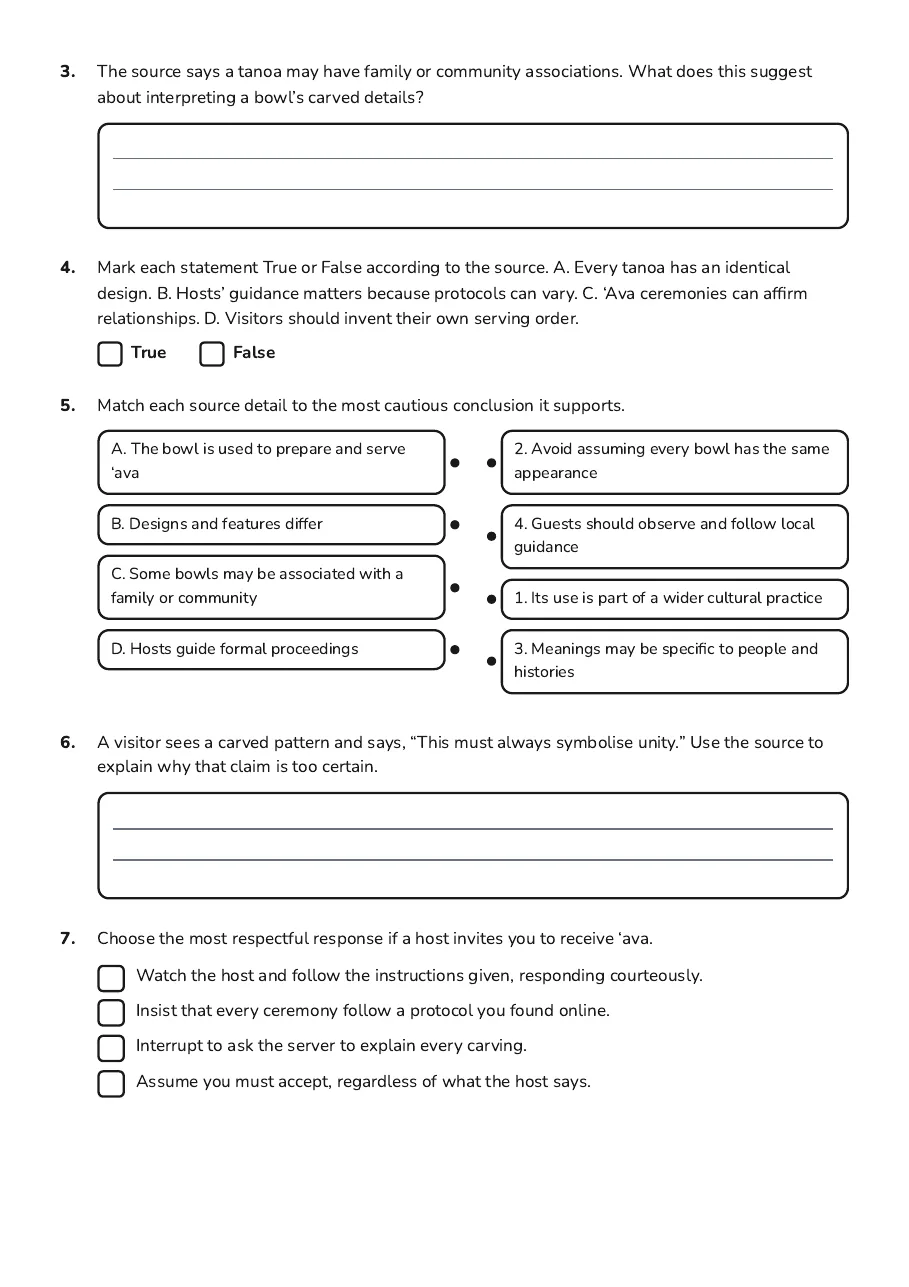
- A. The bowl is used to prepare and serve ‘ava
- B. Designs and features differ
- C. Some bowls may be associated with a family or community
- D. Hosts guide formal proceedings
- 2. Avoid assuming every bowl has the same appearance
- 4. Guests should observe and follow local guidance
- 1. Its use is part of a wider cultural practice
- 3. Meanings may be specific to people and histories
- Watch the host and follow the instructions given, responding courteously.
- Insist that every ceremony follow a protocol you found online.
- Interrupt to ask the server to explain every carving.
- Assume you must accept, regardless of what the host says.
3 printable pages
Page 1
Page 2
Page 3
About This Worksheet
Free in Kuraplan
Sign up free, grab the PDF, and customize it for your class.
Print-Ready
Formatted for standard paper. Clean layout, easy to read.
AI-Generated
Created with Kuraplan's AI, designed for real classroom use.
For Teachers & Parents
Use in classrooms, for homework, tutoring, or homeschool.
Need a custom version of this worksheet?
Kuraplan's AI generates custom worksheets in seconds — differentiated for every learner, aligned to your curriculum.
Generate Custom Worksheets — Free