ScienceFreePrintable

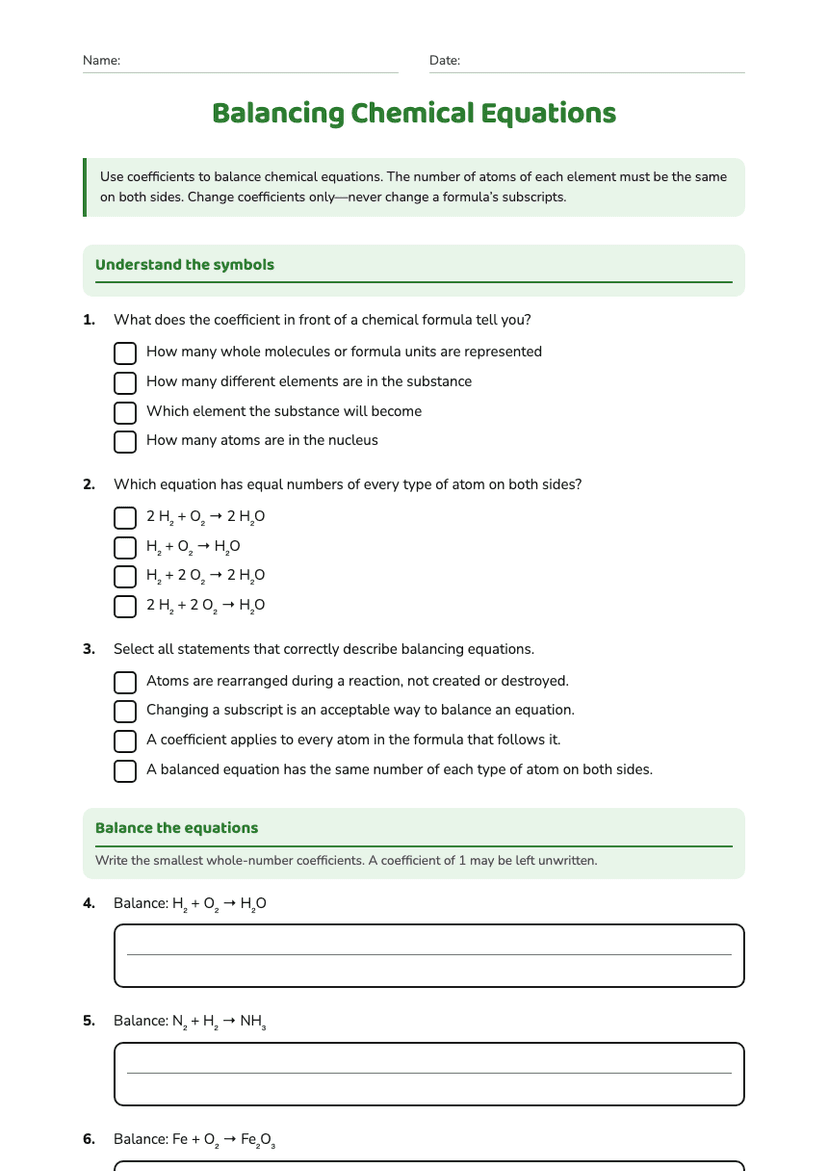
Balancing Chemical Equations Worksheet

A free science worksheet ready for your classroom. Open in Kuraplan to grab the print-ready PDF, customize it for your students, or generate a fresh version in seconds.
Balancing Chemical Equations Worksheet worksheet preview
Name:Date:

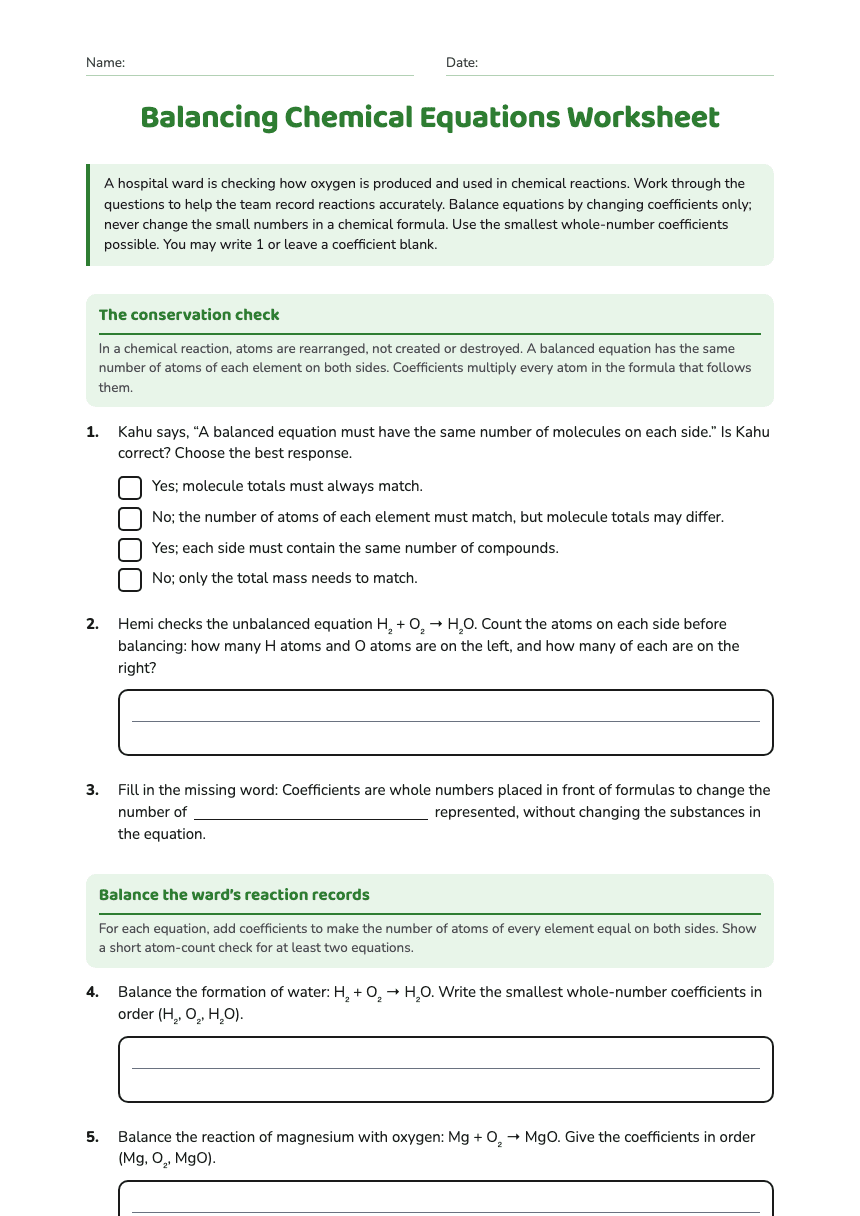
Balancing Chemical Equations Worksheet

A hospital ward is checking how oxygen is produced and used in chemical reactions. Work through the questions to help the team record reactions accurately. Balance equations by changing coefficients only; never change the small numbers in a chemical formula. Use the smallest whole-number coefficients possible. You may write 1 or leave a coefficient blank.

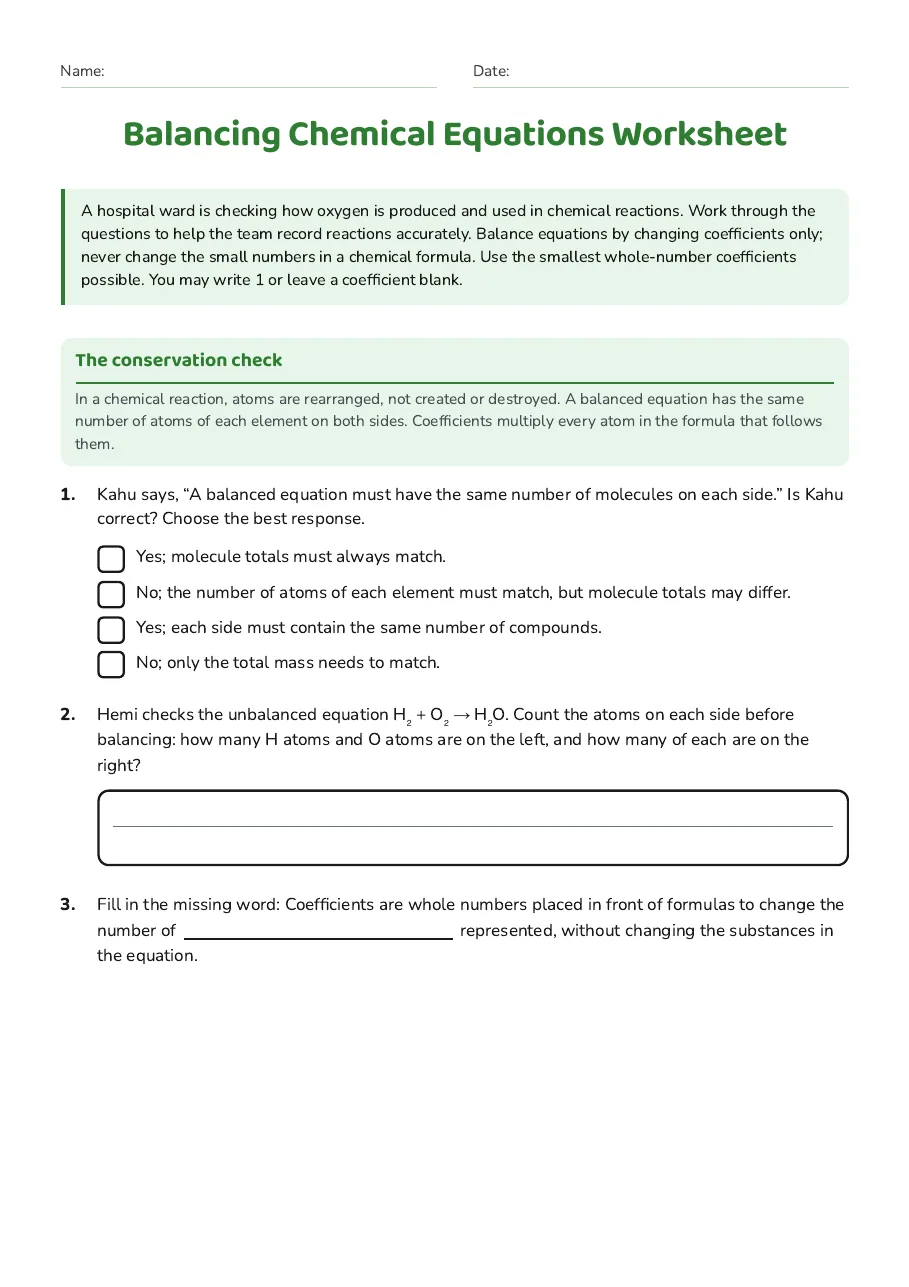
The conservation check

In a chemical reaction, atoms are rearranged, not created or destroyed. A balanced equation has the same number of atoms of each element on both sides. Coefficients multiply every atom in the formula that follows them.

1.Kahu says, “A balanced equation must have the same number of molecules on each side.” Is Kahu correct? Choose the best response.
  • Yes; molecule totals must always match.
  • No; the number of atoms of each element must match, but molecule totals may differ.
  • Yes; each side must contain the same number of compounds.
  • No; only the total mass needs to match.
2.Hemi checks the unbalanced equation H₂ + O₂ → H₂O. Count the atoms on each side before balancing: how many H atoms and O atoms are on the left, and how many of each are on the right?
3.Fill in the missing word: Coefficients are whole numbers placed in front of formulas to change the number of represented, without changing the substances in the equation.

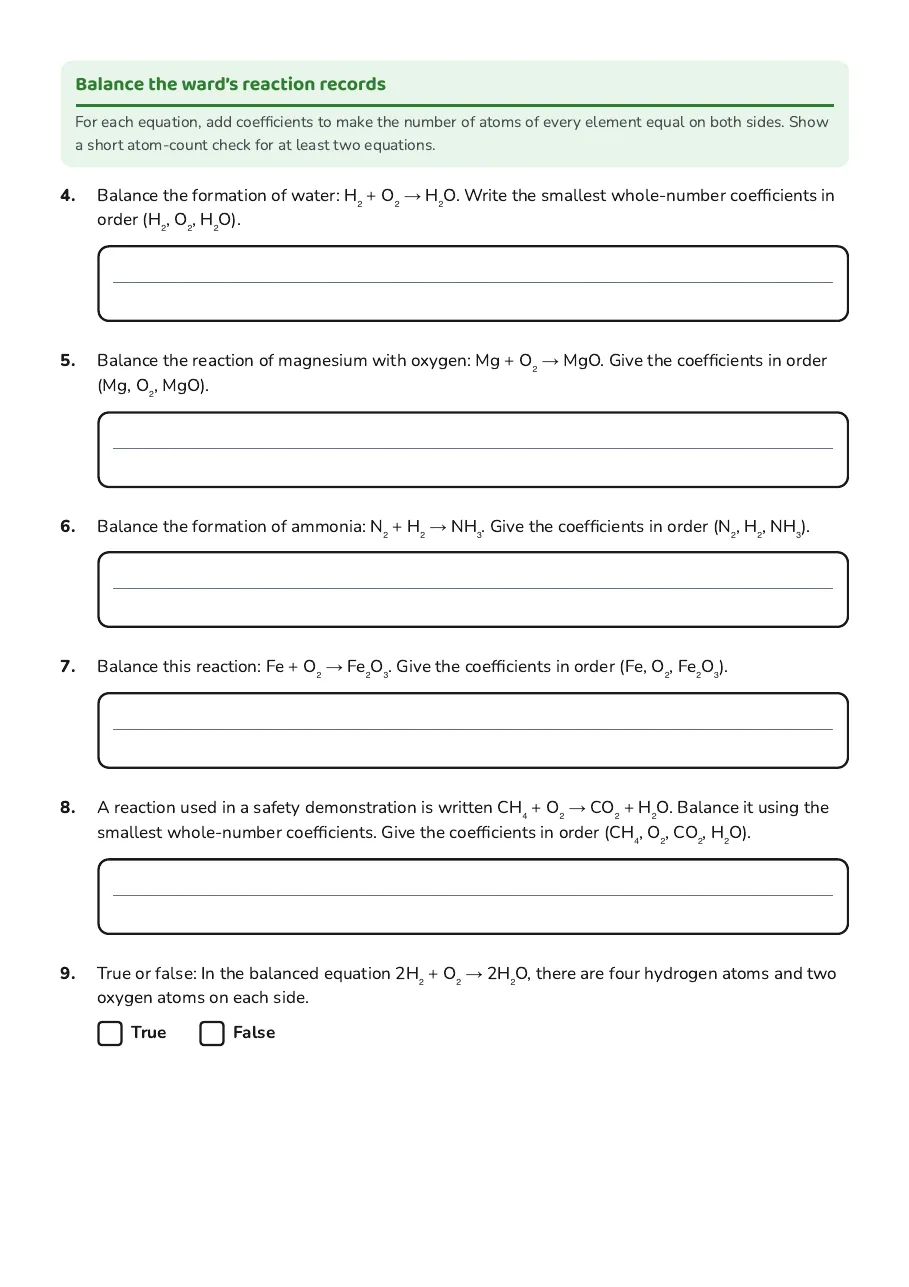
Balance the ward’s reaction records

For each equation, add coefficients to make the number of atoms of every element equal on both sides. Show a short atom-count check for at least two equations.

4.Balance the formation of water: H₂ + O₂ → H₂O. Write the smallest whole-number coefficients in order (H₂, O₂, H₂O).
5.Balance the reaction of magnesium with oxygen: Mg + O₂ → MgO. Give the coefficients in order (Mg, O₂, MgO).
6.Balance the formation of ammonia: N₂ + H₂ → NH₃. Give the coefficients in order (N₂, H₂, NH₃).
7.Balance this reaction: Fe + O₂ → Fe₂O₃. Give the coefficients in order (Fe, O₂, Fe₂O₃).
8.A reaction used in a safety demonstration is written CH₄ + O₂ → CO₂ + H₂O. Balance it using the smallest whole-number coefficients. Give the coefficients in order (CH₄, O₂, CO₂, H₂O).
9.True or false: In the balanced equation 2H₂ + O₂ → 2H₂O, there are four hydrogen atoms and two oxygen atoms on each side.
TrueFalse
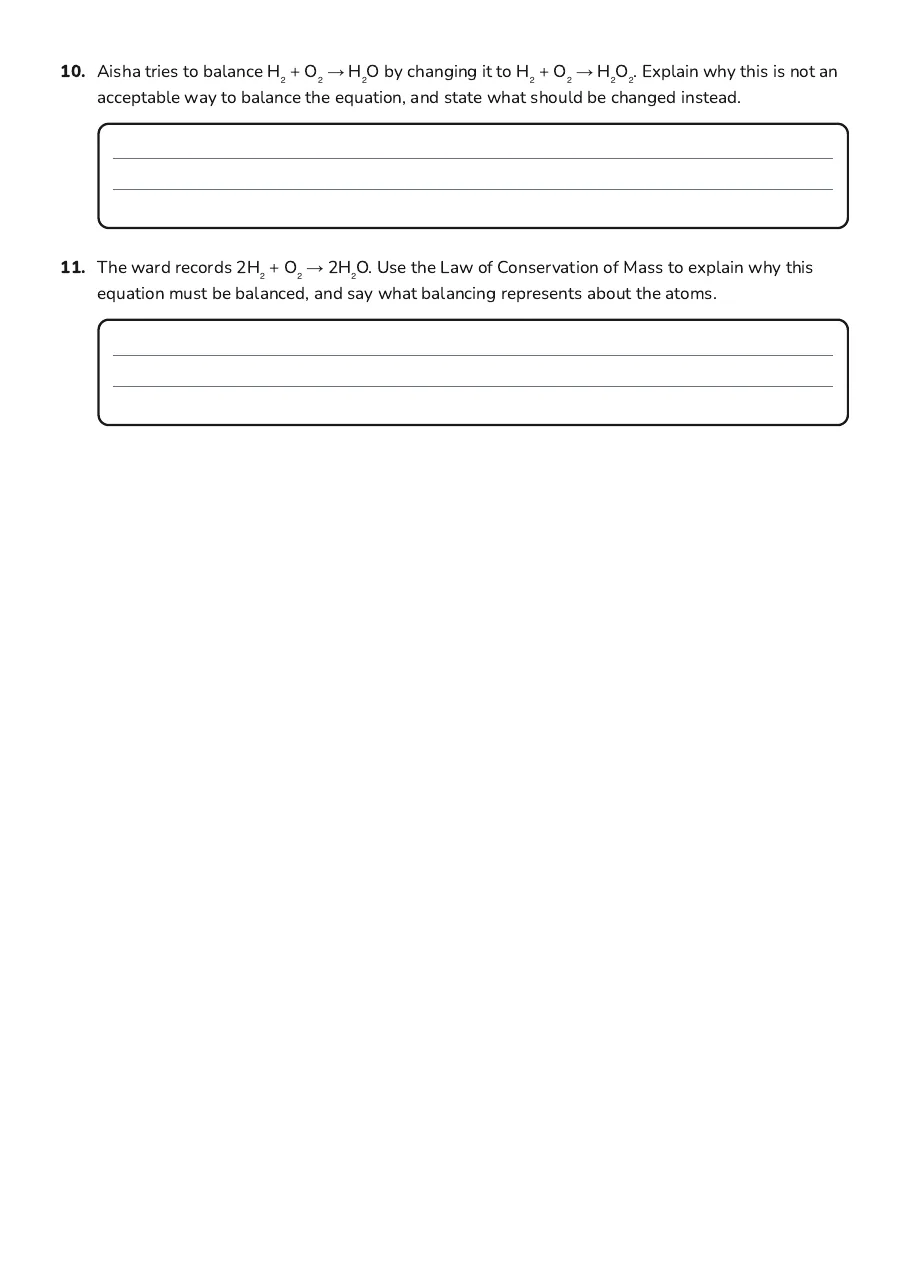
10.Aisha tries to balance H₂ + O₂ → H₂O by changing it to H₂ + O₂ → H₂O₂. Explain why this is not an acceptable way to balance the equation, and state what should be changed instead.
11.The ward records 2H₂ + O₂ → 2H₂O. Use the Law of Conservation of Mass to explain why this equation must be balanced, and say what balancing represents about the atoms.

3 printable pages

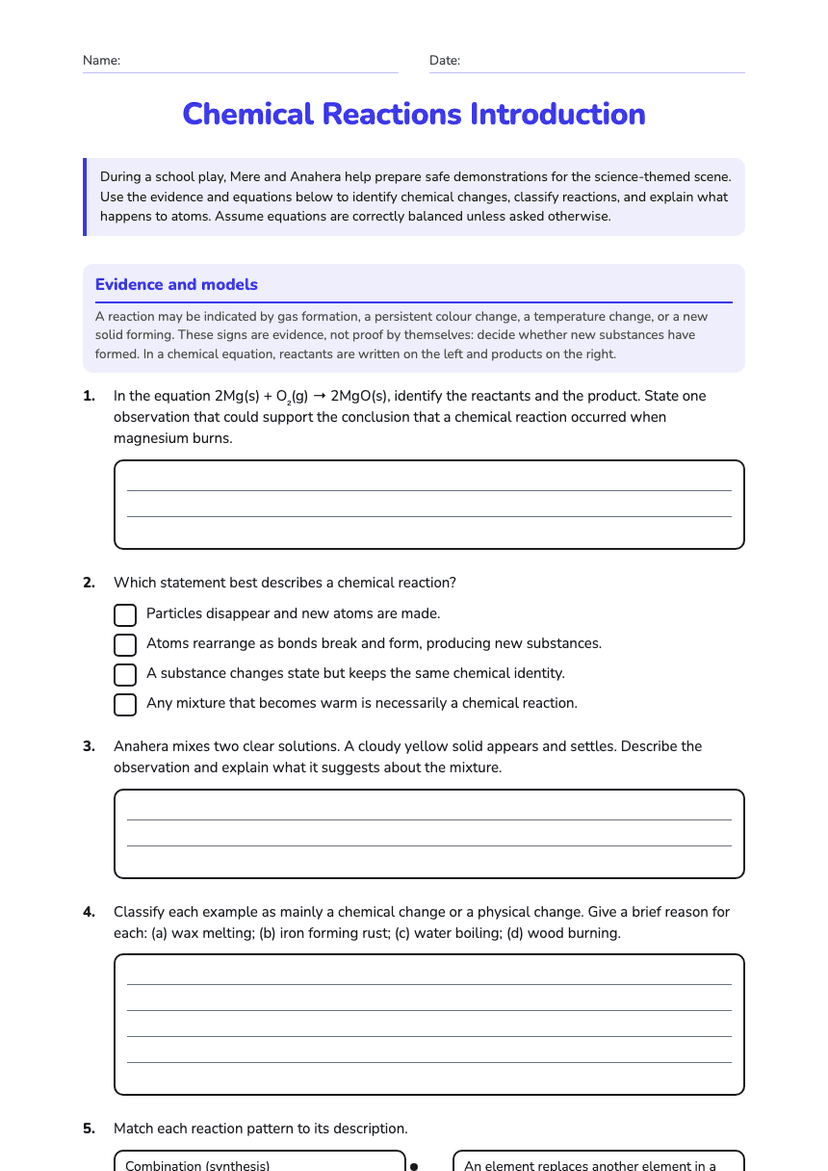
  • Balancing Chemical Equations Worksheet, page 1 of 3: The conservation check

    Page 1

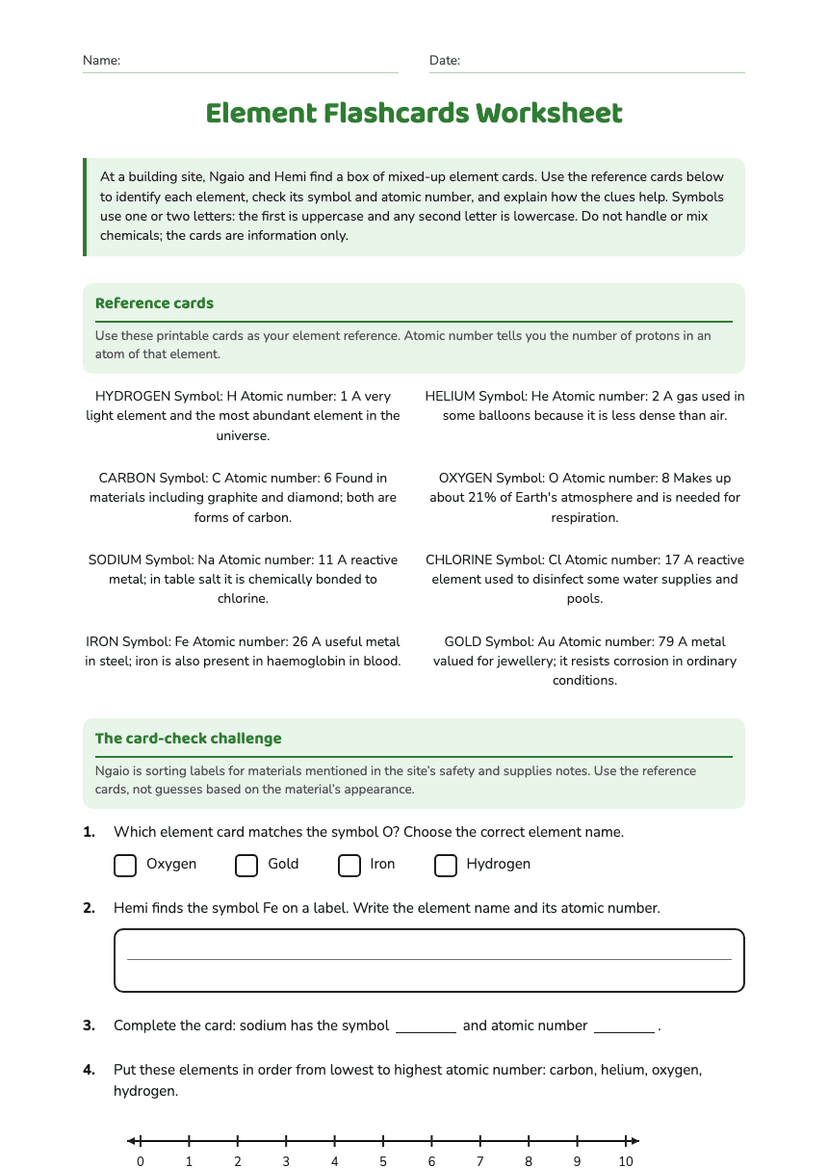
  • Balancing Chemical Equations Worksheet, page 2 of 3: Balance the ward’s reaction records

    Page 2

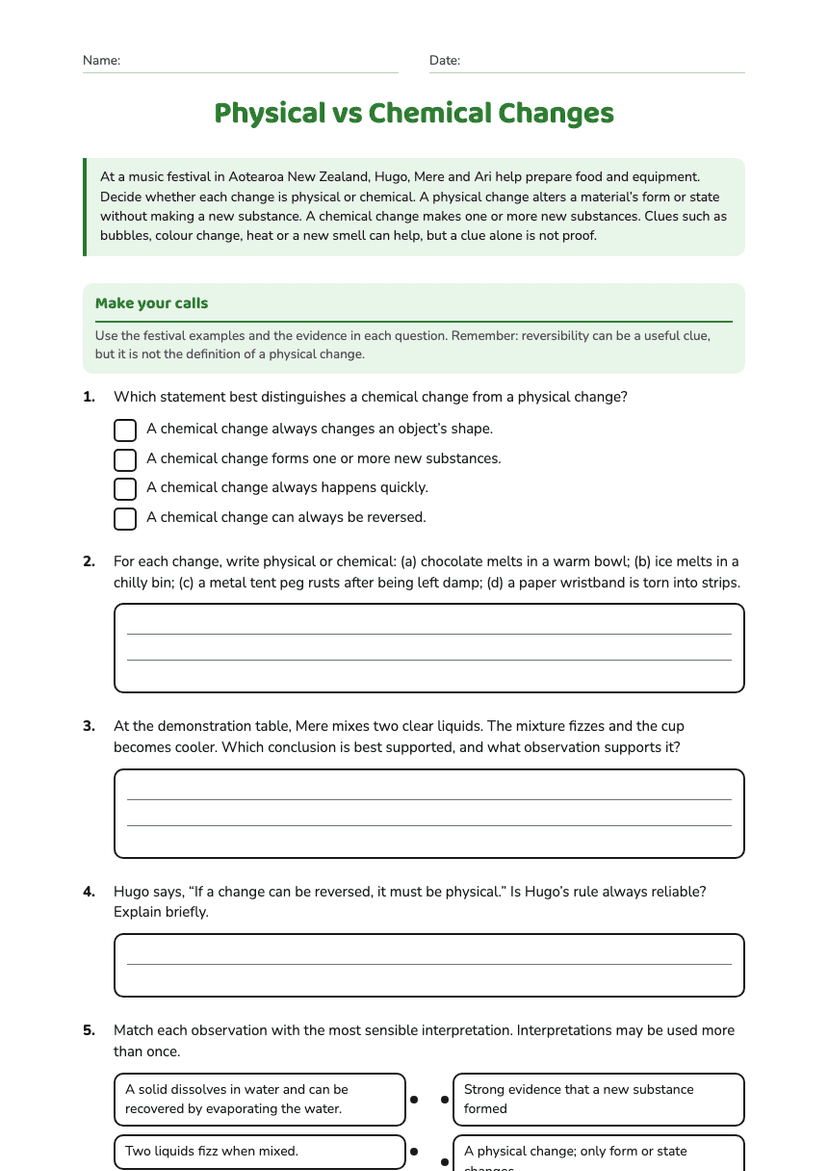
  • Balancing Chemical Equations Worksheet, page 3 of 3: 10. Aisha tries to balance H₂ + O₂ → H₂O by changing it to H₂ + O₂ → H₂O₂. Explain why…

    Page 3

About This Worksheet

Free in Kuraplan

Sign up free, grab the PDF, and customize it for your class.

Print-Ready

Formatted for standard paper. Clean layout, easy to read.

AI-Generated

Created with Kuraplan's AI, designed for real classroom use.

For Teachers & Parents

Use in classrooms, for homework, tutoring, or homeschool.

Need a custom version of this worksheet?

Kuraplan's AI generates custom worksheets in seconds — differentiated for every learner, aligned to your curriculum.

Generate Custom Worksheets — Free
No credit card Curriculum-aligned Under 60 seconds