Bilingual Soil Science Keyword Cards
A free science worksheet ready for your classroom. Open in Kuraplan to grab the print-ready PDF, customize it for your students, or generate a fresh version in seconds.
Bilingual Soil Science Keyword Cards
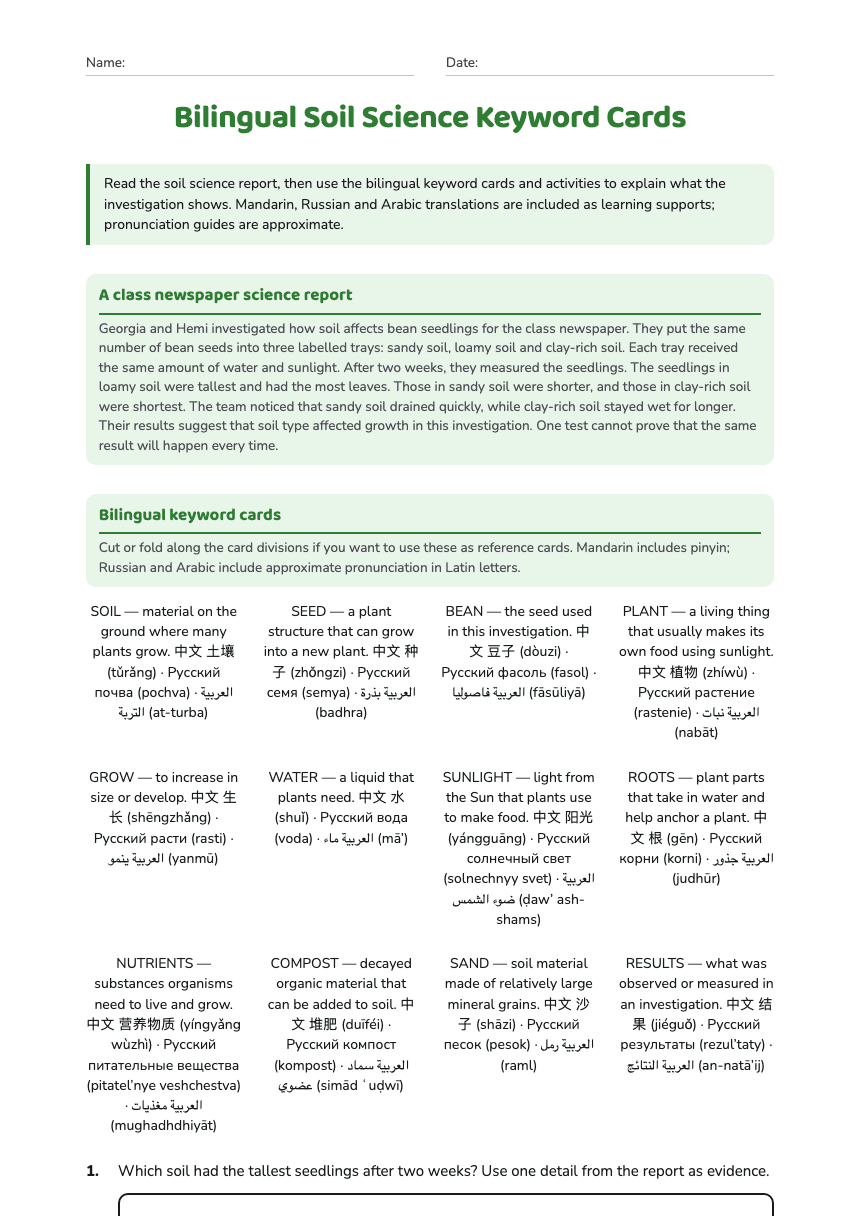
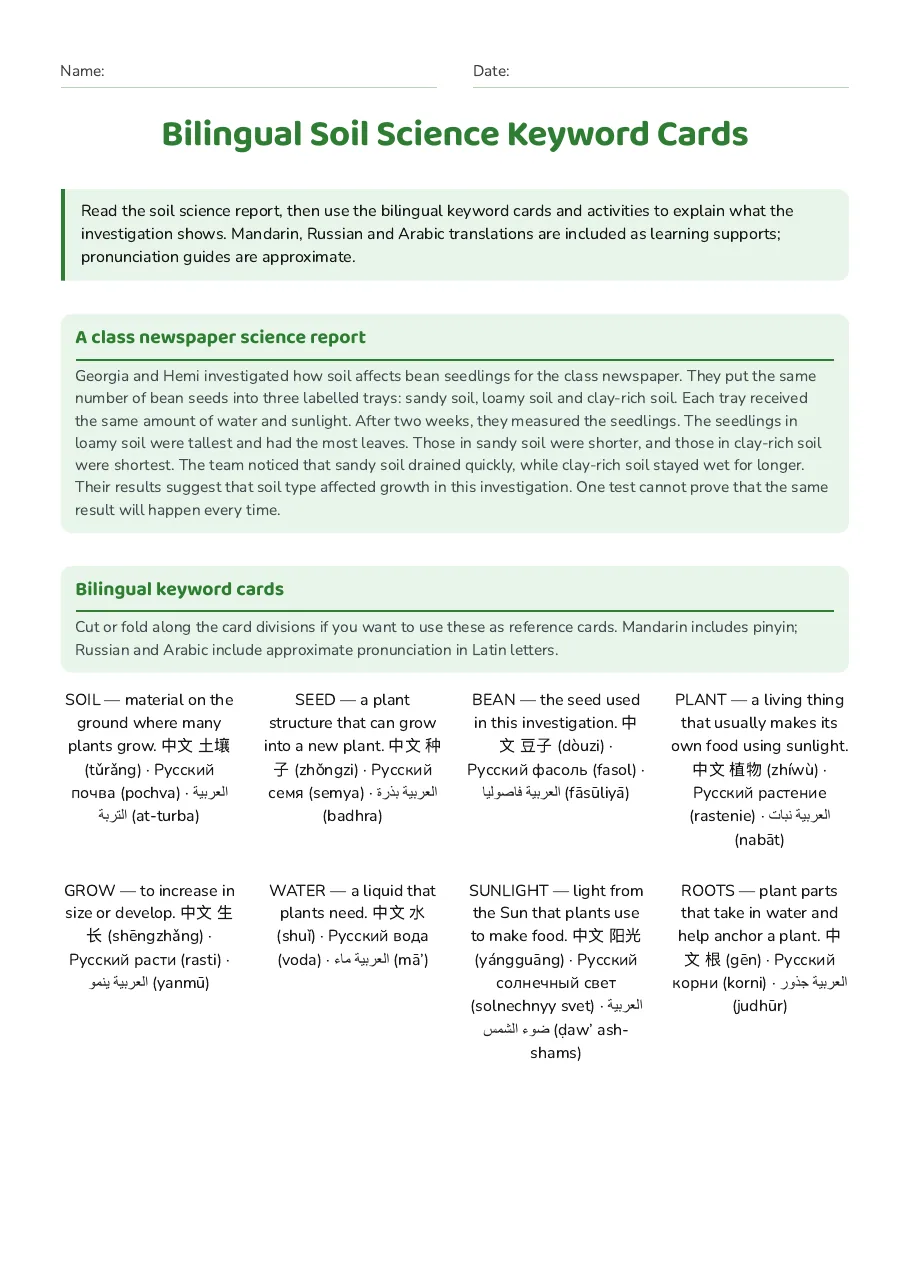
A class newspaper science report
Georgia and Hemi investigated how soil affects bean seedlings for the class newspaper. They put the same number of bean seeds into three labelled trays: sandy soil, loamy soil and clay-rich soil. Each tray received the same amount of water and sunlight. After two weeks, they measured the seedlings. The seedlings in loamy soil were tallest and had the most leaves. Those in sandy soil were shorter, and those in clay-rich soil were shortest. The team noticed that sandy soil drained quickly, while clay-rich soil stayed wet for longer. Their results suggest that soil type affected growth in this investigation. One test cannot prove that the same result will happen every time.
Bilingual keyword cards
Cut or fold along the card divisions if you want to use these as reference cards. Mandarin includes pinyin; Russian and Arabic include approximate pronunciation in Latin letters.
SOIL — material on the ground where many plants grow. 中文 土壤 (tǔrǎng) · Русский почва (pochva) · العربية التربة (at-turba)
SEED — a plant structure that can grow into a new plant. 中文 种子 (zhǒngzi) · Русский семя (semya) · العربية بذرة (badhra)
BEAN — the seed used in this investigation. 中文 豆子 (dòuzi) · Русский фасоль (fasol) · العربية فاصوليا (fāsūliyā)
PLANT — a living thing that usually makes its own food using sunlight. 中文 植物 (zhíwù) · Русский растение (rastenie) · العربية نبات (nabāt)
GROW — to increase in size or develop. 中文 生长 (shēngzhǎng) · Русский расти (rasti) · العربية ينمو (yanmū)
WATER — a liquid that plants need. 中文 水 (shuǐ) · Русский вода (voda) · العربية ماء (mā’)
SUNLIGHT — light from the Sun that plants use to make food. 中文 阳光 (yángguāng) · Русский солнечный свет (solnechnyy svet) · العربية ضوء الشمس (ḍaw’ ash-shams)
ROOTS — plant parts that take in water and help anchor a plant. 中文 根 (gēn) · Русский корни (korni) · العربية جذور (judhūr)
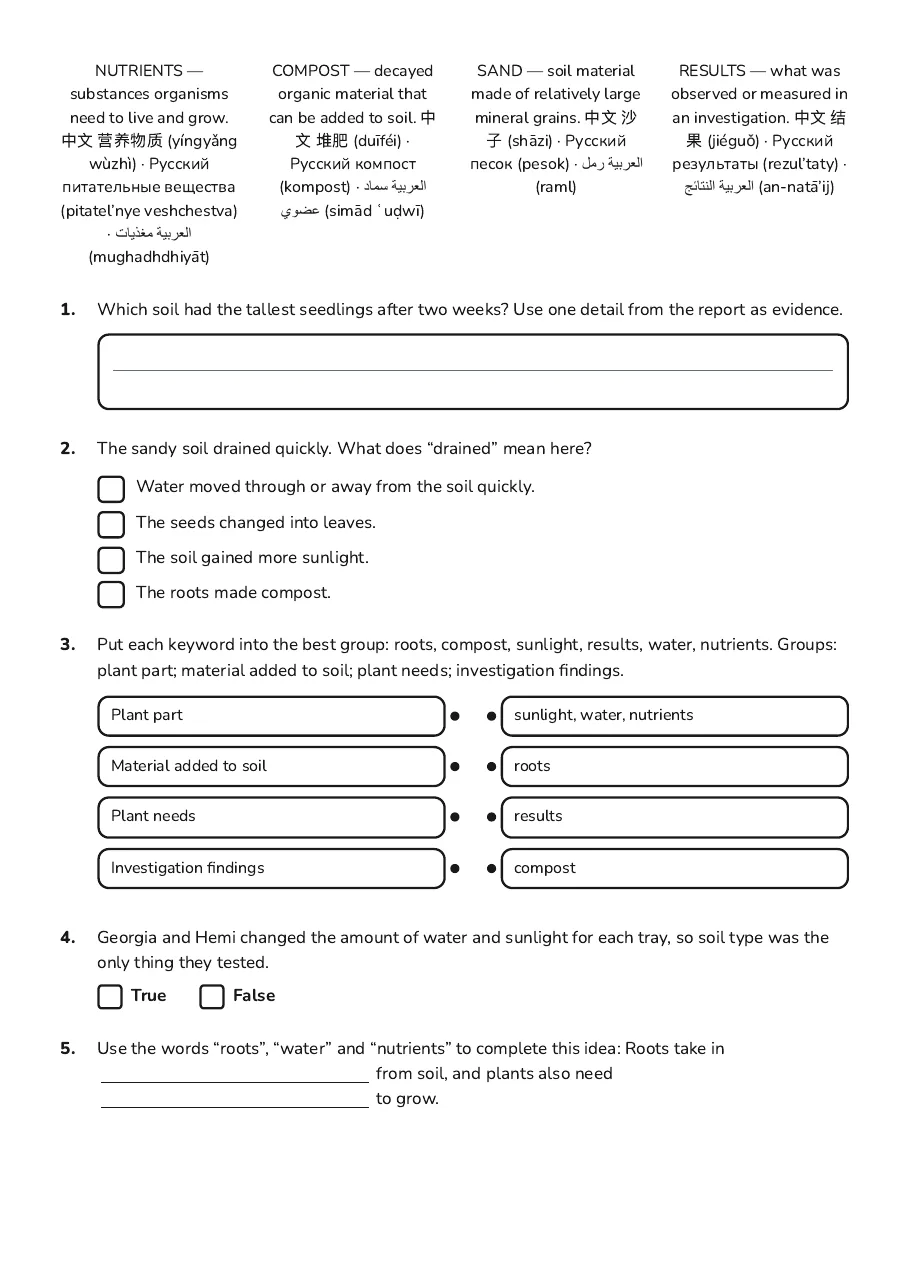
NUTRIENTS — substances organisms need to live and grow. 中文 营养物质 (yíngyǎng wùzhì) · Русский питательные вещества (pitatel’nye veshchestva) · العربية مغذيات (mughadhdhiyāt)
COMPOST — decayed organic material that can be added to soil. 中文 堆肥 (duīféi) · Русский компост (kompost) · العربية سماد عضوي (simād ʿuḍwī)
SAND — soil material made of relatively large mineral grains. 中文 沙子 (shāzi) · Русский песок (pesok) · العربية رمل (raml)
RESULTS — what was observed or measured in an investigation. 中文 结果 (jiéguǒ) · Русский результаты (rezul’taty) · العربية النتائج (an-natā’ij)
- Water moved through or away from the soil quickly.
- The seeds changed into leaves.
- The soil gained more sunlight.
- The roots made compost.
- Plant part
- Material added to soil
- Plant needs
- Investigation findings
- sunlight, water, nutrients
- roots
- results
- compost
3 printable pages
Page 1
Page 2
Page 3
About This Worksheet
Free in Kuraplan
Sign up free, grab the PDF, and customize it for your class.
Print-Ready
Formatted for standard paper. Clean layout, easy to read.
AI-Generated
Created with Kuraplan's AI, designed for real classroom use.
For Teachers & Parents
Use in classrooms, for homework, tutoring, or homeschool.
Need a custom version of this worksheet?
Kuraplan's AI generates custom worksheets in seconds — differentiated for every learner, aligned to your curriculum.
Generate Custom Worksheets — Free