ScienceFreePrintable

Earth's Structure and Tectonics

A free science worksheet ready for your classroom. Open in Kuraplan to grab the print-ready PDF, customize it for your students, or generate a fresh version in seconds.
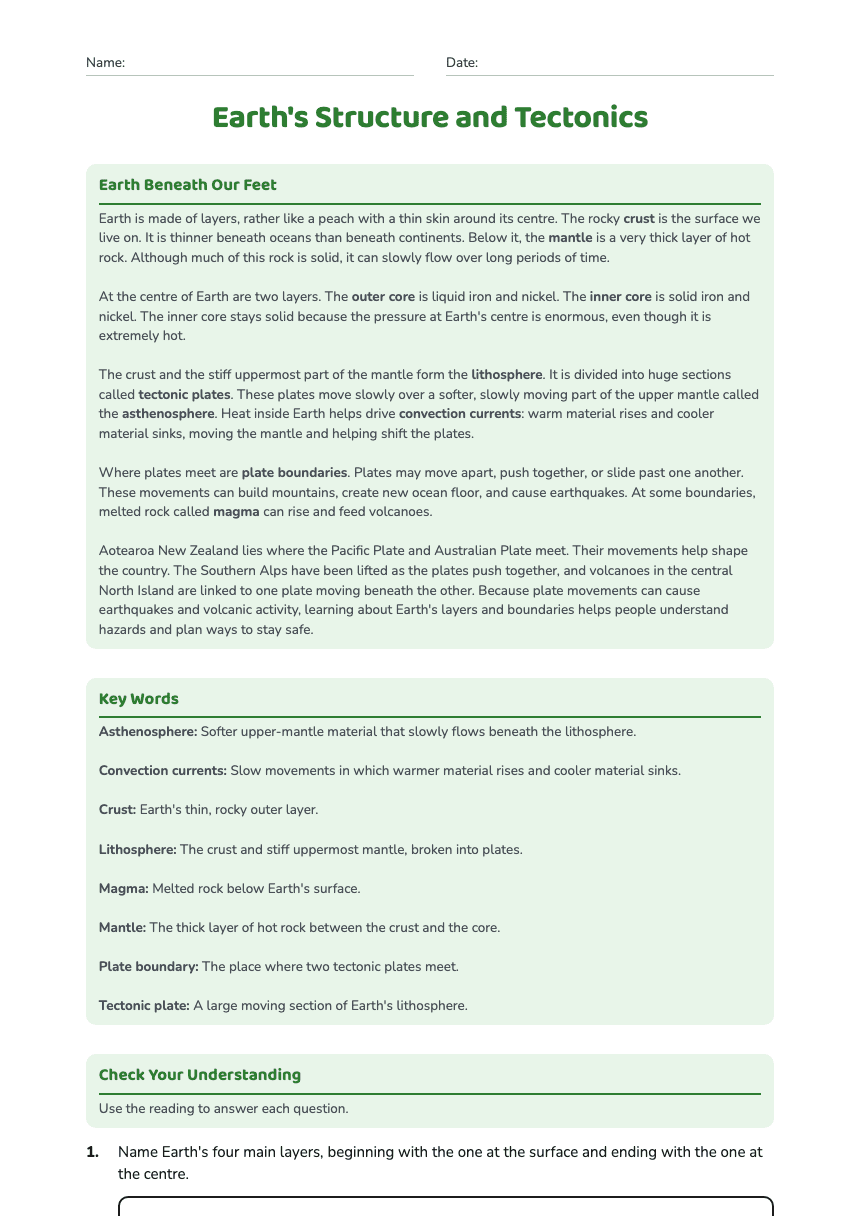
Earth's Structure and Tectonics worksheet preview

Earth's Structure and Tectonics

Cross-section of Earth showing layers and tectonic plates

📖 Reading: Journey to the Centre of the Earth

What's Inside Our Planet?

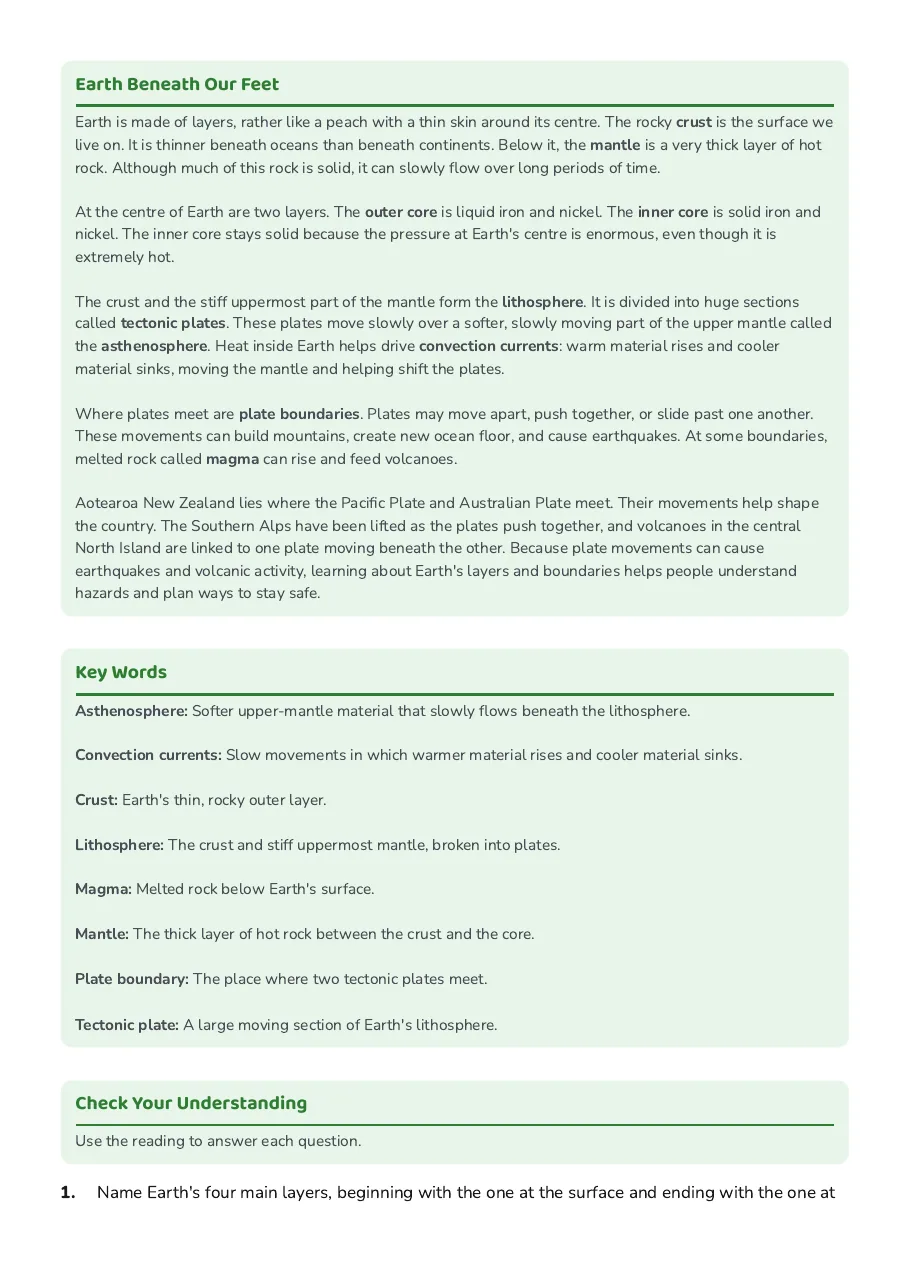
Have you ever wondered what lies beneath your feet? Our planet Earth is like a giant layered ball, similar to a hard-boiled egg. Just as an egg has different parts - the shell, white, and yolk - Earth has distinct layers that scientists have discovered through careful study.

The Four Main Layers

Earth's structure consists of four main layers. The crust is the thin, rocky outer layer where we live. It's like the shell of an egg - very thin compared to the rest of the planet. Under the oceans, the crust is only 5-10 kilometres thick, whilst under continents it can be up to 70 kilometres thick.

Beneath the crust lies the mantle, Earth's thickest layer at about 2,900 kilometres deep. The mantle is made of hot, dense rock that behaves like thick treacle when heated. Though it's solid rock, the extreme heat makes it flow very slowly over millions of years.

Deeper still is the outer core, a layer of liquid iron and nickel about 2,200 kilometres thick. The temperature here reaches 4,000-5,000°C - hot enough to melt metal! This liquid metal creates Earth's magnetic field, which protects us from harmful space radiation.

At Earth's centre sits the inner core, a solid ball of iron and nickel about 1,220 kilometres across. Despite temperatures exceeding 5,000°C (hotter than the Sun's surface!), the enormous pressure keeps this core solid.

The Moving Pieces

Earth's outer layer isn't one solid piece. The lithosphere - which includes the crust and the uppermost mantle - is broken into enormous pieces called tectonic plates. These plates float on the asthenosphere, a layer of partially melted rock in the upper mantle that flows like thick honey.

There are about 15 major tectonic plates constantly moving at 2-10 centimetres per year - about as fast as your fingernails grow! This movement happens because heat from Earth's core creates convection currents in the mantle, like water boiling in a pot.

Where Plates Meet

Plate boundaries are where tectonic plates meet, and these are the most geologically active places on Earth. At some boundaries, plates move apart, creating new ocean floor. At others, plates crash together, forming mountains or causing one plate to slide beneath another. Some plates slide past each other sideways.

Most earthquakes occur along plate boundaries when plates suddenly slip past each other, releasing enormous amounts of energy. Volcanoes also form near plate boundaries where molten rock (magma) from the mantle can reach the surface.

Aotearoa New Zealand's Shaky Ground

Aotearoa New Zealand sits right on the boundary between two major tectonic plates - the Pacific Plate and the Australian Plate. This makes our country one of the most seismically active places on Earth, experiencing about 15,000 earthquakes each year, though most are too small to feel.

The Southern Alps formed where these plates push together, whilst the Alpine Fault runs for 600 kilometres down the South Island where the plates slide past each other. New Zealand's many volcanoes, including those in the central North Island, exist because the Pacific Plate is being pushed under the Australian Plate, melting rock that rises to form volcanoes.

Understanding Earth's structure and tectonic activity helps scientists predict earthquakes and volcanic eruptions, keeping New Zealanders safer in our dynamic landscape.

📚 Glossary

Asthenosphere: The layer of partially melted rock in the upper mantle that tectonic plates float on

Convection currents: Circular movements of heated material that transfer heat from Earth's core

Crust: Earth's thin, rocky outer layer where we live

Inner core: The solid centre of Earth made of iron and nickel

Lithosphere: The rigid outer layer including the crust and uppermost mantle

Magma: Molten rock beneath Earth's surface

Mantle: The thick layer of hot, dense rock between the crust and core

Outer core: The liquid layer of iron and nickel surrounding the inner core

Plate boundaries: The edges where tectonic plates meet

Tectonic plates: Large pieces of Earth's lithosphere that move slowly over time

✏️ Comprehension Questions

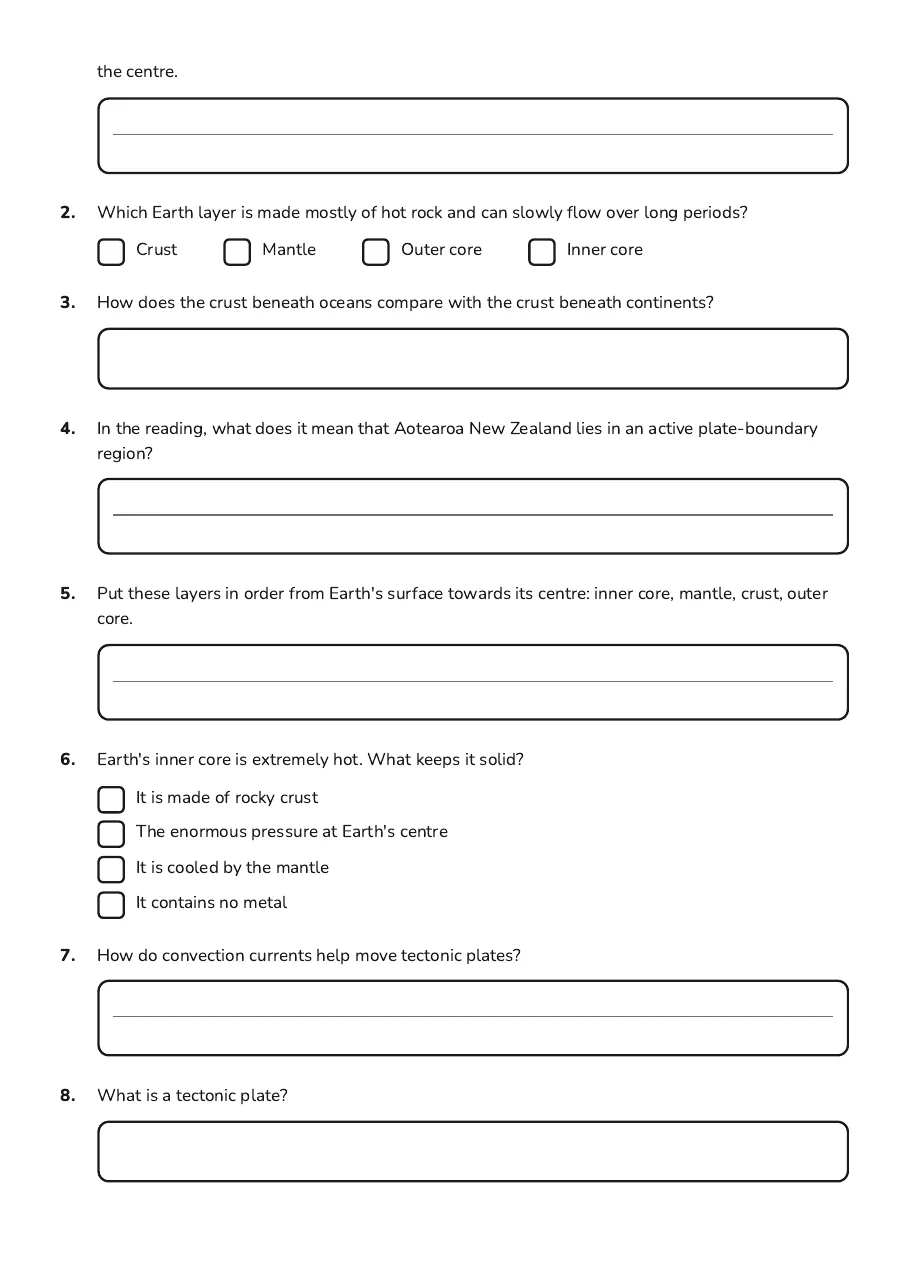
1. What are the four main layers of Earth?
2. Which layer is described as behaving "like thick treacle when heated"?

Crust

Mantle

Outer core

Inner core

3. How thick is the oceanic crust compared to continental crust?
4. What does "seismically active" mean in the context of New Zealand?
5. Put these layers in order from outside to inside: inner core, crust, outer core, mantle

1. _____________ 2. _____________ 3. _____________ 4. _____________

6. Why does the inner core remain solid despite being hotter than the Sun's surface?

It's made of different materials

The enormous pressure keeps it solid

It's actually cooler than described

It's protected by the outer core

7. What causes tectonic plates to move?
8. How fast do tectonic plates typically move?
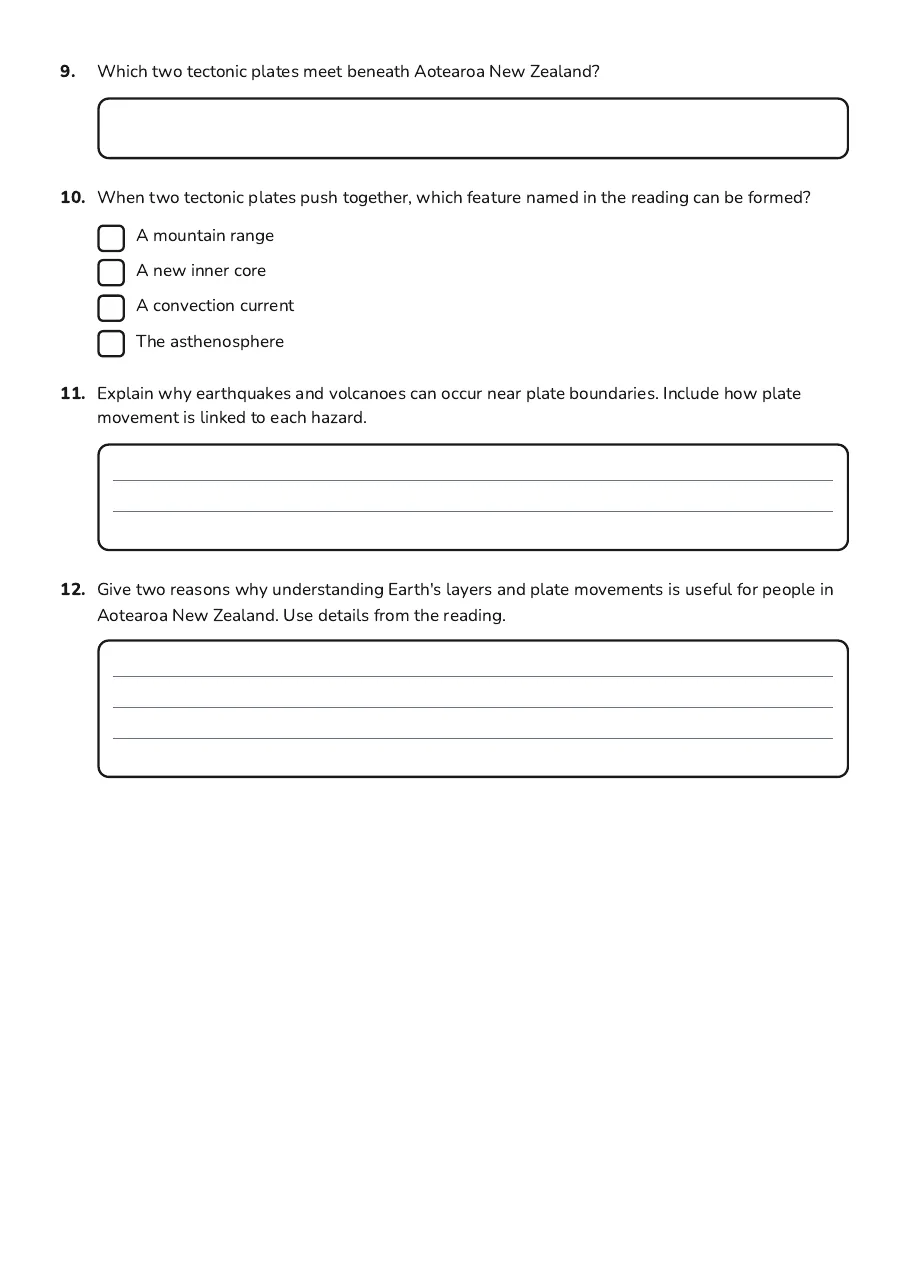
9. Which two tectonic plates meet in New Zealand?
10. What geological features form when tectonic plates crash together?

Ocean floors

Mountains

Magnetic fields

Convection currents

11. Why are most earthquakes and volcanoes found near plate boundaries?
12. Using evidence from the text, explain why understanding Earth's structure is important for New Zealand. Give at least two reasons with examples.

📋 Curriculum Alignment

This worksheet aligns with the New Zealand Curriculum Refresh / Te Mātaiaho (October 2025 draft) Earth Systems learning area, reference code NZ-TMA-SCIENCE-Y0-10-earth-systems-246-DOC184. Students explore Earth's structure and processes that shape our planet's surface.

🔑 Teacher Answer Key

1. Crust, mantle, outer core, inner core

2. Mantle

3. Oceanic crust is much thinner (5-10 km) compared to continental crust (up to 70 km)

4. It means New Zealand experiences many earthquakes due to being on a plate boundary

5. 1. Crust, 2. Mantle, 3. Outer core, 4. Inner core

6. The enormous pressure keeps it solid

7. Heat from Earth's core creates convection currents in the mantle

8. 2-10 centimetres per year (about as fast as fingernails grow)

9. Pacific Plate and Australian Plate

10. Mountains

11. Plate boundaries are where plates interact - they slip past each other causing earthquakes, and magma can reach the surface forming volcanoes

12. Sample answer: Understanding Earth's structure helps predict earthquakes and volcanic eruptions to keep people safe. New Zealand sits on a major plate boundary, so scientists can study the Alpine Fault and volcanic activity in the North Island to warn people of dangers. This knowledge helps with building codes and emergency planning.

About This Worksheet

Free in Kuraplan

Sign up free, grab the PDF, and customize it for your class.

Print-Ready

Formatted for standard paper. Clean layout, easy to read.

AI-Generated

Created with Kuraplan's AI, designed for real classroom use.

For Teachers & Parents

Use in classrooms, for homework, tutoring, or homeschool.

Need a custom version of this worksheet?

Kuraplan's AI generates custom worksheets in seconds — differentiated for every learner, aligned to your curriculum.

Generate Custom Worksheets — Free
No credit card Curriculum-aligned Under 60 seconds