MathsFreePrintable
Composite Shapes Area Perimeter
A free maths worksheet ready for your classroom. Open in Kuraplan to grab the print-ready PDF, customize it for your students, or generate a fresh version in seconds.
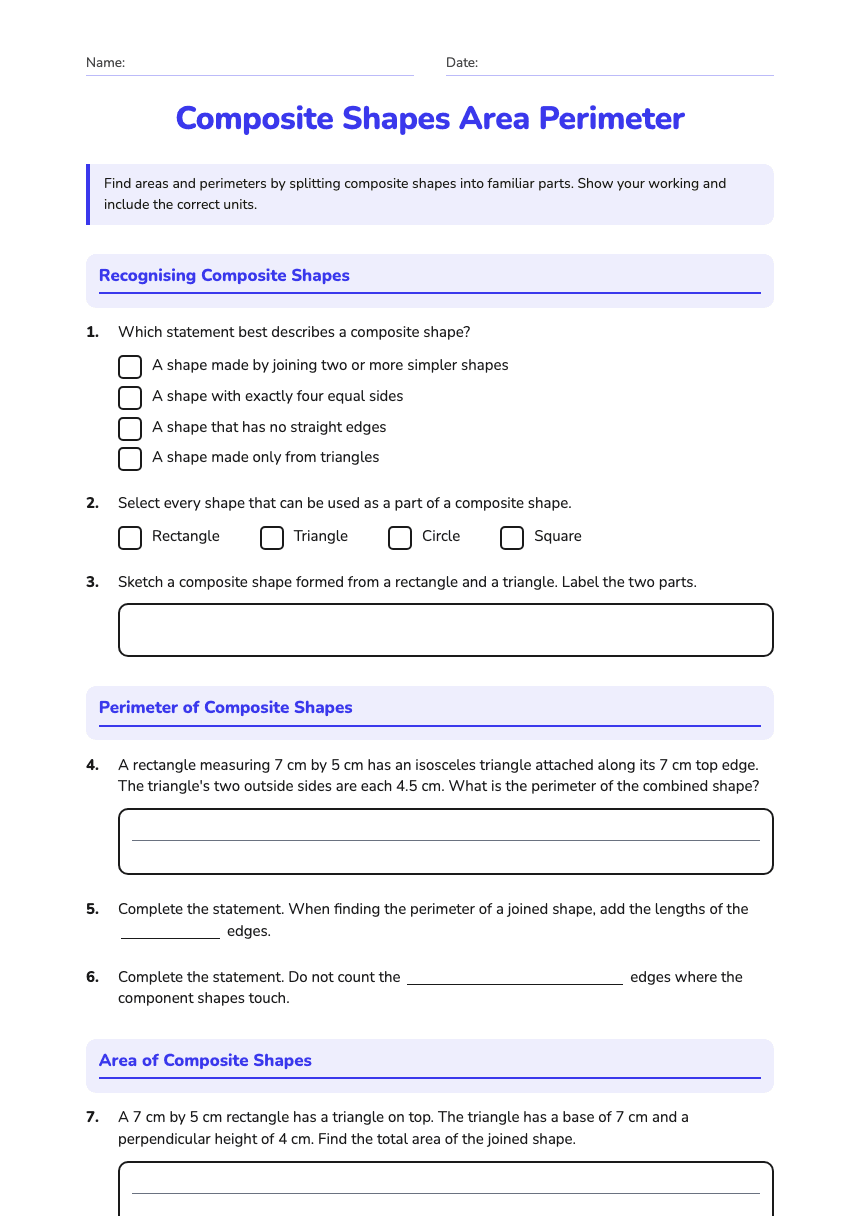
Name:Date:
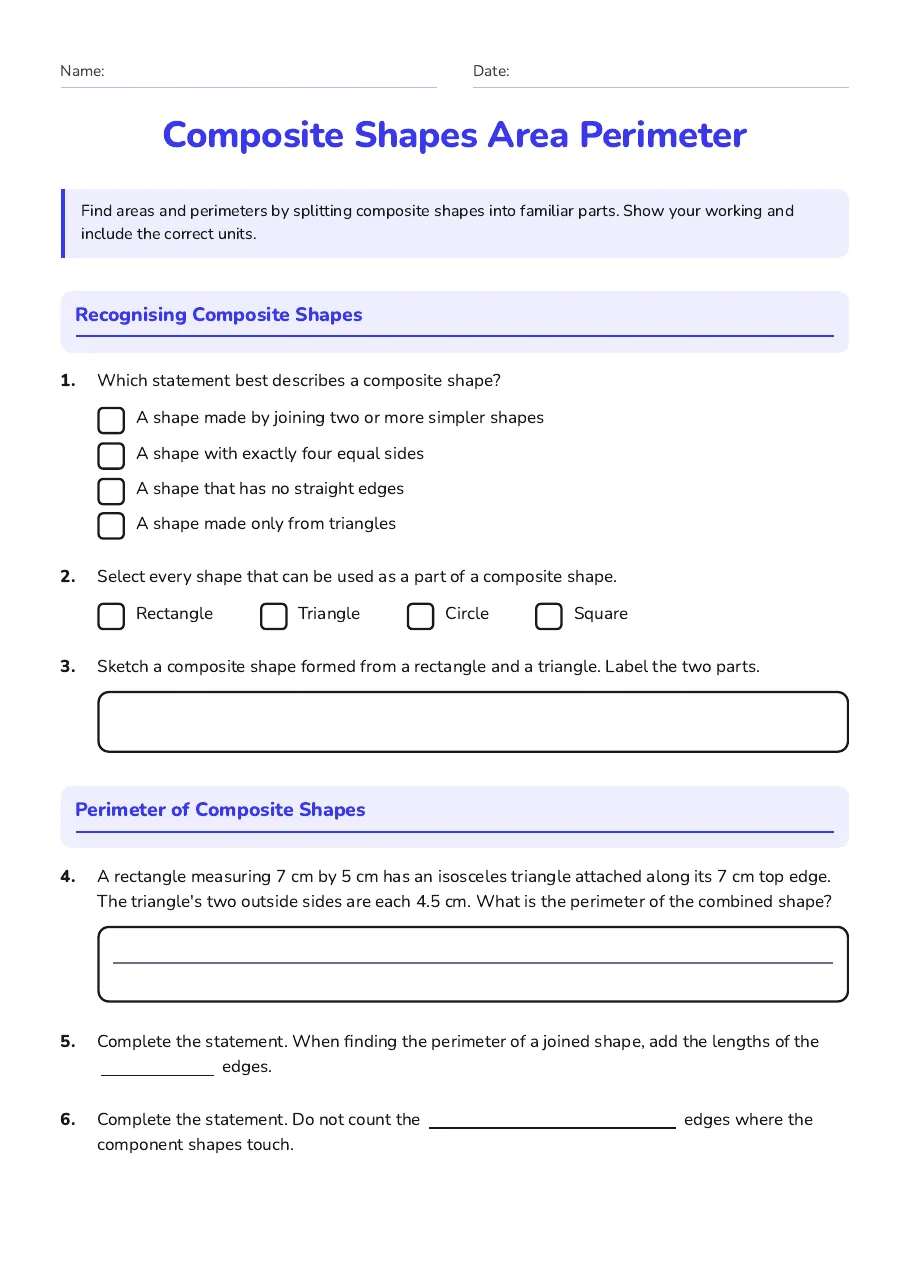
Composite Shapes Area Perimeter
Find areas and perimeters by splitting composite shapes into familiar parts. Show your working and include the correct units.
Recognising Composite Shapes
1.Which statement best describes a composite shape?
- A shape made by joining two or more simpler shapes
- A shape with exactly four equal sides
- A shape that has no straight edges
- A shape made only from triangles
2.Select every shape that can be used as a part of a composite shape.
- Rectangle
- Triangle
- Circle
- Square
3.Sketch a composite shape formed from a rectangle and a triangle. Label the two parts.
Perimeter of Composite Shapes
4.A rectangle measuring 7 cm by 5 cm has an isosceles triangle attached along its 7 cm top edge. The triangle's two outside sides are each 4.5 cm. What is the perimeter of the combined shape?
5.Complete the statement. When finding the perimeter of a joined shape, add the lengths of the edges.
6.Complete the statement. Do not count the edges where the component shapes touch.
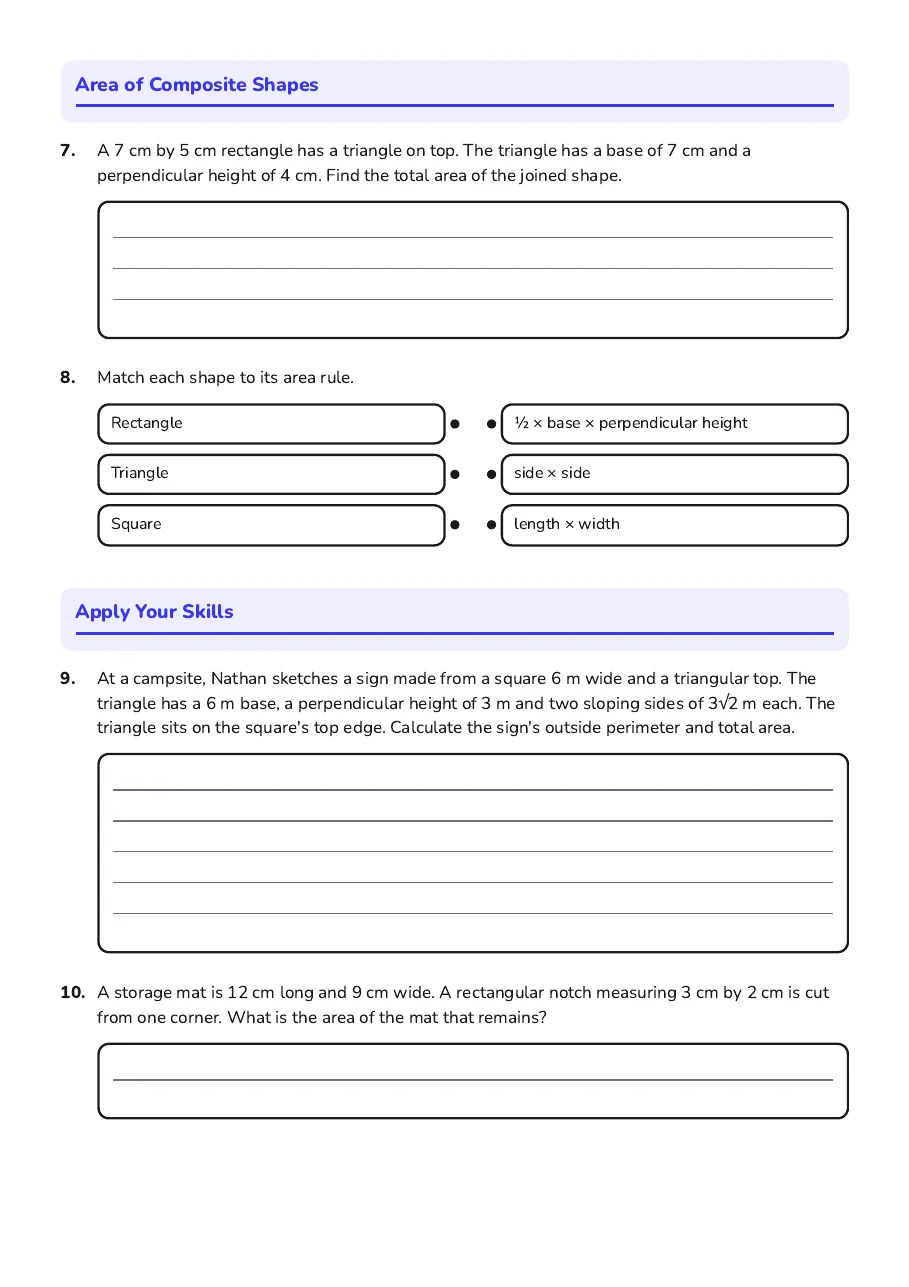
Area of Composite Shapes
7.A 7 cm by 5 cm rectangle has a triangle on top. The triangle has a base of 7 cm and a perpendicular height of 4 cm. Find the total area of the joined shape.
8.Match each shape to its area rule.
- Rectangle
- Triangle
- Square
- ½ × base × perpendicular height
- side × side
- length × width
Apply Your Skills
9.At a campsite, Nathan sketches a sign made from a square 6 m wide and a triangular top. The triangle has a 6 m base, a perpendicular height of 3 m and two sloping sides of 3√2 m each. The triangle sits on the square's top edge. Calculate the sign's outside perimeter and total area.
10.A storage mat is 12 cm long and 9 cm wide. A rectangular notch measuring 3 cm by 2 cm is cut from one corner. What is the area of the mat that remains?
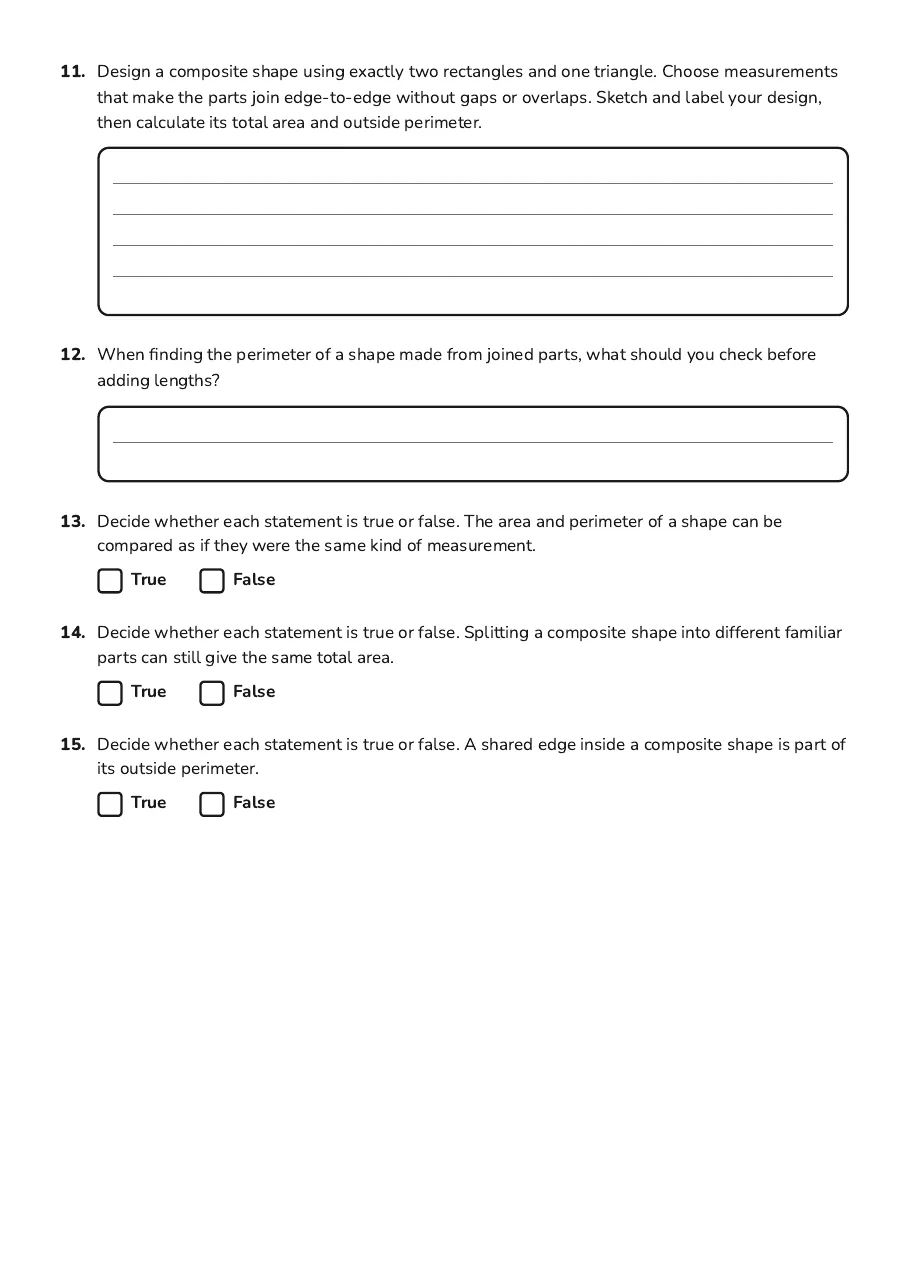
11.Design a composite shape using exactly two rectangles and one triangle. Choose measurements that make the parts join edge-to-edge without gaps or overlaps. Sketch and label your design, then calculate its total area and outside perimeter.
12.When finding the perimeter of a shape made from joined parts, what should you check before adding lengths?
13.Decide whether each statement is true or false. The area and perimeter of a shape can be compared as if they were the same kind of measurement.
TrueFalse
14.Decide whether each statement is true or false. Splitting a composite shape into different familiar parts can still give the same total area.
TrueFalse
15.Decide whether each statement is true or false. A shared edge inside a composite shape is part of its outside perimeter.
TrueFalse
3 printable pages
Page 1
Page 2
Page 3
About This Worksheet
Free in Kuraplan
Sign up free, grab the PDF, and customize it for your class.
Print-Ready
Formatted for standard paper. Clean layout, easy to read.
AI-Generated
Created with Kuraplan's AI, designed for real classroom use.
For Teachers & Parents
Use in classrooms, for homework, tutoring, or homeschool.
Need a custom version of this worksheet?
Kuraplan's AI generates custom worksheets in seconds — differentiated for every learner, aligned to your curriculum.
Generate Custom Worksheets — Free No credit card Curriculum-aligned Under 60 seconds