Context Changes Historical Understanding
A free social sciences worksheet ready for your classroom. Open in Kuraplan to grab the print-ready PDF, customize it for your students, or generate a fresh version in seconds.
Context Changes Historical Understanding
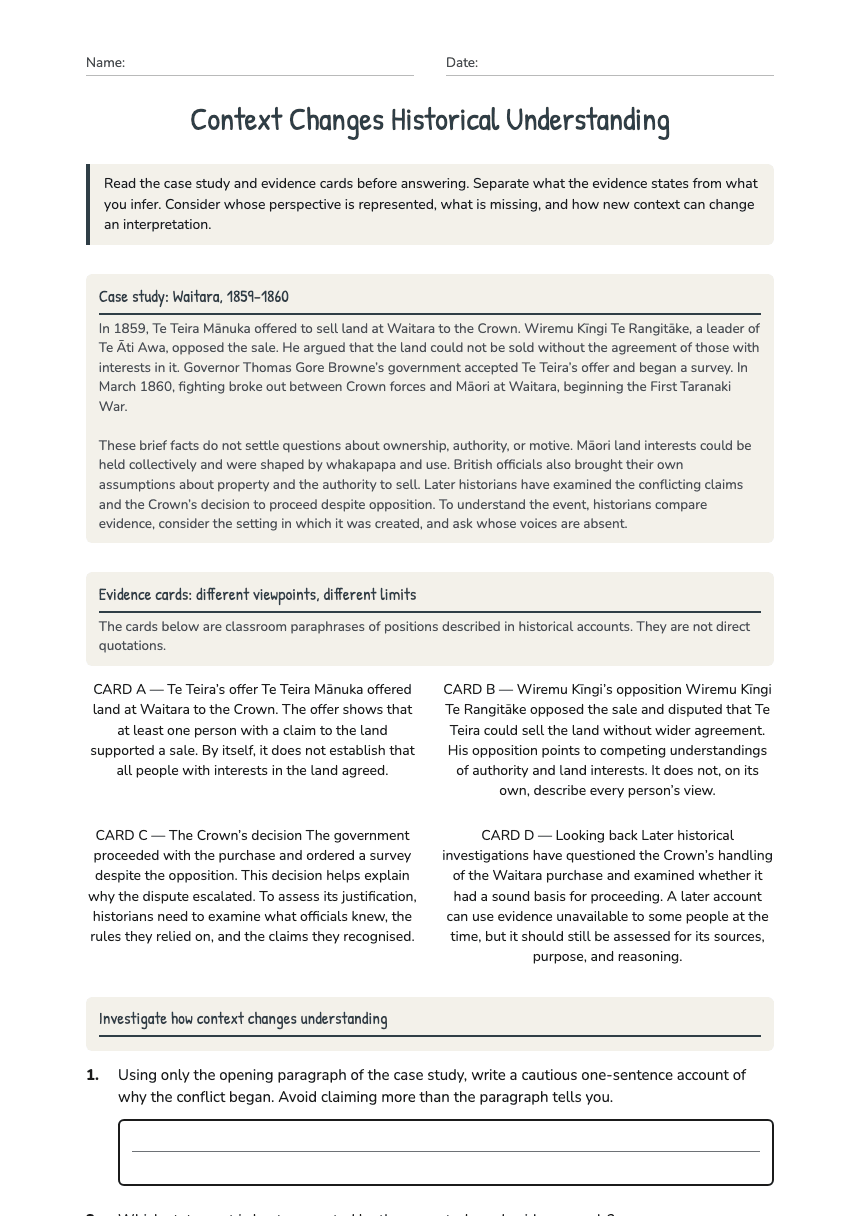
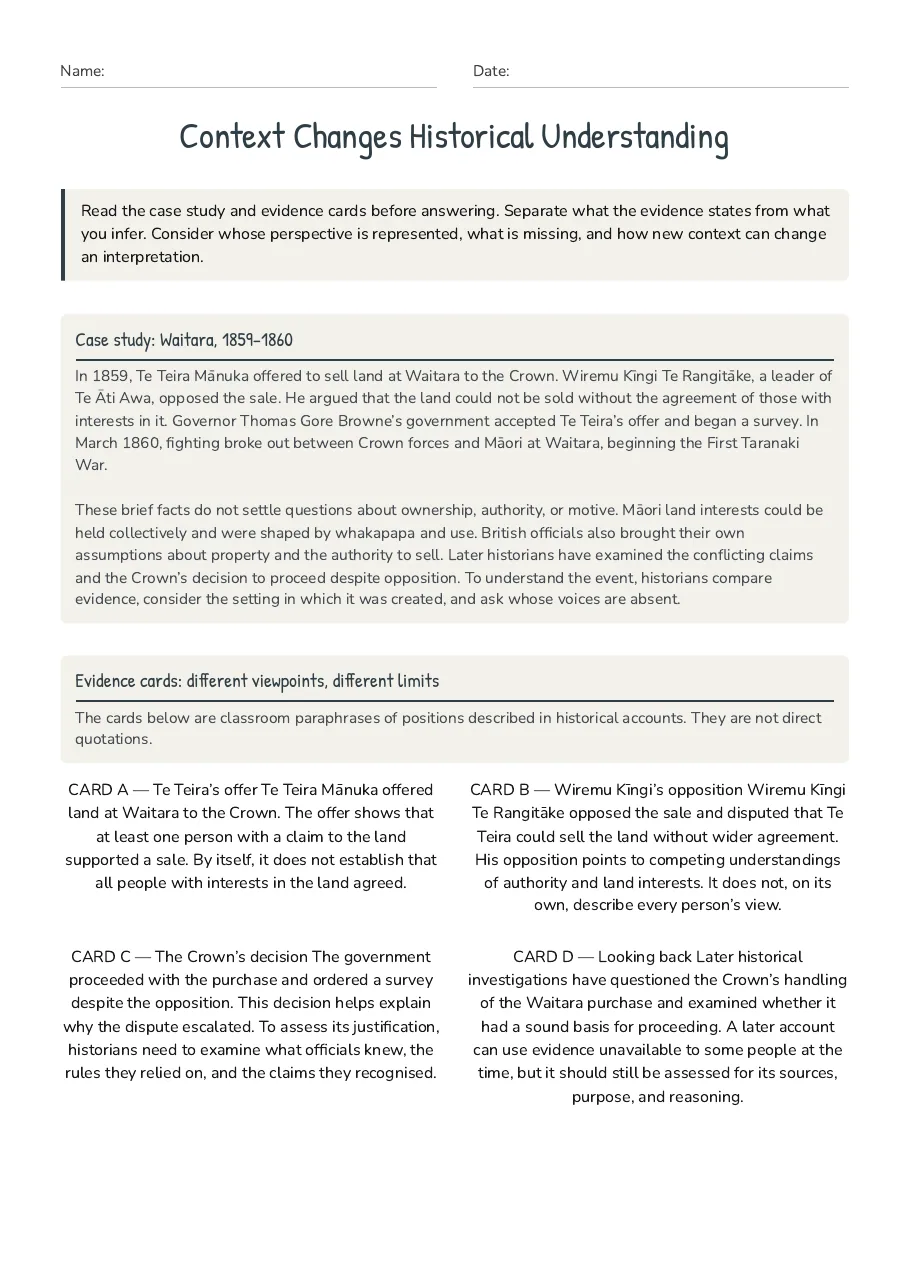
Case study: Waitara, 1859–1860
In 1859, Te Teira Mānuka offered to sell land at Waitara to the Crown. Wiremu Kīngi Te Rangitāke, a leader of Te Āti Awa, opposed the sale. He argued that the land could not be sold without the agreement of those with interests in it. Governor Thomas Gore Browne’s government accepted Te Teira’s offer and began a survey. In March 1860, fighting broke out between Crown forces and Māori at Waitara, beginning the First Taranaki War. These brief facts do not settle questions about ownership, authority, or motive. Māori land interests could be held collectively and were shaped by whakapapa and use. British officials also brought their own assumptions about property and the authority to sell. Later historians have examined the conflicting claims and the Crown’s decision to proceed despite opposition. To understand the event, historians compare evidence, consider the setting in which it was created, and ask whose voices are absent.
Evidence cards: different viewpoints, different limits
The cards below are classroom paraphrases of positions described in historical accounts. They are not direct quotations.
CARD A — Te Teira’s offer Te Teira Mānuka offered land at Waitara to the Crown. The offer shows that at least one person with a claim to the land supported a sale. By itself, it does not establish that all people with interests in the land agreed.
CARD B — Wiremu Kīngi’s opposition Wiremu Kīngi Te Rangitāke opposed the sale and disputed that Te Teira could sell the land without wider agreement. His opposition points to competing understandings of authority and land interests. It does not, on its own, describe every person’s view.
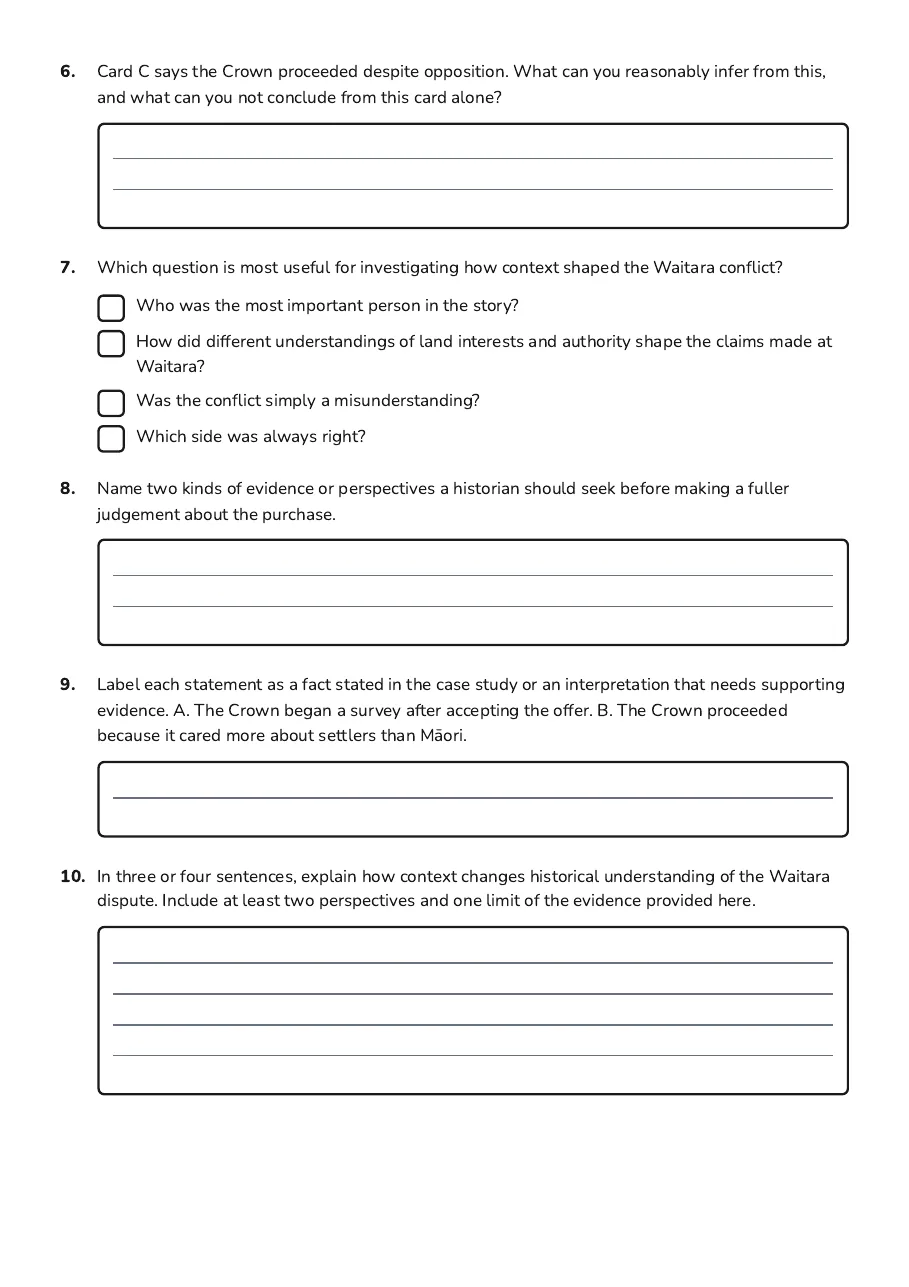
CARD C — The Crown’s decision The government proceeded with the purchase and ordered a survey despite the opposition. This decision helps explain why the dispute escalated. To assess its justification, historians need to examine what officials knew, the rules they relied on, and the claims they recognised.
CARD D — Looking back Later historical investigations have questioned the Crown’s handling of the Waitara purchase and examined whether it had a sound basis for proceeding. A later account can use evidence unavailable to some people at the time, but it should still be assessed for its sources, purpose, and reasoning.
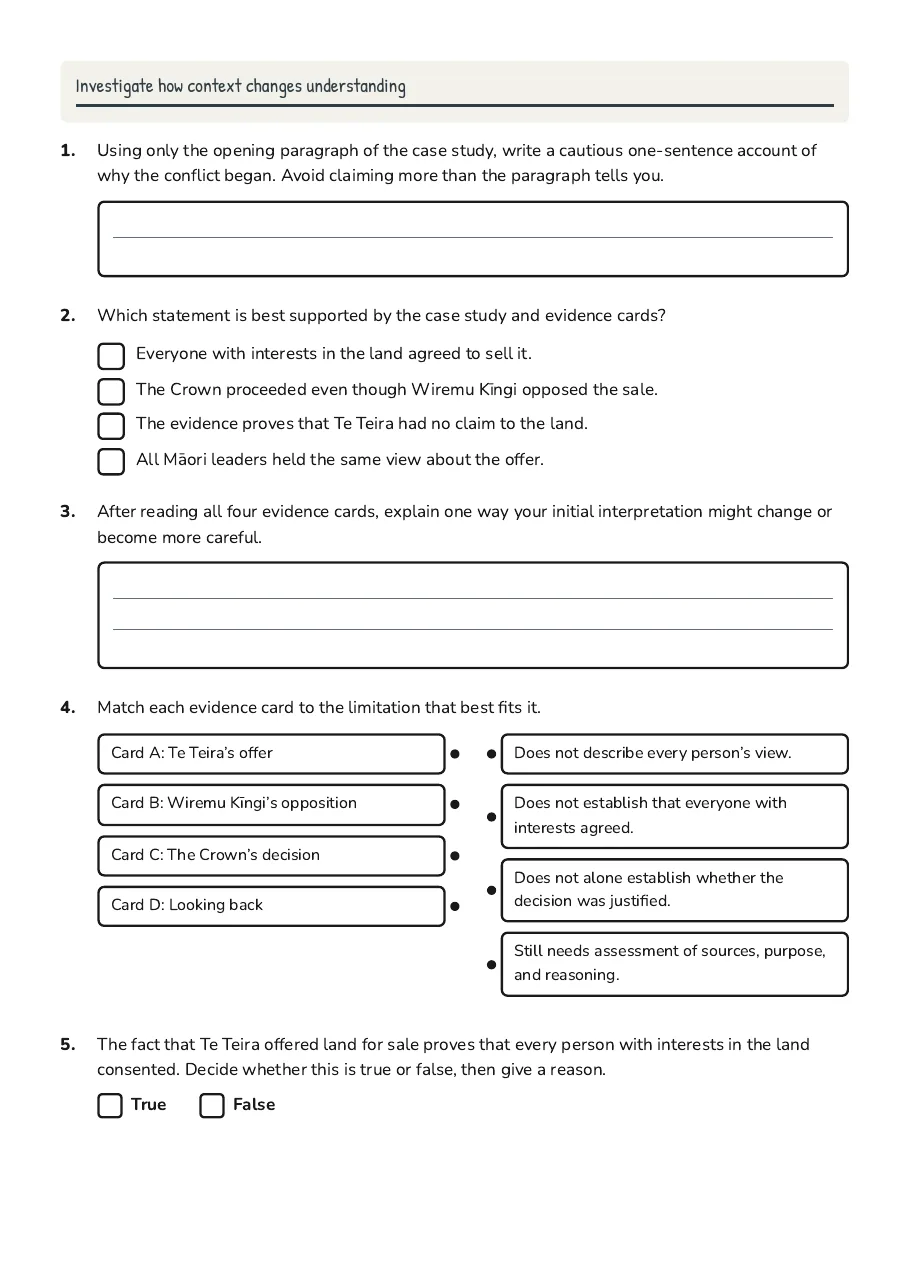
Investigate how context changes understanding
- Everyone with interests in the land agreed to sell it.
- The Crown proceeded even though Wiremu Kīngi opposed the sale.
- The evidence proves that Te Teira had no claim to the land.
- All Māori leaders held the same view about the offer.
- Card A: Te Teira’s offer
- Card B: Wiremu Kīngi’s opposition
- Card C: The Crown’s decision
- Card D: Looking back
- Does not describe every person’s view.
- Does not establish that everyone with interests agreed.
- Does not alone establish whether the decision was justified.
- Still needs assessment of sources, purpose, and reasoning.
- Who was the most important person in the story?
- How did different understandings of land interests and authority shape the claims made at Waitara?
- Was the conflict simply a misunderstanding?
- Which side was always right?
3 printable pages
Page 1
Page 2
Page 3
About This Worksheet
Free in Kuraplan
Sign up free, grab the PDF, and customize it for your class.
Print-Ready
Formatted for standard paper. Clean layout, easy to read.
AI-Generated
Created with Kuraplan's AI, designed for real classroom use.
For Teachers & Parents
Use in classrooms, for homework, tutoring, or homeschool.
Need a custom version of this worksheet?
Kuraplan's AI generates custom worksheets in seconds — differentiated for every learner, aligned to your curriculum.
Generate Custom Worksheets — FreeMore Social Sciences Worksheets
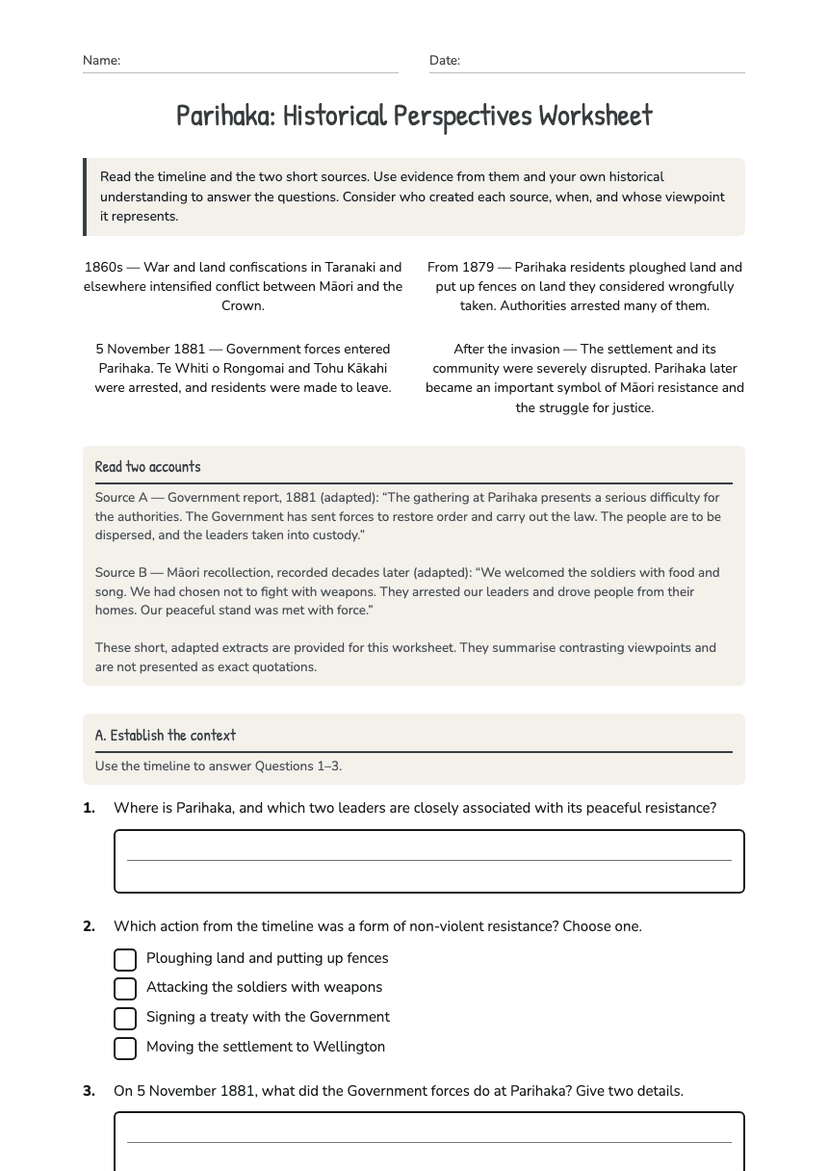
Parihaka: Historical Perspectives Worksheet
Free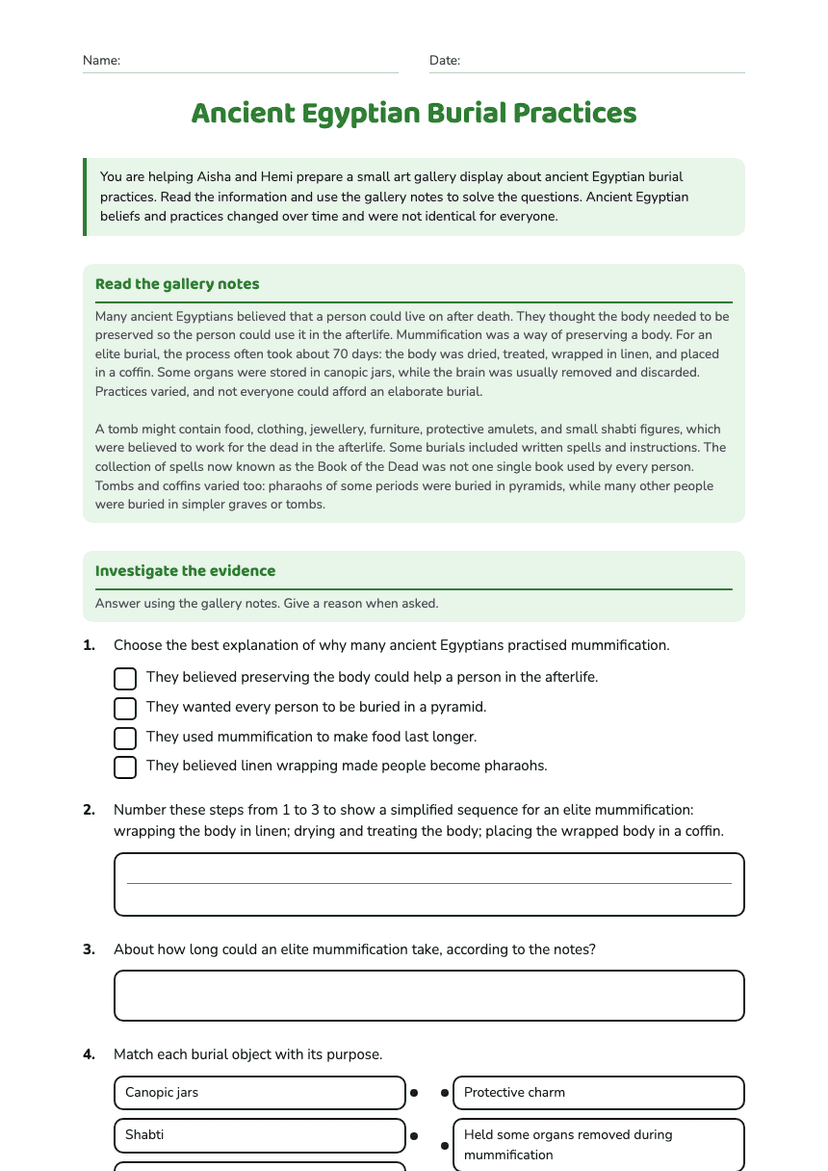
Ancient Egyptian Burial Practices
Free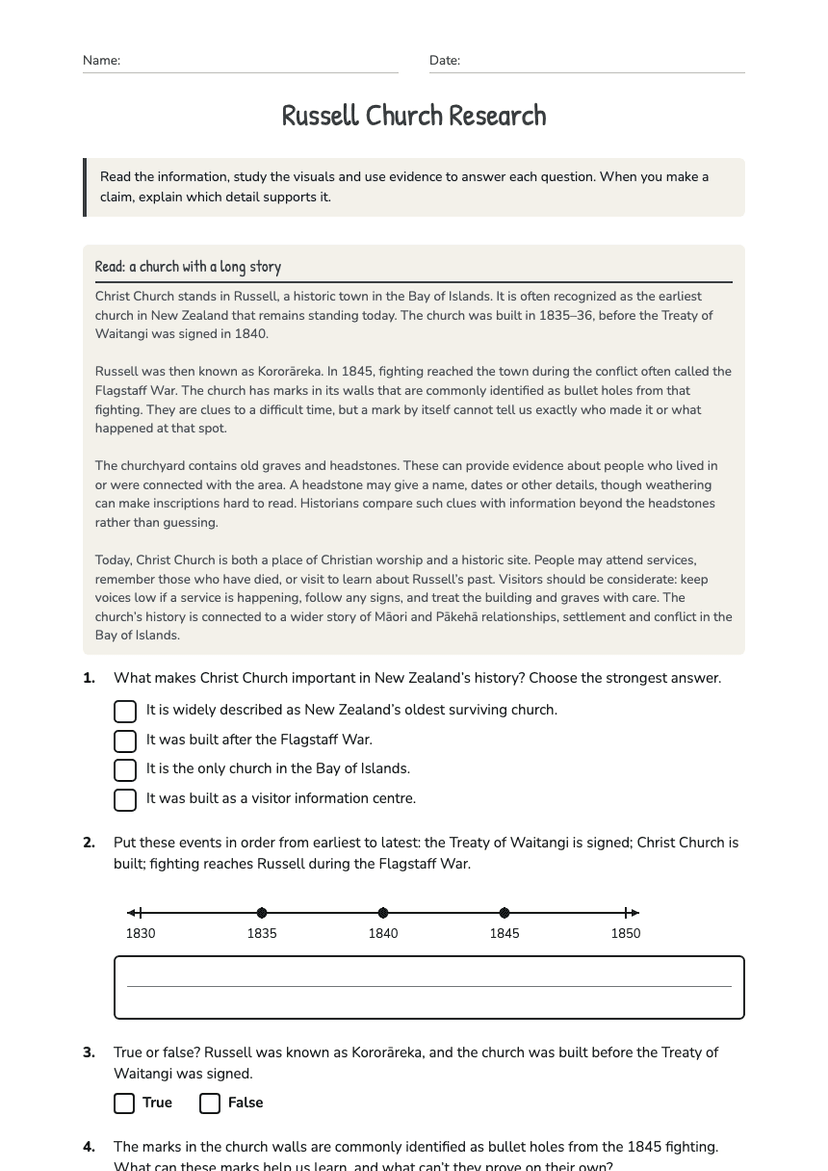
Russell Church Research
Free
New Zealand's Shaping History
Free
Te Aute Historical Insights
Free
World War II: Causes
Free
Traditional and Modern Voyaging
Free