ScienceFreePrintable

Water Cycle Stages and Simple Experiments

A free science worksheet ready for your classroom. Open in Kuraplan to grab the print-ready PDF, customize it for your students, or generate a fresh version in seconds.
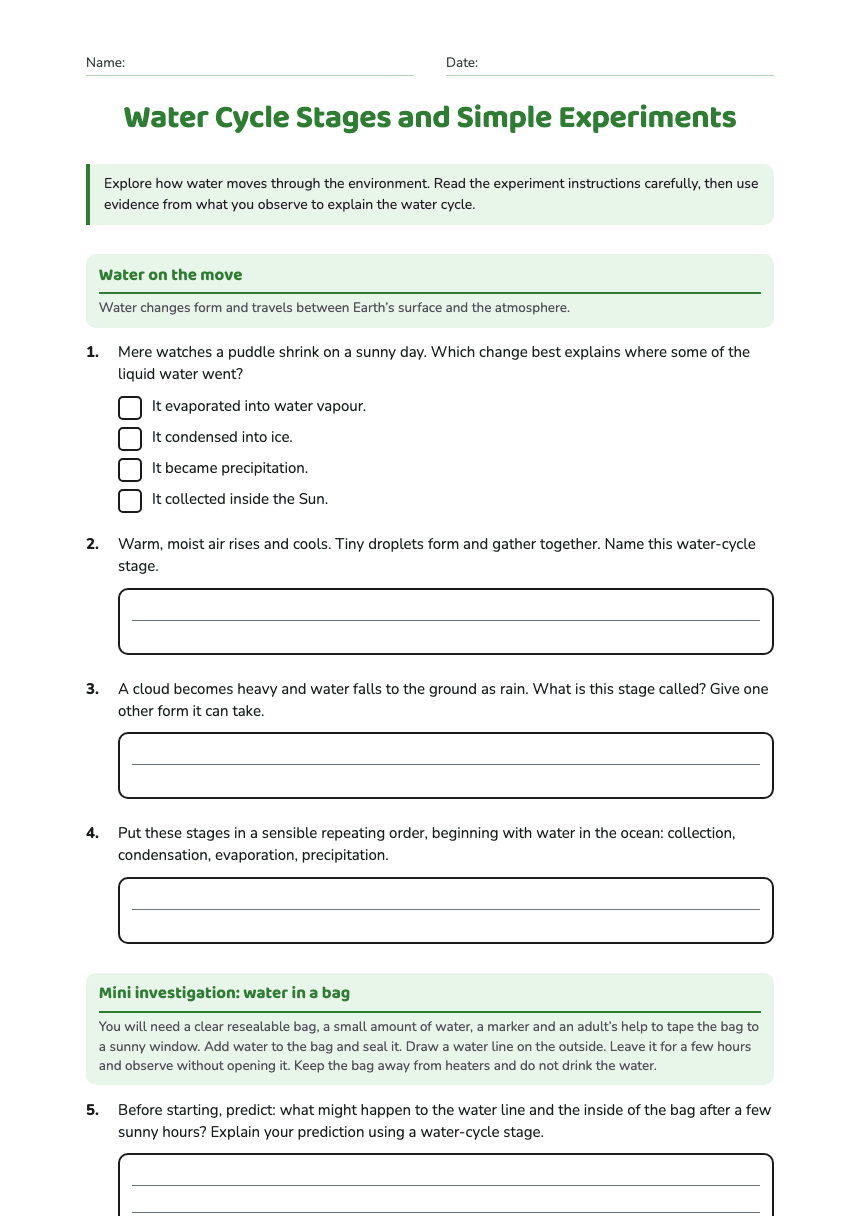
Water Cycle Stages and Simple Experiments worksheet preview
Name:Date:

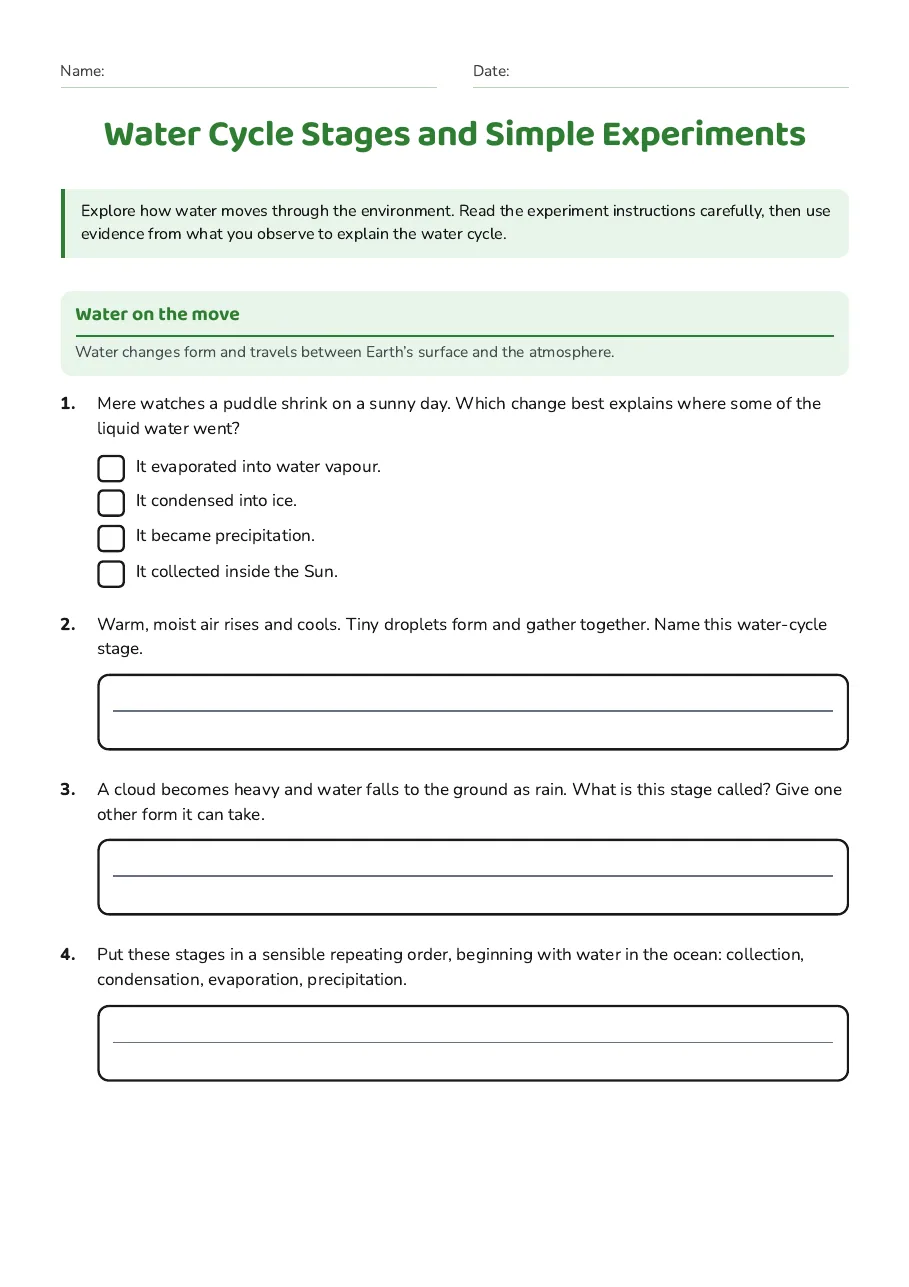
Water Cycle Stages and Simple Experiments

Explore how water moves through the environment. Read the experiment instructions carefully, then use evidence from what you observe to explain the water cycle.

Water on the move

Water changes form and travels between Earth’s surface and the atmosphere.

1.Mere watches a puddle shrink on a sunny day. Which change best explains where some of the liquid water went?
  • It evaporated into water vapour.
  • It condensed into ice.
  • It became precipitation.
  • It collected inside the Sun.
2.Warm, moist air rises and cools. Tiny droplets form and gather together. Name this water-cycle stage.
3.A cloud becomes heavy and water falls to the ground as rain. What is this stage called? Give one other form it can take.
4.Put these stages in a sensible repeating order, beginning with water in the ocean: collection, condensation, evaporation, precipitation.

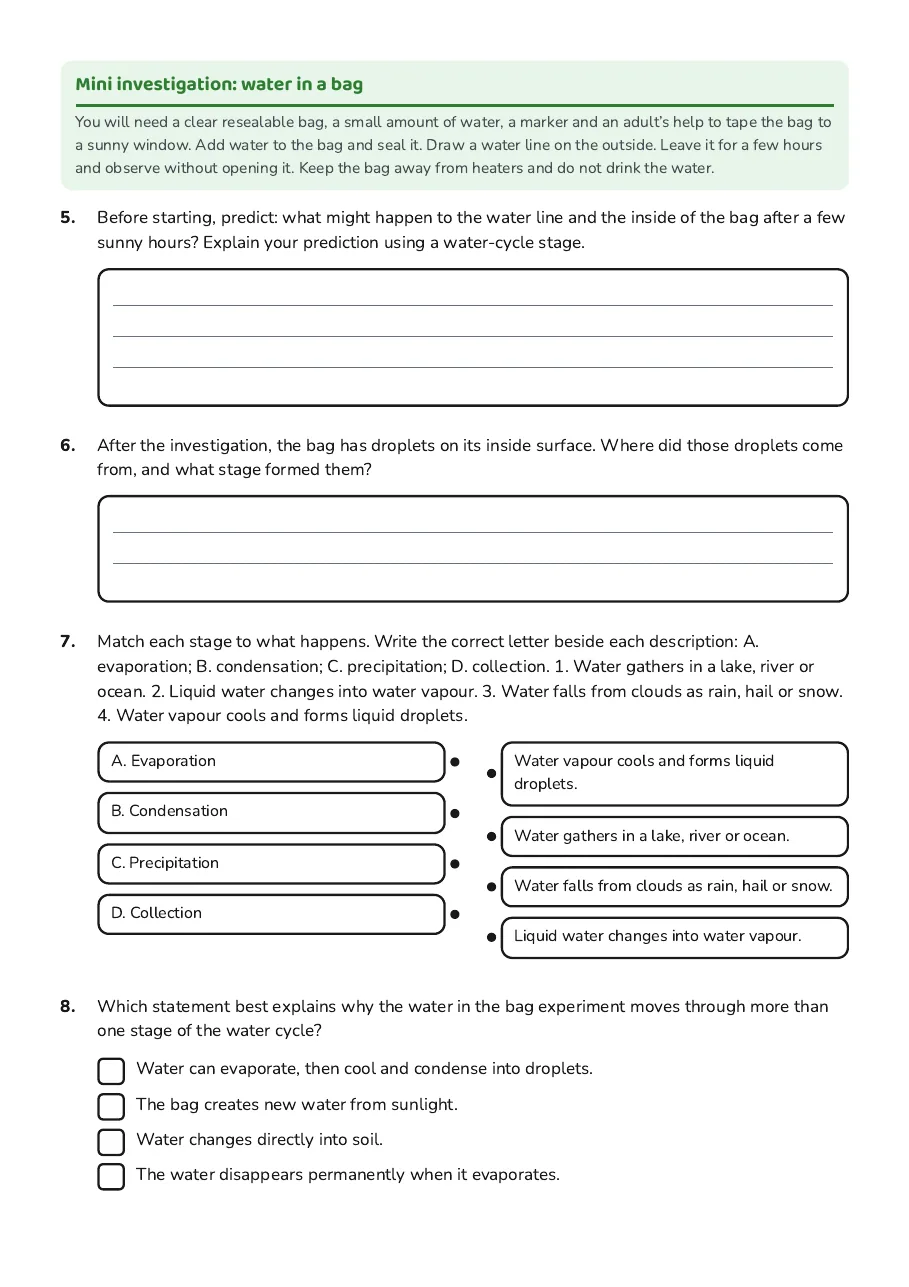
Mini investigation: water in a bag

You will need a clear resealable bag, a small amount of water, a marker and an adult’s help to tape the bag to a sunny window. Add water to the bag and seal it. Draw a water line on the outside. Leave it for a few hours and observe without opening it. Keep the bag away from heaters and do not drink the water.

5.Before starting, predict: what might happen to the water line and the inside of the bag after a few sunny hours? Explain your prediction using a water-cycle stage.
6.After the investigation, the bag has droplets on its inside surface. Where did those droplets come from, and what stage formed them?
7.Match each stage to what happens. Write the correct letter beside each description: A. evaporation; B. condensation; C. precipitation; D. collection. 1. Water gathers in a lake, river or ocean. 2. Liquid water changes into water vapour. 3. Water falls from clouds as rain, hail or snow. 4. Water vapour cools and forms liquid droplets.
  • A. Evaporation
  • B. Condensation
  • C. Precipitation
  • D. Collection
  • Water vapour cools and forms liquid droplets.
  • Water gathers in a lake, river or ocean.
  • Water falls from clouds as rain, hail or snow.
  • Liquid water changes into water vapour.
8.Which statement best explains why the water in the bag experiment moves through more than one stage of the water cycle?
  • Water can evaporate, then cool and condense into droplets.
  • The bag creates new water from sunlight.
  • Water changes directly into soil.
  • The water disappears permanently when it evaporates.
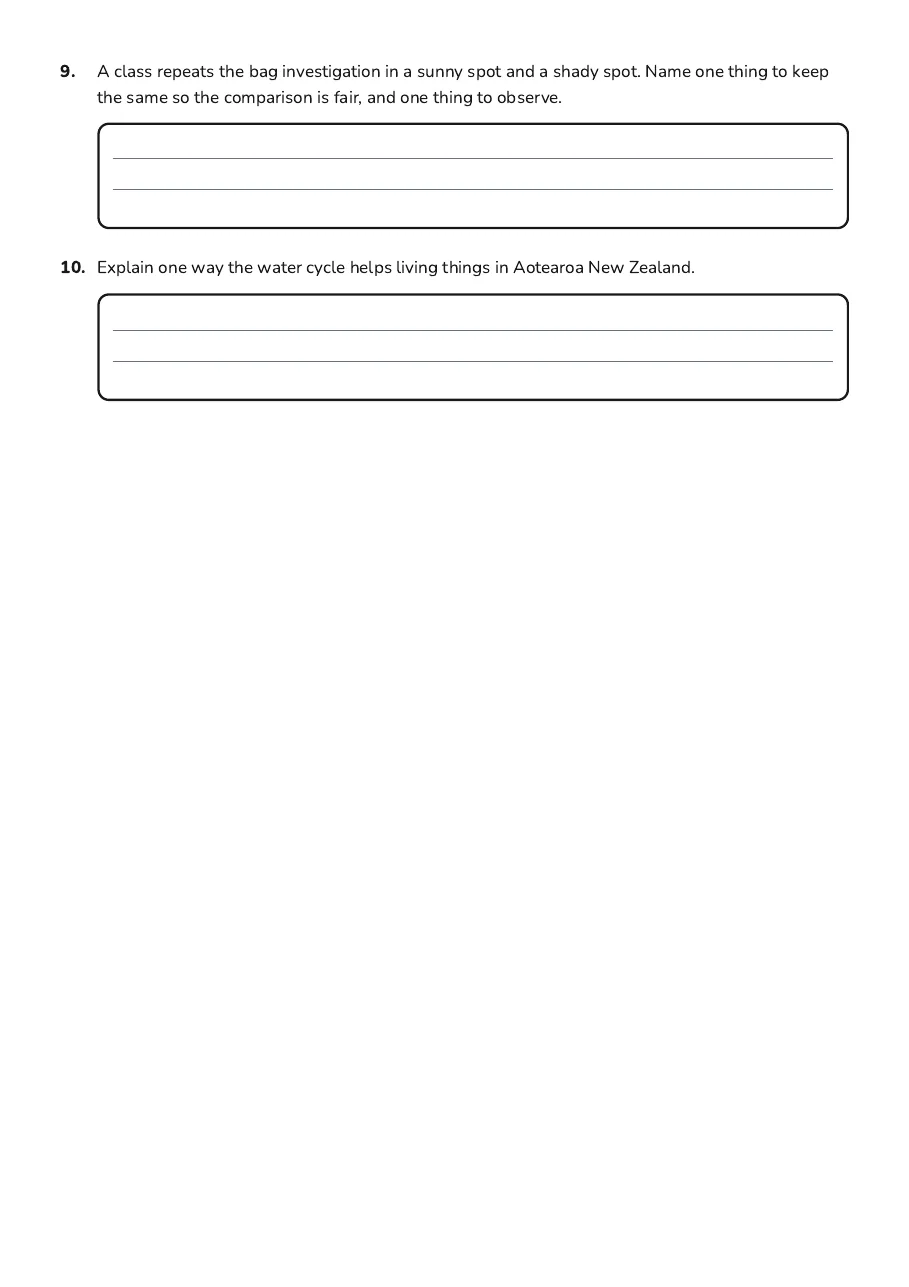
9.A class repeats the bag investigation in a sunny spot and a shady spot. Name one thing to keep the same so the comparison is fair, and one thing to observe.
10.Explain one way the water cycle helps living things in Aotearoa New Zealand.

3 printable pages

  • Water Cycle Stages and Simple Experiments, page 1 of 3: Water on the move

    Page 1

  • Water Cycle Stages and Simple Experiments, page 2 of 3: Mini investigation: water in a bag

    Page 2

  • Water Cycle Stages and Simple Experiments, page 3 of 3: 9. A class repeats the bag investigation in a sunny spot and a shady spot. Name one thing…

    Page 3

About This Worksheet

Free in Kuraplan

Sign up free, grab the PDF, and customize it for your class.

Print-Ready

Formatted for standard paper. Clean layout, easy to read.

AI-Generated

Created with Kuraplan's AI, designed for real classroom use.

For Teachers & Parents

Use in classrooms, for homework, tutoring, or homeschool.

Need a custom version of this worksheet?

Kuraplan's AI generates custom worksheets in seconds — differentiated for every learner, aligned to your curriculum.

Generate Custom Worksheets — Free
No credit card Curriculum-aligned Under 60 seconds