ScienceFreePrintable
Density Exploration Answer Key
A free science worksheet ready for your classroom. Open in Kuraplan to grab the print-ready PDF, customize it for your students, or generate a fresh version in seconds.
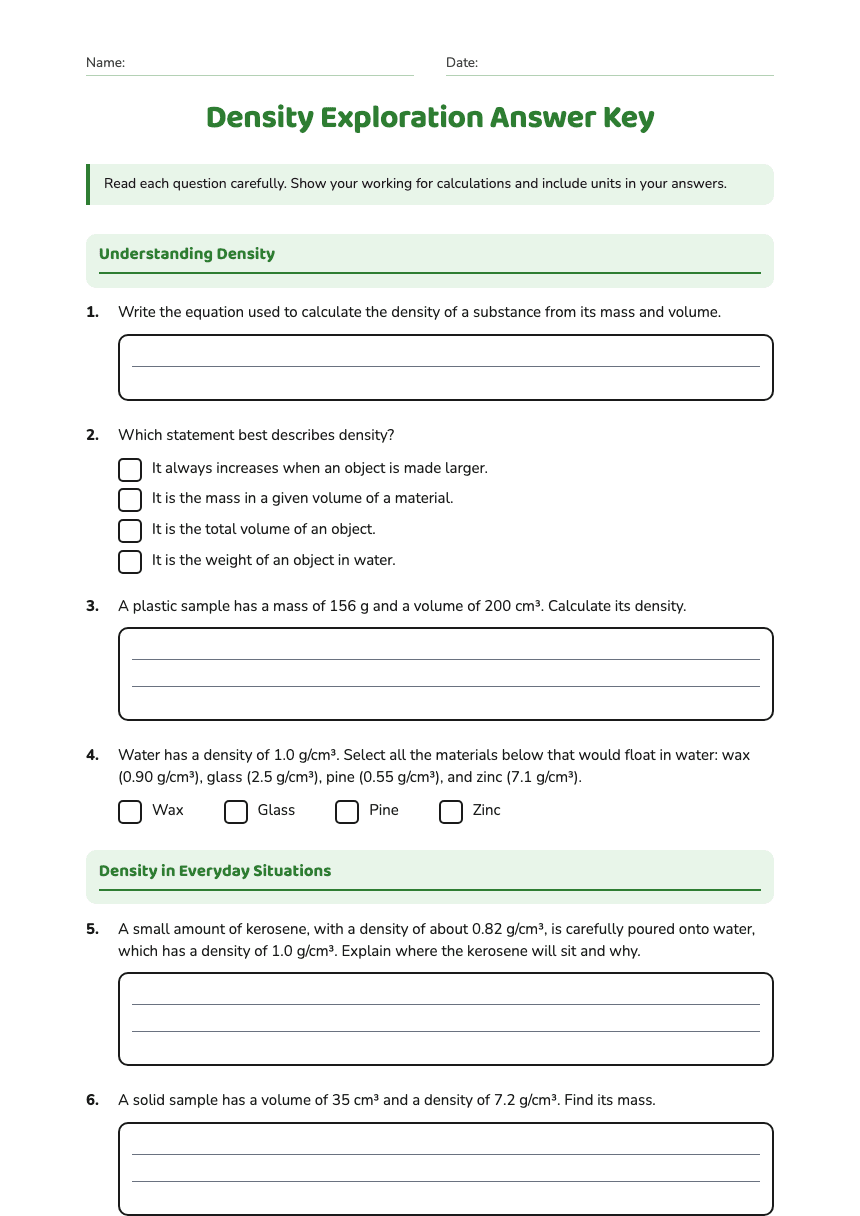
Name:Date:
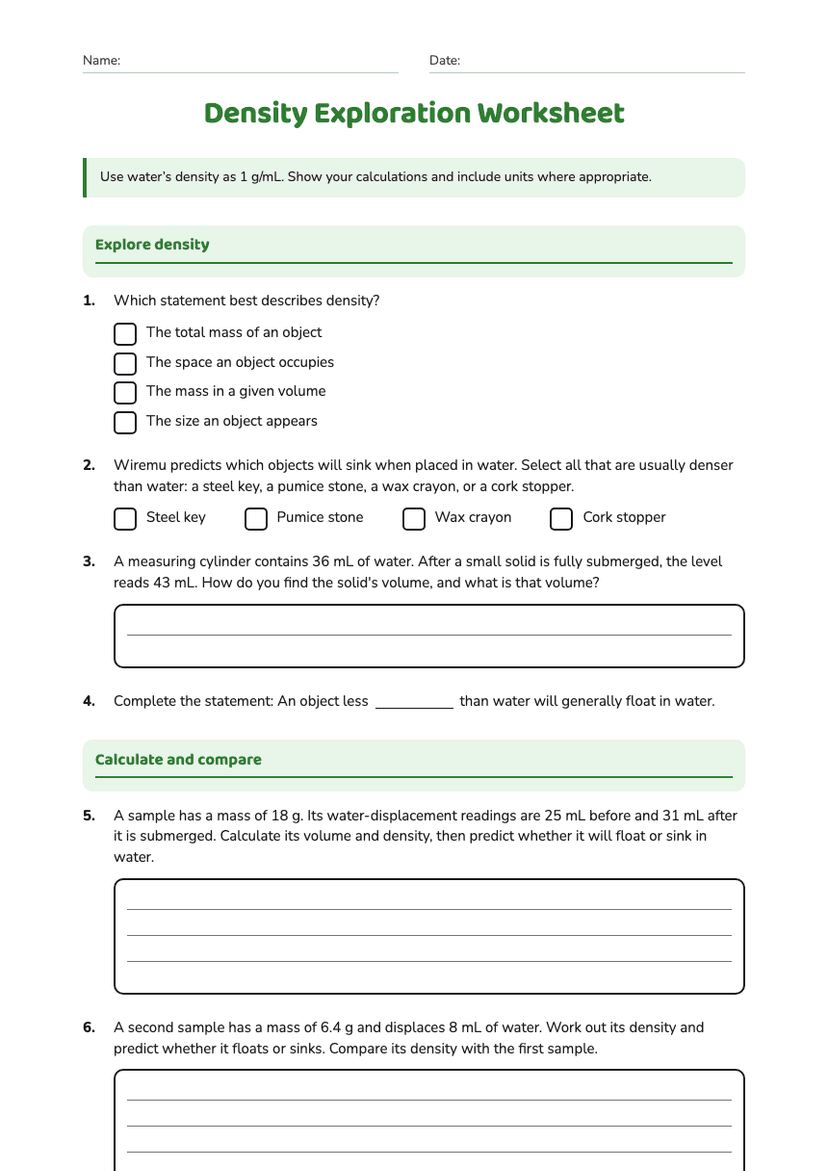
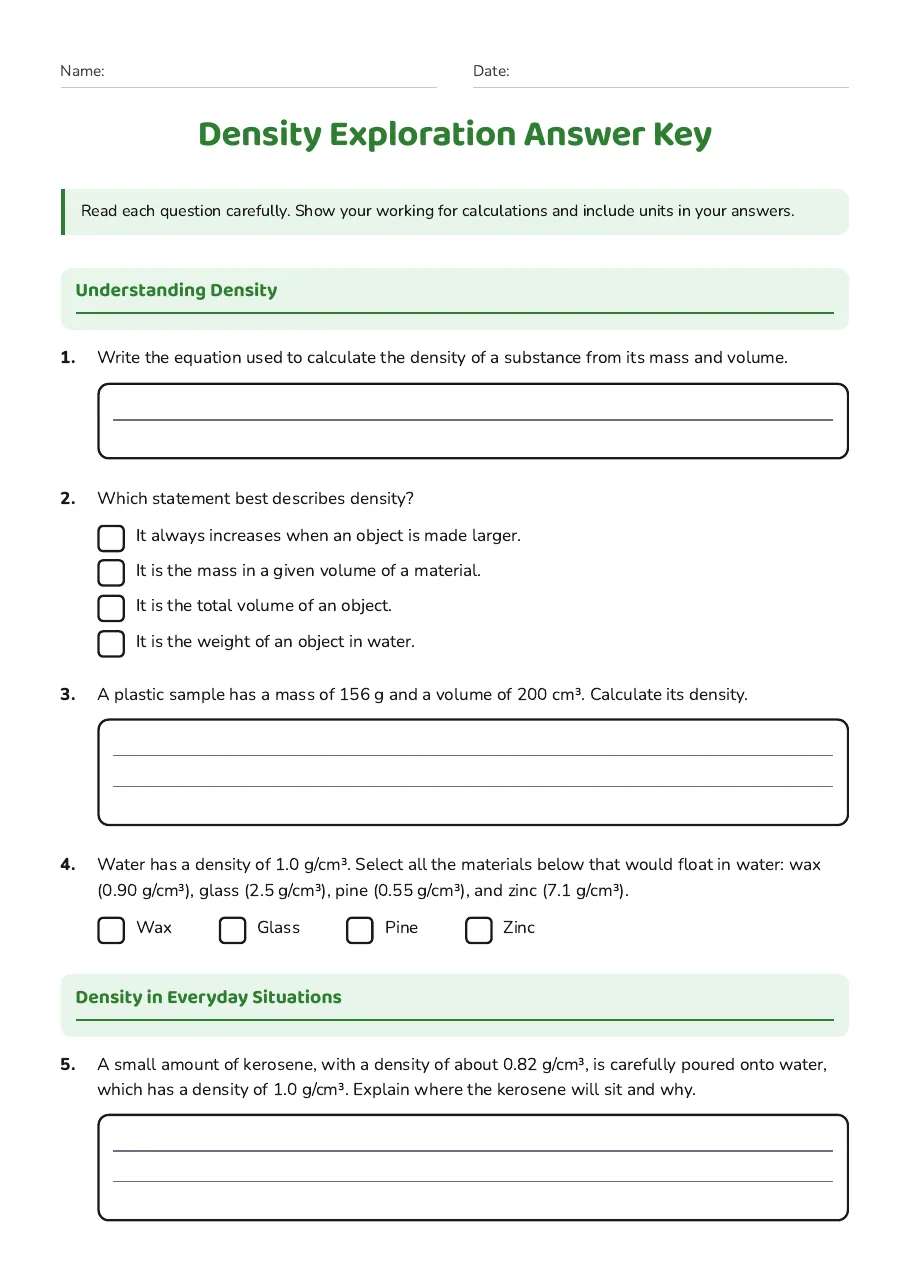
Density Exploration Answer Key
Read each question carefully. Show your working for calculations and include units in your answers.
Understanding Density
1.Write the equation used to calculate the density of a substance from its mass and volume.
2.Which statement best describes density?
- It always increases when an object is made larger.
- It is the mass in a given volume of a material.
- It is the total volume of an object.
- It is the weight of an object in water.
3.A plastic sample has a mass of 156 g and a volume of 200 cm³. Calculate its density.
4.Water has a density of 1.0 g/cm³. Select all the materials below that would float in water: wax (0.90 g/cm³), glass (2.5 g/cm³), pine (0.55 g/cm³), and zinc (7.1 g/cm³).
- Wax
- Glass
- Pine
- Zinc
Density in Everyday Situations
5.A small amount of kerosene, with a density of about 0.82 g/cm³, is carefully poured onto water, which has a density of 1.0 g/cm³. Explain where the kerosene will sit and why.
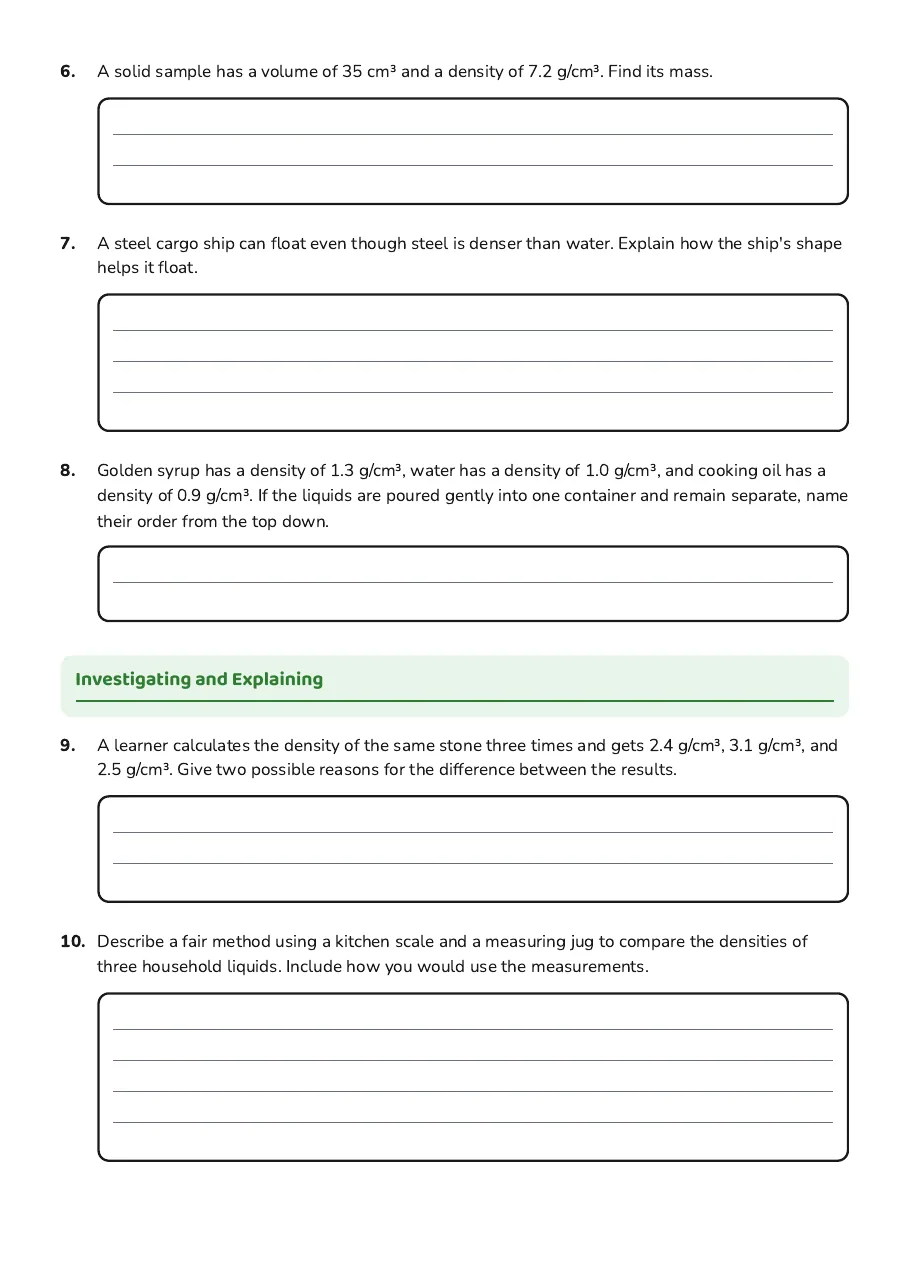
6.A solid sample has a volume of 35 cm³ and a density of 7.2 g/cm³. Find its mass.
7.A steel cargo ship can float even though steel is denser than water. Explain how the ship's shape helps it float.
8.Golden syrup has a density of 1.3 g/cm³, water has a density of 1.0 g/cm³, and cooking oil has a density of 0.9 g/cm³. If the liquids are poured gently into one container and remain separate, name their order from the top down.
Investigating and Explaining
9.A learner calculates the density of the same stone three times and gets 2.4 g/cm³, 3.1 g/cm³, and 2.5 g/cm³. Give two possible reasons for the difference between the results.
10.Describe a fair method using a kitchen scale and a measuring jug to compare the densities of three household liquids. Include how you would use the measurements.
2 printable pages
Page 1
Page 2
About This Worksheet
Free in Kuraplan
Sign up free, grab the PDF, and customize it for your class.
Print-Ready
Formatted for standard paper. Clean layout, easy to read.
AI-Generated
Created with Kuraplan's AI, designed for real classroom use.
For Teachers & Parents
Use in classrooms, for homework, tutoring, or homeschool.
Need a custom version of this worksheet?
Kuraplan's AI generates custom worksheets in seconds — differentiated for every learner, aligned to your curriculum.
Generate Custom Worksheets — Free No credit card Curriculum-aligned Under 60 seconds