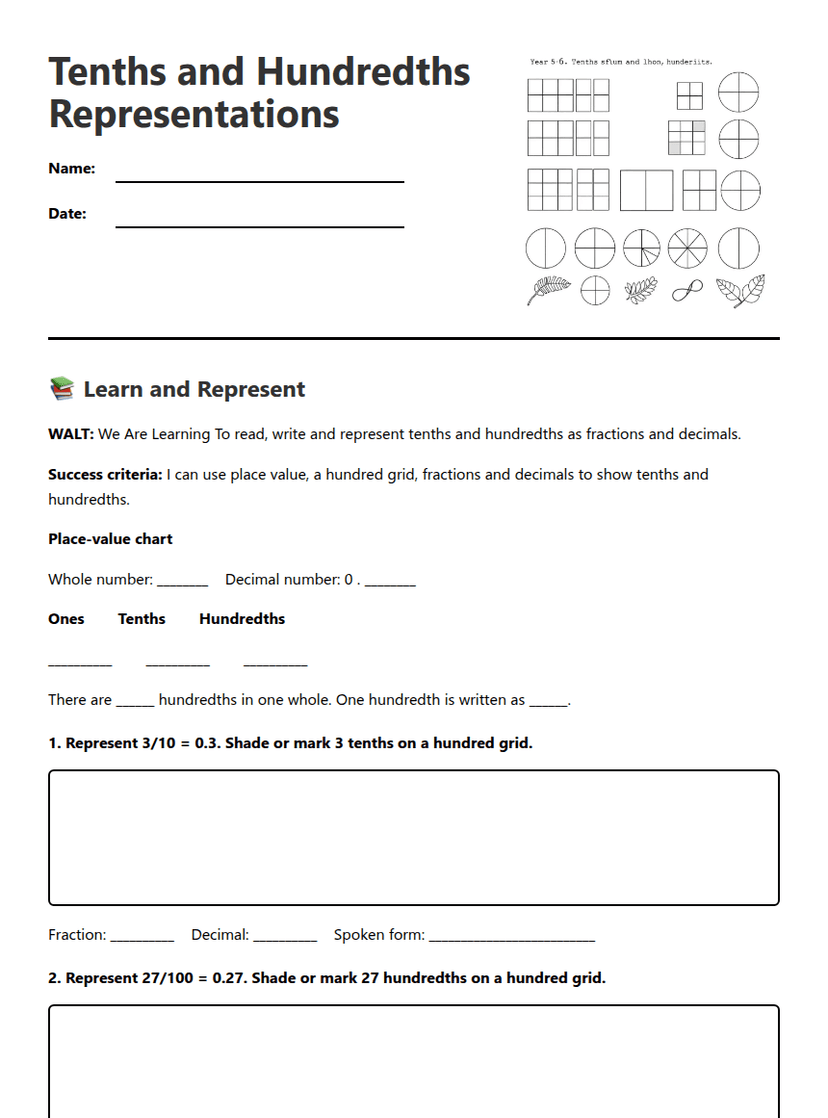
Decimals and Negative Exponents
A free maths worksheet ready for your classroom. Open in Kuraplan to grab the print-ready PDF, customize it for your students, or generate a fresh version in seconds.
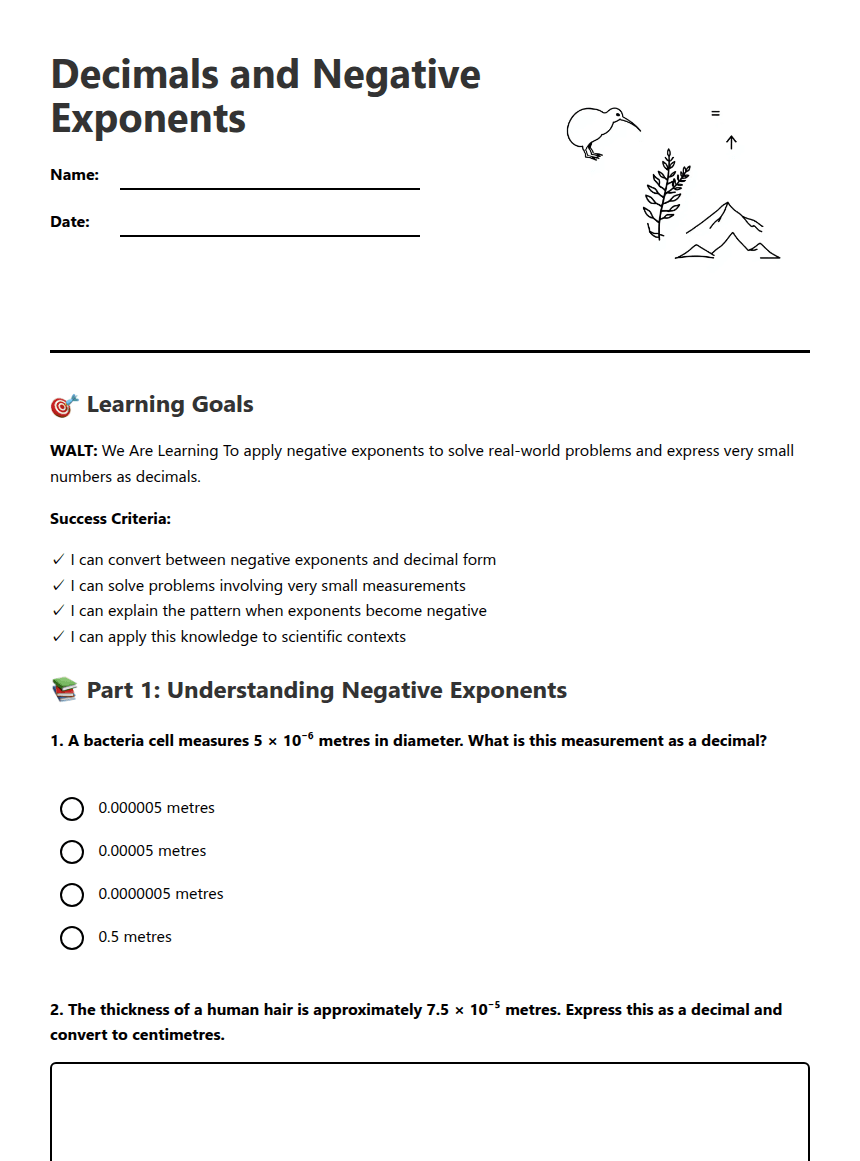
Decimals and Negative Exponents
🎯 Learning Goals
WALT: We Are Learning To apply negative exponents to solve real-world problems and express very small numbers as decimals.
Success Criteria:
✓ I can convert between negative exponents and decimal form
✓ I can solve problems involving very small measurements
✓ I can explain the pattern when exponents become negative
✓ I can apply this knowledge to scientific contexts
📚 Part 1: Understanding Negative Exponents
Answer: ________ × 10⁻⁴ metres
🔬 Part 2: Real-World Applications
🚀 Extension Activities
10² = ______
10¹ = ______
10⁰ = ______
10⁻¹ = ______
10⁻² = ______
10⁻³ = ______
What pattern do you observe?
📋 Differentiation Support
For students needing extra support:
• Use a calculator to check decimal conversions
• Work with a partner for questions 5-7
• Focus on questions 1-4 first, then attempt others
For dyslexic learners:
• Use coloured paper or overlay if needed
• Read questions aloud or use text-to-speech
• Take breaks between sections
Extension for advanced learners:
• Research negative exponents in computer science (bytes, bits)
• Create your own word problems using negative exponents
• Investigate how calculators display very small numbers
📝 Answer Sheet
1. 0.000005 metres
2. 0.000075 metres or 0.0075 cm
3. 10⁻³, 1/1000, 1 ÷ 10³
4. 2 × 10⁻⁴ metres
5. Dust particle: 0.0002 metres, Virus: 0.00000008 metres, Pollen grain: 0.00003 metres
6. Negative exponents simplify the representation of very small numbers, making them easier to read and write.
7. 1.25 mm
8. 10² = 100, 10¹ = 10, 10⁰ = 1, 10⁻¹ = 0.1, 10⁻² = 0.01, 10⁻³ = 0.001
9. Example: The size of a virus is often measured in nanometers (10⁻⁹ meters), which is more manageable than writing out the zeros.
About This Worksheet
Free in Kuraplan
Sign up free, grab the PDF, and customize it for your class.
Print-Ready
Formatted for standard paper. Clean layout, easy to read.
AI-Generated
Created with Kuraplan's AI, designed for real classroom use.
For Teachers & Parents
Use in classrooms, for homework, tutoring, or homeschool.
Need a custom version of this worksheet?
Kuraplan's AI generates custom worksheets in seconds — differentiated for every learner, aligned to your curriculum.
Generate Custom Worksheets — FreeMore Maths Worksheets
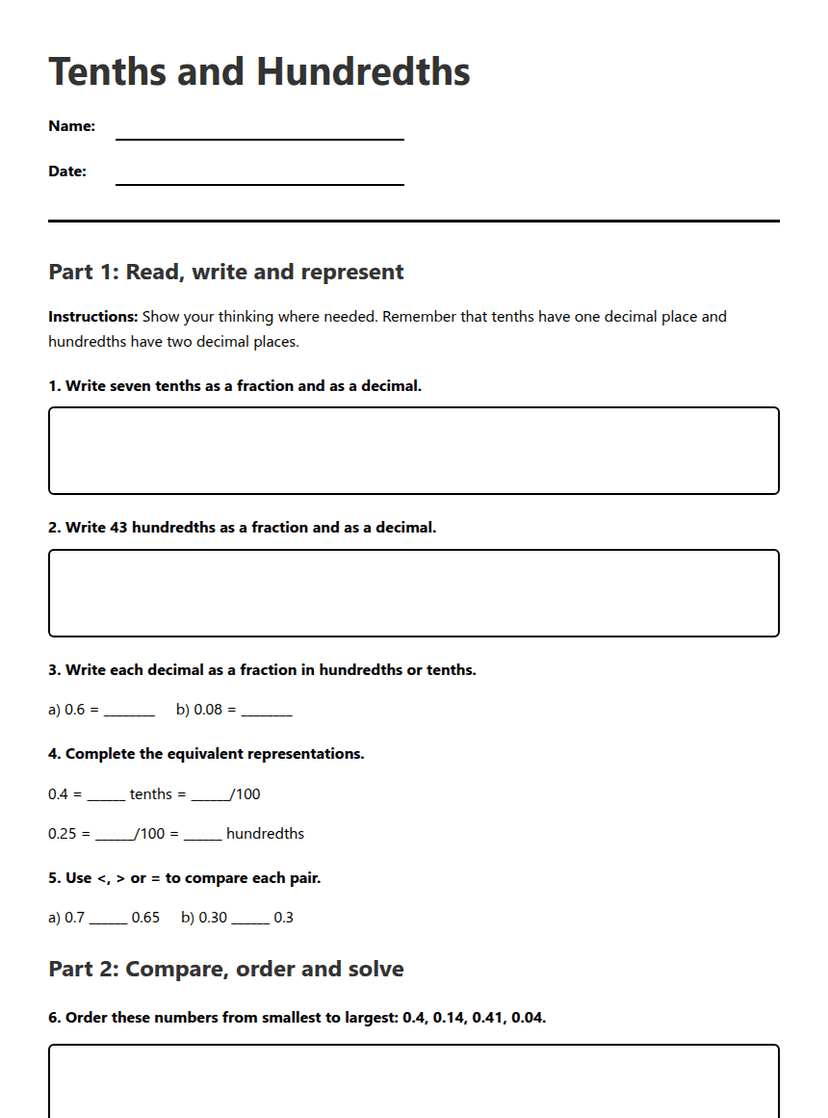
Tenths and Hundredths
Free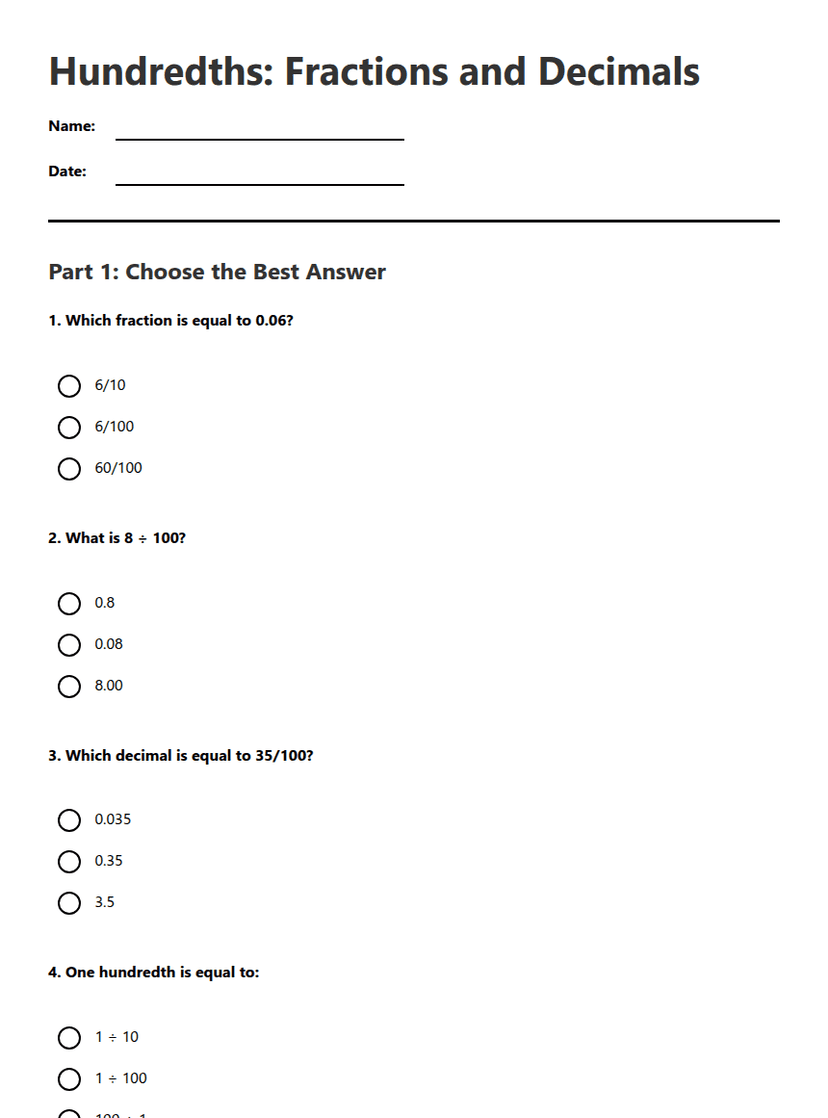
Hundredths: Fractions and Decimals
Free
Understanding Tenths in Decimals
Free
Round Tenths to Whole Numbers
Free
Decimal Fraction Changes
Free
More or Less Numbers and Decimals
Free
Multiplying Tenths and Hundredths
Free