Dinosaur Extinction Overview
A free science worksheet ready for your classroom. Open in Kuraplan to grab the print-ready PDF, customize it for your students, or generate a fresh version in seconds.
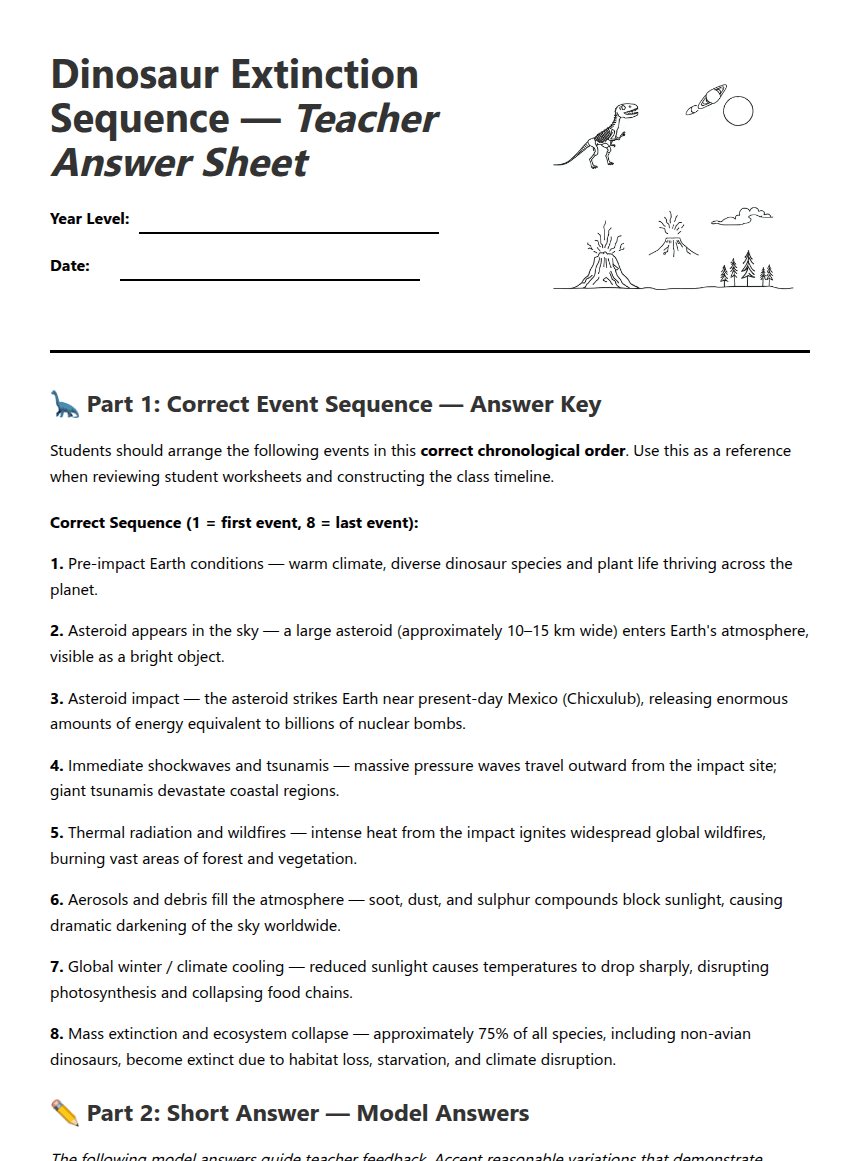
Dinosaur Extinction Sequence — Teacher Answer Sheet
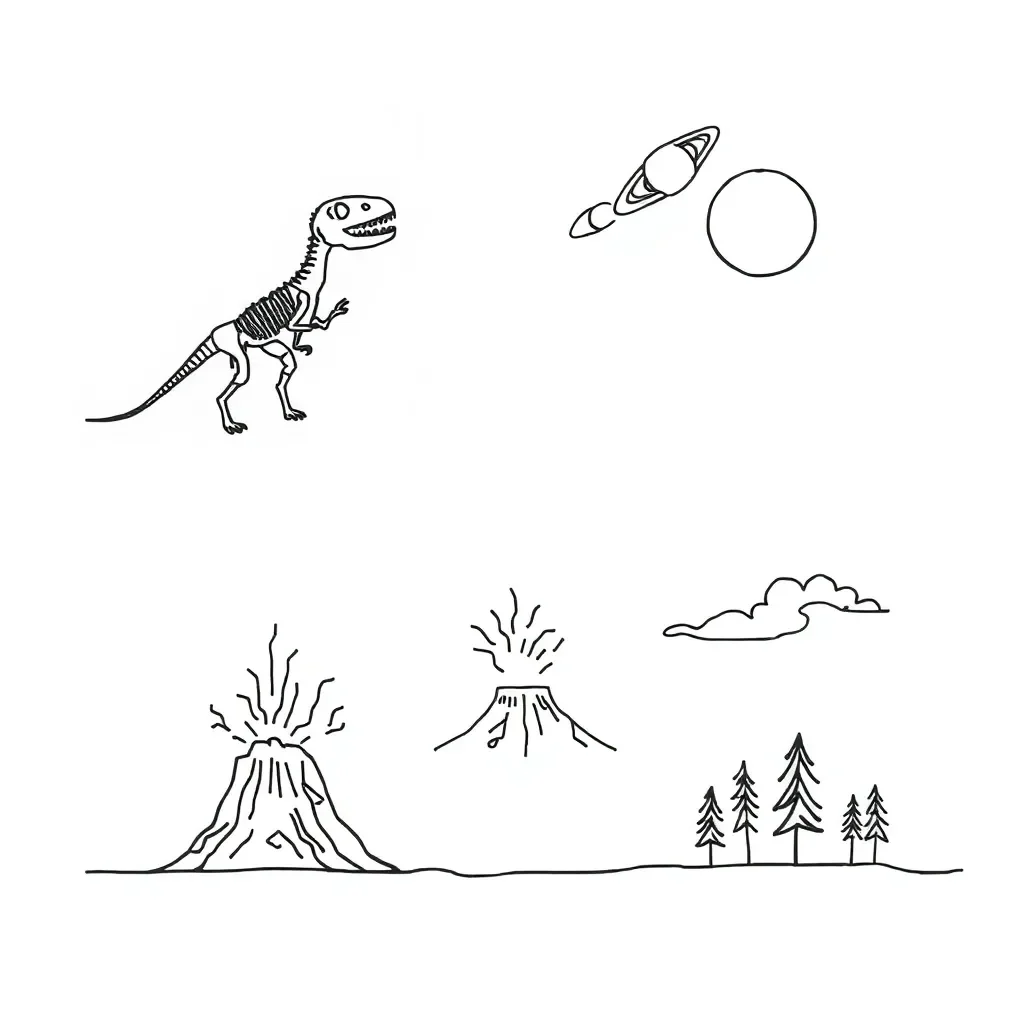
🦕 Part 1: Correct Event Sequence — Answer Key
Students should arrange the following events in this correct chronological order. Use this as a reference when reviewing student worksheets and constructing the class timeline.
1. Pre-impact Earth conditions — warm climate, diverse dinosaur species and plant life thriving across the planet.
2. Asteroid appears in the sky — a large asteroid (approximately 10–15 km wide) enters Earth's atmosphere, visible as a bright object.
3. Asteroid impact — the asteroid strikes Earth near present-day Mexico (Chicxulub), releasing enormous amounts of energy equivalent to billions of nuclear bombs.
4. Immediate shockwaves and tsunamis — massive pressure waves travel outward from the impact site; giant tsunamis devastate coastal regions.
5. Thermal radiation and wildfires — intense heat from the impact ignites widespread global wildfires, burning vast areas of forest and vegetation.
6. Aerosols and debris fill the atmosphere — soot, dust, and sulphur compounds block sunlight, causing dramatic darkening of the sky worldwide.
7. Global winter / climate cooling — reduced sunlight causes temperatures to drop sharply, disrupting photosynthesis and collapsing food chains.
8. Mass extinction and ecosystem collapse — approximately 75% of all species, including non-avian dinosaurs, become extinct due to habitat loss, starvation, and climate disruption.
✏️ Part 2: Short Answer — Model Answers
The following model answers guide teacher feedback. Accept reasonable variations that demonstrate understanding of cause and effect.
Model Answer: Earth had a warm climate with high biodiversity. Dinosaurs were the dominant large land animals, and there was a wide variety of plant life. Conditions were generally stable and supported complex ecosystems.
Model Answer: The impact threw enormous amounts of dust, soot, and sulphur aerosols into the atmosphere. These particles blocked sunlight from reaching Earth's surface, causing global temperatures to drop significantly. This prolonged darkness also prevented photosynthesis, which collapsed plant life and the food chains that depended on it.
Model Answer: (1) Volcanic activity — large-scale volcanic eruptions (e.g., the Deccan Traps in India) released carbon dioxide and sulphur dioxide, contributing to climate instability before and after the impact. (2) Climate change — gradual cooling and sea level changes prior to the impact may have already placed stress on dinosaur populations and ecosystems.
Model Answer: Continuity is shown by the fact that life on Earth continued after the extinction — many species survived, including early mammals, birds (avian dinosaurs), and insects, which eventually evolved and diversified. Sudden change is demonstrated by the rapid and catastrophic loss of approximately 75% of species in a geologically very short period of time following the impact event.
Model Answer: Studying past extinctions helps scientists understand how life responds to catastrophic environmental change. It also informs current asteroid tracking programmes and helps predict how modern climate change or other large-scale events could affect biodiversity today. Understanding cause and effect in past events helps us prepare for and potentially prevent future risks.
📋 Teacher Notes — Key Vocabulary & Common Misconceptions
Key Scientific Vocabulary to Reinforce:
• Mass extinction — a widespread and rapid decrease in biodiversity on Earth.
• Aerosols — tiny particles suspended in the atmosphere that can block sunlight.
• Chicxulub — the name of the impact crater located near the Yucatán Peninsula, Mexico.
• Photosynthesis — the process by which plants use sunlight to produce energy; disrupted during global winter.
• Chronological order — arranged in the order in which events occurred over time.
Common Misconceptions to Address:
• "All dinosaurs disappeared instantly." — Correct students by explaining the extinction unfolded over thousands of years following the impact, not overnight.
• "Birds are not dinosaurs." — Clarify that birds are avian dinosaurs and are direct descendants of theropod dinosaurs; they did survive the extinction event.
• "Only the asteroid caused the extinction." — Emphasise that while the asteroid was the primary trigger, volcanic activity and pre-existing climate pressures also played contributing roles.
About This Worksheet
Free in Kuraplan
Sign up free, grab the PDF, and customize it for your class.
Print-Ready
Formatted for standard paper. Clean layout, easy to read.
AI-Generated
Created with Kuraplan's AI, designed for real classroom use.
For Teachers & Parents
Use in classrooms, for homework, tutoring, or homeschool.
Need a custom version of this worksheet?
Kuraplan's AI generates custom worksheets in seconds — differentiated for every learner, aligned to your curriculum.
Generate Custom Worksheets — Free