Periodic Table Mastery Worksheet
A free science worksheet ready for your classroom. Open in Kuraplan to grab the print-ready PDF, customize it for your students, or generate a fresh version in seconds.
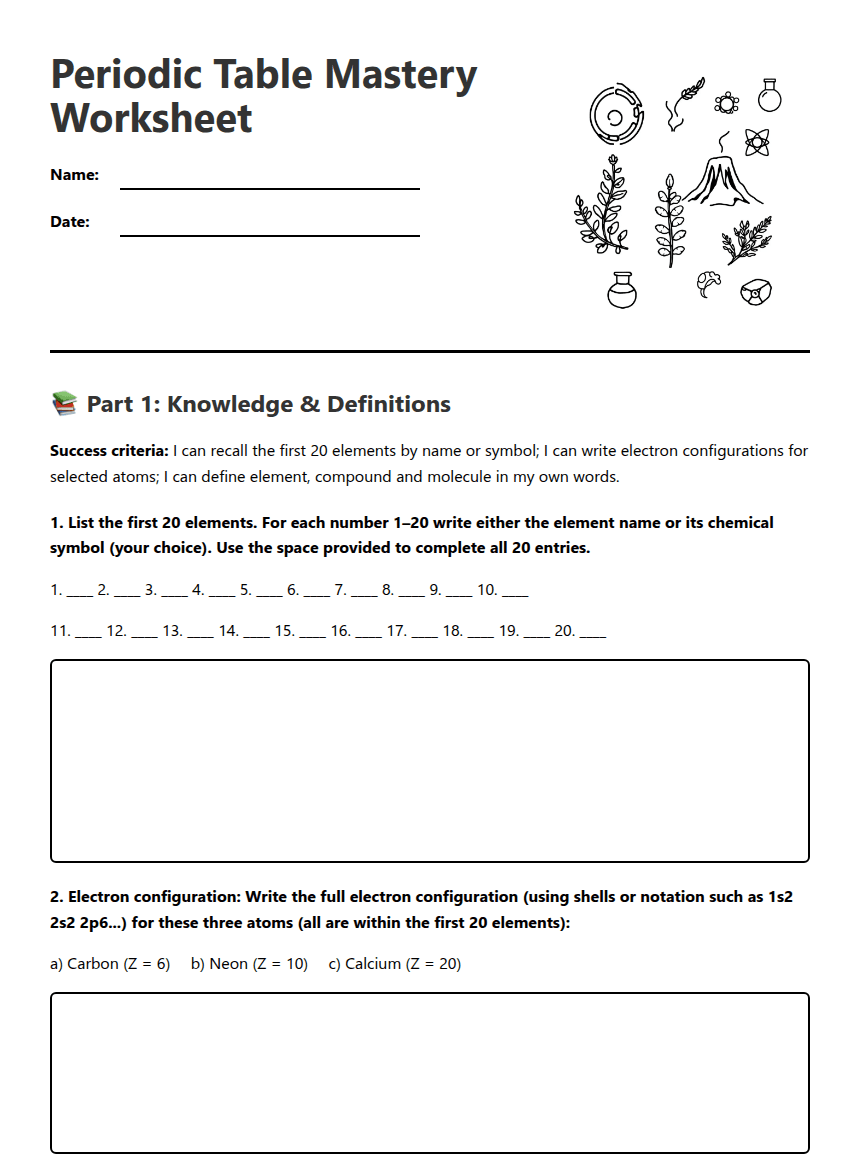
Periodic Table Mastery Worksheet
📚 Part 1: Knowledge & Definitions
Success criteria: I can recall the first 20 elements by name or symbol; I can write electron configurations for selected atoms; I can define element, compound and molecule in my own words.
1. ____ 2. ____ 3. ____ 4. ____ 5. ____ 6. ____ 7. ____ 8. ____ 9. ____ 10. ____
11. ____ 12. ____ 13. ____ 14. ____ 15. ____ 16. ____ 17. ____ 18. ____ 19. ____ 20. ____
a) Carbon (Z = 6) b) Neon (Z = 10) c) Calcium (Z = 20)
a) Element
b) Molecule
c) Compound
✏️ Part 2: Apply & Explain
Success criteria: I can identify substances as element/compound/molecule; I can explain a metal property and justify whether a change is chemical or physical; I can write word equations for common reactions and describe a test for CO₂.
a) Iron rusting when left outside
b) Melting ice into water
a) Acid + hydroxide → ________
b) Acid + carbonate → ________
c) Complete combustion of a hydrocarbon → ________
d) Incomplete combustion of a hydrocarbon → ________
Differentiation strategies: Provide a printed list of first 20 elements for students who need support; offer one-on-one modelling or sentence starters for written answers; extend advanced learners by asking for ionic charges or isotopes of selected elements.
Dyslexia-friendly reading options: Use a larger sans-serif font, increased line spacing, and provide coloured overlays or high-contrast handouts on request; supply audio recordings of the worksheet instructions and key vocabulary.
About This Worksheet
Free in Kuraplan
Sign up free, grab the PDF, and customize it for your class.
Print-Ready
Formatted for standard paper. Clean layout, easy to read.
AI-Generated
Created with Kuraplan's AI, designed for real classroom use.
For Teachers & Parents
Use in classrooms, for homework, tutoring, or homeschool.
Need a custom version of this worksheet?
Kuraplan's AI generates custom worksheets in seconds — differentiated for every learner, aligned to your curriculum.
Generate Custom Worksheets — FreeMore Science Worksheets
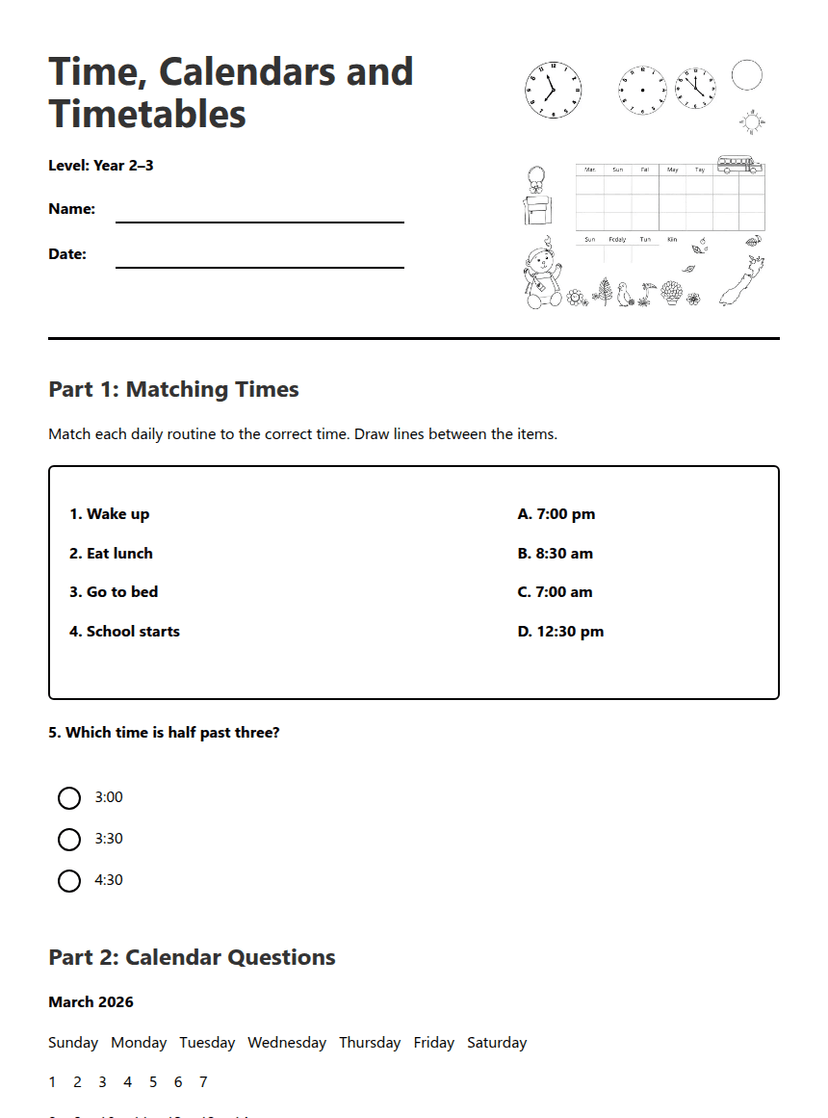
Time, Calendars and Timetables
Free
Times Tables Fun Worksheet
Free
Times Tables Quiz Year 3
Free
Two Times Tables Practice
Free
Time Conversion and Timetables
Free
Bus Route Timetable Practice
Free
Copy of Multiplication Tables Practice Worksheet
Free