Earth's Energy Transfers
A free science worksheet ready for your classroom. Open in Kuraplan to grab the print-ready PDF, customize it for your students, or generate a fresh version in seconds.
Earth's Energy Transfers
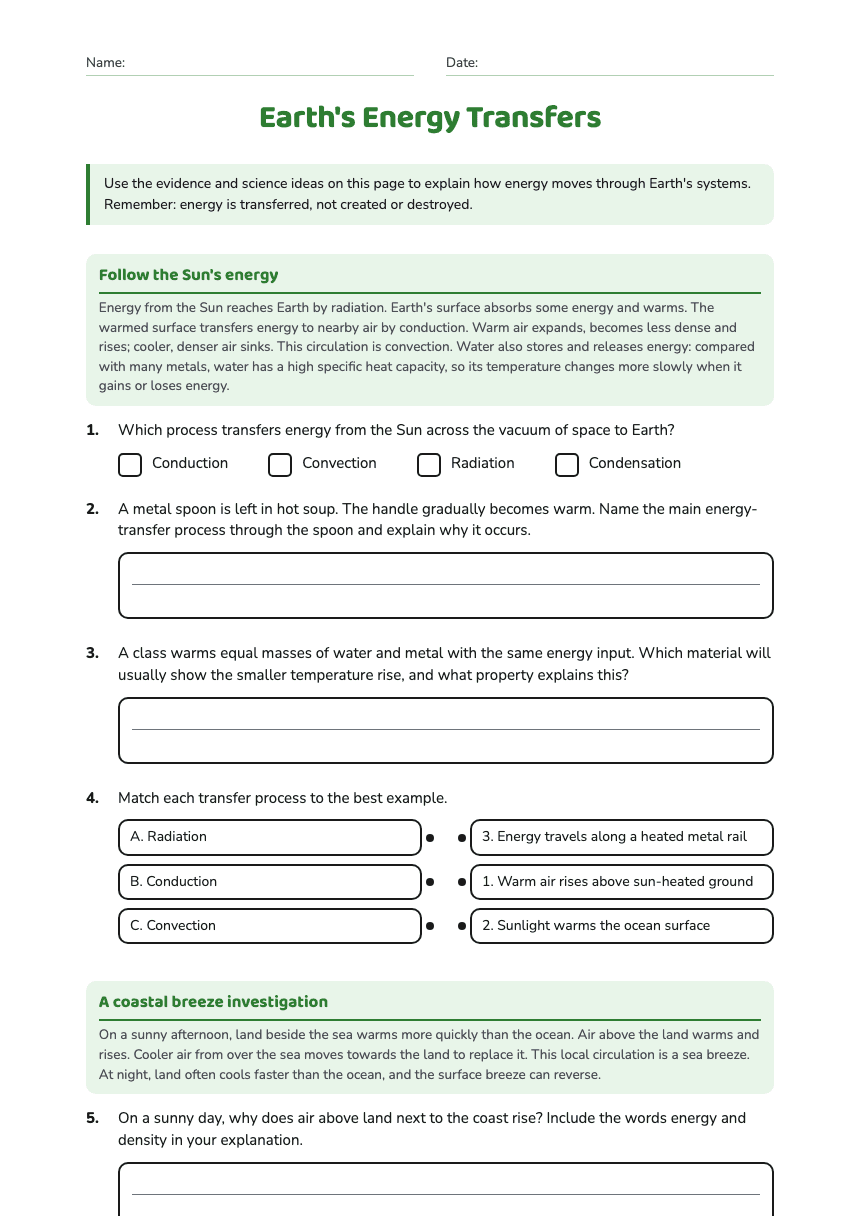
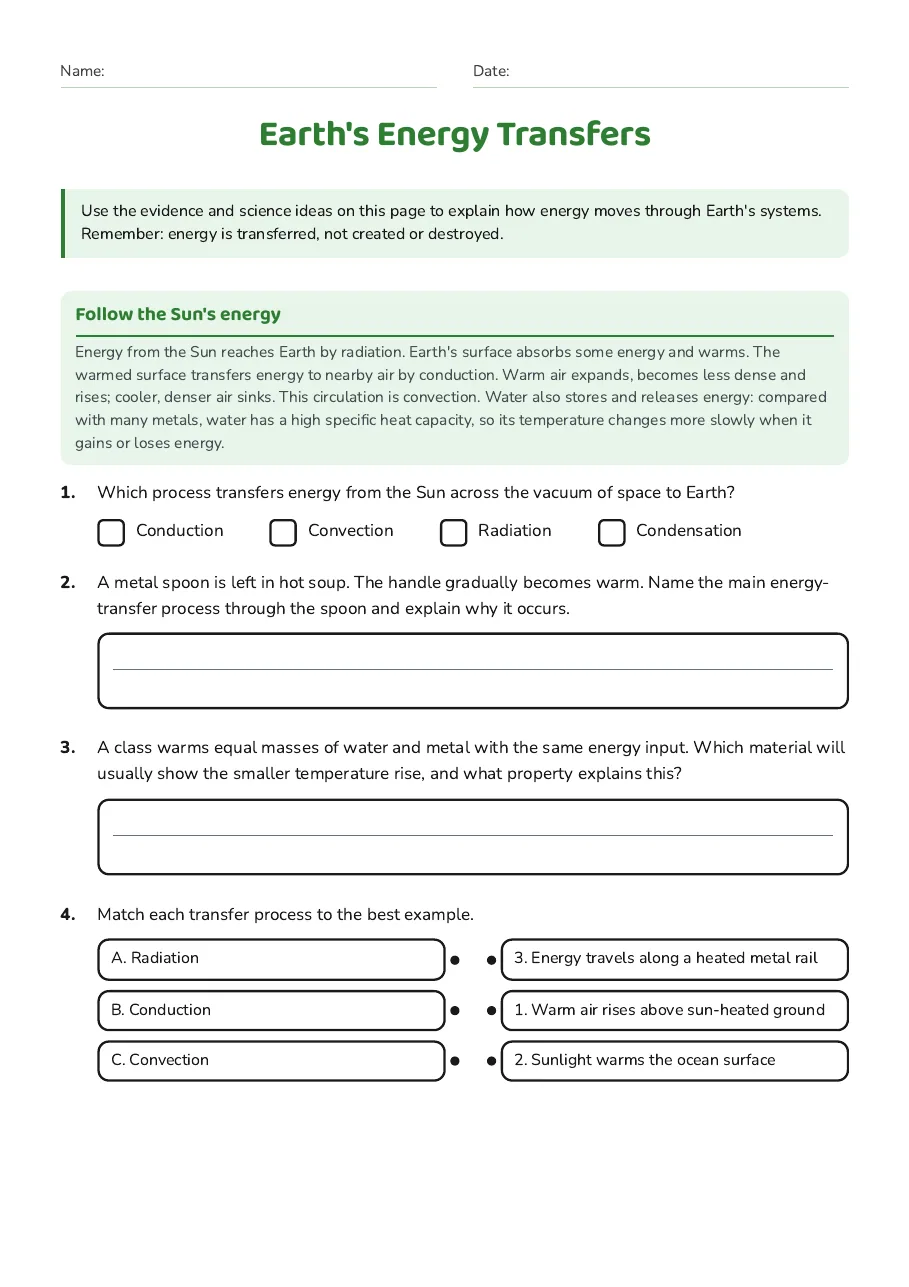
Follow the Sun's energy
Energy from the Sun reaches Earth by radiation. Earth's surface absorbs some energy and warms. The warmed surface transfers energy to nearby air by conduction. Warm air expands, becomes less dense and rises; cooler, denser air sinks. This circulation is convection. Water also stores and releases energy: compared with many metals, water has a high specific heat capacity, so its temperature changes more slowly when it gains or loses energy.
- Conduction
- Convection
- Radiation
- Condensation
- A. Radiation
- B. Conduction
- C. Convection
- 3. Energy travels along a heated metal rail
- 1. Warm air rises above sun-heated ground
- 2. Sunlight warms the ocean surface
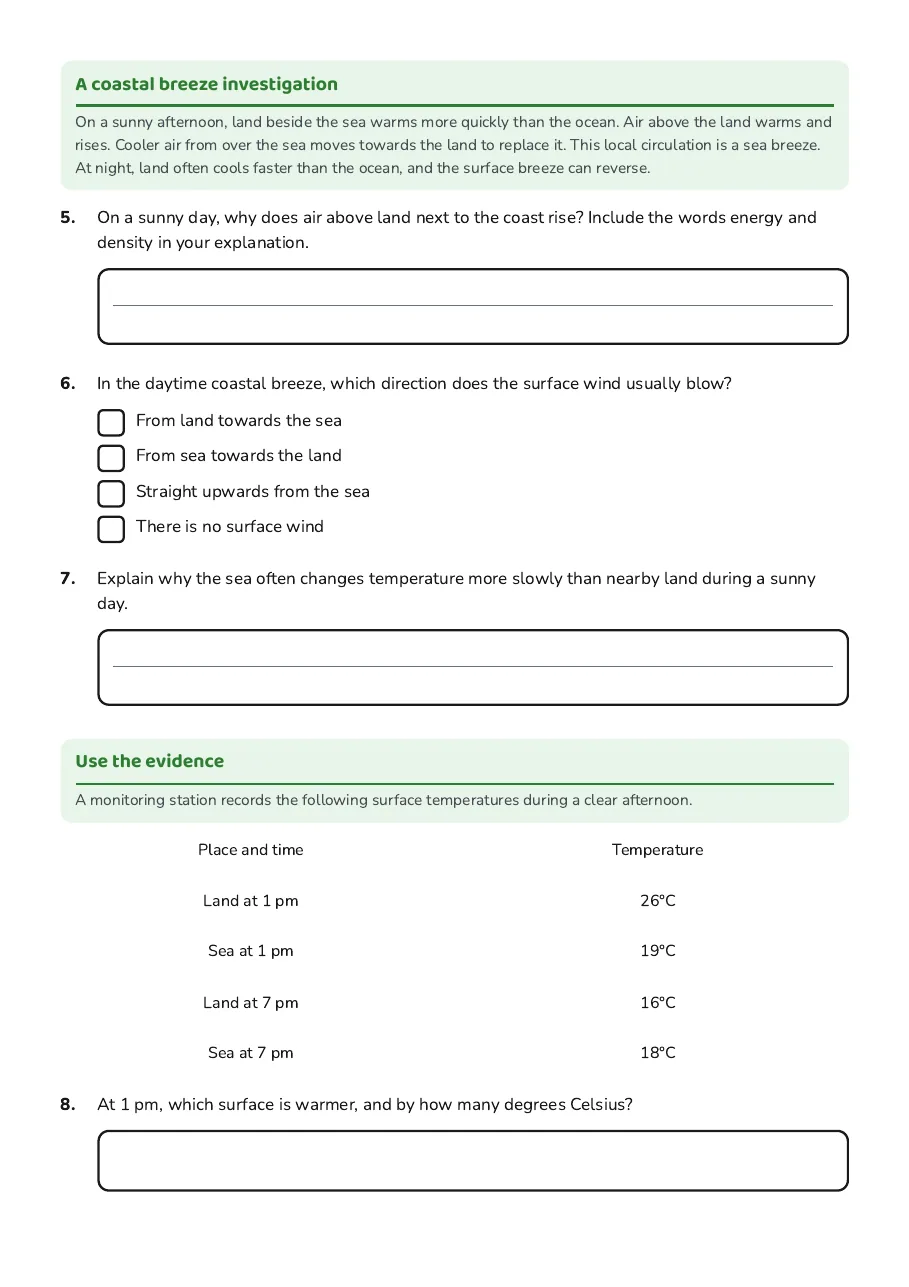
A coastal breeze investigation
On a sunny afternoon, land beside the sea warms more quickly than the ocean. Air above the land warms and rises. Cooler air from over the sea moves towards the land to replace it. This local circulation is a sea breeze. At night, land often cools faster than the ocean, and the surface breeze can reverse.
- From land towards the sea
- From sea towards the land
- Straight upwards from the sea
- There is no surface wind
Use the evidence
A monitoring station records the following surface temperatures during a clear afternoon.
Place and time
Temperature
Land at 1 pm
26°C
Sea at 1 pm
19°C
Land at 7 pm
16°C
Sea at 7 pm
18°C
3 printable pages
Page 1
Page 2
Page 3
About This Worksheet
Free in Kuraplan
Sign up free, grab the PDF, and customize it for your class.
Print-Ready
Formatted for standard paper. Clean layout, easy to read.
AI-Generated
Created with Kuraplan's AI, designed for real classroom use.
For Teachers & Parents
Use in classrooms, for homework, tutoring, or homeschool.
Need a custom version of this worksheet?
Kuraplan's AI generates custom worksheets in seconds — differentiated for every learner, aligned to your curriculum.
Generate Custom Worksheets — Free